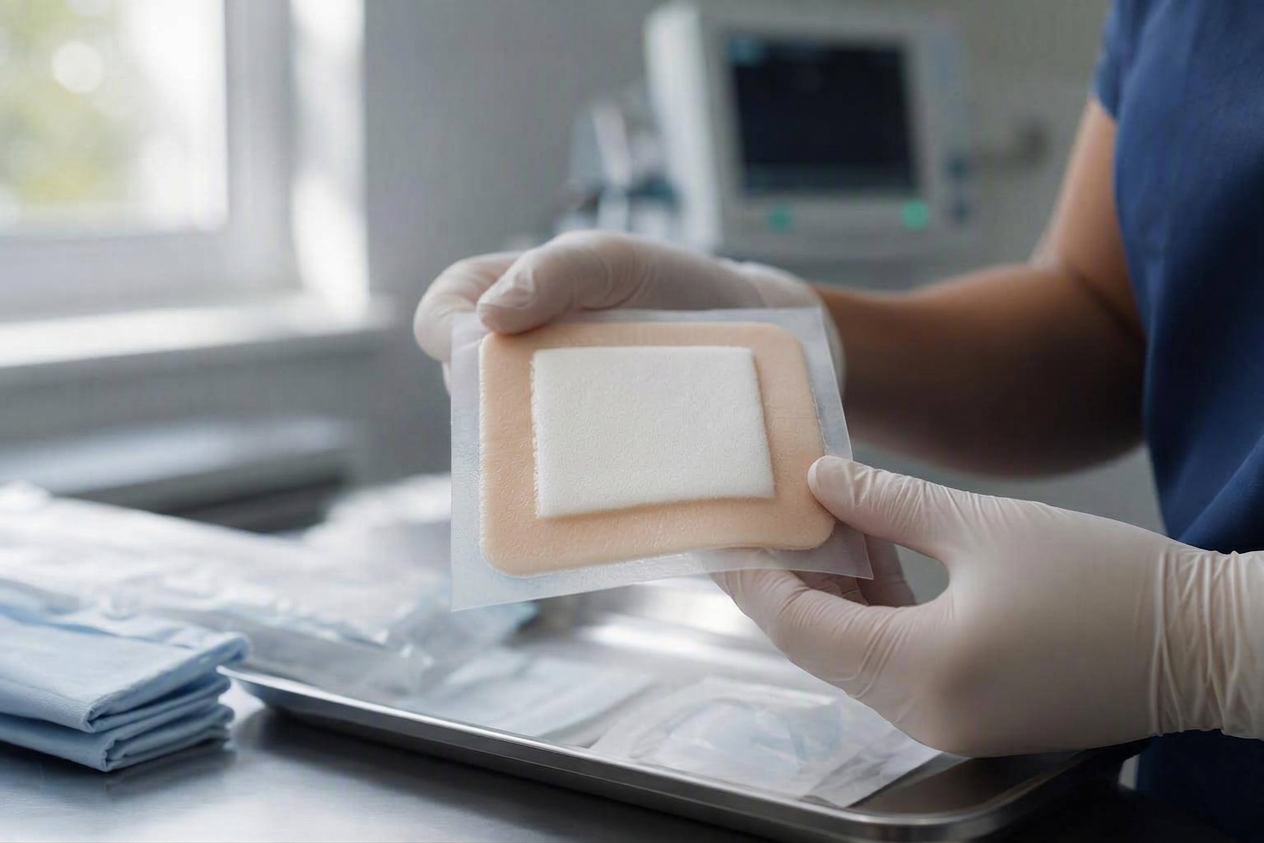
A heavy-exudate dressing rarely fails all at once. It fails in a sequence: fluid pools over the wound bed, creeps sideways under the dressing, softens the intact skin at the margin, lifts the edge, and finally shows through the backing. By the time the outer surface is wet, the barrier is already gone and the periwound skin has been sitting in fluid for hours.
Understanding why that sequence happens is the difference between specifying a dressing that holds up for several days and one that quietly turns into two changes a day. This guide works through the multilayer silicone foam dressing structure piece by piece: what a 5-layer silicone foam dressing actually contains, how fluid moves through each layer, why the stacking order is not arbitrary, how much of the fluid handling is done by absorption versus evaporation, and how to read an MVTR or retention claim so that two supplier datasheets become genuinely comparable.
Key Takeaway: A multilayer silicone foam dressing is a throughput system, not a sponge. Its layers are arranged as acquisition → distribution → retention → evaporation, and performance depends on fluid moving smoothly along that chain — not on how much one layer can hold in isolation.
Why high exudate defeats single-layer dressings
A single absorbent layer has one job and one failure point. It takes up fluid until its structure is full, and after that its behaviour works against you. Once the pore network is saturated, newly arriving exudate has nowhere to go, so it either sits against the wound surface or moves along the path of least resistance — which is usually sideways, toward the periwound skin.
That is why the fluid-handling literature distinguishes between absorbing and retaining. In a comparative crossover study of three multilayered foam dressings published in the Journal of Comparative Effectiveness Research (2021), the authors framed the ideal dressing around three requirements at once: absorb and retain exudate including its dissolved components, keep that fluid away from the periwound area, and do all of it even when the dressing is compressed. A dressing that only absorbs satisfies the first requirement and fails the other two.
Compression is the detail that catches people out. Venous leg ulcers, sacral pressure injuries in bedbound patients, and heel wounds all put external load on the dressing. Under load, the free volume inside a foam decreases. Capillary force can increase to partly compensate, as the engineering review Fluid handling by foam wound dressings (2024) describes, but the two effects do not reliably cancel. Whether a dressing keeps holding fluid when a patient lies on it, or wears a compression bandage over it, is a separate question from how much fluid it can take up in a laboratory beaker.
There is also a gap between labelled and actual wear. Dressings in this class are commonly labelled for up to seven days, while a real-world dataset on dressing change frequency published in PubMed (2024) reported mean intervals closer to two to three days in high-output use. The label describes the best case when exudate is managed; the mechanism in the rest of this article explains why that gap opens up.
What a 5-layer silicone foam dressing actually contains
The construction below is the industry-standard architecture for a bordered multilayer silicone foam dressing, described from the wound surface outward.
Figure 1 — SLK Medical silicone foam dressing (Alexer range): exploded layer schematic. The drawing numbers four material plies; the functional architecture is described as five layers. Both conventions are explained below.
Mapping the schematic to the functional stack. The numbering in the SLK Medical schematic tracks the physical plies as they appear in an exploded view. From top to bottom in that drawing: ① the breathable polyurethane film backing, ② a film/spreading ply that distributes fluid, ③ the foam absorbent ply, and ④ the perforated silicone wound-contact ply at the wound interface. The descriptive “5-layer” convention used in datasheets and clinical literature counts the same construction by function, which separates the distribution function from the superabsorbent retention function rather than treating one ply as one job.
|
# |
Functional layer |
Primary job |
What it fails to do if missing |
|---|---|---|---|
|
1 |
Soft silicone wound-contact layer |
Lets exudate pass through while staying non-adherent to the wound bed; helps seal the margin |
Removal trauma rises; no controlled interface between fluid and wound |
|
2 |
Foam absorbent layer |
Rapid capillary uptake directly off the wound surface; cushioning and pressure redistribution |
No acquisition layer; fluid has no first destination |
|
3 |
Non-woven distribution layer |
Wicks fluid laterally across the absorbent area so the whole pad is used |
Fluid uses one localised spot, saturating early while unused capacity remains |
|
4 |
Superabsorbent retention layer (SAF/SAP) |
Binds fluid into a gel and locks it away from the wound and periwound |
Fluid can re-emerge under compression |
|
5 |
Breathable polyurethane film backing |
Waterproof, bacteria-proof barrier; lets oxygen in and moisture vapour out |
No evaporation route and no external barrier |
SLK Medical manufactures this construction across its silicone foam range, including bordered, non-bordered, and composite types built on the same layered principle of a soft silicone contact layer, absorbent foam core, a distribution layer, a superabsorbent retention layer, and a breathable film backing. For readers who want the basic definition before the mechanism, the overview of what a silicone foam dressing is and how it works covers the same construction at a more introductory level.
One practical note for procurement: layer counts differ between vendors because of what they are counting. Always ask whether a supplier’s stated layer number refers to material plies in the construction or functional layers in the design. Getting that wrong makes cross-vendor comparison meaningless before you even reach the specifications.
How fluid moves from the wound into the dressing
Once you know what the layers are, the next question is what actually drives fluid through them — in other words, how silicone foam dressings manage exudate at the physical level. Three forces do the work. Capillary bed pressure from the wound pushes fluid into the wound cavity and onward into the dressing. Gravity matters on sloped or dependent body sites. And capillary action — adhesion, cohesion, and surface tension pulling fluid through interconnected open pores — does the bulk of the transport.
The engineering term for this transport capacity is sorptivity: the extent to which a dressing structure can lift and move exudate away from the wound surface through capillary effect. In a practitioner-facing technology update, Wounds International puts the idea plainly: a true foam draws fluid into its air spaces by capillary action and holds it within the structure, with only a small fraction leaving by evaporation. The engineering review published in PMC goes further and treats flow through the foam as slow flow through a porous medium, described by the same relations used for other capillary-driven materials.
Direction matters more than total capacity here, and the distinction is worth committing to memory:
-
Vertical (through-thickness) wicking pulls fluid up and away from the wound surface and the periwound skin. This is the mechanism associated with maceration prevention, because fluid ends up stored above the wound rather than spread around it.
-
Lateral spread fills the dressing body sideways rather than only over the wound. Used deliberately, it raises capacity utilisation. Left unmanaged, it moves fluid toward the dressing edge and onto intact skin.
Two variables change how well any of this works. The first is microstructure: pore size, open-cell connectivity, density, and surface topography set the uptake rate, and the relationship is not simply “bigger pores fill faster” across different fluid viscosities. The second is orientation. A dressing tested flat on a bench is not the same system as one under a patient’s sacrum. That is why bench results and bedside behaviour diverge, and why the next section matters.
Why the order of the layers decides whether it works
Most explanations of multilayer dressings list the layers. The more useful question is why they sit in that order — because the sequence is a throughput chain, and each layer’s output is the next layer’s input.
Acquisition before distribution. The foam must be closest to the fluid source, because capillary uptake begins at the wound interface. Distribution then happens above it, where the fluid is already inside the dressing body. If you inverted these two — a wicking layer sitting below the foam — lateral transport would occur right at the wound margin, pushing exudate sideways toward the periwound skin. Lateral movement is only safe once the fluid has been captured.
Distribution before retention. A retention layer fed from a single point saturates in that one spot. The distribution layer’s job is to convert a point source into a spread load, so that the superabsorbent material is hydrated across its whole area instead of in a patch. The engineering review describes exactly this placement, noting that advanced dressings incorporate a spreading layer between the absorbent foam and the superabsorbent layer for uniform exudate transfer.
Retention before evaporation. The retention layer binds fluid so it cannot travel back toward the wound bed. It sits below the backing film because the film is not a storage layer — it is an exit route. Storage and exit are different functions and cannot be merged. There is a hard limit on how much this chain can hold, and it is worth knowing what it is: when a superabsorbent material’s outer surface gels first, the swollen layer can seal off dry material behind it, so the dressing stops short of its rated capacity. The Hydrofiber technology review in Wounds International calls this gel blocking and describes how it progressively reduces absorption strength as retention capacity is approached.
Evaporation last, by necessity. Only the outermost layer is in contact with the outside air, so it is the only layer through which water can leave as vapour. As long as it can transmit vapour, every litre of water removed by evaporation frees space in the structure below for additional incoming exudate.
Read that way, the architecture is not a list of features. It is a chain with a specific direction of flow, and the failure modes in a later section all trace back to a break at one of these links.
How the dressing holds fluid once it is inside
Retention is where most marketing claims and most real-world failures live, and the reason is that “how much fluid does it hold” is at least three different questions.
Free swell versus retention under compression. A free-swell measurement lets the structure expand without constraint and reports the maximum it can take up. A retention-under-load measurement asks what stays inside when the dressing is pressed — the property behind the phrase fluid retention under compression, and a different specification from absorbency. These can diverge sharply. Under external load the available pore volume shrinks, while capillary force may rise and continue moving fluid through the structure — an effect the PMC engineering review describes explicitly. A dressing selected on free-swell figure alone can perform poorly under a compression bandage or beneath a patient.
Chemical binding changes the equation. Superabsorbent materials — sodium-polyacrylate-type polymers and superabsorbent fibers — do not rely on pore volume alone. As the Journal of Wound Care literature review on superabsorbent dressings (2024) explains, these swellable polymers contain numerous binding sites that entrap water molecules, and because the water is held by chemical binding rather than sitting in open pores, most of the fluid stays in the dressing under compression therapy. This is the mechanistic difference between a layer that absorbs and one that retains.
Gel blocking is the limit on that trick. When the outer surface of a superabsorbent material gels first, the swollen gel can isolate still-dry absorbent material from the fluid arriving behind it. Fluid uptake then stops short of nominal capacity, which is a documented reason to treat very high absorbency claims with caution. Gel blocking is a property of how the material is structured, not a defect in individual batches.
Reflux is the failure this layer exists to prevent. Backflow happens when a dressing is saturated, compressed beyond its storage capacity, or fed unevenly. Positioning retention above the acquisition layer, and keeping the distribution layer busy, are the two structural defences against fluid re-contacting the wound bed. Wounds with thick, viscous exudate are the hardest case: that fluid moves more slowly through the pore network and behaves less predictably under load than serous fluid does.
For very high-output wounds, dressings built around a larger superabsorbent capacity are a distinct category worth understanding separately — see this guide to superabsorbent wound dressings and when they are used for the class-level view.
How MVTR closes the fluid-handling loop
If retention is the half of the story people over-focus on, moisture vapour transmission is the half they under-read. MVTR — moisture vapour transmission rate, the number you will see listed as MVTR on a silicone foam dressing datasheet — measures how much water vapour passes through the backing film over time. It is the dressing’s only route for water to leave the system.
This is what makes fluid handling capacity more than absorbency. As the PMC review How should clinical wound care and management translate to wound dressing design? (2024) sets out, fluid handling results from the interaction between the dressing’s absorbency capacity and the permeability of the backing film. After the initial uptake into the foam, evaporation through the backing largely controls how the dressing behaves over a wear period. As evaporation takes place, additional moisture can be drawn into the foam from the wound — which means the total amount of moisture removed from a wound over time can exceed the dressing’s static absorbency capacity.
That single sentence reframes the whole selection problem. Absorption and evaporation are one combined throughput system: the film keeps freeing up space, and the layers below keep refilling it.
It also sets a two-sided constraint on the film. Permeability must be high enough that the dressing never reaches saturation without headroom, because a saturated dressing with nowhere for new fluid to go will leak and macerate. It must simultaneously be low enough to remain an effective barrier against pathogens and external contamination. The literature notes that the ideal permeability for a backing film is not established — the optimum is a balance, not a maximum, and some designs add a moisture control layer that modulates vapour transmission depending on how wet the wound is.
Ambient conditions matter too. Reported MVTR is affected by temperature, relative humidity, air velocity, and whatever covers the dressing — clothing, bedding, footwear. Direction of effect is what you can rely on: a backing that transmits vapour well enough for the exudate level supports longer wear and lowers saturation-driven leakage risk, while a backing that is too restrictive for the exudate level eventually leaves no pore headroom and produces leakage into the periwound area.
How to read an MVTR or retention claim
This is the section to keep. Every performance figure on a dressing datasheet is a measurement, and a measurement without its method is not information.
Two orientations, two different tests. The dressing-specific standard is EN 13726-2, which defines moisture vapour transmission in two configurations. Section 3.2 is the upright method, where the dressing is exposed to water vapour. Section 3.3 is the inverted method, where the dressing contacts liquid water. A peer-reviewed comparison of these methods in PMC (2021) shows that the two orientations represent different clinical situations — vapour contact approximates drier conditions and characterises the backing itself, while liquid contact approximates heavily exudating conditions and reflects the whole construction behaving as a saturated system.
The numbers are not interchangeable. MVTR is sensitive to the test setup, not just the material. Orientation, temperature, humidity, dwell time, and how the sample behaves when wet can shift results substantially; across published comparisons, the same dressing has been reported with values differing by roughly an order of magnitude between orientations. ASTM makes the general principle explicit in Standard Test Methods E96/E96M (2022): a water vapour transmission value obtained under one set of conditions is not necessarily indicative of the value under a different set, and agreement between different methods is not expected. The scope of the dressing-specific MVTR standard itself is defined in EN 13726-2.
The test window is shorter than the wear period. EN 13726 specifies a maximum test duration of 48 hours with a shorter 24-hour option, while these dressings are used clinically for up to about a week. A test result is a short-window proxy for a long-window behaviour. The standard also does not account for protein content in the test fluid, so it does not capture how protein-rich wound fluid may evaporate differently from the fluid used in the test.
The rule that makes datasheets comparable. A metric is only comparable when the method travels with the number. Before you put two products side by side, each row needs four things:
|
Required with every figure |
Why it is not optional |
|---|---|
|
Test method / standard |
Says which property was actually measured |
|
Test conditions |
Temperature, humidity, vapour vs liquid contact, applied load, dwell time |
|
Units and reporting format |
Prevents unit-mismatch errors in a comparison table |
|
Failure mode |
Tells you what the number does not cover |
If any of the four is missing, the figure is not procurement-grade — it is a directional hint at best. This is the standard SLK Medical applies in its own silicone foam dressing performance metrics checklist and scorecard, which is a workable template for a value-analysis meeting or an audit.
Pro Tip: Build one internal template with the four fields in the same row as the metric, then send it to every supplier. Vendors who can fill it out are a different category of partner from vendors who reply with a brochure number.
Where multilayer silicone foam fails
With the mechanism in place, the failure modes become predictable rather than mysterious. They occur in a sequence, and each stage is an observable cue.
1. Pooling at the wound interface. Fluid arrives faster than acquisition and distribution can spread it. This is a capacity or rate question, not a sealing question.
2. Lateral creep toward the periwound. Fluid moves sideways because the distribution function is positioned below the acquisition layer, or because the dressing is approaching saturation and the resistance to sideways flow has dropped.
3. Periwound maceration. Intact skin held in sustained contact with fluid softens and whitens. Evaluations of silicone foam dressings in community settings, such as the wound care study reported in the Journal of Wound Care (2024), track exudate pooling and periwound skin as two of the core endpoints for this reason — they are where the mechanism succeeds or fails visibly. For a practical walkthrough of protecting the periwound while containing fluid, see this guide on preventing maceration in exudate management.
4. Edge lift and seal failure. Once the edge seal at the margin is compromised, wear time drops quickly. Anatomical contours, dependent sites, and shear all stress it. Bordered designs exist to extend the margin where fluid would otherwise reach skin — the seal is the containment feature, and it is the first thing to inspect at every change.
5. Strike-through. Fluid reaches the outer surface or the backing. This is the practical saturation indicator, and it also means the film’s barrier function is gone. Strike-through is a late signal: by the time it appears, the layers below have already been saturated long enough for periwound exposure to begin.
6. Backflow to the wound bed. In a saturated or over-compressed dressing, fluid re-contacts the wound surface. This is the failure that retention layers are designed to prevent, and it is why retention under load is a different specification from absorbency.
The operational response is simple, and it is about triggers rather than schedules. Exudate reaching the dressing edge, any visible leakage, and the first sign of edge lift are all indications that the dressing’s fluid handling has been exceeded. Change on those cues, not on the label.
⚠️ Warning: A dressing that has struck through is no longer a barrier. Leaving it in place to reach a wear-time target trades a small saving in dressing cost against periwound skin damage and additional nursing time.
A specification checklist for distributors
For a distributor building a tender pack or validating a new supplier, the mechanism translates into a short list of things to confirm rather than assume.
-
Layer convention stated. Does the supplier’s layer count refer to material plies or functional layers? Get it in writing.
-
Stack order documented. Confirm the distribution layer sits above the absorbent layer and the retention layer above the distribution layer — an exploded drawing plus a written stack description is the cleanest evidence.
-
MVTR reported with orientation. Ask for the standard used (EN 13726-2 §3.2 or §3.3, or an ASTM method) and the contact condition — vapour or liquid.
-
Fluid handling separated into its parts. Request absorption capacity, retention under load, and leakage control as separate values rather than one headline number.
-
Conditions attached. Temperature, humidity, dwell time, fluid type, applied load, and sample size for each figure.
-
Failure modes described. Ask which failure modes the supplier tests for — strike-through, edge leakage, pooling — and what the acceptance criteria are.
-
Lot-to-lot consistency evidence. Request the QC approach and release criteria behind the performance claims, not just a single test report.
-
Documentation pack completeness. Specification sheet, IFU, multi-language labelling control, and certification documentation, reviewed as a set.
-
Sampling and trial plan. Ask for a defined sample quantity and evaluation window sized to your channel’s tendering and launch cycle.
-
OEM/private-label readiness. Confirm artwork control, labelling sign-off, and lead-time commitments if you intend to sell under your own brand.
None of these ten items requires a technical background to check. They require the supplier to have the answers — which is precisely the point.
For B2B & OEM/ODM Customization Capabilities
As a specialized medical manufacturer, SLK Medical provides flexible supply options for the 5-layer silicone foam dressing series:
-
Available Sizes & Shapes:
-
Size: Plenty of sizes available to choose from
-
Anatomical Shapes: Square, Sacrum, Heel, Border-Flex
-
-
Adhesive Border Options: Bordered (Waterproof sealing) or Non-Bordered (Cuttable option)
-
Certifications: ISO 13485 certified cleanroom manufacturing, CE marked, and FDA registered
-
OEM Services: Private labeling, custom packaging, tailored silicone tackiness, and core absorbency adjustments
Next steps
The practical value of this guide is the framework, not any single figure: acquisition, distribution, retention, and evaporation as a chain; retention under load treated as a separate property from absorbency; and method travelling with every number.
If you are evaluating multilayer silicone foam dressings for a tender, a formulary review, or a private-label launch, the SLK Medical silicone foam dressing range is built on the layered architecture described here, and the team can supply a complete technical documentation pack — specification sheet, IFU, certification documentation, and a sampling plan matched to your evaluation window. Requesting the documentation set before a sampling discussion is usually the fastest way to establish whether a supplier’s claims can survive a value-analysis meeting.
FAQ
What does a 5-layer silicone foam dressing consist of?
From the wound surface outward: a soft silicone wound-contact layer, a foam absorbent layer, a non-woven distribution layer, a superabsorbent retention layer, and a breathable polyurethane film backing. Some exploded drawings show four material plies because the distribution and retention functions are sometimes drawn as one component; the functional description counts them separately.
How does a silicone foam dressing hold fluid under compression?
Superabsorbent materials such as sodium-polyacrylate-type polymers entrap water molecules through chemical binding within the swollen polymer network, rather than storing fluid in open pores alone. Because the water is bound rather than pooled, most of it stays in the dressing when the dressing is pressed. Retention under load is still a distinct property from absorbency and should be specified separately.
Why is MVTR important for high exudate?
MVTR is the dressing’s only route for water to leave the system. After initial uptake, evaporation through the backing film largely drives fluid management, and each unit of water evaporated frees space in the structure for new exudate. Total moisture removed from a wound over a wear period can therefore exceed the dressing’s static absorbency capacity. Too low an MVTR for the exudate level eventually causes saturation, leakage, and maceration.
Can I compare MVTR values between two dressings?
Only if the method and conditions match. Upright and inverted test orientations measure different situations — vapour contact and liquid contact respectively — and published comparisons show values for the same dressing differing substantially between them. ASTM states that results from different methods are not expected to agree. Compare within the same standard, same orientation, and same conditions.
What are the signs that a multilayer foam dressing needs changing?
Exudate spreading to the dressing edge, any visible leakage, and the first sign of edge lift. Strike-through at the outer surface is a late indicator — the film’s barrier function is already lost at that point. Dressings in this class are commonly labelled for up to seven days, but high-output wounds are often changed considerably sooner in practice.
Is a bordered or non-bordered version better for heavy exudate?
The border is a seal, not an absorbent layer. A bordered design extends the containment margin over intact skin and helps keep fluid from reaching the periwound, which is useful at contours, dependent sites, and anywhere shear is a factor. Choose the border based on the site and the skin around it, not on exudate volume alone.
This guide is educational and describes dressing construction and measurement in general terms. It does not replace clinical judgment, and dressing selection for an individual patient should follow local protocol and the assessment of a qualified healthcare professional.