

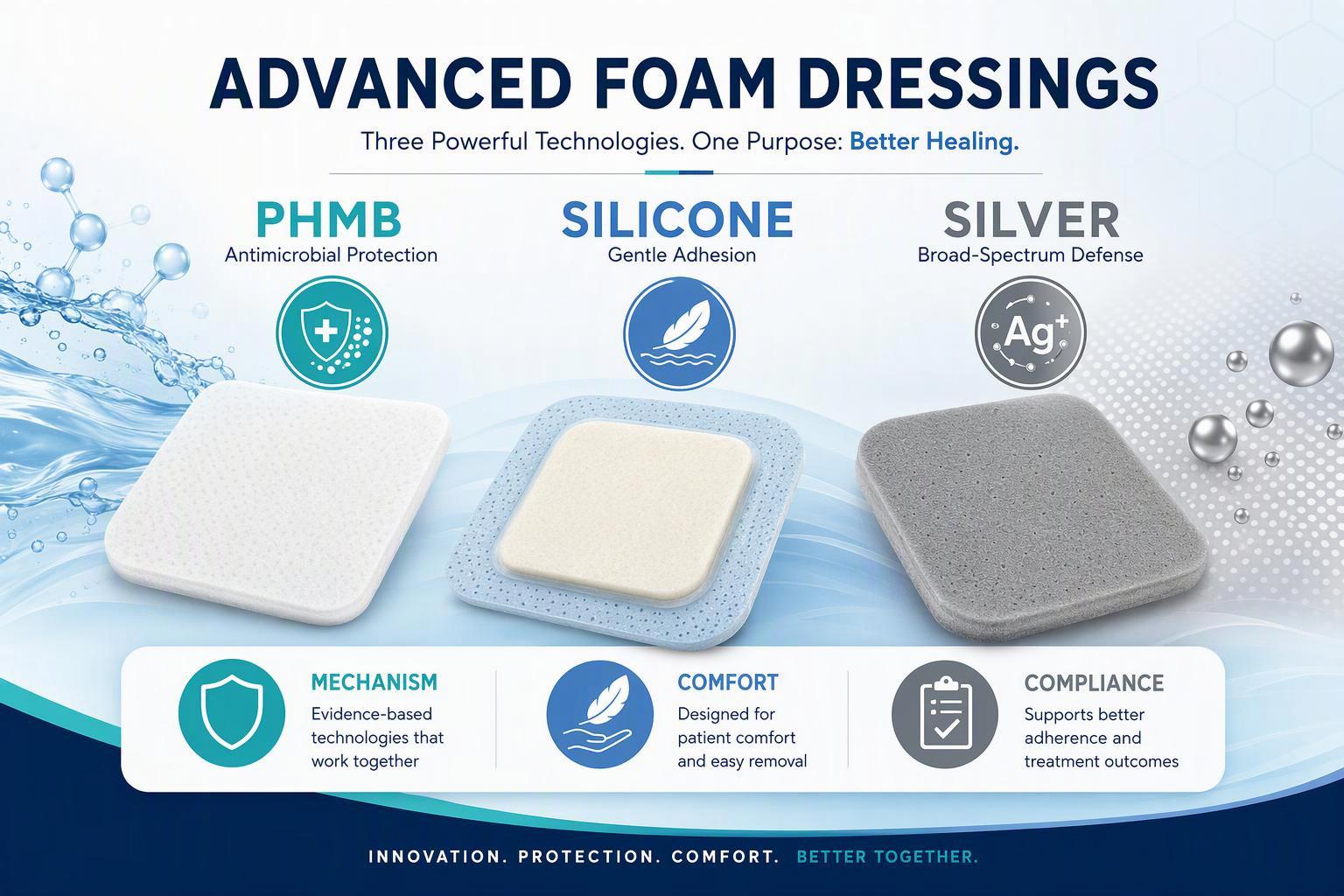
Introduction
This guide compares three foam dressing families that distributors are routinely asked to quote into hospital tenders, wound clinics and home-care channels: PHMB foam, silicone foam and silver foam. All three are built on a foam absorbent core, and all three are commonly used in advanced wound care for moderately to highly exuding wounds. The differences that decide a tender line — and a repeat order — sit in the antimicrobial agent or its absence, the wound-contact layer, the fluid-handling construction and the documentation pack behind the product.
One boundary matters more than any other for a distributor’s credibility with clinical customers. Antimicrobial activity demonstrated for a dressing is generally demonstrated within the dressing and in vitro. A PHMB foam cleared by the FDA describes its agent as protecting the dressing from bacterial penetration and colonization, with broad-spectrum activity shown against challenge organisms within the dressing (K190819). A later clearance for the same manufacturer’s antimicrobial version states that, based on in vitro data, the PHMB prevents colonization and proliferation of bacteria, yeast and mold within the dressing for up to 7 days (K223310). Neither statement is a clinical outcome claim, and neither should be paraphrased as one in a tender response or a sales sheet.
The adjunctive role follows from the same logic. The British National Formulary, cited in NICE’s assessment scope for topical antimicrobial dressings in infected leg ulcers, states that an antimicrobial dressing may be used for local wound infection “to reduce the level of bacteria at the wound surface but will not eliminate a spreading infection” (NICE GID-HTE10041). A 2016 FDA advisory panel presentation put the intended purpose in similar terms: exudate management and optimizing the wound environment are primary, while the antimicrobial barrier and bioburden control within the dressing are secondary and intended for short-term use (panel presentation).
For a distributor, that framing sets four buying goals that this guide works through in order: clinical fit against the wound types your customers actually treat; compliance evidence that survives audit and tender review; total cost of care rather than price per piece; and tender readiness, meaning the labels, IFUs, test reports and certificates are already in the file when a framework window opens.
What truly differentiates them
Antimicrobial mechanisms and claims
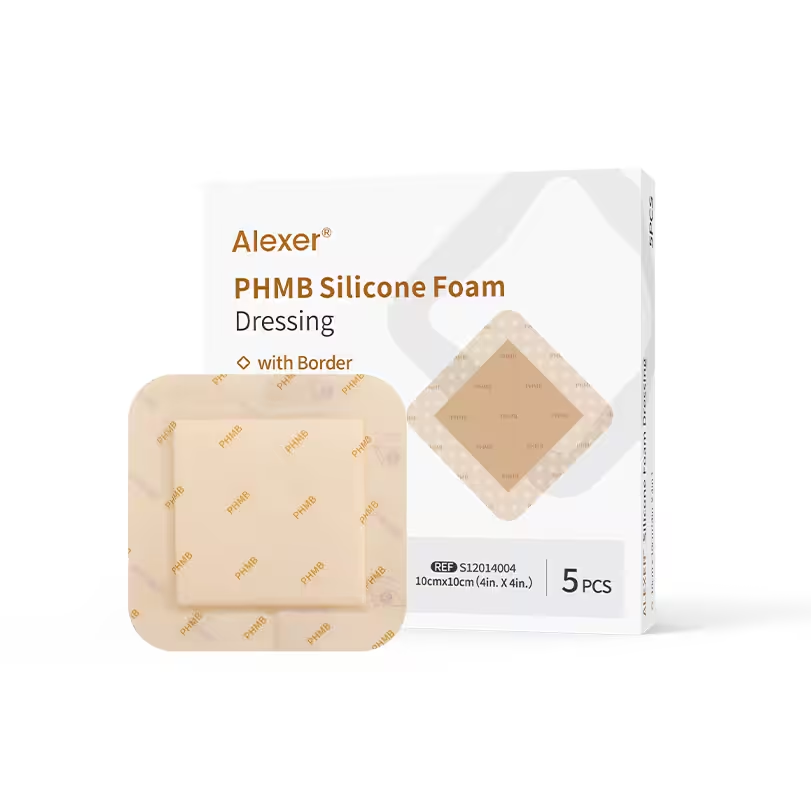
PHMB (polyhexamethylene biguanide, also written polihexanide) is incorporated into the foam itself. In the cleared device descriptions above, the foam is a polyurethane trilaminate impregnated with PHMB, and the claimed effect is protection of the dressing from bacterial penetration and colonization, with in vitro activity against a named panel including MRSA, Streptococcus pyogenes, vancomycin-resistant Enterococcus faecalis, Escherichia coli, Klebsiella pneumoniae, Serratia marcescens and Candida albicans.
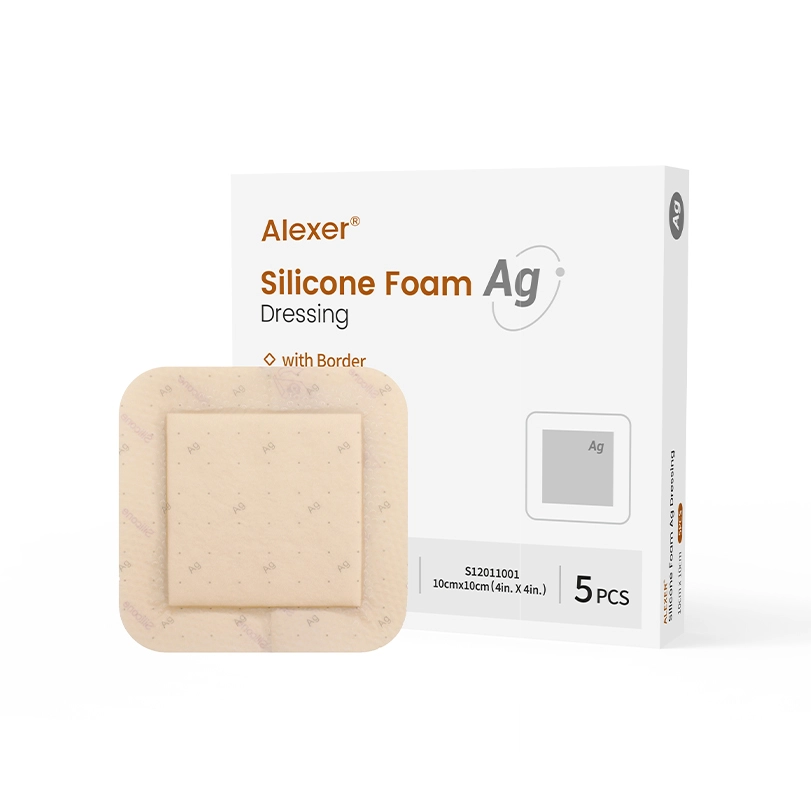
Silver foam works from silver compounds carried in the foam. An FDA clearance for a family of silver foam dressings — non-adhesive, adhesive, silicone silver and silicone silver with border — describes a soft absorbing polyurethane antimicrobial foam containing silver compounds beneath a vapor-permeable, waterproof film, indicated for moderately to highly exuding wounds such as leg and foot ulcers, pressure ulcers, diabetic foot ulcers, abrasions, surgical wounds, donor sites and first- and second-degree burns (K191819).
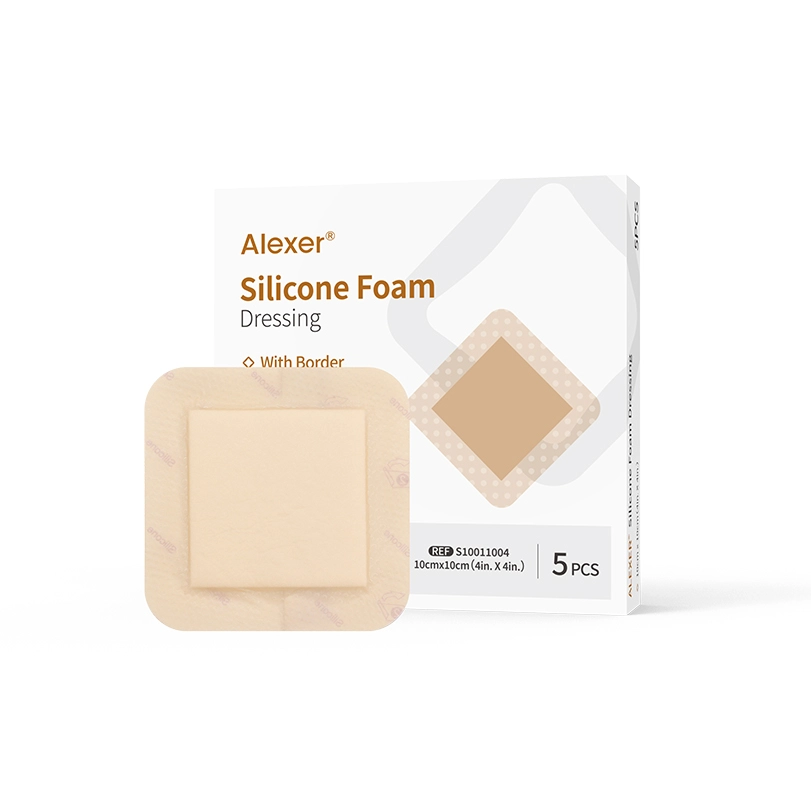
Silicone foam, in the strict sense, carries no antimicrobial agent at all. Its differentiator is the contact layer, not bioburden. That is why the three categories are not interchangeable in a tender: two make antimicrobial claims of different kinds, and one deliberately does not.
Claims discipline is where distributors lose points. The Wounds International consensus on silver dressings is explicit that in vitro tests are unlikely to be truly representative of performance in a wound because of the complexity of the wound environment, and that comparing dressings is complicated by the variety of testing methods and endpoints used (Wounds International). The same document notes that a zone of inhibition does not distinguish bacteriostatic from bactericidal activity and is sometimes mistaken for bactericidal activity. When a hospital asks what a dressing “kills”, the defensible answer describes the test method, the organisms and the fact that the result was obtained in vitro.
Exudate handling and wear time
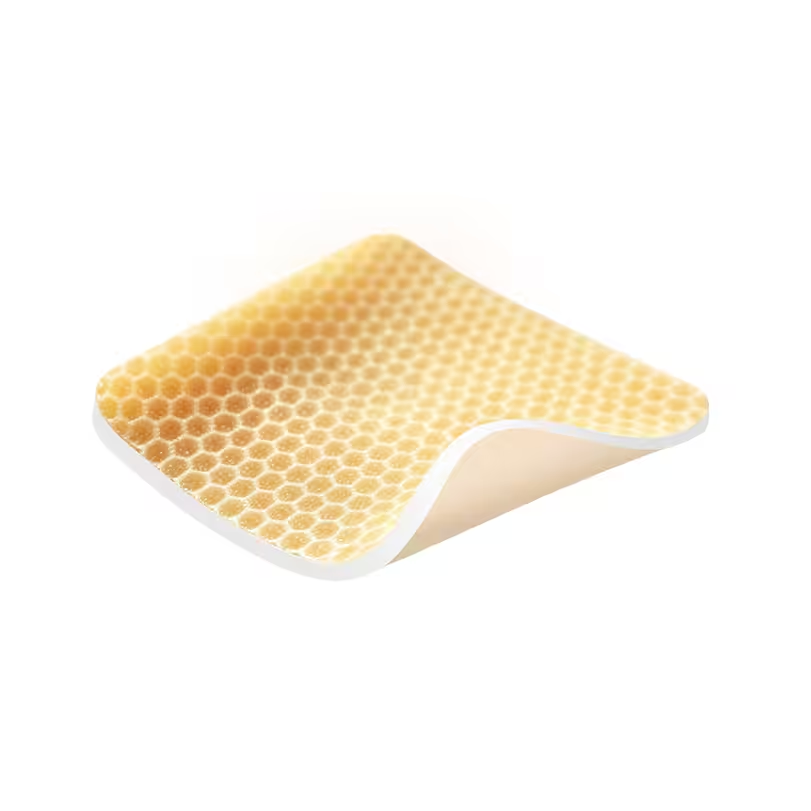
Fluid handling is a construction question, and construction varies more within each family than the family labels suggest. The PHMB device above pairs a microporous hydrophilic foam with a waterproof polyurethane film backing; the bordered version adds a super-absorbent retention layer and a non-woven distribution layer that moves exudate away from the wound contact surface (SLK bordered PHMB foam). The silver family cleared under K191819 is indicated specifically for moderately to highly exuding wounds, which tells a buyer where the manufacturer positions its capacity.
Wear time claims need the same care. The 7-day figure attached to PHMB in the clearances above refers to antimicrobial protection within the dressing, not to a guaranteed wear time on every wound. Clinically, wear time is set by exudate volume, maceration risk around the wound edge, the security of the border and local protocol. For a distributor, the practical implication is that a longer claimed wear interval is only a selling point if the fluid-handling data and the border adhesion data support it on the wound types your customers treat.
Patient comfort and skin protection
Silicone contact layers are the main comfort differentiator across all three families. A silicone wound-contact layer is designed to be non-adherent to the wound bed, which reduces pain at dressing change and the secondary tissue damage that can follow a conventional adhesive removal. In PHMB and silver products, the same silicone contact layer can be combined with the antimicrobial foam, so a buyer does not necessarily have to choose between bioburden control and atraumatic removal — but the combination must be specified, because non-silicone adhesive versions of both exist.
Skin fragility is the other half of comfort. For patients with fragile or macerated periwound skin, the border adhesive and the waterproof film backing determine whether the dressing stays put without stripping skin. DermNet’s overview of silicone dressings notes that cost may limit their use (DermNet), which is a fair reminder that the comfort argument has to be made in total-cost terms rather than as an absolute preference.
When to choose which dressing
Clinical indicators and wound status
The starting point is wound status, not product category. NICE’s scope document records that the International Wound Infection Institute advises topical antimicrobial treatments for wounds with signs and symptoms of local wound infection and for wounds suspected or confirmed as having biofilm, and that for spreading or systemic infection topical antimicrobials are used in combination with systemic antibiotics. Signs may include redness or swelling spreading beyond the ulcer, localized warmth, increased pain or fever.
That gives a workable triage for a distributor’s clinical support team. A wound with no signs of infection and moderate exudate is a candidate for silicone foam without an antimicrobial agent. A wound with local signs of infection, or one where bioburden is suspected of delaying closure, is a candidate for a PHMB or silver foam, subject to local formulary and the patient’s sensitivities. Spreading infection or a systemically unwell patient is a medical escalation, not a dressing selection.
Exudate level and construction matching
Match the construction to the exudate, then to the skin.
|
Exudate and skin picture |
Construction to shortlist |
What to verify |
|---|---|---|
|
Low to moderate exudate, intact periwound skin |
Standard silicone foam, bordered or non-bordered |
Border adhesion and conformability data |
|
Moderate to high exudate, local infection signs |
PHMB or silver foam with silicone contact layer |
Fluid-handling data and organism panel |
|
High exudate, fragile or macerated skin |
Foam with super-absorbent retention layer and silicone contact |
Total fluid handling and edge seal performance |
|
Cavity or packed wound |
Antimicrobial foam as cover or secondary dressing |
IFU wording on secondary use |
The FDA-cleared PHMB indication explicitly includes use “as a secondary dressing or cover dressing for packed wounds”, which is the kind of IFU detail that decides whether a product can be offered for a particular ward protocol. Confirm it in the actual IFU rather than in a brochure.
Time-limited antimicrobial use and reassessment
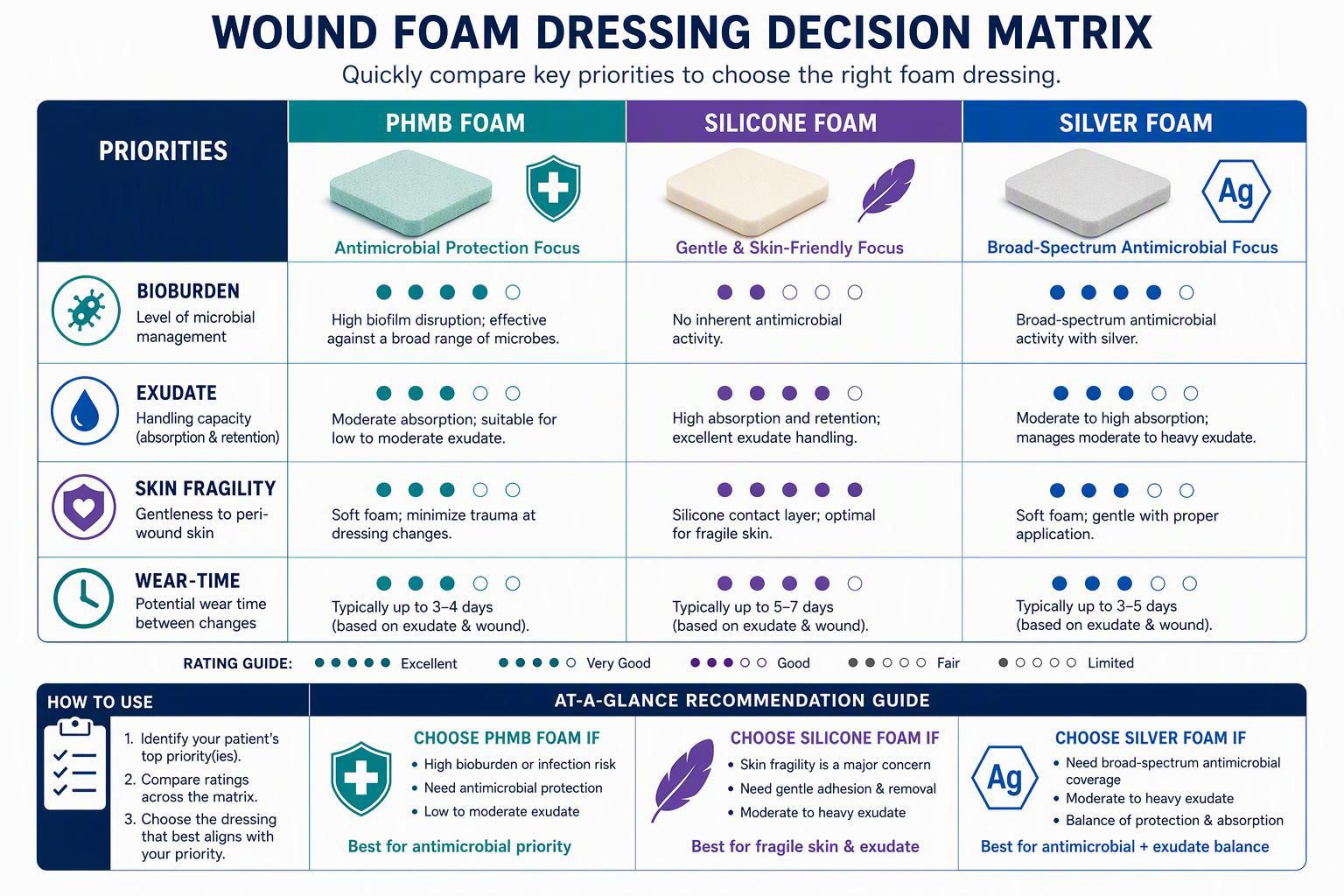
The two-week challenge is the most consistently repeated rule across the guidance reviewed here. NICE’s scope states that, in general, the maximum time a dressing should be used is 2 weeks before the wound and dressing are reassessed, after which the next dressing may be the same type, a step down to a non-antimicrobial dressing, or a step up to a second-line option; if local infection persists beyond two weeks, local guidance typically recommends escalation to the tissue viability team. The Wounds International silver consensus sets out the same two-week challenge in decision form: improvement with continuing infection signs may justify continued use with regular review; resolution of infection signs means the silver dressing should be discontinued; no improvement means discontinue and consider a different antimicrobial agent, with systemic antibiotics if the patient is unwell.
The Wounds UK 2025 best practice statement adds the stewardship frame: antimicrobial agents should not be routinely used as a precautionary measure if the wound is not clinically infected, and antiseptics including PHMB and silver may carry some level of toxicity affecting skin and healing progression (Wounds UK 2025). For distributors, this is a positioning opportunity: a range that includes both antimicrobial and non-antimicrobial silicone foam lets a customer step down without changing supplier.
Regulatory and procurement essentials
FDA 510(k) and EU MDR checkpoints
In the US, antimicrobial foam dressings with a drug component have been cleared through the 510(k) pathway under product code FRO (Dressing, Wound, Drug), as the K223310 comparison table shows. A distributor should hold the clearance letter, the indications-for-use statement and the performance summary for each SKU, because the cleared indication wording is what may be promoted — no more.
In the EU, classification drives the technical documentation burden. Under MDR Annex VIII Chapter III Rule 4, non-invasive devices are class I unless a rule applies; devices intended principally for injuries to skin that have breached the dermis and can only heal by secondary intent are class IIb, and devices principally intended to manage the micro-environment of injured skin are class IIa (MDR Annex VIII). Article 61 requires clinical evidence to support conformity with the relevant general safety and performance requirements (MDR Article 61). A distributor’s due-diligence file should therefore include the notified body certificate, the declaration of conformity and the clinical evaluation documentation, not just a CE mark on the box.
Performance standards and tender criteria
EN 13726:2023 is the current European test-method standard for wound dressings covering aspects of absorption, moisture vapour transmission, waterproofness and extensibility; it replaced the four-part 2002–2003 editions (DIN EN 13726:2023-12; BS EN 13726:2023). Tender specifications written against the older parts may still be in circulation, so check which edition a framework references before submitting data.
NHS Supply Chain’s Advanced Wound Care specification illustrates how frameworks translate standards into requirements: absorbency defined as Total Fluid Handling Capacity per BS EN 13726, a requirement that all antimicrobials provide evidence of in vitro reduction of bacterial load, IFU in English or pictograms, and notification of any proposed change to technical specifications during the framework term (NHS Supply Chain specification). The same document lists ISO 13485:2016 and MDR conformity among the standards applicants must evidence on request, with the right to suspend product lines where evidence is not provided. That suspension clause is the concrete risk behind an incomplete documentation pack.
Sourcing, OEM/ODM, and documentation readiness
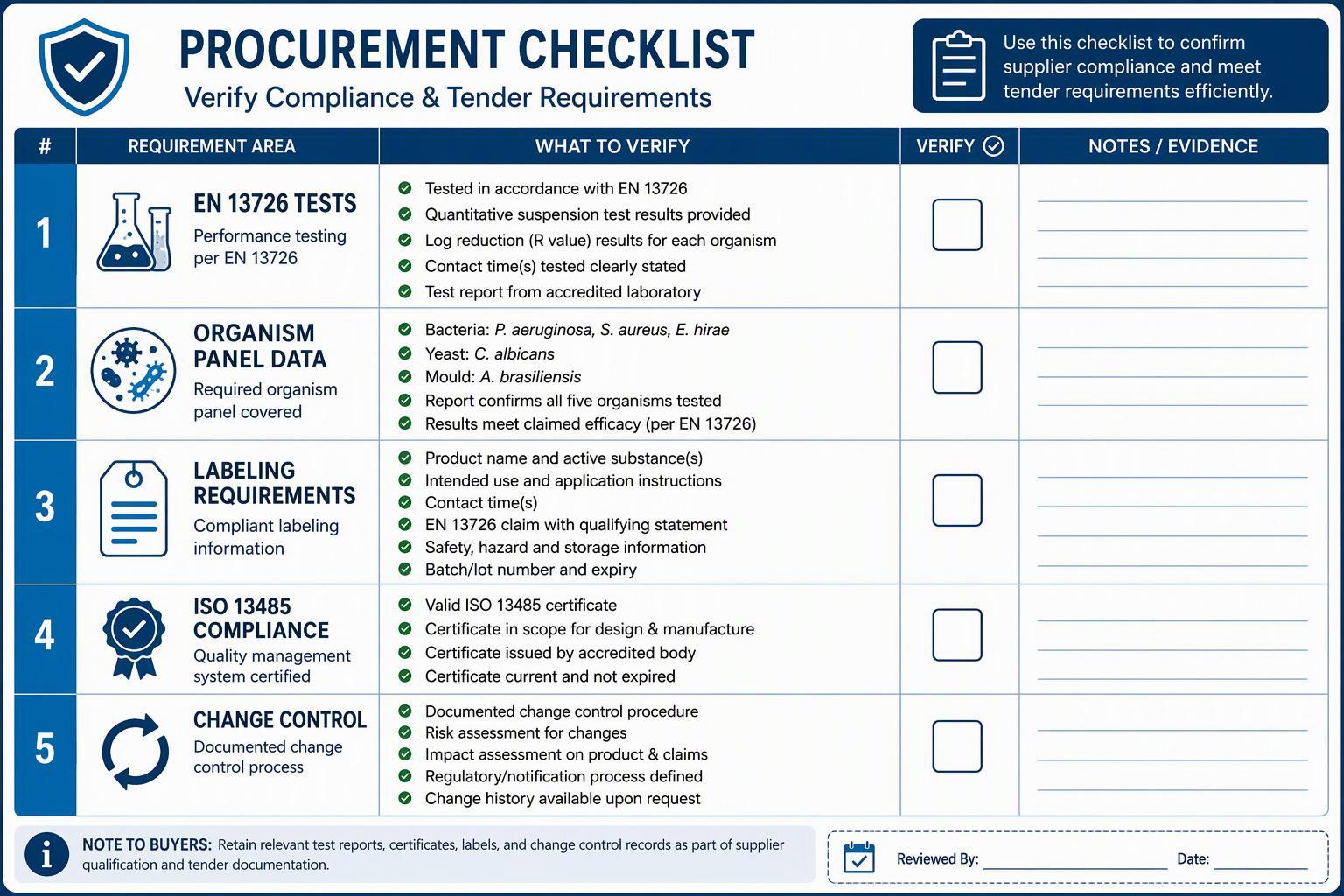
SLK Medical offers OEM/ODM support with MDR and FDA documentation readiness for silicone foam, PHMB and silver foam ranges (slkmedical.com).
For any supplier, verify the scope of the quality certificate rather than its existence. SLK Medical’s ISO 13485:2016 certificate, issued by TÜV SÜD, covers design, development, production and distribution of sterile polyurethane dressings and production and distribution of sterile foam, transparent, waterproof, hydrocolloid, alginate and silicone absorbent fiber dressings, among others, valid to 8 May 2028. Its EU MDR Annex IX Chapter I quality management system certificate covers Class IIb adhesive dressings with absorbent pad, valid to 22 September 2030. Ask for the certificate scope page, not the cover sheet, and check that the specific SKU family you intend to tender falls inside it.
Three documentation items are worth building into your standard supplier request. First, a change-control commitment: who notifies whom, in how many days, when a material, sterilization method or manufacturing site changes. Second, a multilingual label and artwork control process, since label errors are a common cause of customs holds. Third, a complaint and CAPA response timeline, because a slow CAPA response becomes your problem in front of the customer.
Conclusion
The selection logic reduces to three questions asked in order. Is there clinical evidence of local infection or biofilm? If not, silicone foam without an antimicrobial agent is the default, and the decision turns on exudate capacity and skin protection. If yes, PHMB or silver foam is appropriate within a time-limited challenge, and the choice between them turns on local formulary preference, the organism panel and in vitro data you can document, and the patient’s sensitivities. Throughout, the contact layer and border construction decide comfort and wear time more than the antimicrobial agent does.
The evidence strength behind these categories is uneven and should be represented honestly. The regulatory clearances establish indications and in vitro antimicrobial performance within the dressing; they do not establish healing rates or infection incidence. The clinical guidance establishes when antimicrobial dressings should and should not be used, and how long before reassessment. Neither body of material supports a claim that one agent is clinically superior to another across wound types.
Build change criteria into the customer conversation: a documented two-week reassessment point, a defined step-down to non-antimicrobial silicone foam when infection signs resolve, and a step-up or escalation path when they do not. Frame the commercial case in total cost of care — dressing count, nursing time, dressing-change pain, and the cost of a failed course — rather than price per piece alone.
Finally, align every product choice with the instructions for use and the regulations of the market you are supplying. Indications, contraindications and wear instructions differ between SKUs and between jurisdictions, and the IFU, not this guide, governs.
To review specifications, IFUs and certification packs for silicone foam, PHMB and silver foam ranges, contact SLK Medical for the current documentation set and a sampling plan.
FAQ
1. What is the primary difference between PHMB foam and Silver foam dressings?
Both PHMB and Silver (Ag+) foam dressings belong to the antimicrobial category, but they serve different clinical applications and cost-structure brackets:
- Silver (Ag+) Foam Dressings: Utilize ionic silver to provide rapid, broad-spectrum bactericidal action against high-risk or actively infected wounds (including MRSA). They generally carry a higher unit cost and are positioned as premium antimicrobial solutions for critical care procurement.
- PHMB Foam Dressings: Utilize Polyhexamethylene Biguanide to inhibit a wide spectrum of microbial growth over extended wear periods. PHMB offers a cost-effective, highly biocompatible alternative for bioburden management and infection prevention without the risk of silver resistance or staining.
2. Under what clinical and sourcing conditions should non-antimicrobial silicone foam dressings be specified?
Non-antimicrobial soft silicone foam dressings should be specified when the primary objectives are exudate management, tissue preservation, and cost optimization:
- Clinical Suitability: Ideal for clean, non-infected, exuding wounds (e.g., Stage 2–4 pressure injuries, donor sites, post-operative surgical wounds) where moisture balance and atraumatic removal are required.
- Commercial Advantage: Offers lower unit costs and broader regulatory clearance, making it the primary high-volume workhorse SKU for hospital tenders, long-term care inventory, and standard private label catalogues.
3. Can antimicrobial foam dressings replace systemic antibiotic pills?
No, they work as a team, but they do different jobs!
-
Antimicrobial foam dressings (like silver or PHMB foam) stay on the outside of the body to protect the wound surface and kill local germs.
-
Antibiotic pills go inside your whole body through your blood to fight deep, severe infections. If a wound is seriously infected, a doctor will usually prescribe both pills and a special dressing!
5. How can buyers evaluate a good OEM/ODM wound dressing supplier?
A great supplier should make your life easy! Here is what buyers should look for:
-
Real Factory Experience: Make sure they are the actual makers (like SLK Medical), not just middle-men.
-
Custom Options (OEM/ODM): Can they print your brand logo on the box and make custom sizes or shapes (like heel or sacral patches)?
-
Reliable Shipping & Quality: Do they test every batch of foam so you never receive bad products?
-
Manufacturing Transparency: Verify whether the vendor is an actual direct factory with cleanroom facilities (Class 100,000 / ISO 8 cleanroom) rather than a trading intermediary.
-
Supply Chain Stability & Scalability: Evaluate factory production capacity, lead times, minimum order quantities (MOQs), and post-market regulatory support.