



Those two documents answer the first question a distributor asks about an unfamiliar supplier: is this a manufacturer with an audited quality system, or a trading arm reselling someone else’s output?
This review is a supplier-qualification exercise built on published certification and product documentation. It is not an independent laboratory test, and it is not a clinical evaluation. No certificate in the public record proves that any specific PHMB foam SKU performs as claimed, and nothing here should be read as a safety or efficacy finding.
What follows separates what the certificates and product pages actually establish from what a buyer still has to demand in writing before signing.
What exactly does SLK Medical manufacture, and what do its certificates actually cover?
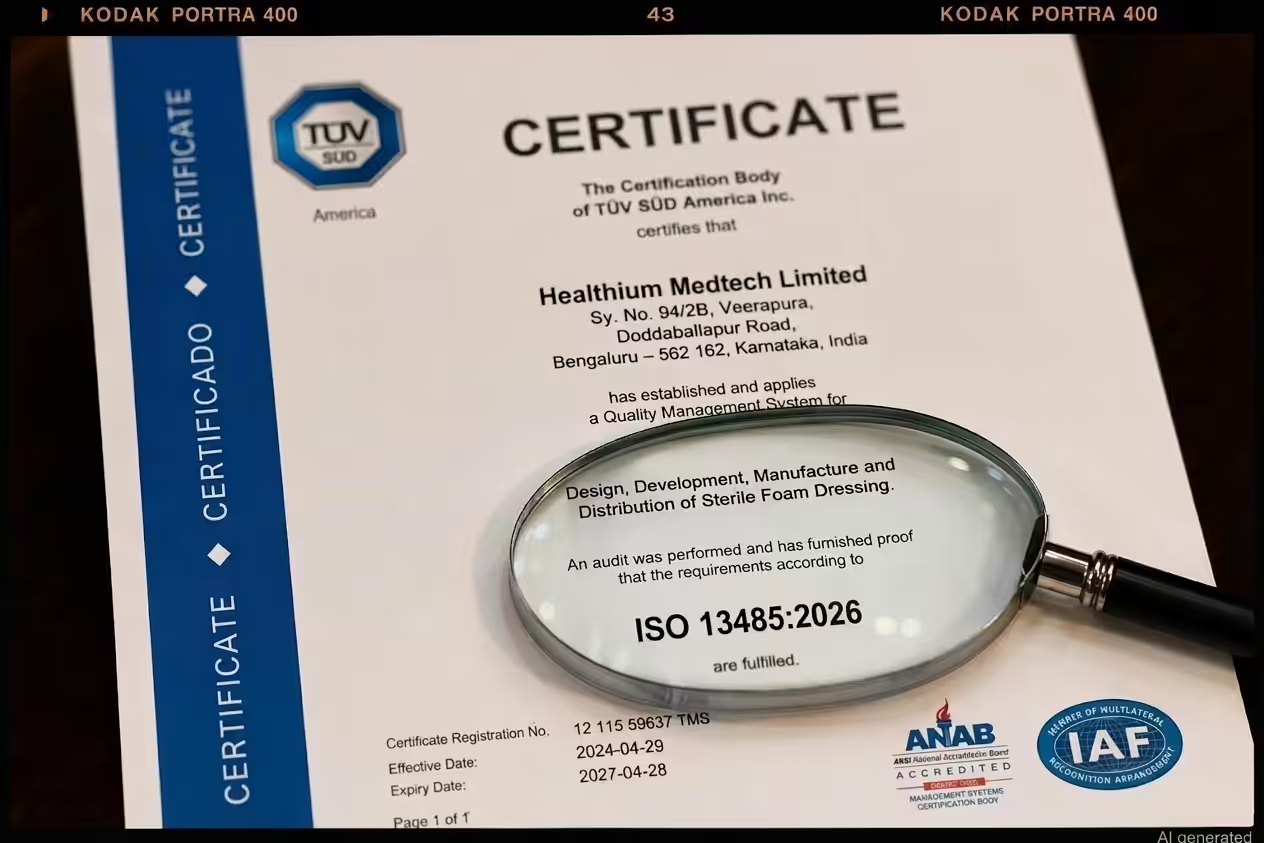
SLK Medical’s ISO 13485:2016 certificate is issued to SLK Medical Material (Tianchang) Co., Ltd. in Tianchang City, Anhui, China, which means the certificate holder and the manufacturing site are the same legal entity rather than a trading address. The current revision, Q5 112764 0001 Rev. 01, lists 11 product category lines, and the scope text separates design and development for part of that list from production and distribution for the rest.
The scope line that matters most for a PHMB foam buyer is “Production and Distribution of Sterile Foam Dressing,” which appears alongside sterile polyurethane, hydrocolloid, alginate, silicone absorbent fiber and super absorbent dressings, plus non-sterile scar gel, medical tape, silicone gel sheets and silicone tapes. The applied standard is ISO 13485:2016, including EN ISO 13485:2016/AC:2018 and EN ISO 13485:2016/A11:2021. The previous revision of the certificate carried a narrower line set, so confirm you are reading the current revision before you rely on any scope line.
Certificate | Number | Body | Standard or regulation | Scope or activity | Validity | What it does not establish |
|---|---|---|---|---|---|---|
ISO 13485:2016 | Q5 112764 0001 Rev. 01 | TÜV SÜD Product Service GmbH | ISO 13485:2016 (EN ISO 13485:2016/AC:2018, EN ISO 13485:2016/A11:2021) | Design, development, production and distribution across 11 product category lines, including sterile foam dressing | Dates not present in the source text; verify on the TÜV SÜD register | That any specific PHMB foam SKU is CE marked |
EU QMS | G15 112764 0002 Rev. 00 | TÜV SÜD Product Service GmbH, Notified Body 0123 | Regulation (EU) 2017/745, Annex IX Chapter I | QMS assessment, positive result; report No. SH23185901 | Valid from 2025-09-23 to 2030-09-22 | Product-level technical documentation approval |
Its EU MDR Annex IX Chapter I QMS certificate was assessed with a positive result and names an EU Authorized Representative in Hamburg plus the manufacturer’s SRN, as the regulation requires of a non-EU manufacturer. The certificate text also states the limit plainly: Class III or Class IIb implantable devices need an EU Technical Documentation Assessment Certificate under Annex IX Chapter II before market placement. A QMS certificate is not a product certificate.
Two gaps stay open. The certificate’s device details sit on a following page that the source text did not return, so this review cannot claim the EU certificate names the PHMB foam family specifically. And the ISO 13485 effective and expiry dates are absent from the source text, so verify both certificates against the TÜV SÜD register rather than trusting a PDF copy.
What PHMB foam configurations can be OEM’d, and what does the PHMB do in the foam?
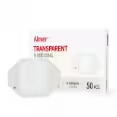
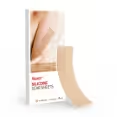
The manufacturer documents three PHMB foam OEM configurations: a with-border silicone foam, a non-border silicone foam, and a non-adhesive PHMB foam. All three product pages carry the same sentence, that the foam contains the antimicrobial substance polyhexamethylene biguanide (PHMB, polihexanide), “which kills and inhibits the growth of bacteria.” The with-border page adds the construction stack: a polyurethane film backing, a super absorbent fiber layer, a non-woven distribution layer, and the PHMB-containing foam layer.
That wording is the manufacturer’s own, and it is worth reading carefully. It describes an antimicrobial substance in the foam. It is not a clinical efficacy claim, and this review does not treat it as one.
The with-border page also states antimicrobial protection for up to 7 days and that the foam layer “reduces the risk of infection.” No test method is cited on the page, so treat the 7-day figure as a claim to verify in the dossier, not as performance data. For calibration, an FDA-cleared PHMB foam dressing contains about 0.5% (w/w) PHMB in its polyurethane foam, lists 7 days as its antibacterial duration, and sits in the prolonged-contact category of more than 24 hours to 30 days. That clearance tested biocompatibility to ISO 10993-5, -7, -10 and -11 and demonstrated reduction of S. aureus, E. coli, Candida albicans, P. aeruginosa, MRSA, VRE and Klebsiella. It is a comparable device, not this supplier’s product, and the distinction matters.
A published review of PHMB-releasing wound membranes reports release durations from 0.5 hours to 20 days, with 1 to 24 hours the most common range, and warns that in vitro release conditions differ so much from in vivo conditions that durations cannot be translated directly (Guiomar & Urbano, Membranes, December 2022). A fixed 7-day claim and a variable release literature are not contradictory, but they are not the same kind of statement either.
Is PHMB accepted in my target market, and what evidence should I demand before I sign?
PHMB is accepted in both major markets, but the two regimes classify it on different axes, and the EU answer is the stricter one. The Commission’s classification guidance lists dressings incorporating an antimicrobial agent with an ancillary action on the wound among the Rule 14 examples and states that all Rule 14 devices are Class III. A published classification of a PHMB dressing confirms this for Suprasorb X + PHMB, while noting that the same bacterial cellulose dressing without PHMB is Class IIb under Rule 4.
The contested point is whether PHMB’s action is genuinely ancillary. A review of substance-based devices notes that where antimicrobial efficacy contributes significantly to clinical performance, separating physical action from pharmacological effect becomes difficult, and that inconsistent interpretation across Member States has produced divergent classifications for similar products (Ianev et al., Polymers, January 2026). The guidance is authoritative; the commentary describes how it is applied in practice. Plan for Class III and a consultation procedure on the ancillary substance.
Correct one common assumption: the Commission’s scientific committee opinion on PHMB is SCCS/1535/14, it addresses cosmetic preservative use at up to 0.3%, and it could not conclude on genotoxic potential. It is not a wound-dressing opinion, and there is no SCENIHR opinion on polihexanide in dressings.
In the US, FDA’s device classification record places PHMB wound dressings in product code FRO, class Unclassified, cleared through the 510(k) pathway. “Unclassified” carries no information about the EU class.
The 2024 antimicrobial wound-dressing standard, EN 17854:2024, defines a dressing as microbicidal at a 3-log reduction and microbistatic at 0-log, tested at a mandatory 24-hour exposure against three specified organisms in simulated wound fluid.
Before signing, demand the final specification, PHMB identity and assay, an antimicrobial efficacy report run against the standard you name, the ISO 10993 set for every patient-contacting layer, the EN 13726 performance set, and the change-control history. The FDA endpoint matrix requires seven endpoints for a breached-surface device in prolonged contact: cytotoxicity, sensitization, irritation or intracutaneous reactivity, acute systemic toxicity, material-mediated pyrogenicity, subacute or subchronic toxicity, and implantation. If the antimicrobial claim sits on a textile or nonwoven layer, name ISO 20743 for textile-based dressings; for a direct-contact surface claim, name ISO 22196 for non-porous surfaces.
What are the honest limitations of this supplier review?
This review cannot tell you SLK’s own PHMB concentration, its antimicrobial test standard, its log reduction, or its contact time, because none of those appear in the available documentation. It also found no EN 17854:2024, ISO 20743 or ISO 22196 evidence for these products. Every one of those is a dossier item to request, not a published result.
Capacity, minimum order quantity, lead time, customer cases and testimonials are absent by design, and this review does not substitute estimates for them. The buyer-guide material that describes how to evaluate a wound dressing supplier is largely manufacturer-authored, so it is used here only as practice framing, not as independent evidence. No independent distributor-side risk dataset on PHMB foam dressings was located either.
That leaves a clear next step. Request the spec sheet, the instructions for use, the certifications pack and a sampling plan, then verify both certificates against the TÜV SÜD register before you open a technical file. What to verify in a silicone foam production line covers the manufacturing side of that same check.
Conclusion
SLK Medical belongs on a shortlist for PHMB foam OEM manufacturing when the buyer needs a documented quality system and a defined OEM pathway, and is prepared to run its own dossier validation. The ISO 13485:2016 scope names sterile foam dressing production and distribution at the Tianchang site, and the EU QMS certificate sits under MDR Annex IX Chapter I with Notified Body 0123, valid to 2030-09-22. Those are auditable facts, not marketing.
It is not the right fit for a buyer who needs published capacity figures, guaranteed lead times, or clinical outcome data before engaging. None of that exists in the public record, and a supplier review cannot manufacture it.
The single next action is the document request: spec sheet, IFU, certifications pack and sampling plan, with both certificates verified against the TÜV SÜD register. Choosing between foam and other dressing formats is the natural follow-on if the format decision is still open.
About the publisher: SLK Medical is a manufacturer of advanced wound care dressings, including silicone foam dressings, and its ISO 13485 certificate covers the production of sterile foam dressings. It therefore has a commercial interest in PHMB foam OEM manufacturing, and readers should weigh its perspective accordingly. The guidance above does not depend on its products.