The FDA’s Quality Management System Regulation took effect on 2 February 2026, amending 21 CFR Part 820 to incorporate ISO 13485:2016 by reference, and the first four EUDAMED modules became mandatory on 28 May 2026. For anyone comparing foam wound dressing OEM manufacturers, those two dates reset what a supplier’s paperwork actually proves. This guide gives procurement, regulatory affairs and product teams a wound dressing OEM due diligence framework for choosing a foam dressing OEM manufacturer: which documents to request, which numbers to demand, and which answers belong in writing before you shortlist.
Key Takeaways
Verify the scope of a certificate, not just its existence: the covered site, the product families and the standard revision.
Ask for numeric test values against named methods rather than a pass or fail statement.
Fix legal-manufacturer identity and change-control ownership in writing before tooling or artwork is released.
Reviewed by the SLK Medical regulatory affairs team, which holds FDA, ISO 13485 and CE MDR documentation experience across OEM wound dressing programs for the EU, Americas and Middle East. This guide is not regulatory or legal advice; confirm requirements with your own regulatory affairs function or notified body.
Introduction
Choosing among foam wound dressing OEM manufacturers now starts with a compliance question, not a price question. Two rule sets that decide whether a supplier’s claims still hold both changed recently. The FDA’s Quality Management System Regulation took effect on 2 February 2026, amending 21 CFR Part 820 to incorporate ISO 13485:2016 by reference (FDA, QMSR page). In the EU, the first four EUDAMED modules became mandatory on 28 May 2026, with actor registration and UDI/Devices among them (European Commission, EUDAMED page). A certificate issued under the old expectations may still be valid while the evidence behind it no longer answers what your notified body or US agent will ask.
This guide gives you a wound dressing OEM due diligence framework you can run before an RFQ goes out and again during the audit. It is organized around the three things that actually gate a launch: regulatory and market access, validation and quality evidence, and operations, cost, and scalability. Each part converts a supplier claim into a document request with a named standard, clause, or numeric value you can check yourself. Treat it as a framework for comparing foam wound dressing OEM manufacturers on equal terms, not as a recommendation of any one supplier.
Key Takeaways
Verify the scope of a certificate, not just its existence: the covered site, processes, and product families are what your technical file depends on.
Ask for numeric test values from EN 13726 and ISO 10993 reports rather than a pass/fail summary.
Fix legal-manufacturer responsibility and change-control ownership in writing before sampling, because those two items decide who carries the regulatory burden after launch.
Use the framework to standardize how you compare suppliers across 2025 and 2026 submissions, so that every candidate is measured against the same evidence list rather than the same sales deck.
Reviewed by the SLK Medical regulatory affairs team, which supports OEM and ODM wound dressing programs for US, EU and Middle East market access. The team holds FDA, ISO 13485 and CE MDR documentation experience and works from a 10,000 m² plant running two foam dressing production lines since 2018. This article is a procurement framework, not regulatory or legal advice; confirm requirements with your own regulatory affairs function or notified body.
Your OEM due diligence plan
Wound dressing OEM due diligence works best as one shared artifact that procurement, quality assurance and regulatory affairs can all mark up, rather than three separate questionnaires that never reconcile. The framework below splits supplier evaluation into three workstreams: regulatory and market access, validation and quality evidence, and operations, cost and scalability. Run all three before you shortlist, and you will be able to compare two or three foam wound dressing OEM manufacturers on the same criteria instead of on the quality of their sales decks.
Each workstream ends in a document request, not a yes/no question. That matters because a supplier’s claim of certification tells you almost nothing until you know which legal entity, which site and which product families the certificate actually covers.
Regulatory and market access

Start with the classification rationale, because it determines everything downstream. Under the EU Medical Device Regulation, a foam dressing that manages exudate in a chronic wound is typically a Class IIa device under Rule 4 of Annex VIII, and the manufacturer must hold a notified body certificate for that class. Ask for the classification rationale in writing, then check the certificate against it.
The certificate itself is where most evaluations go wrong. A supplier may hold a valid ISO 13485 certificate while the scope statement excludes the very process you are buying, such as sterile barrier packaging or the silicone coating step. Request the full certificate, not the logo, and read the scope line by line. Confirm the covered site address matches the plant that will actually run your order. If your supplier operates multiple facilities, a certificate for the head office does not cover a satellite plant.
For US market entry, ask separately about FDA establishment registration and device listing, and about the transition to the Quality Management System Regulation, which aligns US requirements more closely with ISO 13485. A supplier that can hand you a one-page QMSR alignment brief has usually thought about this already.
Then test market access breadth. If you sell into the EU, you need a manufacturer that understands EUDAMED timelines and can supply Basic UDI-DI assignments plus UDI label samples. If you sell into multiple regions, ask how the supplier handles labelling variants without re-triggering design validation. The SLK Medical MDR and FDA readiness guide lists the artefacts a buyer should expect at this stage, including an Annex II and III technical documentation table of contents, a clinical evaluation report executive summary, post-market surveillance and PMCF synopses, and AccessGUDID links. Treat that list as a checklist you send to every candidate, not as a description of one supplier.
One red flag deserves its own line: a supplier who answers a scope question with a marketing page instead of a PDF. Another is a certificate whose expiry date has passed but which still appears on the website.
Validation and quality evidence
This is the workstream that separates a trading company from a manufacturer. Ask for the validation dossier before you ask for a quote, because the dossier tells you whether the supplier can support your regulatory submissions or will leave you assembling them yourself.
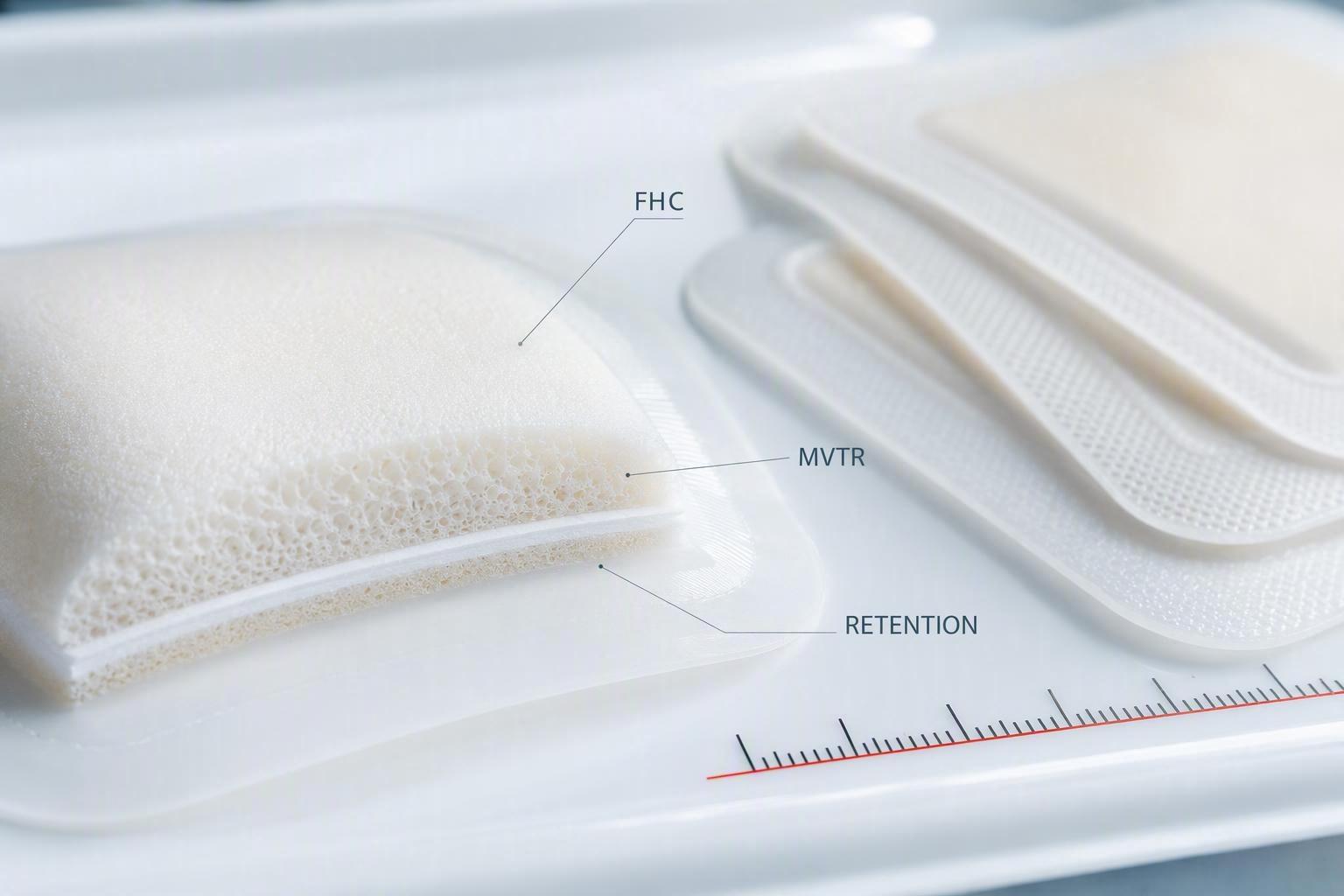
The core evidence set for a foam dressing covers four areas. First, performance testing to EN 13726, the European standard series for primary wound dressings, which includes fluid handling, moisture vapour transmission and conformability. Second, biocompatibility testing to the relevant parts of ISO 10993, typically ISO 10993-5 for cytotoxicity and ISO 10993-10 for irritation and sensitization, depending on the materials and contact duration. Third, sterilization validation, whether by ethylene oxide or gamma, with the dose-setting or cycle development report. Fourth, packaging validation, including accelerated and real-time aging studies that support your shelf-life claim.
Ask for the reports themselves, not summaries, and check that the test articles match your intended construction. A report on a 10 cm by 10 cm non-bordered dressing does not validate a bordered sacral dressing with a different adhesive.
To make this concrete, here is the evidence set you should expect any credible foam dressing manufacturer to assemble: EN 13726 performance reports, ISO 10993 biocompatibility summaries, and sterilization and packaging validation outlines covering each product family and construction. Use that list as a neutral benchmark against every candidate, including SLK Medical. Nearly all suppliers, ours included, publish certification logos and product pages without the certificate scope statement or the covered site address, because those details sit inside the certificate PDF rather than on the marketing site. That is exactly the gap this section tells you to close in writing: confirm in the same email to every candidate that the ISO 13485, CE MDR and FDA documentation on file covers the specific plant and the product families you intend to buy.
Two red flags here. A supplier who offers “ISO 10993 compliant” without naming the parts and the test laboratory. And a supplier whose validation reports are dated more than five years ago with no re-evaluation note.
Operations, cost, and scalability
Once the evidence holds up, evaluate whether the supplier can actually run your programme at volume. This is where buyers most often discover that a capable manufacturer is not a scalable one.
Start with the process steps the supplier performs in-house. Silicone coating, silicone punching, dressing composite and automated packaging are the four steps that determine both quality control and lead time in a foam dressing line. If any of those are outsourced, ask who performs them and how the supplier audits that subcontractor. Outsourced coating, in particular, complicates change control because a formulation change at the coater can invalidate your biocompatibility data.
Then map capacity to your forecast. Ask for the number of coating lines, the shift pattern, and the maximum monthly output in square metres. Compare that against your peak demand, not your average, and add a margin for the supplier’s other customers. A plant that runs at 90 percent utilization for existing accounts will not absorb your launch order on schedule.
At SLK Medical we answer those questions with our own numbers rather than with adjectives, because that is the level of transparency this framework demands of every supplier. Our foam dressing operation runs from a 10,000 m² facility with two dedicated production lines, and we have focused on foam dressings since 2018. We support OEM and ODM buyers across the EU, the Americas and the Middle East, and supply source manufacturers behind several top Amazon sellers. Those are the concrete facts a buyer should hold every candidate to, so we apply the same scrutiny to ourselves: ask us for coating line count, shift pattern, monthly output and current utilization in writing, exactly as you would ask any other manufacturer.
Commercial terms come next, and this is where published information runs out. SLK Medical does not publish MOQ, lead time or pricing, and neither do most credible manufacturers, because those figures depend on construction, size range and order volume. Marketplace listings that advertise a fixed delivery window are marketing copy, not a specification, and should not be treated as one. Ask every candidate for the same three numbers in the same format: minimum order quantity per SKU, quoted lead time from purchase order to ex-works shipment, and the tooling or artwork cost for a new size.
Finally, test change control and communication. Ask how the supplier notifies you of a raw material change, what notice period applies, and whether they will sign a quality agreement that names your regulatory affairs contact. A supplier who supports variant breadth across bordered, post-op and antimicrobial configurations, and who can scale sizes without re-validating artwork, will save you weeks on every line extension. One who cannot will make each new SKU feel like a new supplier qualification.
Conclusion
Choose a foam wound dressing OEM manufacturer the way you would qualify any critical supplier: on evidence you can inspect, not on assurances you cannot. The three proof pillars from this guide are regulatory readiness, complete validation, and reliable capacity. A partner who can hand over an ISO 13485 certificate with a scope statement, EN 13726 test reports, ISO 10993 summaries, and sterilization and packaging validation outlines has already done the work your audit would otherwise force.
Then lock the commercial terms into the RFQ itself. Ask for line items covering label claims and the evidence behind them, testing scope and the laboratory used, MOQs by SKU and size, lead times for a pilot lot and for repeat orders, and the change-control process for formulation, supplier, or site changes. Those six lines turn a quotation into a document your quality, regulatory, and procurement teams can all sign off on.
SLK Medical supports this documentation-first approach: request the spec sheet, IFU, certification pack, and sampling plan before you shortlist, so the comparison starts from complete files rather than follow-up emails.
Disclosure and references
Authorship and review. This guide was written and reviewed by the SLK Medical regulatory affairs team, which holds FDA, ISO 13485 and CE MDR documentation experience and supports OEM and ODM wound dressing programmes for the EU, the Americas and the Middle East. Last updated: 18 September 2026.
Disclosure. SLK Medical is a manufacturer of advanced wound care dressings and a potential supplier of the products discussed here. This guide is written as a neutral procurement framework and is intended to be applied equally to SLK Medical and to every competing manufacturer; readers should factor this commercial relationship into their evaluation. SLK Medical does not publish MOQ, lead time or pricing, as those depend on construction, size range and order volume.
Sources.
-
U.S. Food and Drug Administration, Quality Management System Regulation (QMSR), amending 21 CFR Part 820 to incorporate ISO 13485:2016 by reference, effective 2 February 2026.
-
European Commission, EUDAMED, first four modules mandatory from 28 May 2026.
-
ISO 13485:2016, Medical devices — Quality management systems — Requirements for regulatory purposes.
-
EN 13726 series, Test methods for primary wound dressings.
-
ISO 10993 series, Biological evaluation of medical devices.
-
Regulation (EU) 2017/745 on medical devices (EU MDR), Annex VIII classification rules.
This guide is not regulatory or legal advice. Confirm classification, testing, and market-access requirements with your regulatory affairs function or notified body before you commit to a foam wound dressing OEM manufacturer.