Introduction
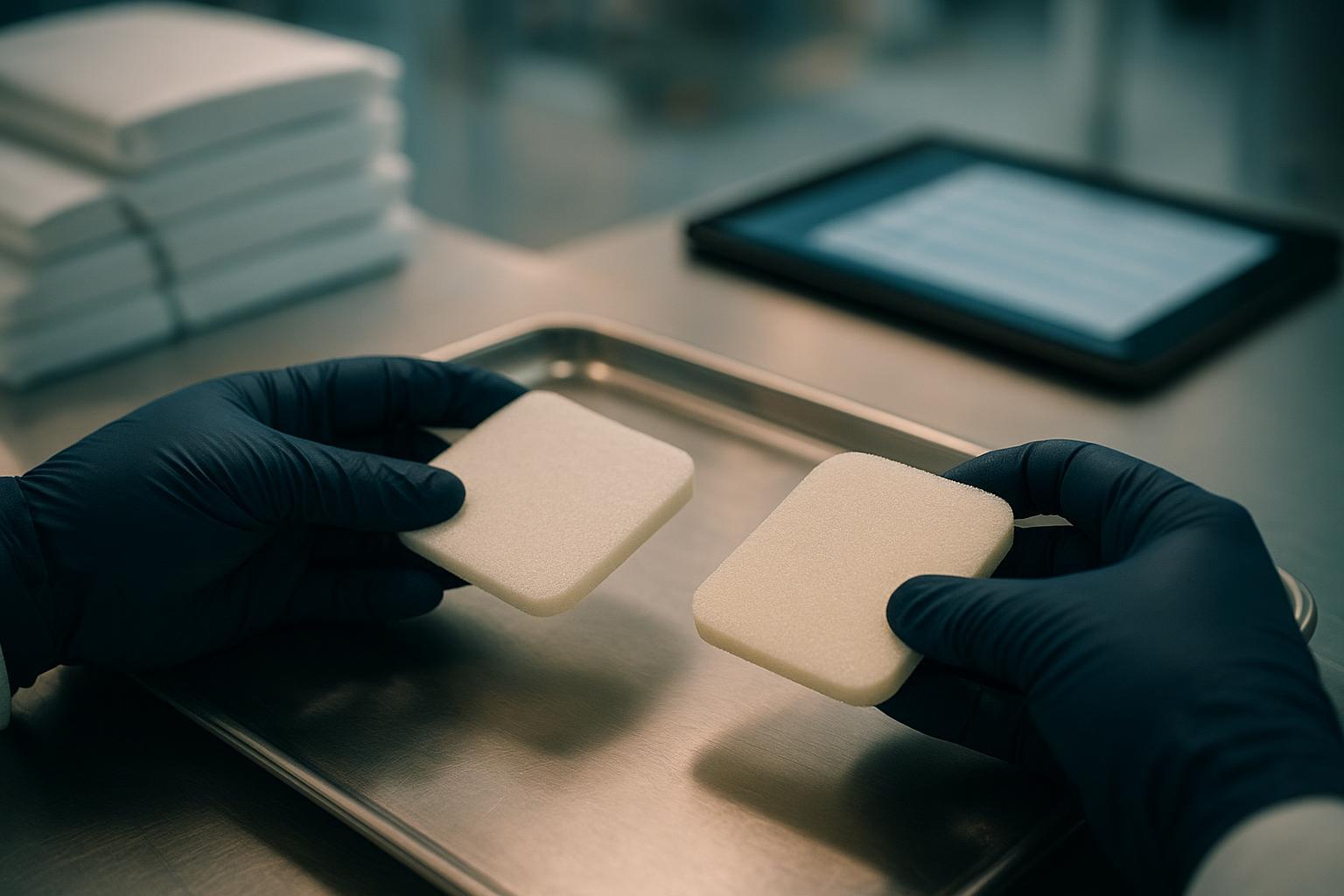
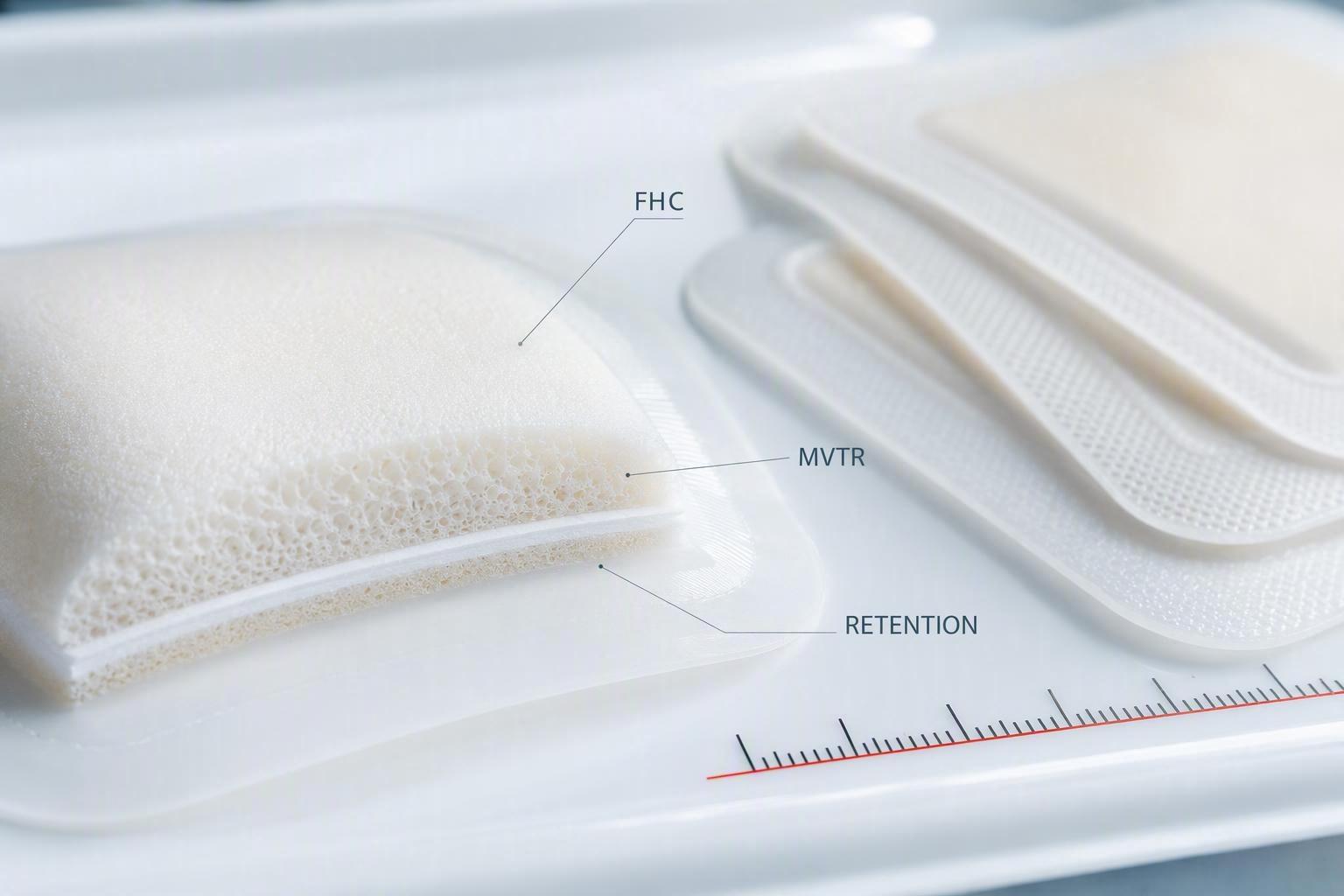
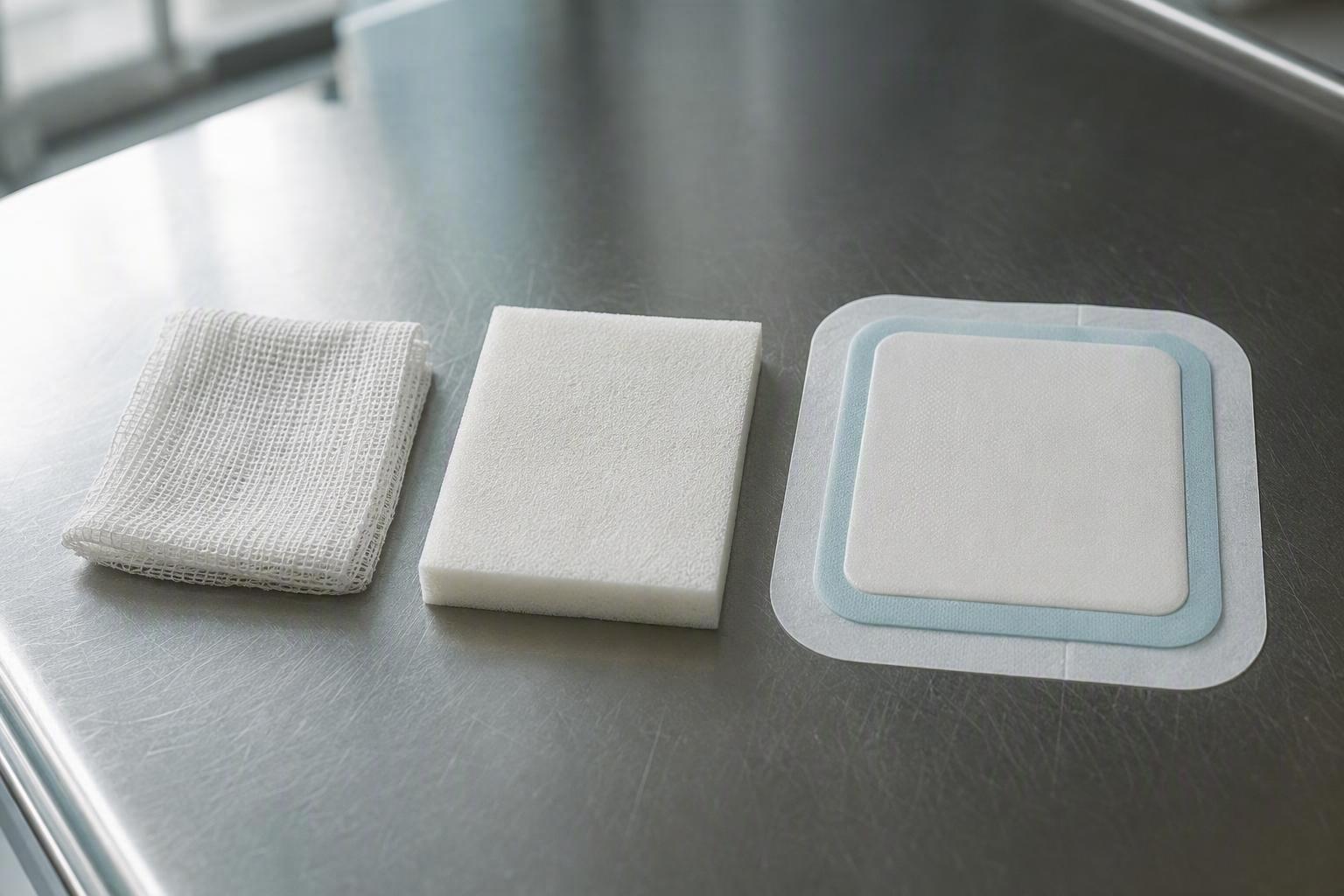
Silicone foam dressings are multi-layer dressings built around a soft silicone wound contact layer, typically combined with an absorbent foam core, a fluid-distribution layer and a breathable backing film. In US practice they compete against two very different incumbents: woven gauze, which is cheap, universally stocked and still used as a primary dressing in many protocols, and standard polyurethane foam without a silicone interface, which absorbs well but relies on a more aggressive acrylic adhesive to stay put.
The comparison that matters to distributors and clinical evaluation teams is not which class heals wounds faster. It is which class reduces pain at removal, contains exudate long enough to extend wear time, and lowers total cost of care once labor and change frequency are counted. Those three outcomes, plus the limits that come with them, are what this article examines. If you need the category basics first, the manufacturer resource SLK Medical’s silicone foam dressing guide (SLK Medical resource) covers construction and indications.
This article supports clinical and procurement education. It does not replace facility policy, product instructions for use, or clinician judgment.
Disclosure of commercial interest: This article is published by SLK Medical, a manufacturer of silicone foam and other advanced wound dressings. SLK Medical has a direct commercial interest in the category discussed here, and several in-text links point to its own product and technical pages. Those links are labeled as SLK Medical resources where they appear. Where possible, claims are anchored to independent peer-reviewed sources rather than manufacturer materials, and readers are encouraged to verify cost and outcome claims against their own facility data.
About the author and review: This article was prepared by the SLK Medical clinical and product team, which develops and manufactures advanced wound dressings and works with wound care clinicians and distributors on product evaluation. It was reviewed internally for alignment with current standards on wound bed preparation, exudate management and atraumatic dressing selection. SLK Medical is not an independent clinical body, and its perspective reflects its role as a manufacturer. Readers are encouraged to combine the evidence cited here with independent clinical guidance, such as peer-reviewed consensus documents and their own facility protocols. More about SLK Medical and its manufacturing standards, including CE MDR/FDA compliance and ISO 13485 quality management.
Key Takeaway: Silicone foam’s best-evidenced advantage is comfort at removal, not faster healing. The Cochrane review of dressings for surgical wounds healing by secondary intention (2004) found no clear difference between foam and gauze in healing, but did find gauze associated with significantly more pain and significantly more nursing time.
A quick orientation before the detail:
|
Criterion |
Gauze |
Standard foam |
Silicone foam |
|---|---|---|---|
|
Pain at removal |
Higher; can adhere as it dries |
Moderate; depends on adhesive |
Lower with a soft silicone interface |
|
Exudate handling |
Saturates quickly at moderate volume |
Absorbs and retains well |
Absorbs and retains well |
|
Typical wear time |
1–2 days |
1–3 days |
3–7 days |
|
Unit price |
Lowest |
Middle |
Highest |
|
Total cost of care |
Often highest once labor is counted |
Variable |
Lowest where full wear time is achieved |
How this comparison was assembled
This is a synthesis of peer-reviewed reviews and trials, not a clinical trial of its own. Evidence was selected by searching for systematic reviews and randomized or comparative studies on foam, gauze and soft silicone dressings in wound care, then prioritizing sources that report outcomes relevant to clinical and procurement decisions: pain at removal, exudate containment, wear time, nursing workload and cost of care. Where a source is a manufacturer document or a vendor-published guide, it is labeled as such. Cost figures are taken from the specific studies cited and are not adjusted across health systems; they should be re-run against your own facility data before any formulary decision.
Readers should note the limits of that method. Head-to-head trials that isolate the silicone interface from absorbency are scarce, several cost studies are single-site or modeling exercises rather than prospective economic evaluations, and demonstrated outcomes vary with wound type, patient population and protocol. Where the evidence is mixed or inconclusive, this article says so.
Clinical advantages
Atraumatic removal and less pain
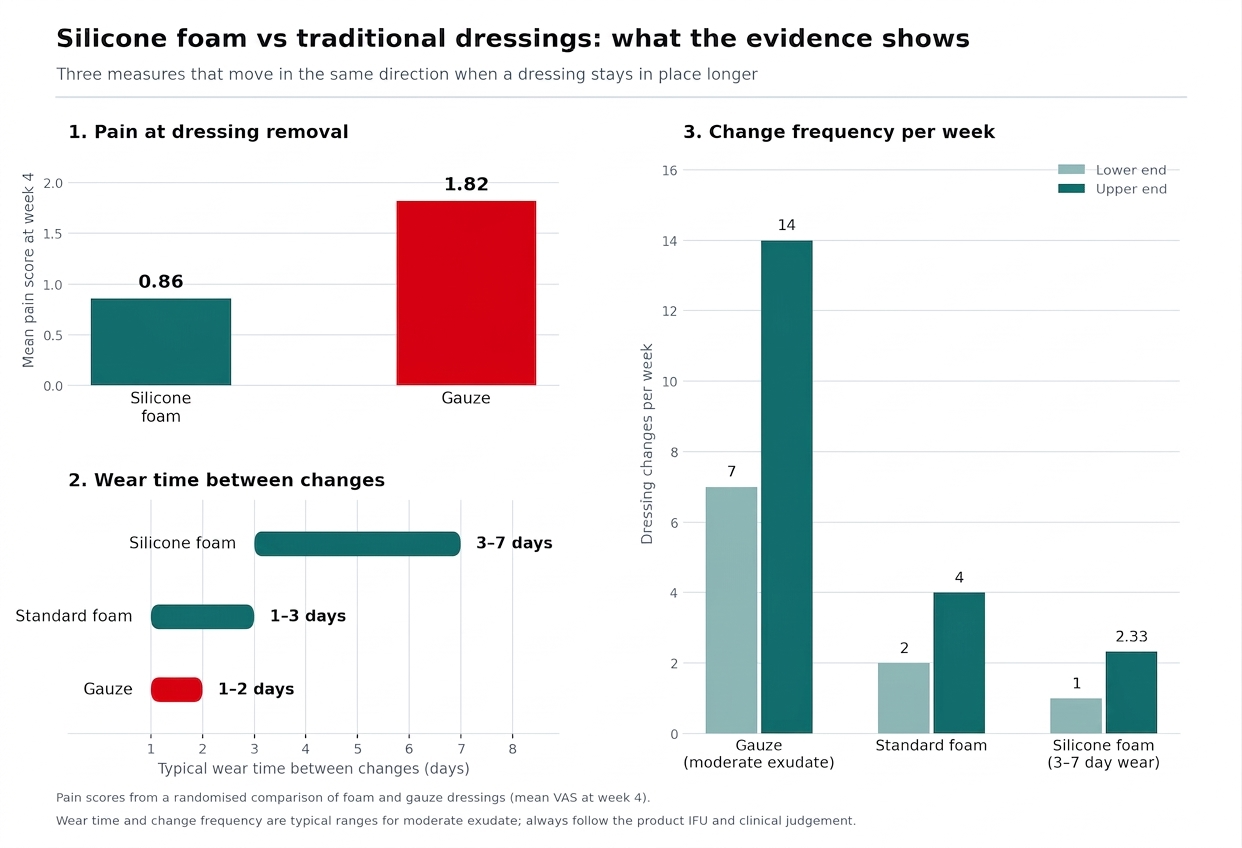
Pain at dressing removal is the most consistently measured difference between foam and gauze. The Cochrane review of dressings for surgical wounds healing by secondary intention assessed foam against gauze directly. Mean pain at week four was 0.86 with foam versus 1.82 with gauze, a statistically significant difference in favor of foam. In a separate trial in the same review, 60% of patients in the gauze group needed analgesia compared with 16% in the foam group.
What elevates silicone foam above standard foam is the interface, not the absorbency. Soft silicone adheres gently to dry peri-wound skin but does not bond to the moist wound bed, so removal lifts the dressing rather than peeling tissue. Wounds International’s review of soft silicone dressings documents lower removal pain and less epidermal stripping across pediatric, burn, heel ulcer and radiation-reaction patient groups, and warns that these dressings should not be used on bleeding wounds or where silicone allergy is known. A prospective crossover comparison of three multilayered foam dressings found soft silicone reduced traumatic injury and discomfort compared with traditional adhesives.
That distinction matters commercially. Foam is not one product class, and a distributor selling against a cheaper non-silicone foam is competing on adhesive chemistry, not absorbency.
Exudate management and moisture balance
The BMJ’s wound dressings review is blunt about where foam wins: “The major advantage of foam is the ability to contain exudate.” Foam draws fluid vertically away from the wound bed through capillary action and locks it into the core, so the wound interface stays moist while the peri-wound skin stays dry. Gauze does the opposite. It absorbs fluid but holds it against the skin, and once saturated it wicks laterally and leaks.
Moisture balance is where the failure mode lives. A dressing that holds fluid but loses its seal lets exudate pool against peri-wound skin, and maceration follows. Retention under compression, edge seal quality and fit deserve more attention during evaluation than absorption capacity alone. A 2024 review of fluid handling by foam wound dressings notes that real-world wear time depends on exudate level, infection status, peri-wound skin condition, wound contours, movement, patient weight and external forces, not on a single datasheet figure. For the mechanism in more detail, see the SLK Medical resource on how silicone foam dressings maintain moisture without causing periwound maceration (commercial page).
Longer wear time and fewer changes
Wear time is what turns a clinical advantage into an operational one. Comparative effectiveness data on wound dressings describes foam as usable for up to 4–7 days, changed once saturated and atraumatic on removal, while a 2023 review of foam dressings notes that gauze “is easily overwhelmed by the moisture content in the wound, requiring frequent dressing changes (up to 3 times a day),” and that the resulting nursing burden may increase wound care cost relative to other modalities.
Put plainly: silicone foam at 3–7 days means roughly one to two changes a week. Gauze at daily to twice-daily means seven to fourteen. Every avoided change removes a room entry, a sterile setup, a documentation event and a waste disposal event.
Indications and limitations
When silicone foam dressings outperform gauze and standard foams
Silicone foam earns its price in three situations: moderate-to-heavy exudate where gauze would saturate daily, fragile or elderly skin where removal trauma risks further breakdown, and high-friction sites where a dressing has to stay sealed through movement. Burns, skin tears and radiation-reaction patients add further weight.
The construction that makes this work is a soft silicone contact layer over an absorbent core, with a backing film that lets water vapor escape while keeping external fluid and contaminants out. A dressing built this way absorbs and retains fluid in the vertical plane, and the silicone interface stays gentle on surrounding skin during repeated changes. SLK Medical’s silicone foam dressings are one representative example built on that architecture (SLK Medical product page), with a multi-layer absorbent structure and a breathable backing, designed for moderate-to-high exudate and for atraumatic removal. Where wounds are heavily exuding or at higher infection risk, clinicians may also consider super absorbent dressings as an alternative or adjunct, again subject to the product’s instructions for use. Indication and wear time for any specific product are set by its instructions for use, not by the category, and no single brand should be assumed to be superior to another on the evidence reviewed here.
Standard foam still wins on unit price in low-complexity, short-duration situations. Gauze still wins where the wound is small, drainage is minimal, and the dressing comes off in a day anyway.
Contraindications and cautions
The honest version of this comparison includes where silicone foam is the wrong choice:
-
Dry, necrotic or eschar-covered wounds. Foam needs some moisture to function and can dry a low-exudate wound further.
-
Third-degree burns. Contraindicated by manufacturer instructions for use.
-
Heavily bleeding or arterial wounds. Soft silicone should not be used on bleeding wounds, and arterial insufficiency needs frequent professional inspection rather than routine dressing management.
-
Silicone hypersensitivity, or allergy to any dressing component.
-
Oxidizing agents. Hydrogen peroxide and hypochlorite degrade polyurethane foam.
-
Clinical infection. Non-antimicrobial foam is not a stand-alone answer to infected wounds. Some silicone foams may be used on clinically infected wounds, but only under professional supervision with monitoring and systemic treatment where indicated.
Foam also does not fix a fit problem. On an irregular contour, a dressing that loses its seal will fail whatever its absorbency spec, and an unplanned change erases the wear-time advantage.
Application best practices
Most dressing failures are application failures, and they are preventable:
-
Prepare the skin. Cleanse and dry the peri-wound skin and remove oils, lotions or adhesive residue so the silicone border can seal.
-
Size with margin. Leave a border of intact skin around the wound (typically 2 cm) so exudate cannot reach the pad edge.
-
Respect anatomy. Sacral wounds need a dressing that extends into the gluteal cleft; heels need a shaped or cup design that does not roll with movement. Guidance on sacral silicone foam application covers sizing and placement.
-
Do not stretch the dressing. Apply without tension, then press the edges to seat the seal.
-
Inspect daily. Check without removing the dressing, and change it when exudate approaches the pad edge, the seal lifts, or the wound deteriorates.
-
Remove slowly. Lift the edges gently, pull back in the direction of hair growth, and moisten with saline if the dressing is stuck.
Economic value and prevention
Total cost of care and nursing workload
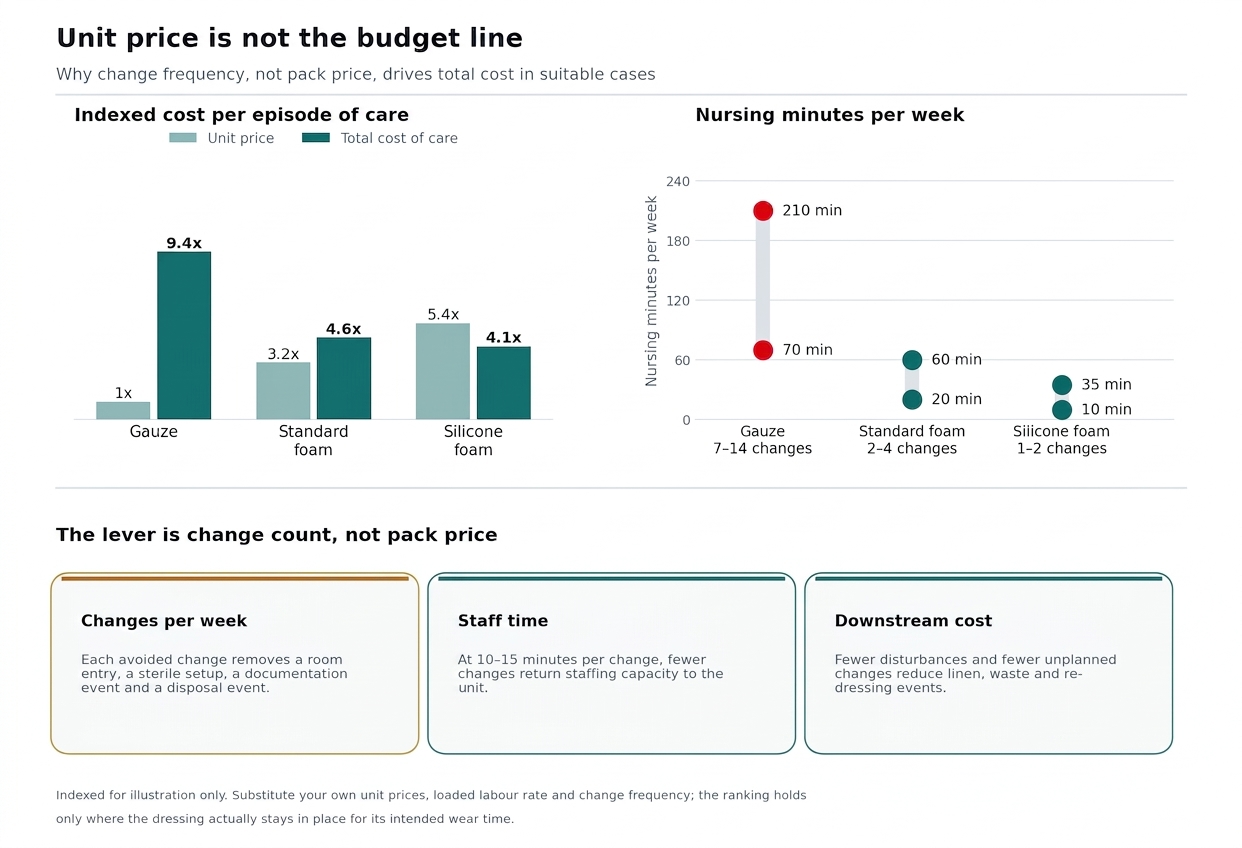
Unit price and cost of care point in opposite directions. The Cochrane review found gauze inexpensive but associated with significantly more nursing time than foam; the two trials that measured it recorded 35.1 and 46.9 home nursing visits for gauze against 4.6 and 14.1 for foam. A cost analysis of foam versus saline-soaked gauze reported mean weekly treatment cost of $91 for foam versus $209 for gauze, mostly attributable to nursing time.
Build your own model anyway. Take the change frequency each dressing realistically achieves for your patient mix, multiply by minutes per change (10 to 15 minutes including removal, cleansing, assessment, application and documentation is a reasonable planning figure), and apply your own loaded labor rate. Then add secondary dressings, securement, waste disposal and linen changes. Run the arithmetic twice: once assuming the foam achieves full wear time, and once assuming it does not. The second scenario is where the case usually collapses.
Budget impact and formulary decisions
For a value analysis committee, separate two numbers that are usually blended. Material cost per change covers the primary dressing plus secondary dressing and securement. Labor cost per change covers nursing minutes at your loaded rate. A foam protocol reduces the second sharply and raises the first modestly, so the question is not whether foam costs more per pack, because it will, but whether the change-count reduction covers the difference in your setting.
Practically, that means asking any supplier for three things before standardizing: a spec sheet showing absorbency and retention under compression, instructions for use that state wear time and contraindications explicitly, and a small sampling plan so the protocol can be tested on your patient mix before it reaches committee. Cost-in-use claims that cannot be reproduced in your own facility should not be accepted, from any manufacturer.
Prophylactic use on sacrum and heels
Prevention is a separate decision from treatment, and the evidence is more conditional than marketing suggests. The 2019 international pressure injury guideline suggests multilayer soft silicone foam dressings on the sacrum and heels for high-risk patients as an adjunct to standard prevention, as a conditional recommendation rather than a universal one. A multicentre trial of silicone adhesive multilayer foam dressings reported a reduction in pressure injuries of category 2 or worse from 6.3% to 4.0% in hospitalized at-risk patients.
Cost-effectiveness is site-specific. An economic analysis of an ICU randomized trial calculated €1,945.30 per pressure ulcer avoided overall, splitting into €701.54 for sacral ulcers and €8,144.72 for heel ulcers, leading the authors to conclude the dressings are cost-effective at the sacrum and only marginal on the heels. A US-perspective economic model found adjunctive use cost-saving, while a pragmatic trial in medical-surgical patients found no reduction in sacral hospital-acquired pressure injuries and an incremental cost of $99.90 per patient.
The practical reading: prophylaxis inside a prevention bundle for high-risk patients, concentrated at the sacrum, with daily skin inspection. Not a universal application, and not a substitute for repositioning, support surfaces and heel offloading.
Conclusion
Silicone foam dressings are most defensible where exudate is moderate to heavy, skin is fragile, and the dressing can genuinely stay in place for several days. Their strongest evidence is in comfort (significantly less pain at removal than gauze) and in workload, where fewer changes translate into measurable nursing time. The atraumatic interface, rather than absorbency, is what separates them from standard foam.
Be equally clear about what the evidence does not show. Foam and gauze have not demonstrated a difference in time to healing in the trials reviewed, and the infection-control picture is thinner than the exudate and comfort evidence. Silicone foam helps manage bioburden by containing exudate and reducing dressing disturbance; it does not replace antimicrobial therapy where infection is clinically present.
For patients, the benefit is straightforward: fewer painful changes and better protection of fragile skin. For clinical teams, the workflow stops revolving around daily re-dressings. For distributors, the argument that survives a value analysis meeting is not that foam is better in every case, but that where the wound matches the dressing, the change count falls and the total cost of care follows it down. SLK Medical publishes its silicone foam range and technical materials in a form that supports that kind of review.