Most dressing leaks are not random. They trace back to a gap between what the dressing can handle in a lab test and what the wound asks of it at the bedside. Fluid pools at the wound interface, creeps sideways, softens the periwound skin, lifts the adhesive border, and eventually shows through the backing. By the time anyone notices, maceration has started, the seal is compromised, and a change is due sooner than the label suggested.
Understanding why that sequence happens — and which numbers on a datasheet predict it — is what separates a dressing selected on evidence from one selected on habit. This article works through the fluid handling metrics that appear on silicone foam dressing documentation: what each metric measures, what the test conditions actually mean, and how to apply the numbers when selecting dressings for moderate-to-heavy exudate wounds and high-risk anatomic sites such as the sacrum, heel, and trochanter.
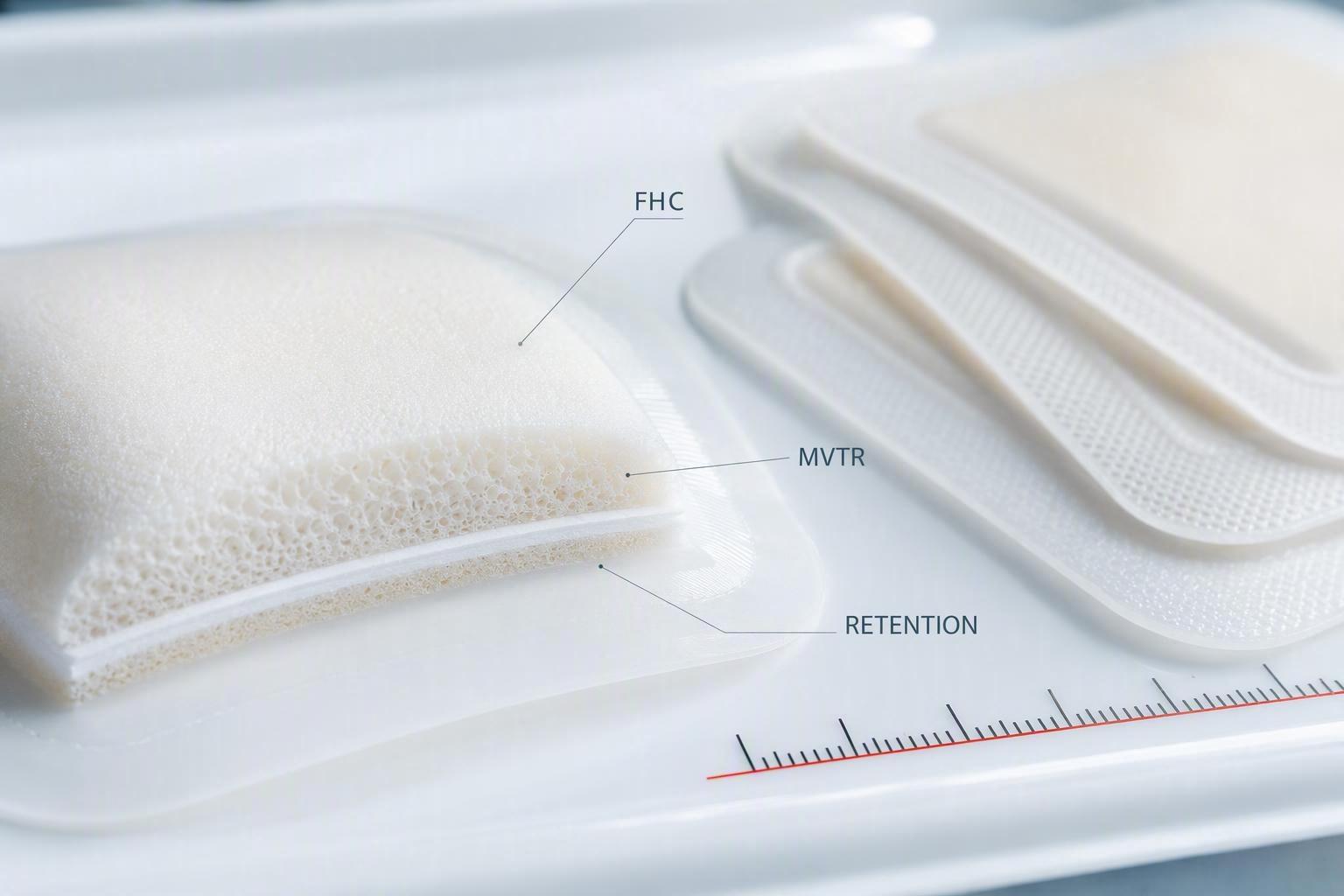
Key Takeaway: Fluid handling capacity is not a single number. It is a system of interconnected metrics — FHC, absorption under compression, retention, MVTR, rewet, and wicking — and understanding how they interact is what makes a datasheet useful at the bedside.
What this article is not. It does not recommend or rank specific commercial products. It does not declare pass/fail thresholds. It is a framework for interpreting standardised data so that your team can compare dressings on a shared, auditable basis — regardless of which brands you are evaluating.
Introduction
Why fluid handling metrics matter in clinical practice
A silicone foam dressing manages exudate through four linked mechanisms: acquisition (pulling fluid off the wound surface), distribution (spreading it across the absorbent core), retention (locking it away from the wound and periwound), and evaporation (releasing water vapour through the breathable film backing). When any link in that chain is overwhelmed, the failure cascade begins.
The clinical consequences are predictable. Leakage exposes the periwound to sustained moisture, leading to maceration — the whitening, softening, and eventual breakdown of intact skin. Maceration is one of the most common wound-related complications in inpatient settings, and it is a direct driver of unplanned dressing changes, additional nursing time, and pressure injury progression. In a large-scale review published in the International Wound Journal (2024), researchers noted that fluid management failure accounts for the majority of early dressing changes in exudating wounds, with leakage and periwound maceration cited as the two most frequent clinical endpoints.
Wear time amplifies the problem. Dressings for this class are typically labelled for up to seven days, yet real-world data consistently shows shorter intervals. A US hospital dataset reported in PubMed (2024) found mean dressing change frequency of approximately three changes per week for exudating wounds — roughly a two-to-three-day interval in clinical practice. The gap between the label and reality is not a product defect; it is what happens when the exudate volume exceeds what the fluid handling system can sustain. Knowing the metrics is how you close that gap through better selection.
What EN 13726:2023 measures and how to read the numbers
EN 13726:2023, published by the European Committee for Standardization (CEN), is the consolidated reference standard for wound dressing performance testing. It replaces the earlier EN 13726-1 through 13726-4 series and covers absorption, moisture vapour transmission, waterproofness, and extensibility in a single document. Adoption of this standard has also been noted internationally, with the 2023 revision reviewed in the NAMSA EN 13726 update summary (2024).
Several points are essential before reading any number reported against EN 13726:
The standard uses Solution A — an aqueous, protein-free saline solution — as the test fluid. Real wound exudate contains proteins, lipids, cellular debris, and enzymes. A comparative study published in PubMed (2024) found that using Solution A produced statistically significantly higher FHC values for several dressings compared with more biologically representative fluids. That does not make EN 13726 data useless; it makes the test conditions a mandatory column in any comparison table.
Test incubation time for FHC is standardised at 24 hours in the 2023 revision, with longer periods allowed. Clinical use extends to seven days. A lab proxy for a one-day window is not a seven-day wear prediction — it is a standardised comparative benchmark.
Cutting dressings to fit the test apparatus can alter multilayer constructions. The engineering review Fluid handling by foam wound dressings (PMC, 2024) describes this as a known artefact, particularly for bordered or anatomical-shape dressings.
The core principle from ASTM E96/E96M — which governs moisture vapour transmission test conditions — applies directly here: a result obtained under one set of conditions is not expected to agree with a result obtained under a different set of conditions. Two FHC numbers are only comparable when the test method, fluid, temperature, incubation period, and sample geometry are the same.
How to apply metrics for moderate-to-heavy exudate and high-risk anatomic sites
Moderate-to-heavy exudate demands the full fluid handling system to work simultaneously: rapid acquisition so fluid does not pool, adequate retention so it does not reflux under compression, and sufficient evaporative capacity so the backing film does not become the bottleneck. High-risk anatomic sites — sacrum, heel, trochanter — add a mechanical dimension: the dressing is compressed by body weight and shear, and the adhesive border must conform to curved surfaces without lifting.
At these sites, a dressing that performs well in a free-swell absorption test but poorly under load can still fail clinically. The metrics that matter most at anatomical pressure points are retention under compression and edge-seal integrity — neither of which appears on a simple absorbency datasheet.
Metrics That Matter
Fluid handling capacity (FHC = absorption + MVL)
Definition. Under EN 13726:2023 Annex E, fluid handling capacity is defined as the sum of absorbed fluid and moisture vapour loss (MVL) over the test period. The formula is:
FHC = absorbed fluid (g) + moisture vapour lost through the backing (g)
Results are expressed per 100 cm² of absorbent area (g/100 cm² per 24 h) to enable size-normalised comparison across different dressing formats. This definition was formalised in the 2023 revision and represents a meaningful step forward from earlier standards that reported absorption and MVTR separately without combining them into a single throughput figure.
What FHC tells you — and what it does not. A higher FHC means the dressing can manage more total fluid over the test period, which generally supports longer wear time and lower leakage risk when exudate volume is moderate to heavy. However, FHC does not tell you whether the fluid is primarily absorbed (stored in the dressing) or primarily evaporated (removed via the backing film). The ratio matters clinically: a dressing that evaporates most of its managed fluid but retains little under compression behaves very differently from one that retains most of it.
FHC also does not reflect edge-seal performance. A dressing with a high FHC figure but a poorly adhering border on a curved surface may still leak laterally before the absorbent core is saturated. Treat FHC as a capacity signal, not a wear-time guarantee.
How to compare FHC numbers across suppliers. Before placing two FHC figures side by side, confirm that the following conditions match:
Condition | Why it matters |
|---|---|
Test fluid (Solution A vs protein-containing) | Solution A can overestimate FHC by 17–155% for some dressings (PMC 2024) |
Incubation period (24 h vs 48 h vs longer) | Longer periods yield higher apparent FHC |
Sample size and geometry | Cut samples behave differently from whole, bordered products |
Temperature and humidity | EN 13726 specifies 37 ± 1 °C; deviations shift results |
Applied load during test | Free-swell vs compression-conditioned protocols produce different values |
If any condition is unstated, ask the supplier for the full test report, not just the headline number.
Absorption and retention under compression
The clinical problem compression creates. Most EN 13726 absorption tests measure free-swell capacity — how much fluid a dressing takes up when no external force is applied. This matters for some clinical situations. It does not describe what happens on a patient’s sacrum under body weight, or on a lower limb under a compression bandage.
Under external load, pore volume inside the foam decreases. Fluid that would otherwise stay in the structure can be pushed back toward the wound surface — the failure mode known as reflux or backflow. A dressing selected on free-swell data alone can underperform in exactly the situations where it is most needed.
EN 13726:2023 addresses this through two separate tests:
Absorption under compression (Annex B/D variant): measures how much fluid the dressing absorbs while a defined load is applied continuously. This is the acquisition-under-load question: can the dressing still draw in fluid when pressed?
Fluid retention capacity (Annex C): measures how much fluid the dressing retains after it has been saturated and then temporarily compressed. This is the reflux question: how much comes back out when you press it?
The engineering review in PMC (2024) explains the physics: under load, capillary force within the foam increases partly to compensate for the reduced pore volume, but the two effects do not reliably cancel. Whether net fluid movement is inward or outward depends on the specific foam structure and the applied pressure — which is why retention under compression must be measured, not inferred from free-swell data.
Superabsorbent retention and gel blocking. Advanced multilayer silicone foam dressings incorporate a superabsorbent polymer (SAP) or superabsorbent fibre (SAF) retention layer that binds fluid chemically rather than holding it in open pores. As the Journal of Wound Care literature review on superabsorbent dressings (2024) explains, water molecules are entangled within the swollen polymer network, so the fluid stays retained even under compression therapy. This is the key mechanistic distinction between a foam that absorbs and one that retains — a dressing may score well on free-swell absorption and still lose fluid under compression if it lacks a proper retention layer.
One documented limit of superabsorbent retention is gel blocking: when the outer surface of the SAP gels first, the swollen gel can isolate still-dry material deeper in the structure, stopping absorption short of nominal capacity. This is not a manufacturing defect — it is an intrinsic property of how the polymer architecture gels under rapid fluid loading. Procurement teams requesting retention data should ask specifically whether the test was conducted with pre-saturated or dynamically loaded specimens, since the two protocols can yield meaningfully different values.
Pro Tip: When requesting performance data from suppliers, ask for absorption under compression and fluid retention capacity as two separate figures. A single headline absorbency number cannot differentiate between dressings that hold up under body weight and those that do not.
MVTR/MVL, rewet, and wicking
Moisture vapour transmission — the only exit route. Every litre of exudate that evaporates through the breathable polyurethane film backing frees capacity in the structure below. Moisture vapour transmission rate (MVTR) or moisture vapour loss (MVL) measures the rate at which water leaves the dressing as vapour. It is expressed in g/m²/24 h.
As the clinical-translation review in How Should Clinical Wound Care and Management Translate to Wound Dressing Design? (2024) sets out: after initial uptake, evaporation through the backing film largely controls how the dressing performs over a multi-day wear period. Total fluid removed from a wound over a week can therefore exceed the dressing’s static absorption capacity — provided the backing film allows enough evaporation to continuously free headroom.
This two-sided constraint is important. Too low an MVTR for the wound’s exudate output, and the dressing saturates before the next planned change. Too high, and the wound risks drying out between changes — a concern for wounds that benefit from a moist healing environment. The optimum is a balance, not a maximum.
Test orientation matters. MVTR is sensitive to the test method used. EN 13726 specifies two configurations:
Upright cup (Annex H): vapour diffuses upward through the dressing surface in contact with dry air above. This characterises the backing film itself and approximates drier wound conditions.
Inverted cup (Annex I): the dressing contacts a liquid water surface directly. This approximates heavily exudating conditions and reflects the entire wet construction as a system.
Published interlaboratory comparisons — including the SMTL/SDMA MVTR inter-lab report — show that the same dressing can produce substantially different MVTR values depending on orientation. One PMC study comparing methods for IV dressings found that upright and inverted results for the same material can differ by an order of magnitude. The 2013 SMTL report noted that high-MVTR foam dressings caused the test specimen to dome into the chamber, artificially increasing measured surface area and inflating the reported value — an artefact that the 2023 EN revision modified the apparatus to reduce.
The rule is simple: upright and inverted MVTR numbers are not interchangeable, and comparing one supplier’s upright figure against another’s inverted figure is meaningless.
Rewet. Rewet measures how much fluid returns to the surface of the dressing — or is transferred back to the wound contact zone — when pressure is applied after absorption. A lower rewet value indicates that the dressing retains fluid more effectively under contact or compression, which translates clinically to a drier wound contact surface and lower risk of periwound moisture damage. Rewet is reported in grams and is typically measured by placing an absorbent weight on the loaded dressing and recording how much transfers.
Wicking. Wicking describes how far and how fast fluid spreads laterally within the dressing structure. Effective wicking distributes incoming exudate away from the wound centre across the full absorbent pad, improving capacity utilisation and reducing the risk of early edge leakage from a localised saturated spot. Wicking can be beneficial or harmful depending on where it occurs in the construction: lateral wicking above the distribution layer keeps fluid away from the wound margin, while unmanaged lateral spread at the wound interface contributes to periwound maceration.
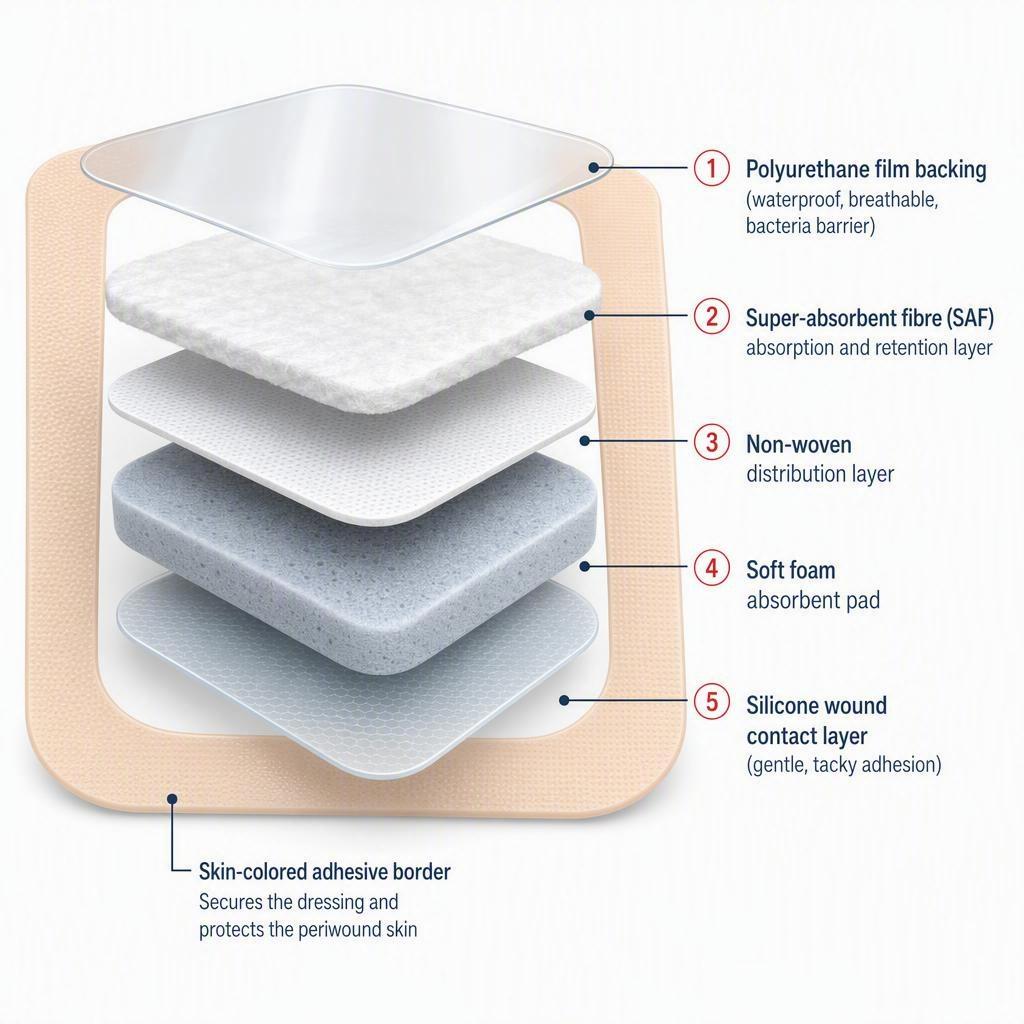
Layered structure of a bordered silicone foam dressing: polyurethane film backing, SAF absorption and retention layer, non-woven distribution layer, foam absorbent layer, and silicone wound contact layer — each layer corresponds to a different stage in the fluid handling chain described in the metrics above.
From Lab Metrics to Clinical Decisions
Understanding what the metrics measure is the first step. The next is knowing which metrics to prioritise for specific clinical problems and how to use standardised data to build defensible, protocol-grade dressing decisions.

Prevent leaks and maceration
Leaks and periwound maceration share the same upstream cause: fluid reached skin it should not have reached. The metrics most predictive of this failure are retention under compression and wicking direction.
Retention under compression determines how much fluid stays locked in the dressing rather than refluxing to the wound surface or migrating laterally when the patient moves, rolls, or receives compression therapy. In a prospective clinical evaluation of silicone foam dressings across venous leg ulcer patients, published in PMC (2024), the key performance parameters tracked by clinicians were exudate leakage to the margin, periwound maceration score, and dressing displacement — all of which are downstream consequences of retention failure.
Wicking direction matters for maceration prevention in a less obvious way. If wicking is effective within the absorbent core, incoming fluid spreads across the pad and reaches the retention layer uniformly. If wicking is inadequate or if the distribution layer is positioned incorrectly, fluid accumulates near the wound centre and the path of least resistance becomes lateral — toward the periwound skin. The peer-reviewed bench-to-bedside evaluation published in PMC (2025) used EN 13726:2023 FHC testing alongside fluid dispersion assessment and found that dressings with superior lateral spreading performed significantly better in real-world exudate containment.
Rewet adds the third protection layer. Once fluid is inside the dressing, low rewet prevents it from returning to the wound contact surface when the patient repositions or when the wound is assessed by pressing gently on the dressing. For periwound protection specifically, a dressing with high retention and low rewet provides the most reliable barrier.
A simple clinical rule follows: if leakage or maceration is the primary problem, prioritise retention under compression and rewet over headline FHC. A dressing with a lower FHC but superior retention under load will outperform a high-FHC dressing with poor compression performance at exactly the anatomic sites where body weight matters most.
⚠️ Warning: Requesting only a free-swell absorption figure from a supplier when selecting a dressing for sacral or heel use is the equivalent of requesting a car’s fuel tank size without asking whether the engine works under load. Retention under compression is a mandatory specification for pressure-point applications.
Extend wear time and workload impact
Wear time is an outcome of fluid handling capacity working as a complete system. Each component contributes:
FHC sets the ceiling on total fluid managed per 24-hour window, directly determining how many days the dressing can remain in place before saturation risk becomes the dominant driver of change decisions.
MVTR continuously frees headroom inside the structure by removing water as vapour, extending the effective service life beyond what static absorption capacity alone would predict.
Retention prevents early leakage-driven changes by keeping absorbed fluid locked away even as the patient moves and weight is redistributed across the dressing.
Rewet reduces unplanned changes triggered by moisture feedback to the wound surface or periwound skin.
The clinical and economic consequences of extended wear time are meaningful. A reduction in change frequency from three changes per week to two represents a 33 percent reduction in nursing time per wound — and nursing time is typically the dominant cost driver in wound care, not product cost. The economic analysis published in PMC (2024) estimated nursing time at 15 minutes per change for US wound clinic settings; even modest improvements in wear time translate to material cost differences at the system level.
What wear time metrics cannot guarantee: the label maximum. Every wear-time claim assumes that the exudate volume falls within the dressing’s capacity, that the seal remains intact, that the wound is not infected, and that periwound condition is stable. These are clinical judgement calls that belong to the nurse at the bedside, not to the datasheet. As a practical guide on when to change silicone foam dressings for heavy exudate summarises: shorten wear time when exudate approaches the seal, the edge lifts, or the periwound shows moisture damage — regardless of where the dressing is on its nominal schedule.
Selection and documentation (EN 13726-aligned)
The practical application of fluid handling metrics is a documentation task as much as a clinical one. For a ward protocol, a formulary committee review, or a value analysis submission, the metrics are only useful when the test conditions travel with the numbers.
The following framework structures the comparison:
Metric | What to request | Why the conditions matter |
|---|---|---|
FHC | g/100 cm² per 24 h, EN 13726 Annex E, Solution A, 37 °C | Without temperature and fluid identity, results are not comparable |
Free-swell absorption | g/g or g/100 cm², EN 13726 Annex B | Baseline capacity; separate from retention |
Absorption under compression | g per sample, defined load (kPa), EN 13726 Annex B variant | Must state applied pressure; omitting it renders the figure uninterpretable |
Fluid retention capacity | g retained after compression, EN 13726 Annex C | The reflux/backflow prevention metric; separate from absorption |
MVTR/MVL | g/m²/24 h, upright or inverted, EN 13726 Annex H or I | Upright and inverted values are not interchangeable |
Rewet | g, method stated | Low is preferred; ask for the applied weight and dwell time |
Wicking/dispersion | cm or area, method stated | Relevant for edge control assessment |
For each figure received from a supplier, the minimum usable entry in a comparison table is: metric name, value with units, standard and annex, test conditions, and the name of the accredited test laboratory or internal QC protocol.
Protocol design application. When designing a dressing protocol for moderate-to-heavy exudate wounds, the EN 13726 data bundle supports three decisions: threshold selection (minimum FHC to qualify for a given wound type), change-frequency guidance (MVTR and FHC together suggest the theoretical wear window, before clinical cues narrow it), and compression compatibility (absorption under compression and retention capacity determine whether the dressing is appropriate for use under bandaging or for dependent anatomy under body weight).
Value analysis application. A value analysis submission that includes EN 13726 data — with full test conditions — is structurally stronger than one that relies on marketing claims alone. When the methodology is transparent and reproducible, procurement can audit it. SLK Medical’s silicone foam dressing performance metrics checklist and scorecard provides a workable template for structuring supplier comparison data in a format that aligns with the EN 13726 framework and supports value analysis committee review.
Conclusion
The fluid handling metrics on a silicone foam dressing datasheet are not marketing numbers — they are the measurable outputs of a physical system. Each metric captures a different property of how a dressing manages exudate, and none of them is sufficient alone.
Balancing the metrics in practice:
FHC tells you the total fluid the dressing can manage; it is the starting point for exudate-volume matching.
Absorption under compression tells you whether FHC holds when the patient’s body weight or bandaging acts on the dressing.
Fluid retention capacity tells you whether absorbed fluid stays inside the structure rather than refluxing to the wound bed.
MVTR/MVL tells you how fast the backing film vents vapour — the mechanism that continuously frees internal capacity and extends wear time.
Rewet tells you how dry the wound-contact zone stays after the dressing has absorbed a load.
Wicking tells you whether incoming fluid spreads evenly across the absorbent pad or concentrates in one spot and risks early edge leakage.
No single number predicts clinical performance. High FHC with poor retention under compression fails at anatomic pressure sites. High MVTR with low retention may vent fluid quickly but allow reflux when compressed. A balanced dressing is one where all components of the throughput chain work together — acquisition, distribution, retention, and evaporation — under the actual conditions of use.
Using standardised data for protocol design and value analysis:
EN 13726:2023 provides the methodological language for comparing dressings across suppliers on a shared basis. The standard is most useful when the test conditions travel with every reported value: fluid identity (Solution A vs protein-containing), incubation period, applied load, MVTR orientation (upright or inverted), and testing laboratory. Without those conditions, two figures in the same column of a comparison table may not be measuring the same thing.
For institutions building formulary protocols or preparing value analysis submissions, the practical payoff is a selection framework that is auditable, replicable, and defensible — one that aligns with clinical need rather than marketing convention.
Key Takeaways
EN 13726:2023 defines fluid handling capacity as FHC = absorbed fluid + moisture vapour loss — it is a throughput metric, not a maximum storage figure.
Free-swell absorption and retention under compression are different measurements — both are required for dressings used at anatomic pressure sites.
MVTR orientation matters: upright and inverted cup methods yield different values; never compare one against the other across supplier datasheets.
Rewet and wicking are supporting metrics that determine periwound protection quality and early edge-leakage risk.
Any EN 13726 figure is only comparable when test conditions — fluid, temperature, load, orientation, incubation period — are stated alongside the number.
Use the metric bundle — FHC, retention under compression, MVTR, rewet, wicking — as a set when selecting dressings for moderate-to-heavy exudate or anatomic pressure sites.
Standardised, condition-matched data supports stronger formulary protocols and value analysis submissions than headline marketing claims.
This article describes laboratory measurement methods and general principles for interpreting wound dressing performance data. It is intended as educational context for clinical and procurement decision-making and does not replace the assessment and clinical judgement of a qualified healthcare professional. Dressing selection for individual patients should follow local formulary protocol and the recommendation of the attending clinician or wound care specialist.