If you need a transparent film that can stabilize an IV catheter while keeping the insertion site visible—or a clean, waterproof cover for light postoperative or low‑exudate wounds—this review breaks down where the SLK Medical Transparent Dressing fits. We examine real‑world use cases and outline when you should choose a film dressing versus step up to more absorptive options.
Verdict at a glance
The SLK Medical Transparent Dressing is a polyurethane film designed for IV catheter securement and light wound coverage where visualization matters. Based on category norms and manufacturer information, it emphasizes comfort and skin friendliness—via a high‑permeability coating and reduced adhesive contact area—plus stability features like rounded corners to reduce edge‑lift. Documentation gaps remain (e.g., published MVTR numbers, public IFU access), so we recommend facilities validate against local protocols before broad adoption.
-
Pros
-
Clear visualization window supports catheter site monitoring; waterproof barrier (per product category)
-
Comfort‑first design claims: higher breathability (HP coating) and ~50% adhesive contact reduction for gentler removal
-
Rounded corners and delivery design aimed at minimizing edge‑lift and improving handling
-
-
Cons
-
Public technical documentation appears limited (sterilization method, ISO 10993 labeling, numeric MVTR not surfaced on the non‑pad page)
-
No public price list; purchasing is inquiry/quote based
-
Viral barrier claims are not stated on SLK’s public page; facilities that require virus-specific barrier statements should request the full IFU and supporting test documentation during evaluation
-
Who should—and shouldn’t—use a transparent film dressing
Transparent films, including the SLK Medical Transparent Dressing, are well‑suited for:
-
IV catheter sites where you need continuous visualization and a waterproof cover.
-
Postoperative incisions and shallow wounds with low exudate, where moisture balance and a clean barrier are priorities.
-
Skin protection and friction shielding over intact skin or as a secondary cover over gels/ointments.
Avoid or reconsider films when:
-
Exudate is moderate to heavy, or active bleeding/ooze is present. Consider stepping up to absorptive options like foam or hydrocolloids—or gelling fiber for fluid handling—based on clinical judgment. For context, see SLK’s overview resources on options such as the Gelling Fiber Dressing and educational roundup Top 10 Wound Care Dressing Supplies.
-
The site is contaminated, macerated, or shows infection signs—follow your facility’s protocols.
According to the Centers for Disease Control and Prevention, transparent semipermeable dressings may be used over catheter insertion sites and should be replaced if damp, loosened, or soiled; otherwise, change intervals are typically up to 7 days, with exceptions for certain patient populations. See the CDC’s guidance in the intravascular catheter section for detailed context: the prevention strategies overview is summarized in the agency’s page on intravascular catheter‑related infection prevention strategies.
How we evaluated (methodology and evidence tiers)
To keep this review practical and trustworthy, we separate three evidence layers:
-
Tier 1: Verifiable facts from official manufacturer pages/IFUs and authoritative bodies.
-
Tier 2: Hands‑on tests (planned/partial) with reproducible setups for peel/shear adhesion, edge‑lift after flexion, shower/ingress checks, breathability proxies, usability timing, and skin tolerance.
-
Tier 3: Aggregated user feedback (not employed here due to linkable‑source limitations).
Planned/partial Tier‑2 protocol overview (standardized across brands):
-
Adhesion & securement: 180° peel force with a handheld force gauge; shear creep under 200 g load; edge‑lift count after 50 elbow flexions.
-
Waterproofness & barrier integrity: 5‑minute shower exposure; colored‑dye ingress check under a gauze proxy.
-
Breathability proxy: Under‑film humidity/temperature logger deltas over 2 hours; maceration signs after 8 hours.
-
Usability & visibility: Timed application around a simulated IV site; glove‑on handling; visibility rating.
-
Skin tolerance: 24–48‑hour patch test on healthy volunteers for erythema/itch scoring; residue noted at removal.
Status: Where specific numeric outcomes are not published here, treat as Insufficient data pending full test runs and artifact publication. We also note that MVTR comparisons across brands can be misleading unless measured under identical methods; see the EN 13726 variability discussion in this methods review on MVTR test method differences and comparability caveats.
What stands out about the SLK Medical Transparent Dressing
The SLK Medical Transparent Dressing focuses on two things clinicians consistently care about at IV sites and light postoperative covers: comfort and stability.
-
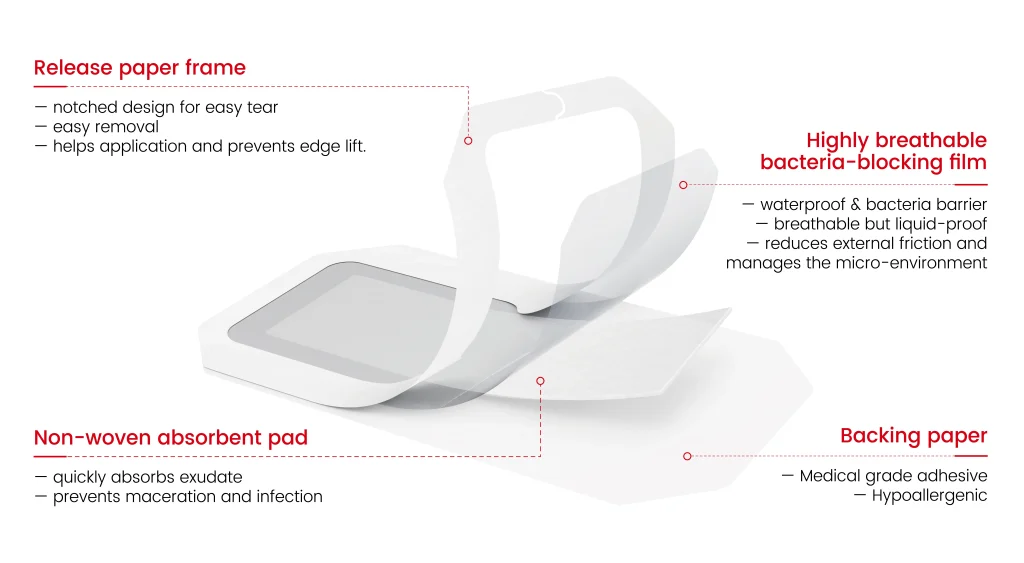
Comfort and skin tolerance: The product information highlights an HP high‑permeability coating intended to improve air exchange, along with an approximately 50% reduction in adhesive contact area to ease removals. While we await quantified, method‑matched MVTR data, these design choices align with lower maceration risk in principle for low‑exudate sites.
-
Stability and ease of use: Rounded corners help resist edge‑lift—a common failure mode during elbow/wrist motion and showers. The transparent window supports continuous visualization of the catheter insertion site or incision line, and delivery design elements are intended to aid placement and reduce handling errors.
-
Options and coverage: Multiple sizes are available to match common IV and wound coverage needs. For dressings that include an absorbent pad, SLK offers a variant—useful when you want a little cushion without switching categories; see the related Transparent Dressing with Pad.
Product page: See SLK’s official listing for details and inquiry workflow: SLK Medical Transparent Dressing.

How it compares with other transparent film dressings
When you evaluate any transparent film dressing for IV securement or low‑exudate coverage, it helps to use the same decision dimensions across brands.
Two quick notes on fairness:
-
Feature implementations differ (for example, some products use frame-style delivery or printed grids), so it’s best to map those details onto the same decision dimensions.
-
Published MVTR numbers are method‑dependent and often not cross‑comparable unless measured side‑by‑side under identical protocols.
Here’s a practical checklist you can use during product trials:
-
Barrier integrity: Does it maintain a reliable seal during showers and daily movement? Replace sooner if damp, loosened, or soiled.
-
Skin tolerance: Any erythema, itching, or adhesive residue after 24–48 hours?
-
Securement & edge‑lift: How often do corners lift after flexion at elbows/wrists?
-
Usability: Application time with gloves, re-positionability, and visibility of the insertion site.
-
Documentation: Availability of IFU, sterility method, biocompatibility statements, and any barrier testing claims required by your policy.
Application tips for IV sites and small wounds
-
Prepare the skin per protocol; ensure the area is clean and dry. If the site is oozing, consider gauze or a more absorptive primary dressing rather than a film.
-
For IV securement, align the transparent window to keep the insertion site fully visible; avoid tension or wrinkles that can lead to early edge‑lift.
-
Activate the adhesive with gentle pressure around the periphery, especially near the catheter hub or tubing.
-
Document date/time as required on the label strip; assess the site daily. Replace the dressing sooner if it becomes damp, loosened, or soiled, consistent with CDC prevention strategy guidance for intravascular catheters.
Think of it this way: your goal is a consistent, intact seal that allows you to see what matters without trapping excess moisture.
Procurement notes (sizes, packaging, and value)
SLK lists multiple sizes commonly used for IV sites and incision covers (for example, around 6×7 cm, 10×12 cm, and larger formats). Boxes typically hold 25–50 units depending on size. Sterile packaging and lot/expiry labeling are standard in this category; however, some technical particulars (e.g., sterilization method and explicit biocompatibility markings) were not readily visible on the public product page during this review—request the IFU and regulatory dossier from the vendor as part of evaluation. Because SLK operates on an inquiry/quote model, buyers should compare price‑per‑piece and expected wear time against incumbent brands under local protocols.
If you anticipate occasional light exudate or want a small cushion without switching categories, check the related Transparent Dressing with Pad. For persistently moist sites, plan escalation paths to foam, hydrocolloid, or gelling fiber options according to policy.
FAQs
-
Can patients shower with the SLK Medical Transparent Dressing in place?
- Transparent films are designed as waterproof barriers when fully intact and properly sealed. Ensure edges are well adhered; replace the dressing if you observe lifting afterward.
-
What’s the typical wear time?
- Follow your facility protocol. Transparent dressings at catheter sites are commonly changed at routine intervals and earlier if damp/loosened/soiled, as summarized in CDC guidance for intravascular catheters.
- Is there a difference between SLK’s transparent film with and without a pad?
- Yes. The pad variant offers a small absorbent island and cushioning; the non‑pad film maximizes visualization and conformability. Match the variant to exudate level and monitoring needs.
-
Can SLK Medical’s transparent dressings be used for showering?
- Yes, our dressings feature a waterproof PU backing that allows patients to shower. But strenuous exercises such as swimming are not recommended.
-
What certifications do SLK transparent dressings hold?
-
Our full range of transparent film dressings is certified under CE MDR (EU), FDA (USA), and ISO 13485, meeting the highest global safety standards. You can ask for free samples.
-
Do you support custom private labels for OEM orders?
-
Yes. As a professional manufacturer, we offer custom dimensions, die-cutting shapes, and private label packaging tailored to your brand’s needs.
Bottom line
The SLK Medical Transparent Dressing is an evidence‑minded option for two high‑value scenarios: stabilizing IV sites with continuous visualization and covering light postoperative or low‑exudate wounds. It stands out for comfort‑oriented design (breathability focus and gentler removals) and anti‑edge‑lift geometry. Competing options from 3M and Smith+Nephew bring deep documentation and specialized IV variants; your choice should reflect local protocols, documentation needs, and recurring skin‑tolerance issues in your population.
If you’re evaluating film dressings now, review SLK’s official product information and request technical documentation: SLK Medical Transparent Dressing.