


Periwound maceration rarely shows up because someone “forgot” a dressing. It shows up when fluid handling fails in a specific way: too much exudate, too little retention under pressure, an occlusive layer that traps moisture, edge lift that lets fluid creep onto skin, or a strike-through response that’s reactive instead of protocol-driven.
This best-practice guide is written for cross-functional teams (wound care, value analysis, procurement, and quality). It focuses on four technical levers you can actually specify and validate (with citations referenced later in the article):
Absorbency curves (uptake over time)
Retention under compression (backflow risk)
MVTR/WVTR (evaporation and moisture balance)
Strike-through behavior and response protocols
Clinical note: This article is educational and procurement-oriented. Always follow local clinical policy and each product’s IFU, and consult qualified clinicians for patient-specific decisions.
Key takeaways
Maceration prevention is a system: dressing selection + periwound protection + fixation + monitoring.
Don’t treat “absorbency” as one number. For silicone foam, the failure modes that drive maceration are often pooling, edge leakage, and backflow under compression.
MVTR matters, but test method and conditions matter just as much; ask vendors to disclose both.
Strike-through should trigger a standard response playbook, not just more frequent changes.
Definitions you’ll need (and what they mean operationally)
Periwound maceration (a MASD pattern)
Periwound maceration is moisture-associated skin damage (MASD) at the wound edge caused by prolonged exposure to fluid and irritants—often with friction/shear as a co-factor. A structured MASD prevention approach commonly includes gentle cleansing, restoring/protecting the barrier, and minimizing further moisture exposure; barrier films/ointments are frequently recommended tools within that toolkit (see the 2017 MASD scoping review, cited in the references section).
Strike-through
Strike-through is when exudate reaches the outer surface/edges of the dressing (or leaks beyond it), increasing contamination risk and—practically—exposing periwound skin to ongoing moisture.
MVTR/WVTR
Moisture vapor transmission rate (MVTR) describes how much vapor passes through a dressing over time. It’s a useful proxy for “breathability,” but values can vary greatly by test setup (upright vs inverted), making apples-to-apples comparisons risky unless the method is stated.
Why silicone foam can prevent maceration—and how it can fail
This section is the core of exudate management with silicone foam in practice: it explains what to measure, what to monitor, and what to change when the system fails.
Silicone foam dressings are often selected for moderate-to-high exudate because they can combine:
a gentle contact layer (to reduce skin trauma during changes),
an absorbent foam core (for uptake and retention), and
a vapor-permeable backing (for moisture management).
But in practice, “foam failure” tends to look like one of these:
Pooling: fluid remains at the wound interface when the dressing is removed.
Edge leakage: fluid escapes at borders due to seal/fixation issues or insufficient margin.
Backflow under compression: fluid is expressed back toward the wound/periwound when pressure is applied (e.g., patient positioning, compression garments).
A 2024 engineering-focused review (with clinically grounded failure modes) emphasizes that fluid handling depends on variables like exudate viscosity, gravity, and compression, and that leakage/pooling/backflow are key outcomes to evaluate—not just “total absorbency” (see the 2024 review cited in the references section).
Best practice 1: Specify absorbency curves in exudate management with silicone foam
Why this matters
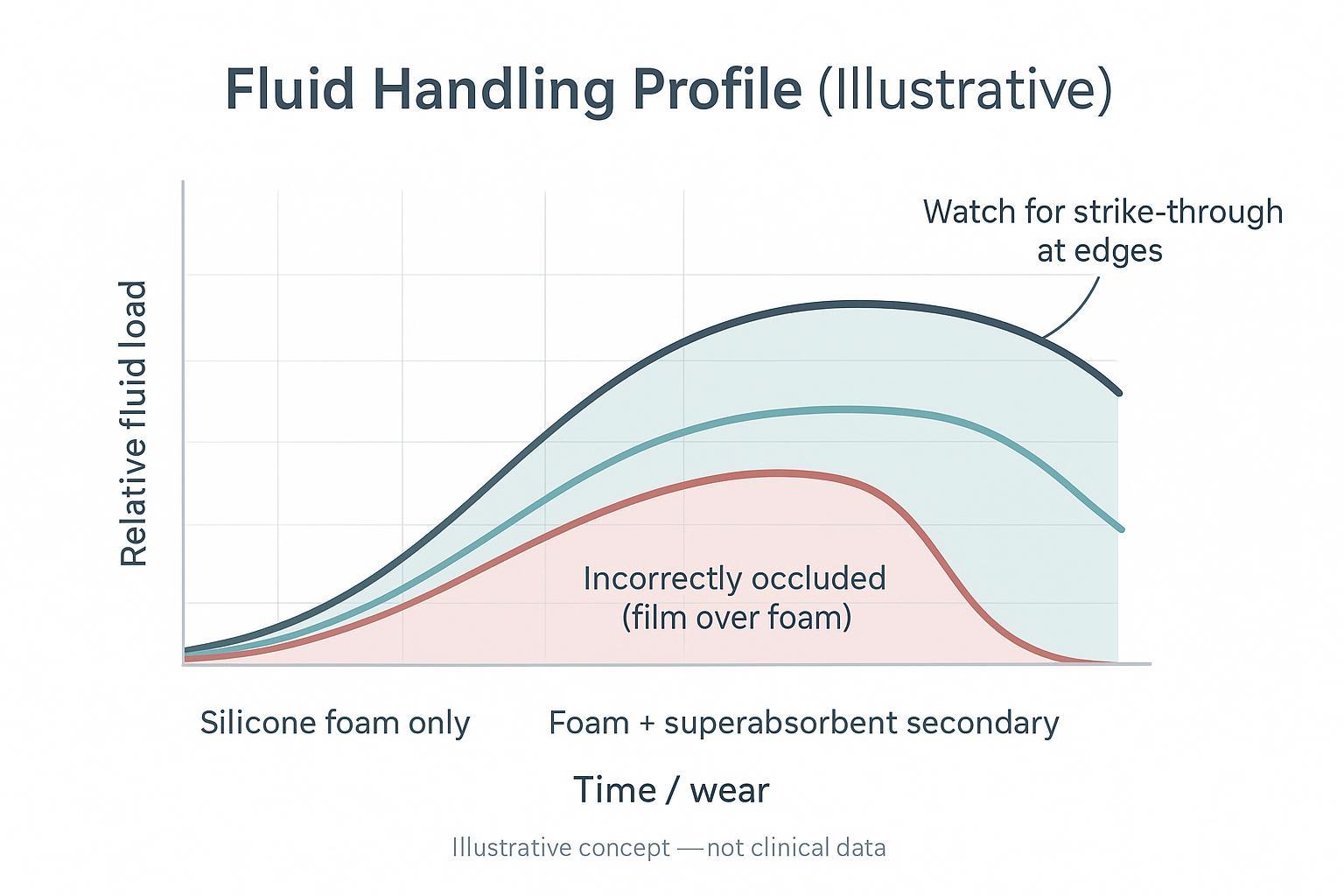
Two products can both claim “high absorbency,” but behave differently over wear time:
one may take up fluid quickly but release it under pressure,
another may absorb slower but retain better,
another may handle vapor well but be overwhelmed by high flow rates.
How to implement
Use a procurement-friendly checklist when comparing absorbency performance:
Request uptake over time (e.g., first 30–60 minutes vs 24 hours).
Ask for retention after compression (backflow/reflux testing) and the applied pressure used.
Ask whether testing used simulated wound fluid (protein-containing) vs water, and the flow rate.
Failure mode if you don’t
You’ll see “mysterious” maceration despite frequent changes—because the dressing is behaving like a sponge that can’t hold what it collects when conditions change.
Example
If the wound is in a location exposed to pressure/shear (sacrum, heel, lateral malleolus), prioritize retention-under-pressure disclosures over generic “capacity” claims.
Best practice 2: Treat MVTR as a method-dependent parameter (and document the method)
Why this matters
MVTR is often used as shorthand for moisture balance. But MVTR numbers can shift dramatically depending on whether the dressing is tested in an “upright” (vapor-only) vs “inverted” (in contact with liquid) configuration. The 2021 comparison paper shows the correlation between methods is not consistent across dressings, which is a practical warning against vendor-to-vendor MVTR comparison without method disclosure (details in the References section).
How to implement
Add these lines to your evaluation template:
“Report MVTR/WVTR test standard, orientation (upright/inverted), temperature, RH, and duration.”
“Provide MVTR results under wet and dry conditions when available (adaptive behavior is often more informative than a single value).”
Failure mode if you don’t
Teams may unintentionally select a configuration that is overly occlusive (raising maceration risk) or overly evaporative (risking desiccation and delayed healing), based on a single number taken out of context.
Example
If a film is used over an otherwise vapor-permeable dressing, it may reduce the system’s effective vapor transmission. Document when fixation methods materially change breathability.
Best practice 3: Use a layering protocol for high-exudate scenarios (don’t “wing it”)
Why this matters
When exudate load is high, a single silicone foam layer may not provide enough “buffer” before strike-through—especially when fluid dynamics shift (temperature, viscosity, gravity, compression). Layering can increase total fluid handling without changing the wound-contact interface.
How to implement
Adopt a simple, neutral layering protocol (customize to local policy):
Primary: silicone foam as the wound-contact dressing when clinically appropriate.
Periwound protection: apply a thin barrier film (per local formulary) on intact periwound skin if maceration risk is high.
Secondary (when needed): add a superabsorbent secondary layer when exudate rate/volume or prior strike-through history indicates overload.
Fixation: choose fixation that maintains seal without excessive skin trauma; confirm edges are secure.
Monitoring: set a reassessment checkpoint (e.g., first 24 hours) to validate wear time and periwound condition.
Failure mode if you don’t
You’ll end up in a high-friction cycle: unplanned changes, adhesive trauma, escalating periwound dermatitis—and cost increases that never show up in unit price comparisons.
Example
When procurement and clinical teams align on “when to add superabsorbent,” variation drops and so do unplanned changes.
Best practice 4: Make strike-through a trigger for a response playbook
Why this matters
Strike-through isn’t just a “mess” event. It’s a signal that one or more elements of the system has failed: size margin, seal, absorption/retention, secondary capacity, or an underlying clinical change.
How to implement
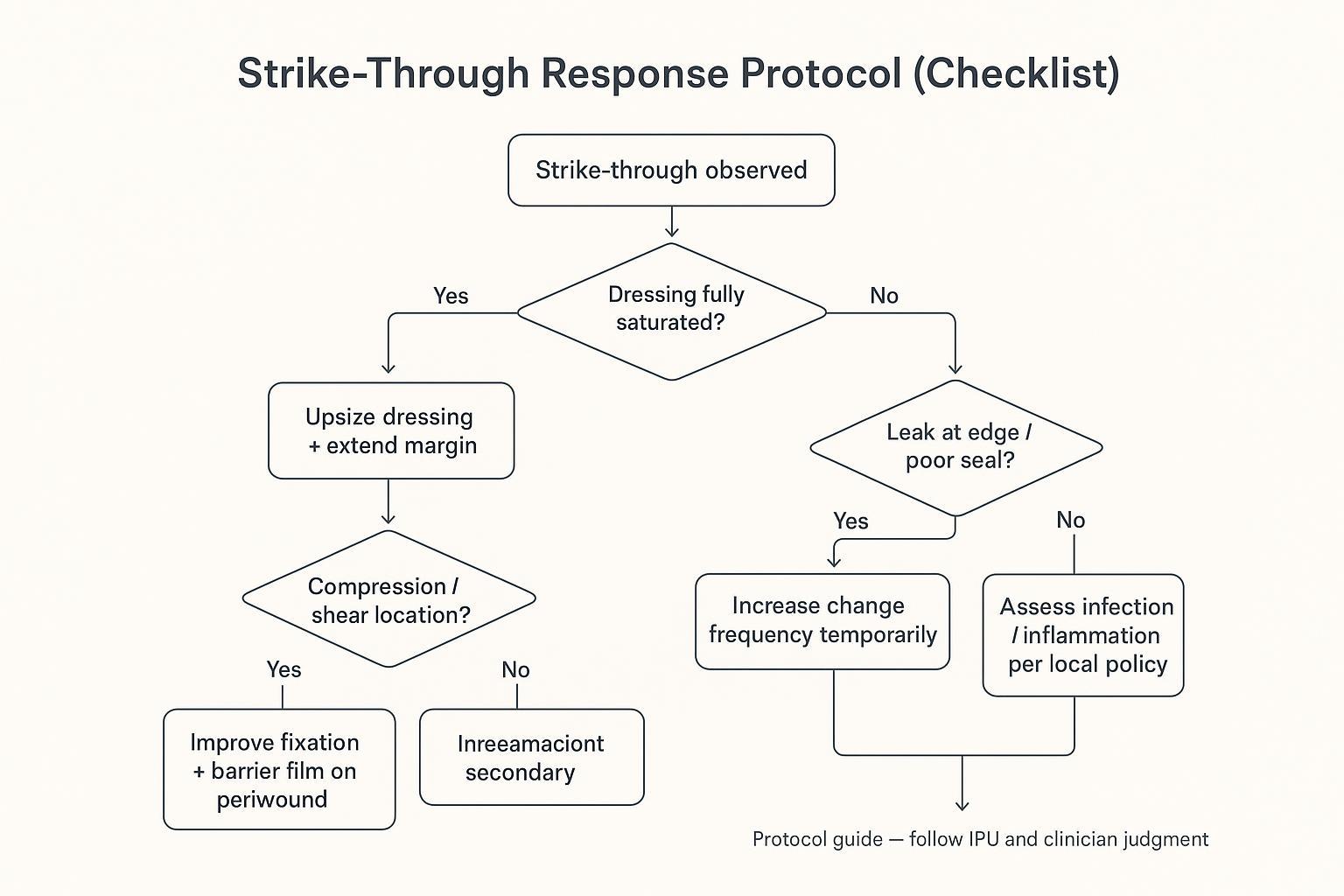
Use a response protocol that changes the right variable first:
If the leak is at the edge: upsize and extend margin; improve fixation; consider barrier film on intact periwound.
If the dressing is saturated: add secondary superabsorbent, reassess change frequency, and consider whether the current dressing category fits the exudate load.
If exudate changed suddenly: reassess for inflammation/infection per local policy.
Failure mode if you don’t
Teams default to “change more often,” which can increase skin trauma and workload without addressing the underlying mismatch.
Example
A standardized strike-through pathway can be used as part of trial evaluation: if repeated strike-through occurs, document which corrective steps were taken and whether performance stabilized.
Procurement checklist: what to ask vendors to disclose (so you can compare responsibly)
Use this as a neutral request-for-information (RFI) checklist:
Absorbency / uptake
Uptake over time (curve preferred) and test conditions
Retention / backflow under compression
Pressure used, duration, and reported reflux/backflow behavior
Leakage and pooling
Any available data on pooling, edge leakage, or strike-through under realistic orientation (gravity)
MVTR/WVTR
Standard/method, orientation, temperature, RH, and wet/dry conditions
Wear-time protocol assumptions
How wear time was validated (if claimed) and what triggers early change
Skin-interface considerations
Adhesive/contact layer design for fragile skin and how it affects removal trauma
Quality and compliance
Manufacturing controls and documentation needed for US/EU procurement (e.g., traceability, ISO 13485 documentation set)
Internal resources (slkmedical.com):
Category hub: silicone foam dressings.
Exudate-management framing: bordered foam dressings vs traditional options.
Selection by fluid load: choosing the right foam dressing based on exudate levels.
Metrics/buying-guide framing: bordered silicone foam dressing comparison buying guide.
Example product page: silicone foam dressing with border.
(Use internal pages as context and navigation; rely on peer-reviewed/consensus sources for clinical evidence.)
Implementation checklist (neutral, protocol-ready)
Document baseline exudate level (low/moderate/heavy) and periwound risk (maceration history, fragile skin, shear zone)
Select dressing type and size with an explicit margin plan (edge containment)
Choose fixation method that maintains seal without repeated skin trauma
Apply periwound barrier protection when risk is high (per formulary)
Define a strike-through response pathway (who does what, within what timeframe)
Reassess at first change: periwound condition, leakage sites, saturation pattern
Where SLK Medical fits (neutral)
For teams sourcing private-label or OEM options, a manufacturer like SLK Medical can support evaluation by providing method-disclosed performance documentation (absorption/retention/MVTR context) and format options (bordered/non-bordered, sizing, packaging) aligned to your trial protocol.
To keep procurement comparisons fair, ask for test conditions and methods—then evaluate results alongside trial observations (unplanned changes, periwound condition, and staff time).
Next step (soft CTA)
If you want, you can share your target wound types, typical exudate levels, and preferred wear-time protocol—then request a neutral RFI checklist pack (absorption/retention/MVTR disclosure template + strike-through response sheet) suitable for your value analysis file.
References (selected)
The 2024 review on foam dressing fluid handling and failure modes
The 2021 paper comparing MVTR test methods (upright vs inverted)
(Optional additional context) A 2013 study comparing MVTR and fluid handling among adhesive foam dressings
The 2017 scoping review on MASD prevention and barrier strategies
Wounds International: best practice recommendations for MASD (PDF)


