


Introduction
For distributors selling into the US and EU, 2026 changes what “qualified supplier” means.
About the manufacturer (example): SLK Medical is a wound care dressing manufacturer. For any specific product family you plan to distribute, request evidence of the applicable certifications/market authorizations (e.g., ISO 13485 certification scope; applicable EU CE marking under MDR where relevant; and US regulatory status as applicable).
In the US, FDA’s Quality Management System Regulation is now in effect and aligns Part 820 to ISO 13485:2016.FDA’s QMSR FAQs, updated 2026 FDA also states that ISO 13485 certification does not exempt a manufacturer from FDA inspection.
In the EU, the MDR transition timeline is still a risk area. If an OEM is relying on legacy certificates, you need evidence that the device is eligible under Regulation (EU) 2023/607, not just a promise.
What to verify first, before pricing or samples:
Market access role: who is the legal manufacturer in each market, and who owns post-market obligations.
Classification: how the dressing is classified, and what drives that classification (intended use and claims).
Documentation: what exists now for the exact SKU you will distribute.
UDI/labeling scope: who controls label artwork, UDI data, multilingual IFUs, and change control.
This guide helps you turn those checks into a shortlisting scorecard that cuts customs risk and reduces quality escapes.
Key Takeaway: In 2026, “ISO 13485 certified” is not the same as “audit-ready for your SKU set.”
Regulatory checkpoints (US/EU 2026)
For a medical foam dressings OEM, this section is your first pass/fail gate.
Treat regulatory posture as a gate. If the OEM cannot pass this cleanly, don’t move forward to operational negotiations.
FDA QMSR alignment and responsibilities
Anchor your US vetting on what FDA can actually inspect. The effective date and legal basis are laid out in FDA’s QMSR final rule (Federal Register, 2024).
Fast document requests that reveal maturity:
QMS architecture (quality manual + process map) and how it is maintained
complaint handling + CAPA workflow, with redacted examples of closed CAPAs
supplier controls for critical inputs (materials and outsourced processes)
labeling and packaging release controls (who checks what, and when)
If responsibilities are “shared” but no one can show a quality agreement or RACI, assume delays when a complaint lands.
US classification and 510(k) status
For a medical foam dressings OEM, classification is driven by intended use and claims. Treat antimicrobial variants as higher scrutiny.
Your practical verification loop:
Ask for the OEM’s US regulatory summary per SKU family: intended use, key claims, and referenced pathway.
If the OEM references a 510(k), verify it in FDA’s releasable 510(k) database search (search by device name, product code, or 510(k) number).
Confirm the 510(k) scope covers the configuration you will private label (materials, design features, antimicrobial positioning, packaging/sterility claims).
EU MDR Rule 4 and 2023/607 transition
Under EU MDR, many wound dressings are classified under Rule 4 because they are non-invasive devices that contact injured skin. The class logic is summarized in the European Commission’s MDCG 2021-24 Rev.1 classification guidance:
Practical accuracy tip: ask the OEM to point you to the exact section(s) in its classification rationale that map intended purpose/claims, wound depth, and mechanism of action to Rule 4 logic (and keep that mapping in your distributor file).
Class I: mechanical barrier / compression / absorption of exudates
Class IIa: principally intended to manage the micro-environment (and “all other cases”)
Class IIb: principally intended for injuries breaching the dermis that can only heal by secondary intent
In 2026, the operational question is often transition status. The European Commission’s Q&A on Regulation (EU) 2023/607 (2023) explains the conditions tied to QMS, notified body application, and written agreement timing.
What to request for your distributor file:
current certificate(s) and scope for the exact device family and variants
an MDR transition status statement per family (not a generic company statement)
change control summary confirming no “significant changes” that could break transition eligibility
Quality, safety, and validation evidence (medical foam dressings OEM)
For a medical foam dressings OEM, validation evidence is what keeps your program out of the recall-and-relabel spiral.
This is where you separate “we can manufacture it” from “we can consistently release it.” Ask for evidence tied to the exact configuration you will distribute.
ISO 10993 biological evaluation mapping
Request a structured mapping, not standalone test PDFs:
biological evaluation plan/report tying materials and patient-contact profile to ISO 10993 endpoints
material/specification control and what triggers re-evaluation (supplier change, formulation change, process change)
Red flag: “We have ISO 10993” with no contact-type/duration rationale for your specific product.
Sterilization validation (ISO 11135/11137)
If the product is supplied sterile (or you plan to private label a sterile variant), verify:
sterilization modality and who is responsible (OEM vs contract sterilizer)
validation summary aligned to the applicable standard (commonly ISO 11135 for EO or ISO 11137 for radiation)
routine monitoring, release criteria, and how capacity is managed during demand spikes
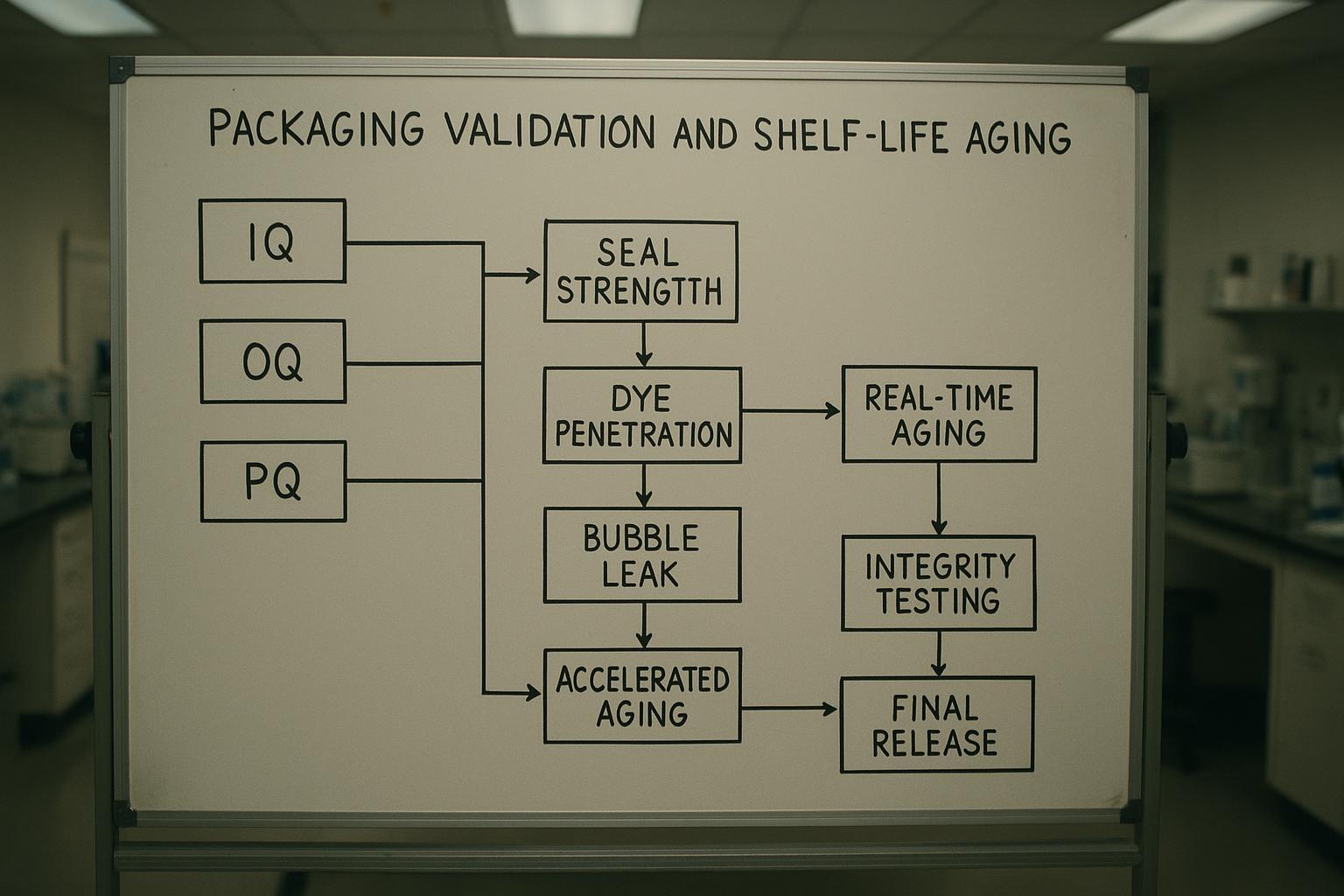
Packaging integrity and shelf life (ISO 11607, ASTM)
Packaging is a frequent root cause of field issues and customs holds. Ask for:
packaging validation summary aligned to ISO 11607 expectations
shelf-life rationale (accelerated and/or real-time aging) tied to integrity performance
distribution simulation and integrity testing approach (ASTM methods are commonly used)
Operations and private‑label readiness
Even a strong compliance package can fail distribution if operations cannot execute your SKU mix, labeling control, and service expectations.
MOQ, lead times, and sterilization capacity reality
Treat this as a capacity conversation. Ask for MOQs and lead times by:
size/shape and whether it is bordered vs non-bordered
packaging format (pouch/carton), language set, and whether it is sterile
forecast ramps and the constraint (materials, conversion, or sterilization slots)
If the OEM cannot explain where sterilization time and release testing fit into lead time, assume the first surge will break the plan.
UDI, labeling, and multilingual IFUs control
For distributors, labeling is a high-frequency compliance failure mode.
Confirm:
label artwork approval and version control (including who signs off)
UDI data ownership and update workflow
translation and IFU change propagation (and how old stock is handled)
A simple stress test: ask the OEM to walk you through its last three label/IFU changes and show the approval trail.
SLAs, OTIF targets, and CAPA responsiveness
Put performance expectations in writing:
OTIF definitions (on time / in full) and what counts as an exception
complaint response windows, containment expectations, and CAPA closure targets
escalation path and named owners
Audit-ready example (neutral): a manufacturer like SLK Medical may be asked to demonstrate that private-label silicone foam (including silver and super-absorbent variants) is supported by an ISO 13485/QMSR-aligned QMS plus validation files commonly requested for wound dressings, such as biocompatibility mapping (ISO 10993), sterilization validation (ISO 11135/11137 when applicable), and packaging validation/shelf-life work aligned to ISO 11607, along with documented labeling/UDI change control.
For background resources, SLK Medical’s site includes a Silicone foam dressing guide, a silver foam dressing comparison, and a representative SKU page such as silicone foam dressing with border.
Compliance note, sources, and update log
This guide is for distributor due diligence and quality planning; it does not constitute legal or regulatory advice. Always validate requirements for your exact SKU, intended use/claims, and target market(s).
Regulatory & standards reference index (public)
Topic | Primary reference | Identifier / version | What to verify in practice | Access date |
|---|---|---|---|---|
FDA QMSR (US) | FDA QMSR FAQs | Web page (QMSR) | Confirm FDA inspection expectations; ISO 13485 certification does not replace FDA oversight | 2026-06-03 |
FDA QMSR legal basis | Federal Register (Final Rule) | 89 FR 7496 (Feb 2, 2024) | Effective date and alignment of 21 CFR Part 820 with ISO 13485:2016 | 2026-06-03 |
510(k) verification | FDA database | Releasable 510(k) search | Verify predicate/clearance scope matches private-label configuration and claims | 2026-06-03 |
EU MDR classification | European Commission / MDCG | MDCG 2021-24 Rev.1 | Confirm Rule 4 logic and rationale aligns with intended purpose and wound depth/secondary intent | 2026-06-03 |
MDR transition extension conditions | European Commission Q&A | Regulation (EU) 2023/607 Q&A | Confirm eligibility conditions are met (QMS in place, notified body steps, written agreement timing, no disqualifying significant changes) | 2026-06-03 |
Biocompatibility evaluation | ISO | ISO 10993 series | Map endpoints to contact type/duration; document triggers for re-evaluation after changes | 2026-06-03 |
EO sterilization (if sterile) | ISO | ISO 11135 | Validate EO process validation and routine monitoring; confirm responsibilities (OEM vs contractor) | 2026-06-03 |
Radiation sterilization (if sterile) | ISO | ISO 11137 | Validate dose setting/verification and routine monitoring; confirm release criteria | 2026-06-03 |
Packaging validation | ISO | ISO 11607 | Validate packaging system, sealing, distribution simulation, and integrity testing | 2026-06-03 |
Package integrity tests (examples) | ASTM | Various ASTM methods | Confirm test method(s) used match package type and distribution profile | 2026-06-03 |
Update log
2026-06-03: Initial publication; references verified and indexed for US FDA QMSR and EU MDR transition context.
Conclusion
In 2026, the red flags that tend to blow up distributor programs are consistent:
ISO 13485 used as a substitute for evidence (FDA is explicit that certification doesn’t replace oversight)
validation gaps (sterilization, packaging integrity, shelf life, and material change control)
labeling errors (UDI scope confusion, uncontrolled artwork changes, multilingual IFU mistakes)
A practical weighting model for shortlists:
regulatory posture + document completeness (40%)
validation evidence depth (30%)
labeling/UDI/IFU control (15%)
operations performance and responsiveness (15%)
Document checklist to request before approval:
QMS map + recent internal audit and management system review evidence
classification rationale (US/EU) + MDR transition status where applicable
technical documentation index and change control summary
ISO 10993 biological evaluation mapping tied to your configuration
sterilization validation summary (ISO 11135/11137 when relevant)
packaging validation + shelf-life integrity rationale (ISO 11607 aligned)
label artwork control + UDI ownership + multilingual IFU workflow
complaint handling + CAPA SOP + response-time SLA
Next steps: Ask for a document pack that mirrors the checklist above plus a sampling plan tied to your launch markets and label language set.


