Published: 2026-06-17
Last reviewed: 2026-06-17
Version: 1.0
Author: SLK Medical Content Team
Medical review: Independent Clinical Reviewer (WOC nurse/MD), 2026-06-17.
Introduction
Procurement teams are often given two inputs that don’t naturally fit together: clinical guidelines (high-level principles) and tender mechanics (SKU lists, change intervals, documentation packs, KPIs). The gap between them is where variability—and avoidable cost-in-use—shows up.
This article translates guideline principles into an operational pathway for stage-based pressure injury management that distributors can use to:
Decide when to deploy silver antimicrobial dressings as a time-limited intervention (and when to stop).
Match absorption capacity to the wound’s exudate load, including when to step up from foam to superabsorbent/SAP solutions.
Standardize change-frequency ranges and step-down logic for consistent, auditable practice.
Scope note: This is not a bedside procedure guide. Dressing decisions must be made by qualified clinicians, aligned with local regulations and the product’s IFU.
Disclosure (commercial relationship): This article is provided by SLK Medical (a manufacturer/OEM/ODM supplier of advanced wound dressings). It is intended for procurement and distributor operations and does not replace clinical judgment. Product examples are included to illustrate pathway-ready category planning, not to recommend any specific product for any individual patient.
Editorial independence: The clinical principles summarized here are based on publicly available guidelines and references cited in the text. Where local protocols or a product’s IFU differ, follow local requirements and the IFU.
Stage-based pathways
Stage 1 (protect/offload)
At Stage 1, skin is intact. Your pathway priority is risk control, not absorption.
Operational pathway
Protect and offload: Build this into the pathway as a default action, not an “if time allows.” The WHS guideline update emphasizes pressure redistribution/support surfaces as foundational to treatment decisions (WHS 2023 guideline update on pressure ulcer treatment).
Protect the skin barrier and microclimate: Standardize a prophylactic “protective dressing + barrier” option for at-risk bony prominences and device interfaces.
What goes wrong if you don’t operationalize it
Without a Stage 1 protect/offload module, teams compensate by “up-dressing” later stages—driving cost and change frequency rather than preventing deterioration.
Stage 2 (moisture balance)
Stage 2 typically introduces superficial skin loss and may bring light-to-moderate exudate. Your pathway priority is moisture balance plus skin protection.
Operational pathway
Use foam as the baseline absorber: Silicone foam dressings are commonly used to protect peri-wound skin while managing light-to-moderate exudate.
Define escalation triggers: If a standard foam is saturating quickly, leaking, or driving peri-wound maceration risk, that’s a pathway signal to step up fluid handling (not just to shorten change intervals).
Failure mode to watch
Stage 2 often becomes “high change frequency” simply because absorption is underspecified. A pathway should make it easy to switch absorption capacity without needing a new approval cycle.
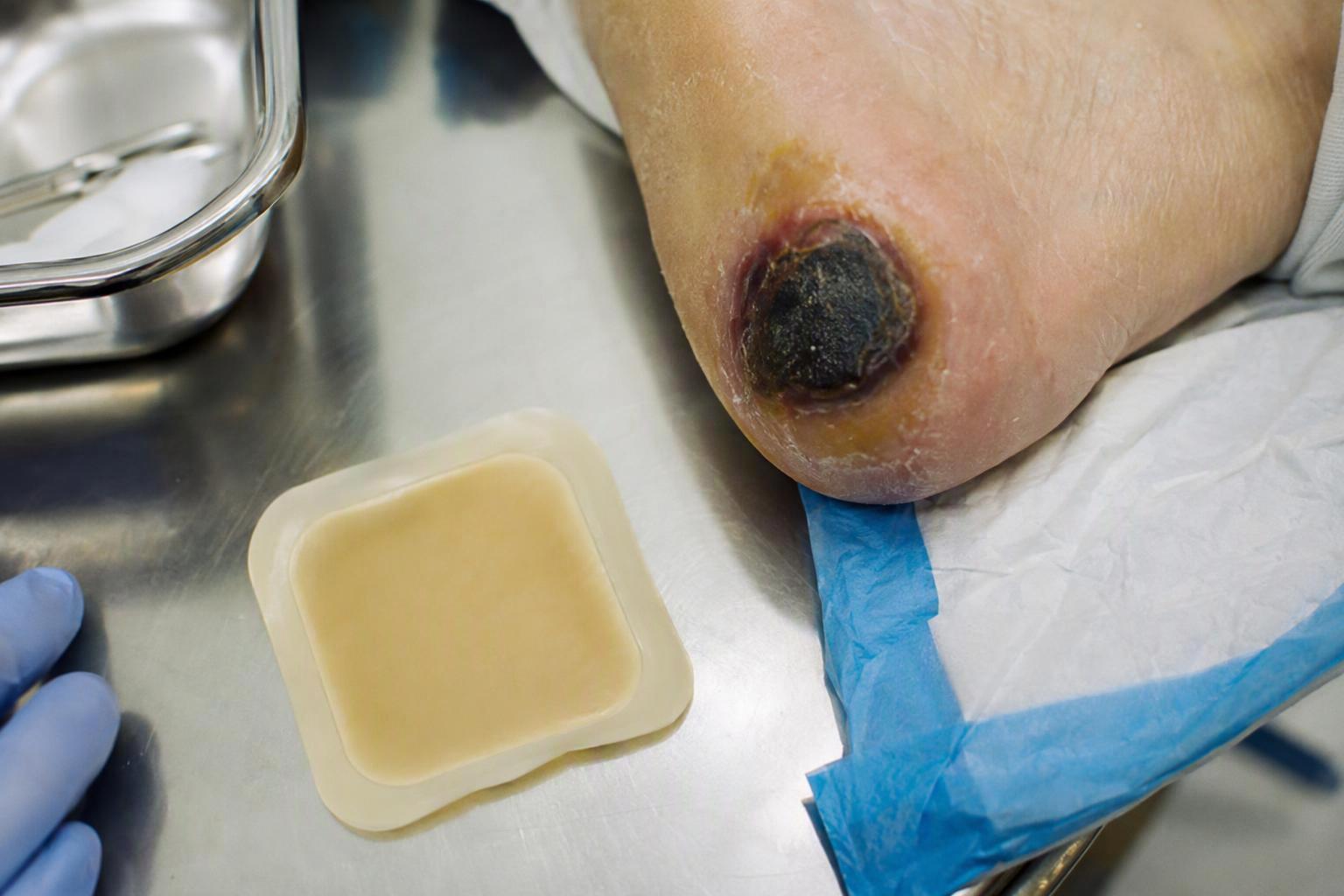
Stage 3–4/unstageable (debride, match exudate)
As depth increases, the pathway must become more explicit about tissue status (slough/necrosis), infection risk, and exudate load. A 2025 review summarizing stage- and exudate-led dressing options notes that deeper injuries with higher exudate commonly require higher-absorbency categories and, when indicated, antimicrobial options (a 2025 review summarizing stage- and exudate-led dressing options).
Operational pathway
Debride when appropriate and allowed: Your formulary should support clinician choice across debridement-supportive options (within local practice). WHS emphasizes the role of debridement (initial and maintenance) in preparing the wound bed when healing is a goal (WHS 2023 guideline update on pressure ulcer treatment).
Match absorption to exudate (make the step-up explicit):
Moderate exudate → foam often works.
Moderate-to-heavy/high exudate → plan for superabsorbent/SAP categories to reduce leakage and protect peri-wound skin.
Add antimicrobials only when clinically indicated: Silver should be driven by infection/bioburden signals and reassessed, not “left on indefinitely.”
Failure modes to watch
Deep wounds managed with underpowered absorption often present as “never stable,” driving daily changes, leakage, and fragile peri-wound skin—an operational KPI problem, not just a clinical one.
Deep tissue injury (monitor, protect)
Deep tissue injury (DTI) can evolve quickly. Your pathway priority is close monitoring, protection, and conservative escalation.
Operational pathway
Protect and offload as the default.
Standardize “monitoring cadence” language: many teams benefit from a clear reminder that the stage can declare itself over time.
Use protective foam strategically: as a cushion and microclimate control layer, with change frequency driven by dressing integrity and skin condition.
Dressing selection and change
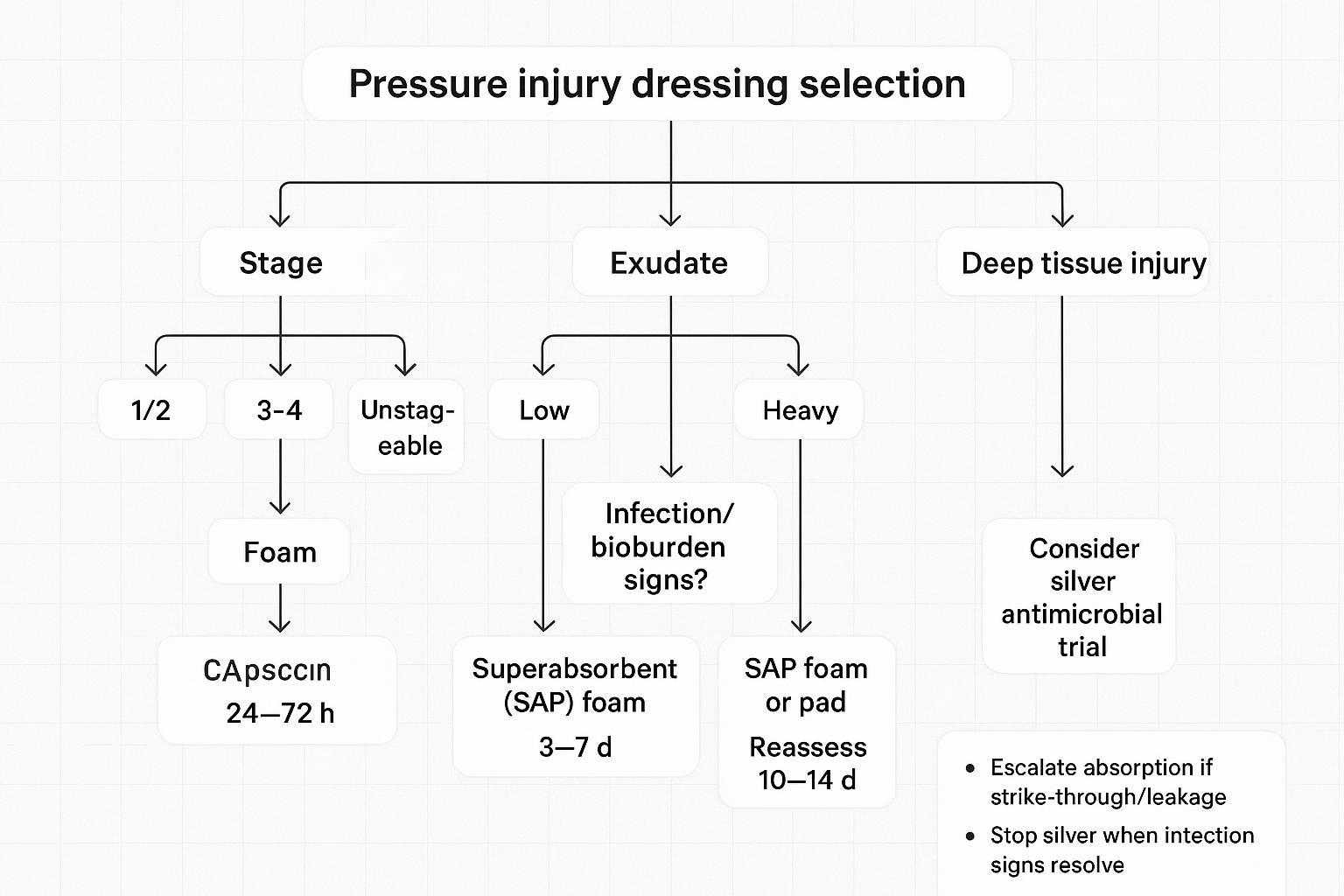
Exudate-led choices (foam vs SAP)
Operational vignette (process example, not clinical advice): A facility team notices that a subset of higher-exudate pressure injuries is driving frequent dressing changes and repeated linen changes due to strike-through. Instead of standardizing “daily foam,” the team updates the pathway so that repeated strike-through/leakage becomes an explicit trigger to step up to a superabsorbent/SAP category and to reassess offloading and peri-wound protection. The operational goal is to stabilize wear time and reduce leakage events while keeping the decision clinician-led and IFU-compliant.
A stage label doesn’t tell you how wet the wound is. Exudate does—and exudate is what drives change frequency, nursing workload, leakage events, and peri-wound maceration risk.
Procurement-ready rule of thumb
Foam is the baseline category for low to moderate exudate with protection/cushioning benefits.
Superabsorbent/SAP options are the escalation path for moderate-to-heavy/high exudate, especially when foam is saturating too fast.
A practical way to justify this in a tender document is to reference recognized wound-care education describing the role of superabsorbents for high exudate management (see WoundSource’s overview of superabsorbent dressings for high-exudate wounds) and case-based summaries on how foam and superabsorbent categories are used to control exudate (Wounds International’s discussion of how foam and superabsorbents are used to control exudate).
Key Takeaway: If foam is requiring near-daily changes due to strike-through or leakage, your pathway should make it easy to step up absorption (superabsorbent/SAP) rather than simply changing foam more often.
Silver stewardship (initiate, reassess)
Silver dressings are best treated as a time-limited antimicrobial trial. The operational goal isn’t “more silver,” it’s controlled, documented use that can be defended in audits and value analysis.
When to initiate (pathway triggers)
Clinical signs suggest local infection/high bioburden risk (as assessed by clinicians), delayed trajectory, or recurrent contamination risk.
How to manage the trial (the stewardship loop)
Use an early reassessment checkpoint. Evidence-based guidance on silver dressings repeatedly frames a practical review window around ~2 weeks; if the wound is improving and infection signs have resolved, discontinue silver and step down to a non-antimicrobial dressing (evidence-based guidance on appropriate silver dressing use).
Avoid extending silver indefinitely without a documented reason; Wounds International also summarizes stewardship expectations in its guidance on silver dressing stewardship.
Pro Tip: In tender specs, define silver as a reviewed intervention (e.g., reassess at 10–14 days) rather than an open-ended “default antimicrobial.” This reduces inappropriate utilization and makes your pathway easier to audit.
Change intervals and step-down logic
You don’t need a single fixed change interval. You need a range tied to observable cues—and a clear rule for stepping down when the wound stabilizes.
Operational ranges (use as cues, not guarantees)
These ranges are procurement-friendly planning cues. In practice, dressing wear time should be determined by clinicians and must follow the product IFU, local protocols, and patient-specific factors (fixation, peri-wound skin tolerance, exudate trajectory, and infection assessment).
Foam: often 24–72 hours for moderate exudate; change sooner with strike-through, leakage, edge lift, odor/soiling, or peri-wound maceration.
Superabsorbent/SAP: often 3–7 days when exudate is controlled and the dressing remains intact; change sooner with saturation, leakage, or compromised seal.
Silver trial: keep a reassessment checkpoint (commonly 10–14 days) and record the stop/continue decision based on clinical assessment and local protocols (see evidence-based guidance on appropriate silver dressing use).
Escalation guardrails (safety): If there are systemic infection concerns, rapidly worsening wounds, uncontrolled pain, spreading erythema, or other red flags, escalate per local clinical pathways rather than extending change intervals or relying on antimicrobial dressings alone.
Step-down logic (make it pathway-native)
If exudate decreases (e.g., SAP no longer needed), step down to foam.
If infection signs resolve, step down from silver to a non-antimicrobial variant.
If the dressing remains intact and the peri-wound is stable, extend within the allowed range; if not, shorten or step up absorption.
Compliance and operations
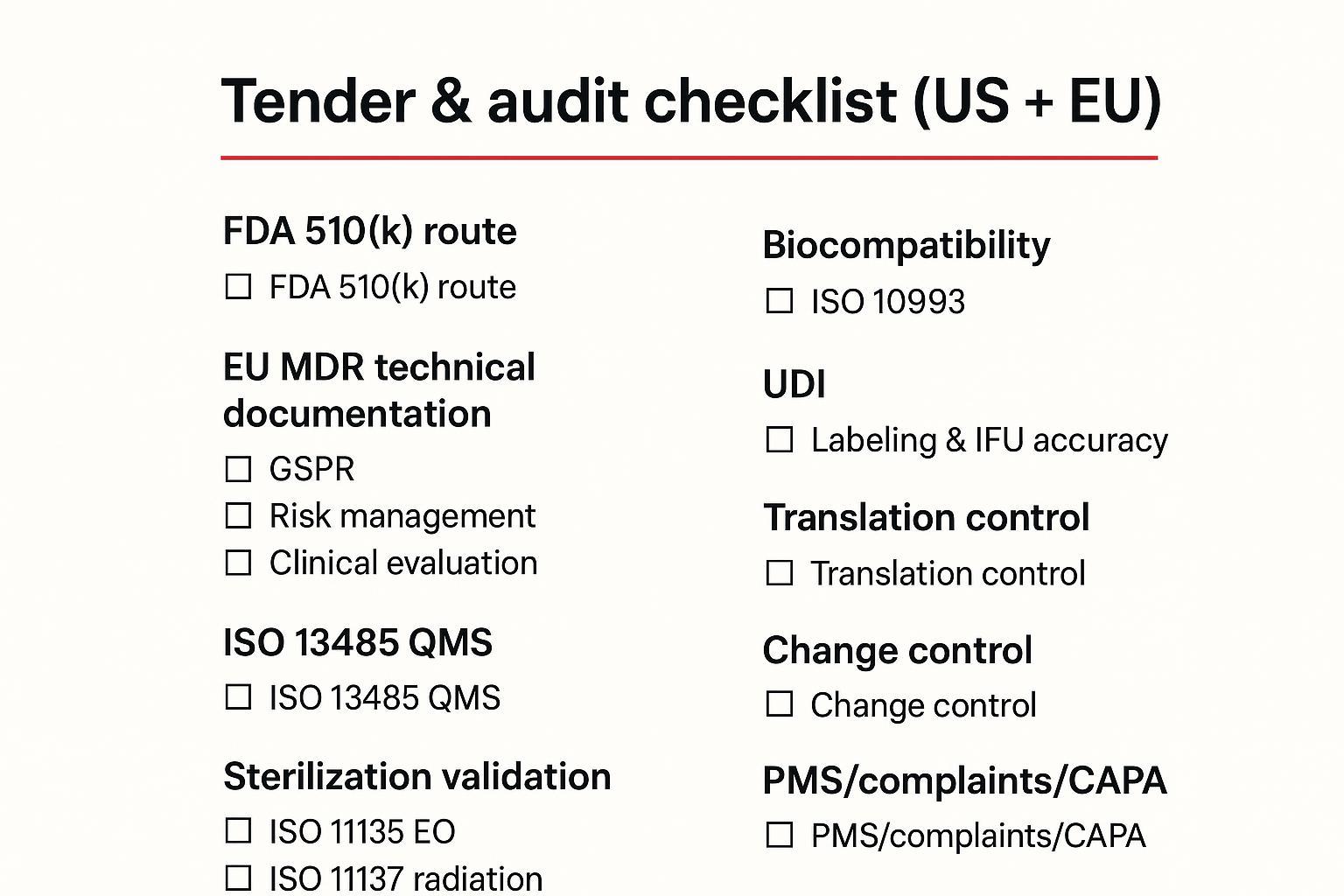
FDA/MDR/ISO essentials
For distributors building formularies and tenders, “compliance” is not a logo. It’s whether the device’s intended use, configuration, testing, labeling, and manufacturing controls align—and remain aligned when you private-label, change packaging, or adjust specifications.
At a minimum, procurement teams should be able to map:
US route: whether a dressing is typically marketed under 510(k) (with a predicate) for its intended use; the FDA database provides category examples such as an FDA 510(k) listing example for Ag foam dressings.
EU route: MDR classification and technical documentation completeness; MDCG provides a reference framework in its guidance on medical device classification under MDR.
QMS: ISO 13485-aligned controls and change management.
UDI, labeling, and IFU accuracy
In tenders, the highest-frequency failure mode is not “lack of documentation.” It’s documentation mismatch.
Operationally, require a tight version-control loop between:
UDI configuration
artwork files and translations
IFU content (indications, cautions, change guidance)
sterilization status and shelf-life labeling
SKU mapping (what you buy vs what was cleared/CE-marked)
A practical way to structure the file is to mirror MDR technical documentation sections; a readable overview of the expected structure is captured in an MDR technical documentation structure overview.
Tender-ready document pack and KPIs
A tender-ready pathway is a bundle of documents plus operational KPIs, not a brochure.
Document pack (minimum viable)
Regulatory status summary (US/EU) + scope mapping to SKUs
IFU + labeling set (all required languages) + revision history
ISO 13485 certificate (and scope) + quality agreement template
Sterilization validation summary and packaging/shelf-life support (as applicable)
ISO 10993 biocompatibility rationale/testing summary (as applicable)
PMS/complaint handling and change notification process
Operational KPIs distributors can track
Change frequency distribution by wound category (how often changes occur in practice)
Leakage/strike-through complaint rate
Peri-wound maceration-related escalations (proxy for underpowered absorption)
Silver utilization duration (median days on silver before step-down)
Fill rate / OTIF and lead-time adherence (supply reliability)
OEM/ODM support (SLK Medical)
Evidence-backed pathway kits
Distributors don’t just need “more SKUs.” They need pathway kits they can defend in value analysis and operationalize across facilities.
SLK Medical can support this packaging-and-pathway approach by combining:
OEM/ODM capability (sizes/shapes, packaging configurations, private label workflows)
a portfolio that includes silicone foam, silver foam (Ag) options, and superabsorbent dressings for higher-exudate scenarios
an operations mindset that treats documentation, labeling, and change control as part of the deliverable—not an afterthought
For reference, SLK Medical’s silicone foam category page outlines OEM/ODM scope and also lists super absorbent dressing variants alongside silicone foam and silver foam categories (Silicone Foam Dressing Manufacturer | OEM/ODM Wholesale).
Supply and SLA alignment
For tender work, align supply discussions to the pathway itself:
Define the “fast movers” (core foam sizes/shapes) vs “specialty” (silver variants; superabsorbent/SAP options).
Set service levels that match clinical operations: lead-time bands, allocation rules, and change-notification timelines.
Convert supply promises into measurable commitments (OTIF, complaint response SLAs, artwork revision SLAs).
Documentation and private label
Private label is where good products fail if documentation is not treated as a controlled system.
Operational requirements to lock in early:
Artwork ownership and approval workflow
Translation control and review responsibility
UDI assignment responsibilities across packaging levels
IFU localization rules (what can change by market, what must not)
Change-control notice periods (so tenders and catalogs don’t drift from the technical file)
Conclusion
A stage-based pathway becomes procurement-grade when it does three things consistently:
Select by exudate first (foam for low–moderate; step up to SAP/superabsorbent when fluid load drives frequent changes).
Use time-limited silver with a documented reassessment checkpoint rather than open-ended antimicrobial default.
Operationalize the pathway with change-frequency ranges, a compliance document bundle, and KPIs that reveal where the pathway is failing (leakage, overuse of silver, unstable change patterns).
Next steps for distributors are straightforward: align formulary SKUs and pathway kits to local regulations, verify label/IFU/UDI consistency, and standardize step-up/step-down triggers so your tenders deliver predictable practice—not just products.
If you’re building a tender pack, a practical next move is to request a pathway-ready bundle: spec sheets, IFUs, ISO 13485 scope, sterilization/biocompatibility summaries as applicable, plus a sampling plan for foam, silver foam, and superabsorbent/SAP variants.