


Introduction
A bordered silicone adhesive foam dressing is a multilayer foam dressing that combines an absorbent core with a soft silicone adhesive border. In advanced wound care, it’s commonly used when you need reliable fixation, exudate management, and removal that’s designed to be gentler on peri-wound skin than traditional aggressive adhesives.
A real-world example of the category is the SLK Medical silicone foam dressing with border, which shows a typical multilayer structure and a practical size-and-pack matrix you can mirror in a tender.
In procurement terms, these dressings sit in the “high-utility workhorse” category: they’re often selected because they can help control moderate to higher exudate while supporting a stable wear period, which matters for nursing workload and stock planning.
This buyer guide is written for teams who need to align clinical performance requirements with tender documentation and supply readiness. The goal is not to “pick a winner,” but to give you a clean evaluation framework you can use across suppliers.
By: SLK Medical Editorial Team
Version: v1.0
Last updated: 2026-06-03
Editorial note (YMYL / medical device content): This buyer guide is for procurement evaluation and tender documentation. It does not replace clinical judgment, product labeling/IFU, or local protocols. For infection-related or antimicrobial claims, rely on the exact labeled claim wording, test methods, and your institution’s infection management policy.
Clinical performance and use (bordered silicone adhesive foam dressing)
This section focuses on what you can evaluate and document, which is what procurement needs.
Indications and cautions
Bordered silicone foam dressings are typically considered for exuding wounds where you want absorption plus fixation (for example, post-operative wounds, pressure injuries, and venous leg ulcers), but you should always follow the specific product labeling and local clinical protocols.
Cautions to include in your evaluation checklist:
Sensitivity to materials: confirm how the supplier documents skin-contact materials and any known sensitivities.
Bleeding or poorly controlled hemostasis: adhesive bordered products may be inappropriate until bleeding is controlled, depending on your clinical guidance.
Infection management and claim boundaries: don’t accept vague “infection control” language. If a product is marketed as antimicrobial, you’ll need the claim wording, test method, and intended-use alignment in writing.
If you’re building a tender specification, keep the indications language conservative and aligned to documentation. Over-claiming in the spec creates downstream compliance problems.
Exudate handling and MVTR
For bordered silicone foam dressings, exudate handling isn’t just “how much it absorbs.” It’s a system behavior:
Absorption: how quickly fluid enters the dressing.
Retention: how well fluid is locked in (reducing pooling and backflow).
Moisture vapor transmission (MVTR): how effectively moisture vapor can pass through the backing film, which can affect how long the dressing stays comfortable and functional.
A practical way to evaluate this is to compare the supplier’s test data across realistic wear conditions. A 2024 technical review in the International Wound Journal explains fluid handling as a balance of absorbed/retained fluid plus moisture vapor loss, and describes common failure modes like pooling, leakage, and peri-wound maceration when exudate production exceeds the dressing’s capacity over time (see the International Wound Journal review on foam dressing fluid handling (2024)).
Procurement takeaway: ask for the test method and conditions. You’re not buying a number. You’re buying performance under your use case.
If your tender file includes performance thresholds, be explicit about whether you’re evaluating foam dressing MVTR alone or the broader fluid-handling system (absorption, retention, and evaporation).
Atraumatic removal and fragile skin
Soft silicone contact layers are often chosen to support lower-trauma removal, especially when peri-wound skin is fragile (geriatric skin, long-term care settings, repeated dressing changes).
On the buyer side, the questions that matter are concrete:
What is the adhesive chemistry and where is it applied (full face vs border-only)?
What evidence is provided for skin compatibility (risk-based biocompatibility rationale, not marketing)?
Does the dressing maintain adhesion at the border after exposure to moisture, shear, and repositioning?
Key Takeaway: For fragile skin, prioritize a dressing that stays sealed without aggressive adhesion. Edge lift and leakage are workflow problems, not just “comfort” issues.
Prevention and workflow impact
Sacral and heel prophylaxis
In many facilities, bordered silicone foam is used not only for treatment but also as a preventative interface in high-risk anatomical sites such as sacrum and heel, where friction, shear, and moisture can combine.
For procurement, prophylaxis use cases change the evaluation criteria. You’re looking at:
Conformability on curved anatomy (sacral shapes, heel cups)
Edge sealing behavior under movement
Skin tolerance for repeated removal and re-application
It also changes forecasting. Prophylaxis programs tend to drive predictable, high-throughput consumption, which makes supply continuity and SKU breadth more important than a single “best” dressing.
Wear time and change triggers
Wear time is not a promise. It’s an operating window defined by exudate load, fixation integrity, and skin response.
Common, procurement-relevant change triggers include:
strike-through or visible saturation
leakage at the border
edge lift (loss of seal)
increased pain/irritation or skin change under the adhesive area
clinical concern for infection or unexpected odor/exudate changes
The operational reason to be strict here is simple: if your dressing changes are being driven by border failure rather than clinical need, your total cost in use will climb.
Nursing efficiency and leakage control
Border performance is workflow performance. When the dressing seals well and retains fluid, it can reduce unscheduled changes, linen changes, and escalations for “dressing won’t stay on” issues.
To keep this section procurement-usable, evaluate efficiency through observable signals:
percentage of changes that are scheduled vs unscheduled
typical reasons for early changes (saturation vs edge lift)
patient positioning and mobility patterns where failures cluster
These are not “clinical outcomes.” They’re operational indicators that help you decide whether the product fits your facility and patient mix.
Compliance and documentation
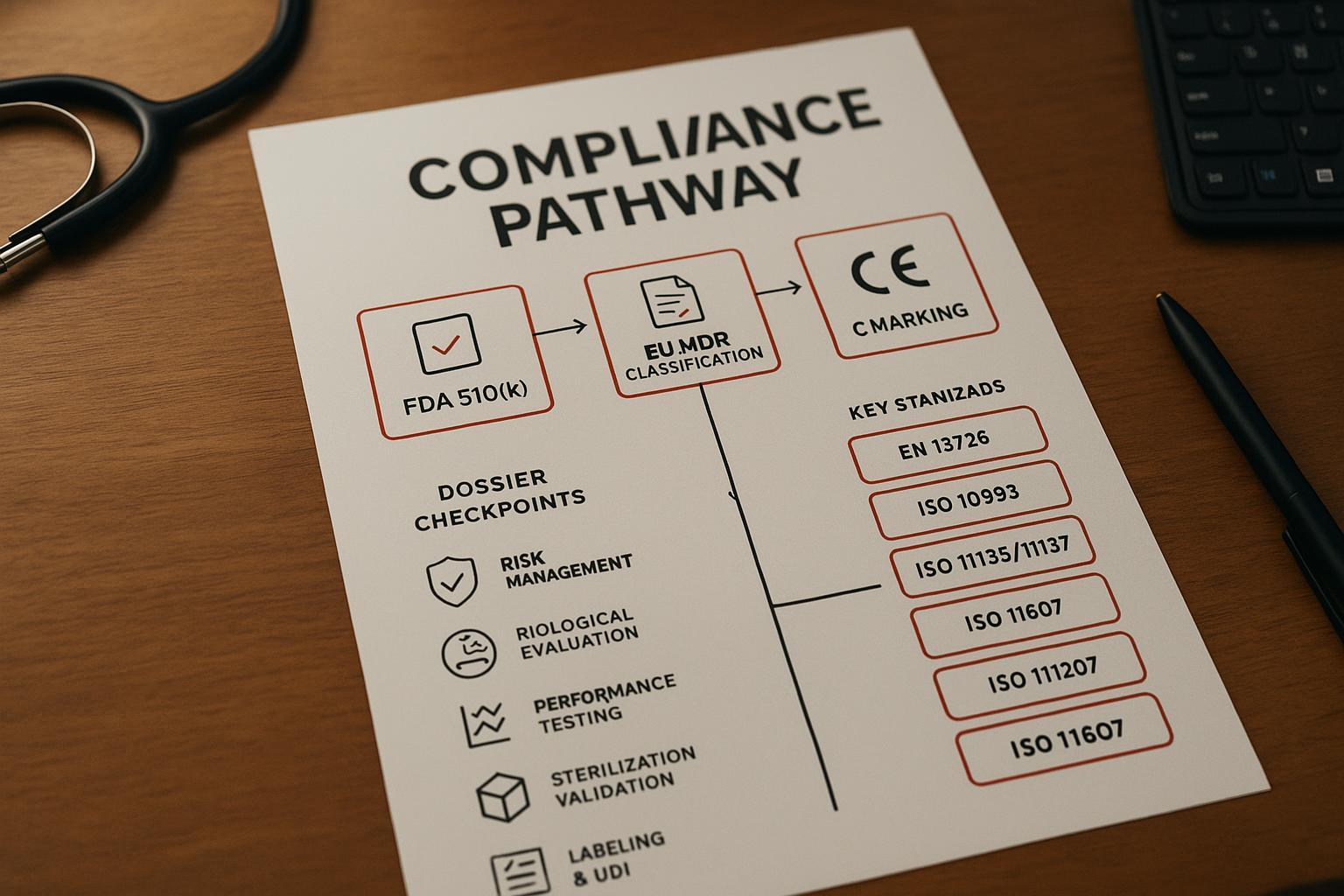
FDA 510(k) and antimicrobial claims
If you’re sourcing for the US market, the regulatory route matters because your tender file usually needs a coherent story: intended use, labeling, performance evidence, and traceability.
FDA’s overview of the Content of a 510(k) is a useful reference point for what a typical dossier includes (for example: final draft labeling, device specifications, performance data, and sterilization information when applicable).
For antimicrobial claims, treat the claim wording as a compliance item, not a marketing line. If a supplier wants “antimicrobial” on labeling, you need to see:
the exact claim statement
test method(s) and report(s)
boundaries of the claim (what it does and does not mean)
how the claim aligns with the intended use and labeling review pathway
MDR class, CE mark, and technical file
In the EU, a CE mark under MDR is supported by technical documentation aligned to Annex II and Annex III, plus the applicable conformity assessment route.
For tender readiness, you don’t need to become a regulatory specialist, but you do need to know where to verify requirements and what to request.
Two official starting points are:
the European Commission UDI overview, which frames UDI assignment and traceability expectations
the MDCG guidance library, which centralizes MDR implementation guidance
Standards, sterilization, labeling, and UDI
A practical tender file often includes a “standards and controls” bundle. For bordered silicone foam dressings, common elements include:
EN 13726: test methods that cover aspects of absorption and MVTR for wound dressings (see EN 13726 wound dressing performance test methods).
ISO 10993 (biocompatibility): a risk-based biological evaluation approach; FDA explains how ISO 10993-1 is used in device submissions in its FDA guidance on ISO 10993-1 (2023).
Sterilization validation: if the device is supplied sterile, the supplier should provide sterilization method and validation summary (for example, ethylene oxide or radiation, with applicable standards).
Packaging validation: if a sterile barrier system is used, request packaging integrity and shelf-life rationale.
Labeling and UDI: confirm label content, symbology, traceability, and UDI carrier placement expectations per market. For US tenders, capture medical dressing UDI labeling requirements in the spec and artwork checklist so it’s auditable.
Procurement and OEM/ODM planning
Specification checklist and SKU matrix
Start with a specification checklist that procurement, clinical, and regulatory can all sign off on. For bordered silicone adhesive foam dressings, your checklist typically includes:
Construction: layer stack (film backing, distribution layer, foam, silicone contact layer, border design)
Fluid handling evidence: absorption/retention data, MVTR data, test conditions, and failure-mode observations (pooling, edge leakage)
Skin contact safety: biocompatibility rationale, sensitization/irritation risk controls, adhesive residue expectations
Fixation and conformability: border width, corner behavior, performance on curved anatomy (sacrum/heel)
SKU matrix: square/rectangle/sacrum/heel shapes; size range; per-box count; carton configuration
Labeling/traceability: UDI fields, lot/batch format, expiry/shelf life, symbols, IFU content and format
SLK Medical supports OEM/ODM with documented QC traceability, sampling in 7–10 days, stable lead times, and post-award labeling/artwork control with defined CAPA response windows.
Private label, MOQ, and lead time
Private label programs usually fail for avoidable reasons: unclear version control, under-defined packaging specs, and unrealistic MOQ expectations.
To reduce friction, align early on:
MOQ logic: which components drive MOQ (base material lots, printed packaging, sterilization batch size)
Lead time structure: separate sampling lead time from mass production lead time; define what triggers a lead-time reset (artwork change, material change, validation change)
Change control: how the supplier manages spec changes and how you’ll be notified
From a tender-readiness standpoint, the best suppliers can state these items as controlled processes, not as ad-hoc promises.
Data, labeling languages, and EDI readiness
Distributors selling across regions often underestimate the operational burden of “simple” packaging changes.
Buyer checklist:
Labeling languages: confirm which languages are supported, how translations are controlled, and how proofs are approved
Artwork file governance: versioning, approvals, and record retention
Data exchange: carton/pallet labels, GTIN/UDI mapping, ASN requirements
EDI readiness: confirm whether the supplier can support standard EDI documents (PO, ASN, invoice) or provide structured data exports compatible with your ERP
Treat labeling and data as part of your quality system, not just a marketing deliverable.
Editorial policy and corrections
To support transparent procurement decisions, this guide follows these editorial practices:
Source standard: We prioritize primary regulators/standards bodies (e.g., FDA, European Commission, ISO/EN) and peer-reviewed literature.
Claim boundaries: We avoid vague performance or infection-control language. Any antimicrobial wording should be verified against the product’s labeling and supporting test reports.
Updates and version control: Material updates are tracked via the version/date shown near the top of this article.
Corrections: If you spot an error or have a documentation question, contact us here: https://www.slkmedical.com/contact-us-for-pricing-and-free-samples/
Conclusion
Bordered silicone adhesive foam dressings sit at the intersection of clinical use and supply reality. If you evaluate them only on absorbency, you’ll miss the failure modes that drive early changes. If you evaluate them only on documentation, you can still end up with leakage, edge lift, and poor workflow fit.
Key takeaways:
Performance is a system: absorption, retention, and MVTR need to match your exudate burden and use conditions.
For fragile skin, the goal is a stable seal with low-trauma removal, not aggressive adhesion.
Tender readiness depends on documentation discipline: labeling, UDI, biocompatibility rationale, and standards alignment.
OEM/ODM success depends on the SKU matrix, change control, and predictable lead times as much as the dressing design.
Next steps: pilot the sizes and shapes that match your highest-volume use sites (often square/rectangle plus sacrum and heel), validate change triggers and leakage rates in your workflow, then finalize your document pack (spec sheet, IFU, and compliance dossier) before tender submission.


