


Introduction
This is a concise, evidence‑based map of advanced wound dressings organized first by exudate level, then by common wound types. It’s designed for quick selection and standardization in clinical and value analysis workflows.
It’s written for WOC nurses, unit leads, and hospital/LTC value analysis teams who need a consistent way to standardize selection without overpromising outcomes.
Editorial notes and disclosure
Author: SLK Medical Clinical Team.
This article is educational information for clinicians and value analysis teams. It does not replace local protocols, product IFUs, or clinical judgment, and it is not medical advice for individual patients.
Disclosure: It may reference concepts or examples relevant to a wound dressing manufacturer. Clinical decisions should be based on patient assessment, accepted guidelines, and the specific product instructions for use.
How to use it:
Start with the current exudate band (none/low, low/moderate, moderate/very high).
Confirm wound goals (protect, donate moisture, absorb/contain, manage bioburden) and check periwound risk.
Reassess on saturation/strike‑through and any clinical change; escalate or de‑escalate as the wound evolves.
For change-frequency drivers, see the CLWK wound dressing selection guideline.
Scope: films, hydrogels, hydrocolloids, foams, alginate/gelling fiber, hydrofiber, superabsorbent polymer (SAP), antimicrobial dressings, and NPWT.
Key Takeaway: Match the dressing’s fluid‑handling capacity to the exudate band, then protect the periwound skin and set a reassessment cadence that prevents leakage and maceration.
Text-only quick algorithm
Identify exudate band now (none/low → low/moderate → moderate/very high).
Set goals: protect newly epithelialized tissue, donate moisture, absorb/contain, reduce bioburden risk, or protect periwound.
Check periwound risk (maceration, fragile skin, high MARSI risk) and plan barrier + gentle fixation early.
Choose the least-occlusive class that still controls fluid:
None/low: film or hydrogel (with an appropriate secondary if needed).
Low/moderate: hydrocolloid or foam.
Moderate/very high: alginate/gelling fiber, hydrofiber, or SAP (usually with a suitable cover and fixation).
Fixation and seal: match the dressing to location/contours, and choose securement that minimizes adhesive trauma.
Reassess early and then by triggers: saturation/strike-through, leakage, odor, increasing pain, periwound breakdown, or any clinical change.
Selection by exudate (advanced wound dressings quick map)
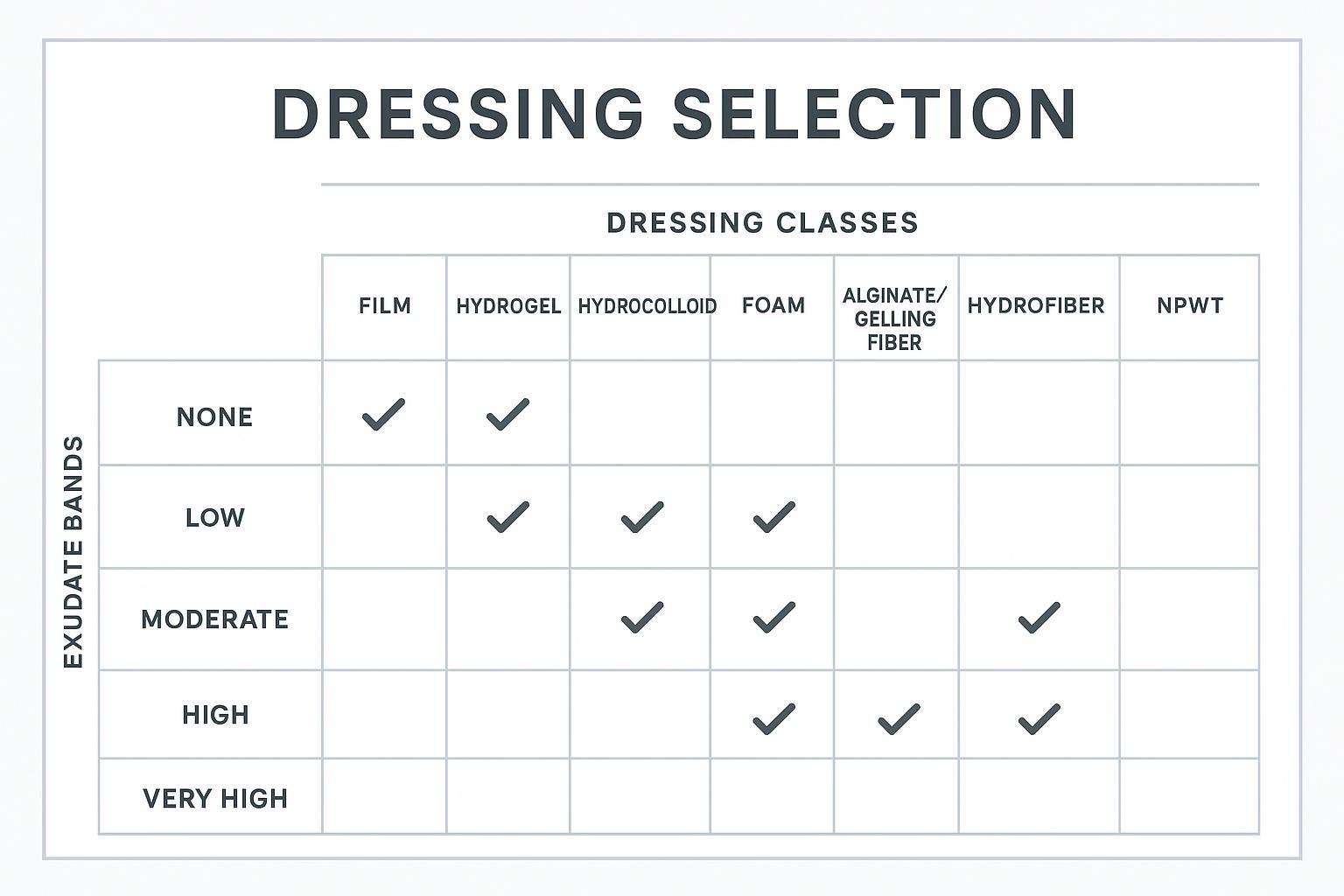
None to low: films, hydrogels
Use when: the wound is superficial and dry/low‑drainage, or the goal is to prevent desiccation and support autolytic debridement.
Films
Typical role: protect fragile or newly epithelialized tissue; allow observation; minimal absorption.
Fit: superficial wounds with little/no exudate.
Watch-outs: fluid will pool under film if exudate increases.
Hydrogels
Typical role: donate moisture; support autolytic debridement in dry wounds.
Fit: dry or minimally exuding wounds.
Watch-outs: limited absorption; not a good match for heavy exudate. A clinical review on wound dressing selection emphasizes choosing classes based on wound characteristics like exudate and tissue type rather than diagnosis alone (Selection of Appropriate Wound Dressing for Various Wounds, 2020).
Low to moderate: hydrocolloids, foams
Use when: the goal is moisture balance plus protection/cushioning, with controlled drainage.
Hydrocolloids
Typical role: occlusive/semi‑occlusive moisture retention with modest absorption.
Fit: shallow wounds with low to moderate exudate when maceration risk is low.
Watch-outs: can trap moisture; reassess closely if exudate increases or periwound maceration appears.
Foams
Typical role: absorb exudate while providing cushioning and thermal insulation.
Fit: many wounds with low‑to‑moderate (often moderate) exudate; can be layered when drainage increases.
Watch-outs: if exudate overwhelms capacity, leakage and maceration risk rise.
For a neutral background on foam selection variables (fit, absorption, securement options), see SLK Medical’s overview of foam dressing types and applications.
Moderate to very high: alginate/gelling fiber, hydrofiber, SAP
Use when: controlling leakage, protecting periwound skin, and reducing strike‑through is the priority.
Alginate / gelling fiber
Typical role: high absorption; forms a gel with exudate; useful in cavities/irregular wounds.
Fit: moderate to heavy exudate.
Watch-outs: needs moisture to function; avoid on dry wounds; often needs a secondary cover.
Hydrofiber
Typical role: absorbs and gels, often with strong vertical wicking that can help contain fluid.
Fit: moderate to heavy exudate.
Watch-outs: typically needs an appropriate secondary dressing and fixation.
Superabsorbent polymer (SAP)
Typical role: very high fluid capture/lock‑in to limit leakage and periwound maceration in heavy drainage.
Fit: heavy to very heavy exudate (including under compression in venous disease scenarios).
Watch-outs: plan fixation and change cadence to avoid strike‑through.
Indications by wound type
Pressure injuries
Pressure injury dressing choice should follow assessment of exudate, tissue type (granulation/slough/eschar), depth/undermining, pain, and periwound skin. Guidance summaries commonly recommend more absorptive classes (foam, alginate, hydrofiber) when exudate is moderate to heavy, and moisture‑donating options (like hydrogel) when wounds are dry.
For an overview of dressing-class selection by wound characteristics, see the 2020 review (previously cited above).
Quick match:
Dry/low exudate: consider hydrogel (moisture donation) ± protective secondary layer.
Low to moderate exudate: foam or hydrocolloid depending on occlusiveness tolerance and maceration risk.
Moderate to high exudate or slough: consider alginate/gelling fiber or hydrofiber with a cover dressing.
Venous leg ulcers
In venous leg ulcers, compression is typically central to management when appropriate, and dressings are selected to manage exudate and protect periwound skin under compression.
For a primary-care overview of venous ulcer management (including compression plus dressings), see: AAFP Venous Ulcers: Diagnosis and Treatment (2019).
Quick match:
High exudate is common: plan for higher-capacity absorption (foam, hydrofiber/alginate, SAP as needed).
Periwound protection matters: prioritize containment (no leaks) and barrier strategies to prevent maceration.
Diabetic foot ulcers
For DFUs, match dressing class to drainage and wound bed status, while coordinating with offloading, infection assessment, and perfusion evaluation. Dressing selection principles still hinge on moisture balance and exudate containment.
General dressing-class principles by wound characteristics are summarized in the 2020 review (previously cited above).
Quick match:
Low exudate: moisture donation (hydrogel) if appropriate for the wound bed.
Moderate exudate: foam or hydrofiber depending on contour and fluid control needs.
Heavy exudate: hydrofiber/alginate or SAP to reduce leakage and protect periwound skin.
Wear time, AMS, implementation
Typical change intervals by class
Actual wear time should be driven by saturation/strike‑through, leakage, pain, and clinical change (odor, increasing exudate, periwound breakdown), not by “maximum days on the box.” The CLWK guideline (cited above) notes that high exudate and infection/monitoring needs are common reasons for more frequent changes.
Typical practical ranges (adjust to the patient and wound):
Films: often changed when edges lift, fluid collects, or periwound is at risk.
Hydrogels: reassess frequently enough to prevent maceration; pair with an appropriate secondary.
Hydrocolloids: can be extended when exudate is controlled; shorten if there’s swelling, leakage, or maceration.
Foams: frequently used for multi‑day wear when exudate is stable; shorten when saturation increases.
Alginate/hydrofiber: change based on gelling/saturation and exudate level; ensure a suitable cover.
SAP: selected to extend time-to-strike‑through in heavy exudate, but still reassess early in the first 24–48 hours to validate capacity.
Practical scenarios for implementation
These short scenarios illustrate how an exudate-based pathway often needs small adjustments in real workflows. They are generalized examples and not patient-specific medical advice.
Scenario 1: Venous leg ulcer under compression with rapid strike-through
Day 1: moderate exudate with foam under compression; by 24 hours, edges show strike-through.
Adjustment: step up to hydrofiber or SAP with an appropriate cover; confirm seal and fixation under compression.
Reassess triggers: strike-through, leakage, periwound whitening/maceration; shorten change interval until stable.
Scenario 2: Pressure injury shifts from dry to low/moderate exudate after debridement
Initially: hydrogel used to donate moisture; within 48 hours, exudate increases and pooling risk rises.
Adjustment: transition to foam (or hydrocolloid only if maceration risk is low) to restore moisture balance.
Reassess triggers: increased drainage, odor, or periwound maceration—escalate absorption if needed.
Scenario 3: Fragile skin / high MARSI risk with frequent changes
Problem: adhesive trauma accumulates when changes are frequent, even when exudate control is acceptable.
Adjustment: prioritize silicone-based contact layers or gentler fixation options, add barrier film to periwound, and use “low and slow” removal technique.
Reassess triggers: skin stripping, erythema, pain on removal—reduce adhesive burden and revisit fixation strategy.
Peri‑wound protection and MARSI
Periwound damage is often a fluid + adhesive problem. Two guardrails reduce avoidable complications:
Keep exudate off the surrounding skin
Choose a dressing class that can contain the current exudate band and seal/fixate appropriately.
Use skin protectants or barrier films when frequent changes or moisture exposure are expected. Wounds International provides practical guidance on preventing and managing periwound skin damage (periwound skin protection guidance).
Minimize adhesive trauma (MARSI)
For at‑risk or fragile skin, consider gentler adhesive approaches (often silicone-based) and use atraumatic removal technique. Wounds International discusses dressing selection as a key lever in MARSI prevention (MARSI: preventing patient harm, 2024), and Wounds UK highlights silicone-based adhesives and “low and slow” removal techniques (MARSI meeting report, 2025).
Neutral brand note (for formulary consideration): SLK Medical manufactures silicone foams designed for gentle adhesion, and SAP options intended for heavy-exudate containment where MARSI and leakage risk are operational concerns.
Stewardship of antimicrobial dressings
Antimicrobial dressings can be useful when there are signs of local infection, high bioburden, or high risk of infection—but they’re not a default choice just because exudate is high.
Practical stewardship rules:
Use antimicrobials for a defined indication and reassess early. A consensus paper on stewardship-oriented use of nanocrystalline silver dressings advises appropriate, limited use aligned to infection status (Appropriate use of nanocrystalline silver dressings, 2018).
Treat antimicrobial dressings as a time-limited “challenge” and review around 1–2 weeks. Wounds International discusses stewardship considerations in the context of silver resistance and review practices (silver resistance focus, 2025).
If local signs aren’t improving on reassessment, change the plan (diagnostics, debridement strategy, offloading/compression, or antimicrobial approach) rather than simply extending the same dressing indefinitely.
Next step for value analysis teams: If you’re standardizing an exudate-based pathway, request a spec sheet, IFU, and evaluation pack (including sampling plan) to align product options to your exudate bands and MARSI-risk populations.
Conclusion
Match the least‑occlusive option that maintains moisture balance and contains exudate.
Reassess by saturation/strike‑through and clinical change; limit antimicrobial courses with 1–2‑week reviews.
Standardize by exudate band and wound type to improve outcomes and cost control.
References
BC Provincial Nursing Skin & Wound Committee (CLWK), Wound Dressing Selection Guideline.
Dhivya S, Padma VV, Santhini E. Selection of Appropriate Wound Dressing for Various Wounds (2020).
American Academy of Family Physicians, Venous Ulcers: Diagnosis and Treatment (2019).
Wounds International, Periwound skin protection guidance (PDF).
Wounds International, Medical adhesive-related skin injury (MARSI): preventing patient harm (2024).
Wounds UK, MARSI meeting report (PDF).
Leaper D et al. Appropriate use of nanocrystalline silver dressings (2018).
Wounds International, Development of silver resistance: a focus on wound care (2025).


