


By SLK Medical team (advanced wound care R&D and manufacturing). Last reviewed/updated: 2026-06-04.
Clinical notice & disclosures
Educational use only: This article supports clinical education and unit standardization. It does not replace clinician judgment, local policies, or product Instructions for Use (IFU).
Use within scope: Follow your facility protocol for wound assessment, offloading/compression, infection control, and escalation when wounds deteriorate or do not improve.
Disclosure (potential conflict of interest): SLK Medical is a manufacturer of wound dressings. No external funding was received for this article.
Evidence window: References and practice alignment reflect evidence and guidelines from 2018–2025 unless otherwise noted.
Introduction
Leakage isn’t just a skin issue—it’s a workload issue. When exudate tracks to the edge, lifts a border, or soaks linens, it triggers unplanned dressing changes, extra cleaning, and more time at the bedside. The right silicone foam dressing features can reduce that cascade by improving fluid handling and helping the dressing stay in place with less skin trauma.
This guide focuses on evidence and practice alignment from 2018–2025, plus guideline-consistent implementation in hospitals and long-term care (LTC). It’s written for WOC nurses, unit leaders, and value analysis teams who need a repeatable selection standard—not marketing claims.
Use it to:
standardize which features matter most for your common use cases
reduce “mystery leaks” caused by fit, technique, or mismatched absorbency
build a total cost-in-use story that accounts for nursing time and rework
Silicone foam dressing features
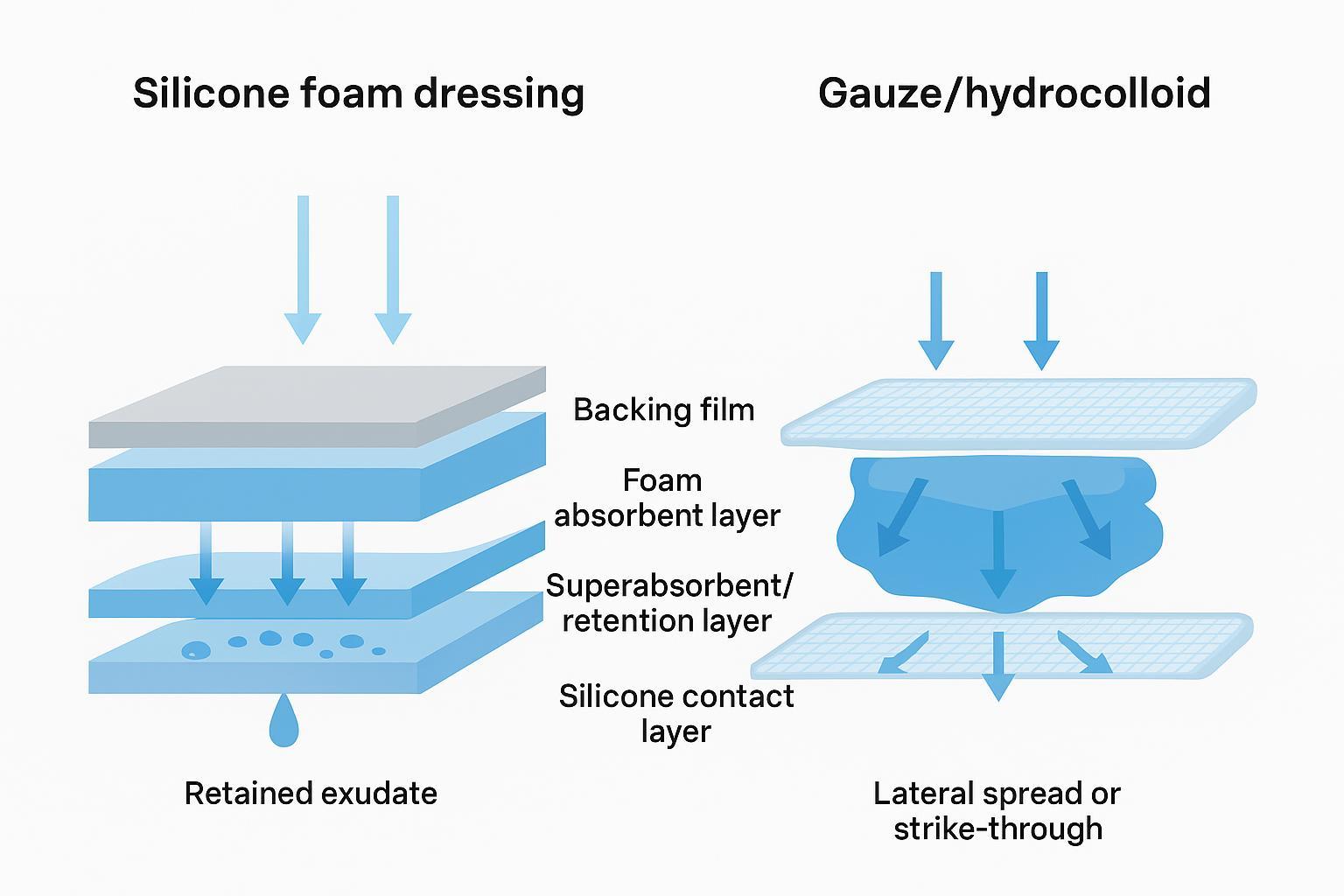
Exudate absorption and retention
Leakage prevention starts with a blunt reality: if the dressing can’t absorb and retain the exudate volume, it will leak, no matter how good the border is. A 2021 review discussing infected wound management notes that polyurethane or silicone foams can absorb substantial exudate, with adhesion sometimes requiring additional strategies depending on design and use case (Kaiser et al., 2021 review on infected wound therapy).
In practice, absorption and retention features that matter include:
vertical wicking into the foam (pulls fluid away from the wound interface)
retention under pressure (helps reduce strike-through when a patient repositions)
a backing film that helps contain fluid while still allowing moisture vapor transmission (varies by product)
When these features are under-specced for the exudate level, failure patterns are predictable: edge lift, lateral seepage, periwound maceration, and linen strikes.
Atraumatic silicone adhesion (MARSI)
For many facilities, leakage and workload rise when skin breaks down around the dressing. That’s where adhesion strategy matters.
Soft silicone contact layers are commonly used when clinicians want secure placement with less removal trauma—especially for fragile skin. This is relevant to MARSI (medical adhesive-related skin injury): avoidable skin injury caused by adhesives (for example, epidermal stripping, blistering, or skin tears).
In this article, “atraumatic” means designed to support secure wear while minimizing removal-related skin injury risk—it doesn’t mean “no risk.”
What “atraumatic” looks like operationally:
the dressing stays put without aggressive adhesion that increases removal trauma
clinicians can lift/reposition the dressing during application to improve fit
removal is slower and gentler, reducing the need for “rip and replace” changes that create more skin problems
Wear time and patient comfort
Wear time is not a number you pick once—it’s a parameter you manage. Silicone foam dressings are often used with multi-day wear when exudate is controlled, the seal holds, and the periwound stays intact.
From an implementation standpoint, “comfort” isn’t soft language. It shows up as:
fewer unplanned changes (less disruption and handling)
less pain during removal and reapplication
less adhesive trauma for patients with fragile skin
Practical reminder: wear time should shorten when the dressing leaks, lifts, or becomes contaminated, and staff should reassess the seal rather than simply replacing with the same size and technique. SLK Medical’s wear-time overview lists common triggers to change (leakage, edge peel, odor, redness) in its post on how long to leave a silicone foam dressing on. If your team also needs a quick internal primer on construction and selection, see SLK Medical’s overview of the benefits of foam dressings for wound care.
Where it works best
Pressure injury sacrum/heel
For high-risk patients, prophylactic dressings can be part of a prevention bundle—when paired with turning/offloading, moisture management, and skin assessment.
The 2025 international pressure injury guideline site states: “We suggest using a multilayered soft silicone foam dressing on sacrum and heels for individuals assessed as having a high risk…” (International Guideline skincare recommendation, 2025). A 2025 meta-analysis also reported reduced pressure injury incidence in pooled comparisons of prophylactic silicone foam dressings versus standard care in the sacral and heel regions (2025 meta-analysis in Frontiers in Medicine).
Note: some facilities call this approach a “pressure injury prophylactic dressing” strategy—implemented under a bundle and audited like any other prevention intervention.
Key Takeaway: Prophylactic silicone foam is best treated as a bundle component for sacrum/heel risk—not a replacement for offloading and repositioning.
DFU, VLU, chronic exudate
Silicone foam dressings are commonly used when the primary clinical problem is ongoing exudate and the secondary problems are leakage, periwound maceration, and frequent change burden. They can fit well in protocols for diabetic foot ulcers (DFU) and venous leg ulcers (VLU) when matched to exudate level and paired with appropriate offloading/compression and clinician oversight.
SLK Medical snapshot (non-promotional): SLK Medical describes multi-layer silicone foam constructions designed for vertical absorption, retention, and gentle silicone contact—features intended to help manage chronic exudate and reduce edge leakage.
For teams standardizing practice, it helps to set a simple escalation rule: if a dressing leaks within 24–48 hours, treat it as a signal to reassess wound geometry, exudate level, and fixation—not as a reason to “just change it more.”
Postoperative and fragile skin
Post-op incisions and patients with fragile skin create a common failure mode: the dressing could manage the exudate, but the adhesive or removal technique damages skin, which then increases exudate and undermines seal.
Silicone foam is often chosen here because it aims for a more skin-friendly adhesion profile. When implementing on fragile skin, standardize:
gentle removal technique (low and slow)
periwound protection where moisture and adhesive trauma overlap
a clear threshold for switching dressing strategy when edges repeatedly lift
Economics and implementation
Lower changes, total cost
Unit price is rarely the cost driver in a “leaky dressing” problem. The drivers are:
nurse time for unplanned changes
linen and clothing changes
skin damage that expands the wound care workload
supply sprawl from too many SKUs and inconsistent selection
A value analysis-friendly way to frame silicone foam selection is to standardize by two variables:
expected exudate level (low/moderate/heavy)
need for seal/fixation (flat vs high-motion/anatomical sites)
Then track the operational metrics your teams actually feel: unplanned change rate, leak events per 100 patient-days (or per unit), and dressing-related skin injury events.
Unit standard work checklist (copy/paste)
Use this one-page checklist to standardize selection, application, and audit.
A) Selection (before opening the package)
Exudate level (expected): low / moderate / heavy
Goal: manage exudate + protect periwound + reduce unplanned changes
Anatomical site risk: flat / high-motion / creased (sacrum, heel, groin)
Fixation strategy: bordered foam vs non-bordered foam + secondary fixation (per policy)
Wear-time plan: set an expected review interval and criteria to shorten wear time
B) Application (during placement)
Clean and fully dry the periwound
Choose a size with adequate margin onto intact skin
Avoid stretching the border; apply from center outward
Use gentle hand warmth/pressure to support initial border seal
C) Shift checks (operational triggers)
Edge lift or rolling
Strike-through or linen/clothing soak-through
Periwound maceration/whitening
Odor, increasing pain, new redness, or suspected infection
D) If leakage occurs within 24–48 hours (do not default to “change more”)
Reassess wound geometry and exudate level (absorbency/retention mismatch)
Reassess size/margin and border technique (stretching, creases, high-motion)
Consider fixation changes per policy (e.g., secondary securement)
Document failure mode to guide SKU standardization
E) Audit KPIs (per unit, monthly/quarterly)
Leak events per 100 patient-days (or per unit-defined denominator)
Unplanned dressing changes (% of total changes)
Dressing-related skin injury/MARSI events
Linen/clothing change events related to wound leakage (optional)
Tip: Use a simple “failure mode” pick-list (too small / border stretched / creased site / exudate overload / overstay) to reduce variation across shifts.
AMS for silver foam
Silver-containing foam dressings can be appropriate when there are signs of local infection or high bioburden risk—but stewardship requires time limits and reassessment.
This is the practical meaning of silver foam dressing antimicrobial stewardship: use only when indicated, document the indication, and plan a review/de-escalation point.
A practical AMS pattern is consistent with general wound management guidance: if there’s no improvement after about 2 weeks, discontinue and re-evaluate (Australian Prescriber wound management update, 2023). The International Wound Infection Institute (IWII) consensus also frames bioburden management as something to de-escalate as the wound improves (IWII “Wound infection in clinical practice” consensus).
Operationally, that means your protocol should include:
an indication statement (why silver is being used)
a review date at ~2 weeks
a step-down option back to non-antimicrobial foam when appropriate
Technique to prevent leaks
Most “foam leaks” are a system problem: sizing, skin prep, border sealing, and reassessment. Standardizing technique reduces variation between clinicians and shifts.
Common causes of early leaks:
dressing too small (insufficient margin for exudate spread)
border stretched during application (creates lift points)
poor seal in anatomical creases (sacrum/heel) or high-motion zones
overstay (wear time exceeds what the exudate and seal can support)
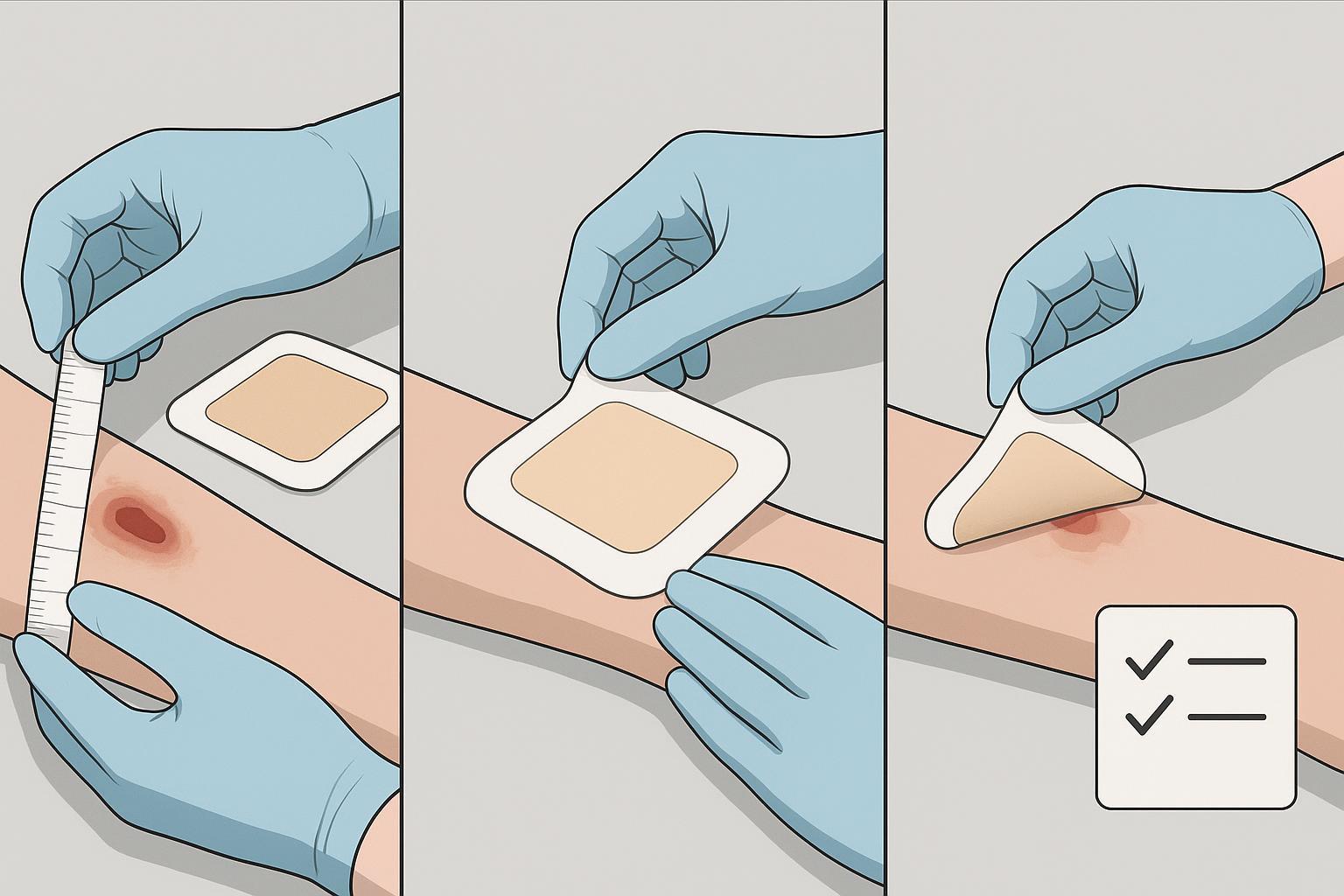
A simple 3-step technique that’s easy to teach and audit:
Skin prep and sizing: clean/dry the periwound; choose a size that provides adequate margin onto intact skin.
Border sealing (hand heat): apply from center outward without stretching; press the border down with gentle hand warmth to improve initial seal.
Reassess wear time: check edges and periwound each shift (or per policy); shorten wear time if lifting, strike-through, odor, or maceration appears.
For teams building standard work, SLK Medical’s explainer on foam dressing types and applications can be used as an internal baseline reference when training new staff on bordered vs non-bordered choices.
Conclusion
Reducing leaks is mostly about matching absorbency + retention + seal to the exudate reality—and then applying and reassessing consistently. When the feature set and technique are aligned, silicone foam dressings can help reduce unplanned changes and the workload that comes with leakage management.
For high-risk patients, consider using silicone foam prophylactically at the sacrum and heel within prevention bundles, consistent with 2018–2025 evidence and guideline-aligned practice.
For silver foams, keep use stewardship-ready: indicate why, review at ~2 weeks, and de-escalate when the wound is improving.
Next step (procurement-grade): If you’re standardizing across units, request a spec sheet + IFU pack, define two or three evaluation KPIs (leak events, unplanned changes, MARSI events), and run a time-boxed sampling plan under your local protocol.


