


Introduction
Procurement teams usually start this comparison with unit price. That’s a mistake.
For most moisture-managed wounds, the purchase decision that holds up in a tender is the one that accounts for total cost of care: change frequency, nursing time, leakage and maceration risk, and complications that extend length of stay.
This article is an evidence-led comparison of foam dressings vs hydrocolloid (with gauze as a baseline), written for B2B distributors, procurement teams, and product managers.
Scope:
Clinical outcomes and comfort
Wear time and exudate control
Infection notes (high level; not a treatment guide)
Economics and compliance essentials for tenders
Compliance and documentation perspective:
US: understand the manufacturer’s FDA pathway, confirm UDI readiness, and align labels to FDA’s UDI requirements.
EU: confirm MDR conformity assessment route and Notified Body involvement where required under the EU MDR (Regulation (EU) 2017/745).
Limits (important): wound dressings are wound-type specific. This is not a claim that one category is “best” in every setting. Use clinician judgment and local protocols.
Clinical outcomes and comfort
Pressure injury evidence (pressure injury dressing snapshot)
If you’re dealing with pressure injuries, the evidence base is large but uneven. Systematic reviews tend to conclude that there isn’t one universally superior dressing, and that choice should align with wound characteristics and exudate management goals.
For broad context, the Cochrane review on dressings and topical agents for treating pressure ulcers summarizes how mixed the comparative clinical evidence can be across dressing categories.
Where foam has clearer, bounded evidence is in prevention at high-risk anatomical sites. A 2025 systematic review and meta-analysis in PubMed Central, “Efficacy of silicone foam dressings in preventing pressure injuries…” (2025), reported reduced pressure injury incidence in sacral and heel regions when silicone foam dressings were used as an adjunct to standard prevention measures (prevention context, not a universal treatment claim). The same paper also notes limitations (e.g., incomplete reporting of allocation concealment and lack of blinding in many RCTs), which matters when procurement teams translate evidence into claims language.
Wound-type snapshots
Use these as procurement-friendly “fit checks,” not as clinical directives.
Pressure injuries (stages vary)
Foam is often chosen when exudate management and cushioning matter.
Hydrocolloid tends to fit best when exudate is low and you want an occlusive moist environment.
Gauze usually increases change frequency and is more sensitive to technique and dressing-change consistency.
Post-op closed incisions or superficial surgical wounds (selected cases)
Foam dressings can provide cushioning and fluid handling when there is drainage.
Hydrocolloids can work when drainage is light and skin tolerance is good, but monitoring can be harder under occlusion.
Fragile skin / geriatric skin
A key practical differentiator is whether the dressing contact layer and adhesive system support atraumatic removal.
For a general overview of dressing categories and typical indications, the NCBI Bookshelf StatPearls “Wound Dressings” chapter (updated 2024) is a useful baseline reference.
Atraumatic removal and pain
For procurement, “comfort” is not a soft metric. It becomes measurable through nursing time, patient tolerance, and the risk of skin injury at dressing change.
Soft silicone contact layers are widely discussed as a design approach to reduce skin stripping and pain during removal, especially in fragile skin. Wounds International’s guidance document “Soft silicone dressings” describes how soft silicone remains tacky enough to stay in place while supporting atraumatic removal.
A neutral, modern example of this design direction is SLK Medical’s silicone foam portfolio (e.g., bordered and non-bordered variants; anatomical shapes such as sacral and heel). The practical procurement takeaway isn’t a brand claim. It’s that product architecture has evolved: multilayer foam structures, silicone contact layers, and border systems aim to balance wear time, exudate retention, and skin protection. If you want a category refresher, SLK Medical’s internal explainer on types of foam dressings is a reasonable starting point for terminology.
Exudate control, wear time, and foam dressings vs hydrocolloid
Capacity and maceration
Exudate management is where category-level differences become operational.
Foam dressings are designed to absorb and retain exudate while supporting a moist wound environment. Engineering-focused reviews explain that fluid handling depends on absorption, retention, and the ability to prevent lateral spread that drives leakage and periwound maceration. The 2024 review “Fluid handling by foam wound dressings” (2024) is a solid reference for why foam performance varies by construction.
Hydrocolloids form a gel as they absorb exudate. That occlusive behavior can help in low-exudate situations, but it also means hydrocolloids are generally positioned for low to moderate exudate and are often avoided when exudate is higher because maceration and leakage risk rise.
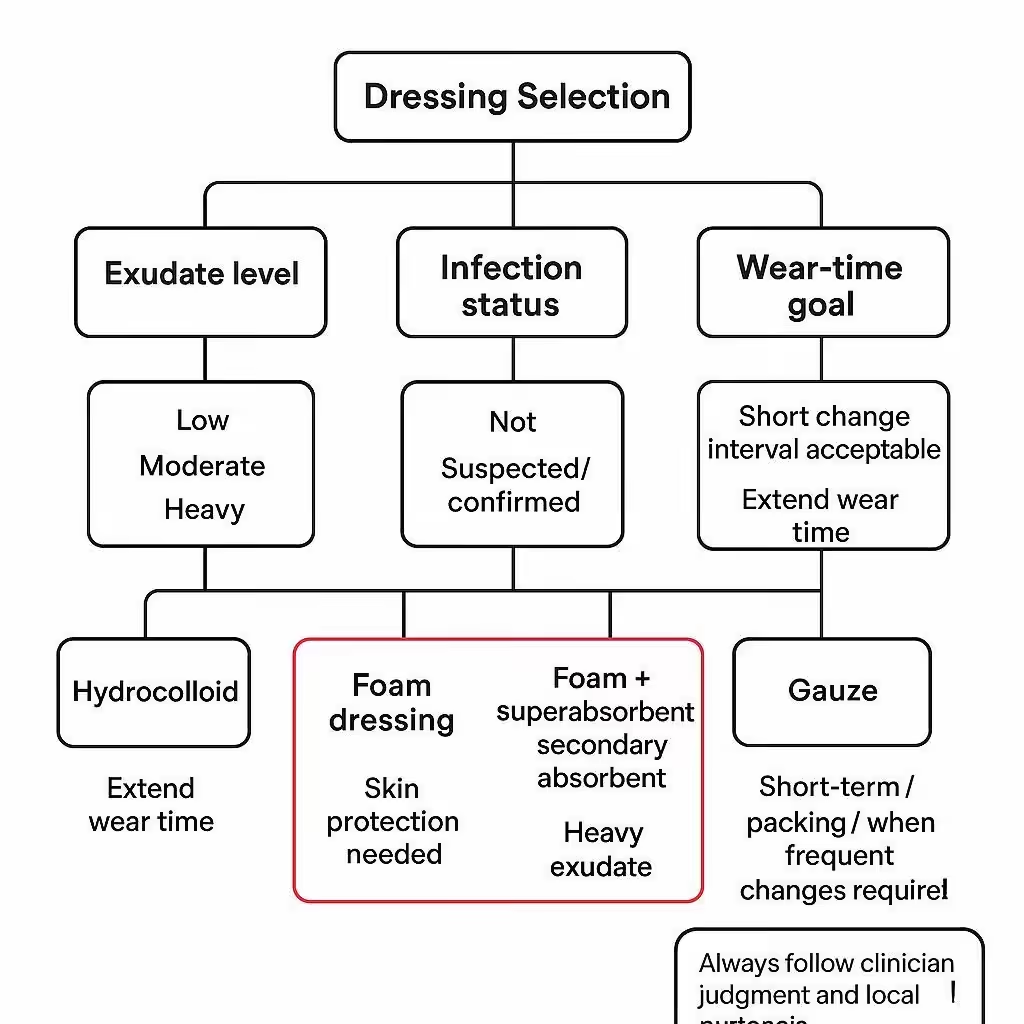
Practical procurement implication: don’t evaluate “foam” or “hydrocolloid” as monoliths. Evaluate the intended exudate band and the failure mode you’re trying to prevent (leakage, maceration, edge lift, or frequent changes).
Wear intervals and change rate
Wear time is not a marketing number. It is a result of whether the dressing stays intact, keeps the wound in moisture balance, and avoids strike-through.
Hydrocolloid wear-time guidance commonly referenced in clinical education materials is in the 3–7 day range, with earlier change if exudate approaches the edge, leakage occurs, or the wound status changes. See Wounds UK, “Choosing the appropriate dressing: hydrocolloids”.
Foam dressings also often aim for multi-day wear, but wear interval collapses quickly when exudate is higher than the construction can retain. Wounds UK’s review, “What is the current status of foam dressings?”, emphasizes variation across foam designs.
For distributors, the actionable move is to build tender pricing around expected change rates by setting (acute care vs long-term care vs home health) rather than assuming the label wear time will be realized.
Edge seal and skin protection
A dressing that leaks once can erase any unit-price savings.
Border design, adhesive chemistry, and contact-layer behavior affect edge seal. The same is true for periwound protection in high-moisture zones (sacrum, groin, under compression). When skin is fragile or the wound sits in a high-shear location, the choice often becomes less about theoretical absorbency and more about whether the system stays put without causing skin trauma.
If you want an internal primer on category-level tradeoffs in plain language, SLK Medical’s foam dressing basics can be used as an educational link for distributor teams.
Economic value and total cost
Cost drivers and model inputs
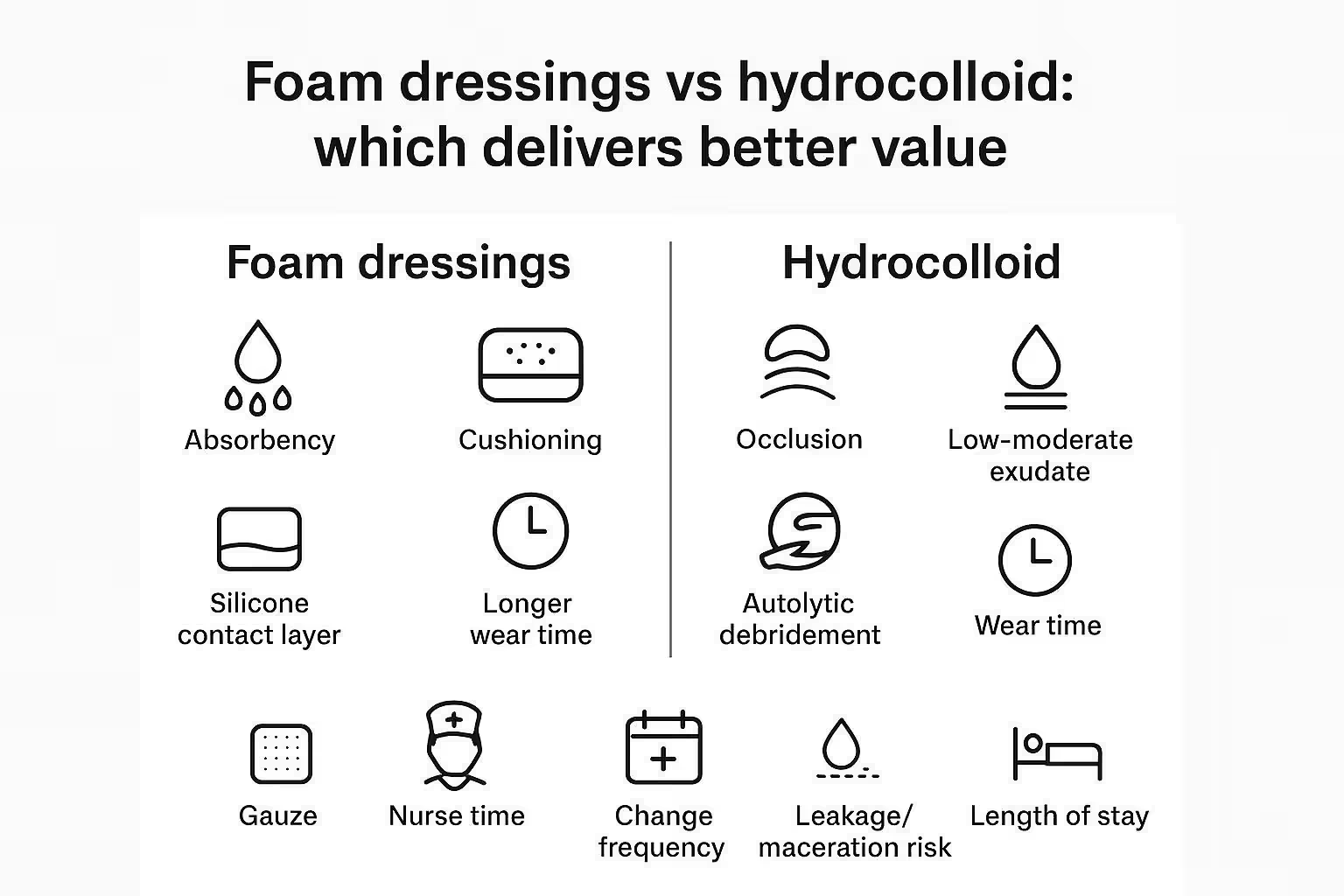
If you’re doing value analysis, use the same inputs your hospital customers care about:
Dressing change frequency (expected changes per week)
Nursing time per change (minutes)
Secondary materials (barrier film, fixation, secondary absorbent, skin protectant)
Complication risk proxies (leakage events, maceration, dressing-related skin injury)
Length of stay (LOS) sensitivity (where relevant)
A basic template:
Weekly dressing cost = unit price × changes/week
Weekly labor cost = (nursing minutes/change × changes/week) × labor rate
Leakage/skin event cost = event probability × event handling time/cost
Key Takeaway: The value winner is usually the dressing that reduces changes per week in the real setting, without increasing leakage, skin injury, or monitoring burden.
Scenario: moderate–heavy exudate
This is where gauze and low-capacity options typically become expensive.
If exudate is moderate-to-heavy, a low-absorbency choice often drives frequent changes and raises leakage risk.
In practice, foam dressings (or foam combined with a higher-capacity absorbent layer, depending on protocol) can lower change frequency versus gauze, and can be easier to operationalize than an occlusive dressing that struggles with higher output.
Hydrocolloids are often deprioritized in this band because occlusion plus higher fluid load increases maceration risk and makes failure harder to manage.
Keep the claim conservative: you’re not promising fewer infections or faster healing. You’re modeling fewer changes and fewer failure events.
Scenario: low–moderate exudate
This is where hydrocolloid can deliver strong value, if the wound is appropriate.
When exudate is low and the wound is clean, hydrocolloid can be a cost-effective way to maintain moist healing with extended wear time.
Foam can still be a good pick when cushioning, conformability, or fragile skin removal matters, even if exudate is not high.
Gauze may still be used for short-term coverage, packing, or when frequent inspection is required, but it is typically a weaker default choice for maintaining moisture balance over multiple days.
Compliance essentials
FDA 510(k) and UDI
In US tenders, the compliance question is not “Is it FDA?” but “What is the device’s regulatory pathway and labeling readiness?”
For the general process, reference the FDA’s overview of 510(k) Premarket Notification.
Confirm that labeling and traceability align to the FDA UDI System, including device identifiers and production identifiers where applicable.
Procurement checklist items to request:
Device listing/registration details as applicable
UDI labeling examples (unit pack, carton)
IFU and indication statements aligned to intended use
EU MDR and Notified Body
Under EU MDR, conformity assessment depends on classification (including whether the device is sterile, has special claims, or falls into higher risk classes).
Use the legal text Regulation (EU) 2017/745 (MDR) as the primary reference.
For the role of Notified Bodies and how they are designated, see the European Commission page “Notified bodies for medical devices” and the official directory NANDO.
Practical checklist items:
CE certificate scope (device family, sterile status)
Notified Body details where required
PMS plan summary and vigilance contact
ISO 13485/10993 and EN 13726
These standards show up repeatedly in tender requirements because they map to controllable risk.
ISO 13485 is the quality management system standard commonly expected for medical device manufacturers; see ISO’s overview of ISO 13485 (2016).
ISO 10993-1 is the cornerstone for biocompatibility evaluation within a risk management process. The FDA maintains guidance on use of ISO 10993-1.
EN 13726 specifies test methods for primary wound dressings (absorbency, adhesion, fluid transmission). In tenders, ask for the test summary and methods used, not just a marketing claim.
Selection framework by wound type
Pressure injuries
If the goal is prevention or microclimate management at bony prominences, silicone foam has peer-reviewed evidence in selected contexts (prevention setting). For example, the 2025 PubMed Central meta-analysis “Efficacy of silicone foam dressings in preventing pressure injuries…” is one widely cited reference.
For treatment dressings, align selection with exudate level, skin tolerance, and wear-time goals, and avoid overstating comparative healing outcomes.
Post-op and donor sites
Evaluate expected drainage and monitoring needs.
Hydrocolloid can fit low-exudate, clean situations.
Foam often fits better when drainage is more variable or when cushioning and skin-protection at removal are priorities.
DFU and VLU
These wounds are where procurement mistakes become expensive.
In DFU/VLU, exudate management and periwound protection are often decisive.
If infection is suspected or confirmed, occlusive dressings can be less practical because monitoring and exudate handling become harder. Lean conservative and follow clinician protocols.
Conclusion
Foam and hydrocolloid both outperform gauze in moist healing contexts, but they win value in different ways.
Choose by exudate band, wear interval goals, infection status, and skin risk.
Judge value via total-cost drivers and setting-specific scenarios.
Verify compliance documents and performance claims before tenders.
If you’re building a tender shortlist, a practical next step is to request a procurement-ready document pack (IFU, labeling/UDI examples, ISO 13485 evidence, biocompatibility summary per ISO 10993-1, and available EN 13726 performance summaries) plus a sampling plan that matches your highest-volume wound types.
For a neutral internal comparison reference on the same topic, see SLK Medical’s silicone foam vs hydrocolloid comparison.