If you’re evaluating a foam dressing OEM manufacturer for North America or the EU, you’re juggling two priorities: fine‑tuning the product configuration to fit real clinical needs and locking in reliable delivery at a sensible total cost. This guide gives procurement teams, product managers, and hospital Materials Management leaders a practical playbook to do both—without guesswork.
You’ll find exactly what documentation to request, how to read performance data (with methods and units), realistic ranges for MOQ and lead times, and a clear view of customization levers—from silicone gel contact layers and Ag options to backing films and absorbency curves. Our aim is simple: help you compare suppliers like‑for‑like and de‑risk your first purchase order.
What “Good” Looks Like for a Foam Dressing OEM Manufacturer
A strong partner can customize construction while evidencing quality and regulatory readiness. At minimum, expect to see:
A current ISO 13485 certificate and a documented ISO 14971 risk process.
Biocompatibility aligned to ISO 10993 for breached/compromised skin contact (method matrix disclosed).
Performance reports with declared methods and units, e.g., EN 13726:2023 subtests for absorption/retention/MVTR (method variant named), and if antimicrobial, quantitative organism/log-reduction data from an ISO 17025‑accredited lab.
Sterilization validation summaries for EO (ISO 11135) or radiation (ISO 11137), including SAL 10^-6 rationale and packaging integrity tests.
Labeling/UDI readiness for the US (21 CFR 801/830 and GUDID) and EU (MDR Annex I + Annex VI and EUDAMED).
New to foam dressings? For quick context on indications and wear considerations, see this educational overview on foam fundamentals: Beginner’s guide to foam dressings.
Map Clinical Scenarios to Product Designs (So You Compare Like‑for‑Like)
If two quotes aren’t built for the same wound environment, the cheaper unit price can be the costlier choice in practice. Match the design to the scenario before you compare.
Think of construction like tailoring. High‑exudate wounds may need a thicker foam core plus a superabsorbent insert, while fragile peri‑wound skin often benefits from a soft silicone contact layer with a defined peel window. Contoured areas (heels, sacrum) favor shaped, bordered options; shallow, low‑exudate sites might suit lite or transfer foams beneath a secondary dressing. Ask yourself: are you scoring the right thing, or simply the easiest thing to measure?
A few practical examples:
High exudate, trunk site: bordered silicone foam with superabsorbent layer; higher total uptake and retention under compression; backing film with balanced MVTR and showerproofing. Example product reference: 5-layer silicone foam dressing with border (skin color).
Fragile skin, frequent changes: lite silicone foam for low-exudate sites, designed to be softer on sensitive skin; specify a peel-strength window and check residue during removal. Example product reference: silicone foam dressing lite.
Irregular geometry (heels/sacrum): anatomically shaped, bordered designs that maintain seal and conformability under movement. Example product reference: composite silicone foam dressing (pink color).
Post-op incisions or areas where edge control matters: bordered flex constructions can help manage movement-related lift; confirm corner radii, border width, and wear-time expectations during sampling. Example product reference: silicone foam dressing border flex.
Regulatory & Standards You Must Verify (United States & EU)
United States: FDA baseline credentials and why sample testing matters
For many advanced dressings, the US regulatory pathway depends on intended use, claims, and the exact build. From a buyer’s standpoint, you can keep the first gate simple: confirm the manufacturer can support FDA establishment registration and the appropriate device listing for the specific product you’re sourcing, and that labeling/traceability is ready for UDI.
For UDI references, start with the FDA’s UDI System overview and the eCFR text for 21 CFR 801 Subpart B.
Now the practical part: paperwork doesn’t tell you whether two “foam dressings” behave the same. Require samples and measure what you plan to buy:
Absorption/retention (with method and units)
MVTR (method variant disclosed)
Peel strength and residue observations on a defined substrate
Edge lift and conformability on the target anatomy (flat vs. contoured)
To see the range of advanced wound dressing configurations SLK Medical manufactures (e.g., silicone contact-layer variants, Ag options, superabsorbent builds, bordered/non-bordered and shaped formats), you can review the Advanced Wound Dressing product category and align your sample matrix to the constructions you’re actually considering.
EU MDR Rule 4 classification logic and UDI/labeling
Under MDR Annex VIII Rule 4, classification depends on wound characteristics, duration of use, and mode of action. Many advanced dressings for wounds healing by secondary intention are Class IIb; simpler use cases may fall in Class I/IIa. For practical classification decision pathways, see the Commission’s guidance: MDCG 2021‑24 classification guidance.
EU UDI and labeling are specified by MDR Articles 27–29 and Annex VI (Parts B & C); the Medical Device Coordination Group provides accessible Q&A and user guides: EU UDI Q&A (MDCG) and the EUDAMED UDI/device user guide.
Core standards you should see in the file
You don’t need to memorize every clause—just know what to ask for and why.
ISO 13485: evidence of a functioning medical‑device QMS; confirm scope includes foam dressings and sites of manufacture.
ISO 14971: risk management file with identified hazards (adhesive‑related skin damage, residue, maceration), mitigations, and post‑market feedback loops.
ISO 10993 suite: biological evaluation fit for breached/compromised skin contact; chemical characterization (10993‑18) plus cytotoxicity (‑5), irritation/sensitization (‑10), and systemic endpoints as justified.
EN 13726:2023: test methods for dressings (absorption, retention under load, MVTR); ask for the exact subtest variants, temperatures, humidities, and units. Public catalog references are limited; an official annual reference acknowledging the standard’s scope appears in the DIN publication: DIN annual reference mentioning EN 13726:2023.
ISO 11135/11137: sterilization validation (EO or radiation) with SAL 10^-6 and routine controls; for practical overviews, see AAMI’s process control notes: AAMI radiation dose‑setting overview and a global testing services summary: SGS medical device sterilization overview.
ISO 14644: cleanroom classification and monitoring appropriate to each operation (film lamination, die‑cutting, pouching); verification should show particle counts and environmental controls.
Performance Benchmarking (With Methods & Units)
Performance numbers only matter when methods and units travel with them. MVTR, for instance, can swing dramatically depending on the cup method used. Always ask suppliers to report the method identifier and conditions (e.g., EN 13726 variant, temperature/humidity, load).
Below is an illustrative, method‑declared benchmarking view you can adapt for sample scoring. These are example ranges often encountered in market evaluations; use them to structure your comparison, not as universal targets.
Attribute | Example Range | Units | Method notes |
|---|---|---|---|
Total fluid uptake (no load) | 6–18 | mL/100 cm² | EN 13726 absorption subtest, 23°C/50% RH |
Retention under compression | 60–85 | % retained | EN 13726 retention under 40 mmHg load |
MVTR (film‑backed foam) | 500–1200 | g/m²/24 h | EN 13726 MVTR variant disclosed (upright vs inverted) |
Peel strength (silicone contact) | 0.5–1.5 | N/cm | Internal method or EN‑aligned; disclose substrate/angle/speed |
Antimicrobial log reduction | ≥3–5 | log10 | Organism panel and contact time disclosed; ISO 17025 lab |
Method dependence is everything here. If one supplier uses an inverted cup MVTR and another uses upright, you’re not comparing the same thing. Here’s the deal: insist on method labels in every cell of your evaluation sheet.
The Customization Playbook (Materials, Adhesives, Backings, Ag, Sizing)
Customization is where product performance meets patient comfort and clinician workflow. Below are the levers that materially change outcomes and the evidence you should expect.
Absorbent core and superabsorbent options
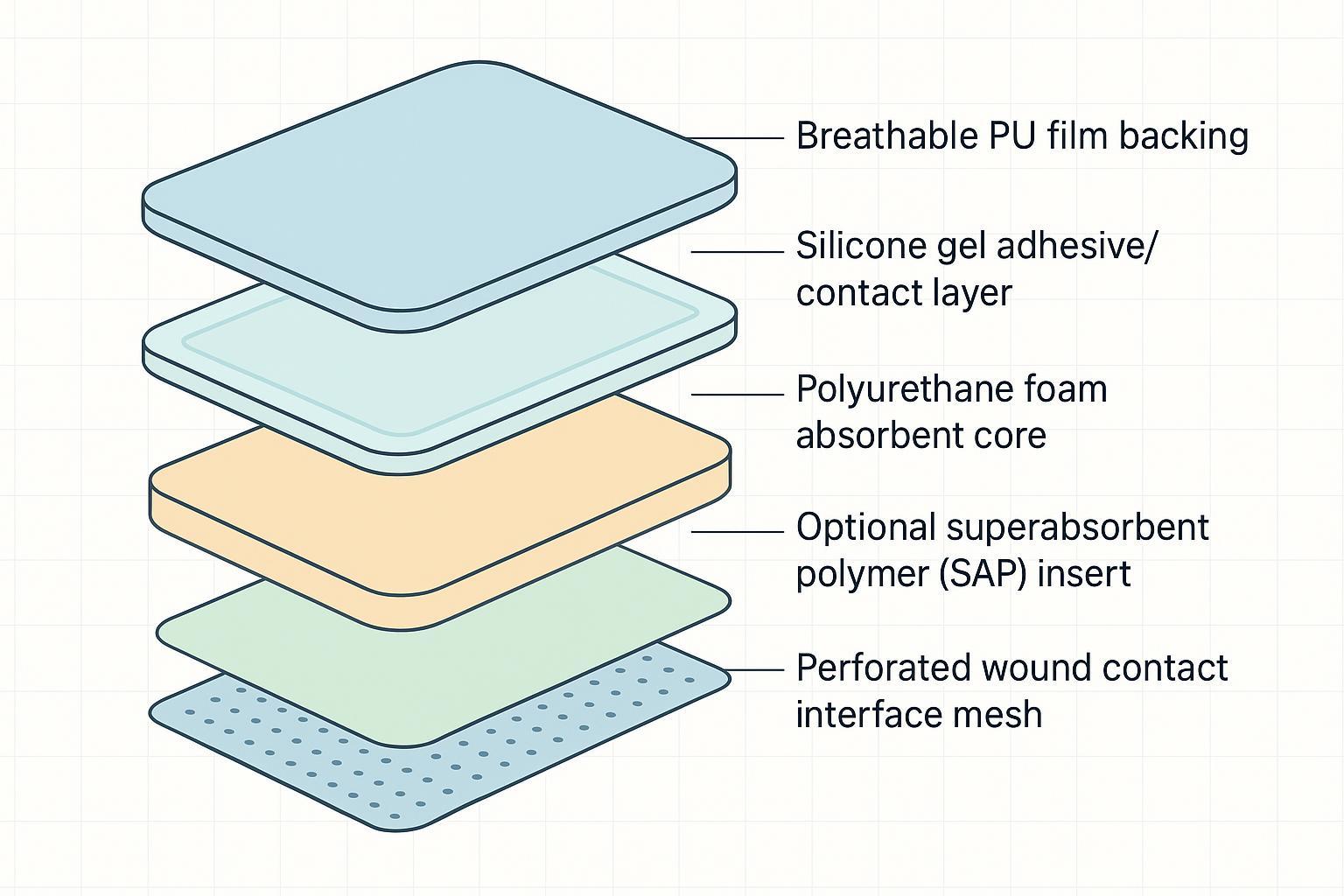
Specify foam density and pore size distribution; for high‑exudate indications, consider a superabsorbent (SAP) insert to increase total uptake and retention under compression. Document how thickness impacts conformity and edge lift risk in your DFM notes.
Adhesion strategy (soft silicone vs. acrylic)
Soft silicone contact layers support atraumatic removal and are often preferred for fragile skin. Ask for peel‑strength windows (N/cm) with test conditions and a residue criterion. Acrylic adhesives may hold better under shear on mobile sites but can increase skin‑stripping risk; they require careful substrate disclosure during testing.
Backing film MVTR and showerproofing
PU films vary widely in MVTR and elongation. Specify your MVTR target together with the method, and confirm water resistance claims align with real‑world wear (e.g., showerproof for up to X minutes isn’t the same as “waterproof”).
Antimicrobial (Ag) options and evidence expectations
If you pursue silver (Ag) dressings, request quantitative organism/log‑reduction data with contact times that mimic intended wear. As a reality check on evidence structure, see FDA 510(k) examples such as K223526 ALLEVYN Ag+ dressing and K221754 silver foam; note how the summaries align claims, biocompatibility, and sterilization.
Geometry, thickness, and fit
Match shape to site—anatomical heel/sacrum options for curves; bordered islands for seals on flat surfaces; transfer foams under secondary fixation when you need flexibility in dressing changes. Confirm thickness tolerances and corner radii to minimize edge lift.
Commercial Reality Check — MOQ, Samples, Lead Time, and Cost Levers
OEM terms vary by construction complexity, sterilization route, packaging, and capacity utilization. Directionally, many buyers observe MOQ bands from 5,000 to 50,000+ units; larger, shaped, or antimicrobial SKUs trend higher. Samples often arrive in 3–21 days, while first custom projects may require 6–8 weeks for tooling, validations, and IFU/package prep. Production lead times of 4–12 weeks after approval are common, and sterilization logistics can add transit days or batching constraints.
As a directional (non‑regulatory) illustration, some B2B listings indicate 5,000–10,000 piece MOQs and 25–30 day build times for stock‑adjacent SKUs; treat such listings as signals, not standards, for regulated private‑label programs. One example reference: Made‑in‑China listing with stated MOQ/lead time.
Cost and timeline can improve when you reduce unique die‑cut sizes at launch, harmonize pouch/carton SKUs to cut changeovers, lock the sterilization provider and cycle earlier to avoid re‑validation, and pre‑qualify alternates for foams, films, and silicone gels to cushion shortages.
Risk & Supply‑Chain Resilience (So You Don’t Stall Mid‑Project)
Raw‑materials volatility: Establish buffer stock and at least one qualified alternate for PU foam, silicone gel, backing films, and SAP. Tie alternates to change‑control plans.
Change control: Require formal notifications for adhesive chemistry shifts, film thickness/MVTR changes, sterilization parameter adjustments, and key supplier substitutions. Reassess biocompatibility and validations as needed.
Regulatory drift: Track FDA classification actions that affect dressing subsets and monitor standard revisions. For example, FDA’s recent classification briefings clarify special controls trajectories for certain wound dressing categories: FDA absorbable wound dressings briefing and FDA topical hemostats briefing.
FAQ — Short Answers to Common Buyer Questions
Q: Do silicone foam dressings require a 510(k) for the US? A: Many advanced foams, including numerous silver‑containing products, proceed via 510(k). Verify by locating comparable predicates in the FDA database and reviewing the 510(k) summaries for device description, indications, and performance evidence (see K223360, K223526, K221754, K213473 above).
Q: What MOQ is typical for private‑label foam dressings? A: Directionally 5,000–50,000 units per SKU, higher for shaped or antimicrobial variants. Actuals depend on construction, sterilization, and packaging changeovers.
Q: How long do samples and first production runs take? A: Samples often in 3–21 days; first custom projects may add 6–8 weeks for tooling and validations. Production runs commonly take 4–12 weeks post‑approval.
Q: Why do MVTR and absorption results vary so much across suppliers? A: Because methods differ. MVTR alone can swing with upright vs. inverted cup approaches; absorption and retention vary by temperature, humidity, and load. Always require method labels and units (e.g., EN 13726 variants).
Q: What do I need to launch in the EU regarding UDI? A: Assign Basic UDI‑DI and UDI‑DI per MDR Annex VI and plan EUDAMED entries. The Commission’s documents explain the process in practical terms (see the UDI Q&A and EUDAMED user guide linked earlier).
For clinician‑facing wear‑time context that may influence your packaging and IFU, this explainer offers a helpful overview: How long can a silicone foam dressing stay on?.
Next Steps
Define the clinical scenarios and indications you intend to serve; decide on adhesion strategy, core thickness, and whether you need Ag or SAP.
Request method‑declared samples and EN 13726 reports with units and conditions, plus peel data and residue criteria.
Obtain ISO 13485, ISO 14971 evidence, ISO 10993 biocompatibility summaries, and sterilization validation overviews (ISO 11135/11137).
Align on labeling/UDI for the US (21 CFR 801/830 + GUDID) and EU (MDR Annex I + Annex VI + EUDAMED) early in the process.
Confirm MOQ bands, lead‑time windows, and sterilization slots; identify alternates for critical materials and codify change‑control.
When you can compare apples to apples—with methods, units, and documents in hand—you’ll shortlist a foam dressing OEM manufacturer that fits your markets and your timelines with fewer surprises later.