


Introduction
Choosing between foam, hydrocolloid, and alginate dressings shouldn’t come down to habit or what’s on the shelf. This guide is meant to support evidence-informed selection across common inpatient, outpatient, and long-term care settings.
Audience: WOC/WOCN nurses, unit leaders, and procurement/value analysis teams across acute care, outpatient, and long-term care settings globally.
Key takeaway: match the dressing family to exudate level, wound depth (including cavities/undermining), infection or bioburden risk, peri-wound skin fragility, and how often the wound needs inspection. A good match reduces leakage, maceration, and unnecessary dressing changes.
Clinical note: This is general educational information and should be used alongside your facility protocols and clinician judgment.
Global practice note: Dressing availability, regulatory requirements, and clinical protocols vary by country and facility. Use this guide alongside local guidelines, formularies, and institutional policies.
Decision drivers for selection (foam vs hydrocolloid vs alginate dressings)
Exudate level and wear time
Start with exudate. It drives both dressing selection and how often you’ll be changing it.
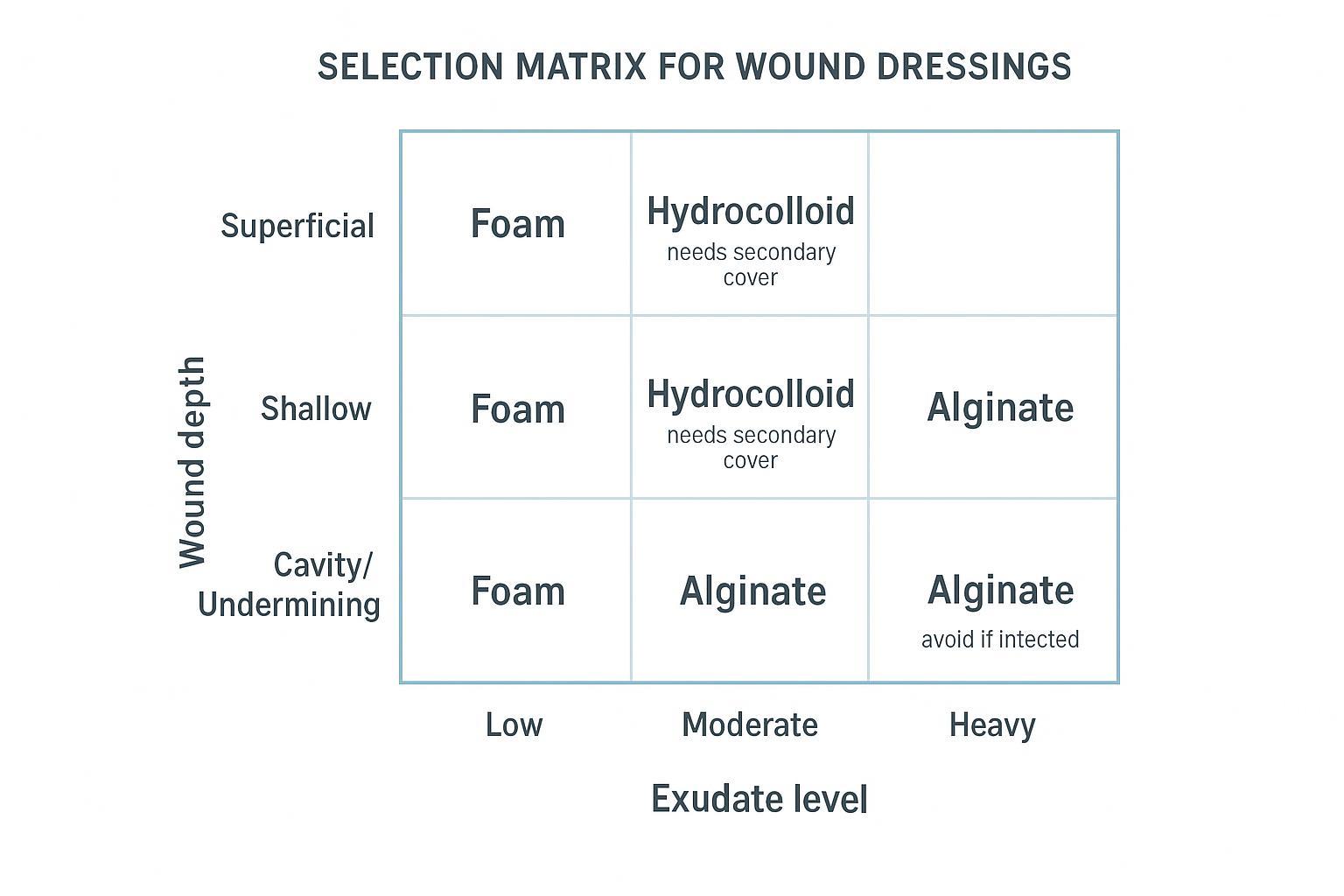
Low exudate: hydrocolloids often fit best when the wound is shallow and not infected, because they maintain a moist environment and can stay in place for several days (when appropriate), as summarized in Choosing a Wound Dressing Based on Common Wound Characteristics (PMC, 2016).
Moderate exudate: foams are commonly used for absorption plus protection. Wear time varies by construction and exudate load, so plan change timing around saturation, edge lift, and leakage risk.
Heavy exudate: alginates are designed to absorb high volumes and gel with exudate. They’re often used when you need strong fluid handling and conformability (with the right secondary cover).
Practical “stop” signals (regardless of dressing family): strike-through on the backing, leakage, new peri-wound maceration, or odor that’s new for the wound’s baseline.
Depth, cavities, and inspection needs
Depth and inspection needs are where “good on paper” dressing choices can fail in practice.
Superficial/shallow wounds: hydrocolloids or thin foams can work when exudate is low to moderate and the wound needs protection with fewer changes.
Cavities, undermining, and irregular contours: alginate ribbons/sheets are commonly used because they can be lightly packed to contact wound surfaces and manage exudate. Foams can also be used depending on the cavity geometry and whether the clinician needs cushioning or additional protection.
Frequent inspection needs (unstable wound, unclear bioburden status, or rapid exudate change): choose a dressing strategy that allows safe removal and re-application without repeated skin trauma. If a product is highly occlusive or difficult to remove intact, it can slow assessment.
A packing reminder: the goal is gentle contact, not pressure. Overpacking increases local pressure and can complicate healing.
Infection status and skin fragility in foam vs hydrocolloid vs alginate dressings
Two things to keep separate: (1) infection or suspected high bioburden, and (2) fragile peri-wound skin.
Infection/bioburden concern: hydrocolloids are commonly avoided in clinically infected wounds because occlusion can make monitoring harder and they’re not intended as an antimicrobial strategy. Some clinical guidance also lists infection as a contraindication for hydrocolloid dressings (e.g., Royal Children’s Hospital Melbourne guideline on acute traumatic wound dressings). If an antimicrobial dressing is used (including silver), treat it as a time-limited trial with reassessment.
Fragile skin / MARSI risk: strong adhesives and frequent border removal are common failure points. The 2016 PMC review above notes hydrocolloid adhesive backing can damage new epidermis or surrounding skin in some patients with fragile skin.
Alginate edge risk: alginates can wick laterally when overloaded, which can contribute to peri-wound maceration if the secondary cover and change schedule don’t match the exudate level (also discussed in the same PMC review).
Foam dressings: indications, cautions, and change triggers
Foam dressings are commonly used when you need absorption plus protection, especially in wounds where friction and shear are concerns.
Typical fit (examples):
Pressure injury (especially when exudate is present and you need protection over bony prominences)
Venous leg ulcer (often under compression when exudate control is needed)
Diabetic foot ulcer (DFU) and post-op incisions when exudate management and protection are the priority and the overall plan supports moisture balance and inspection
Foam cautions to keep in mind:
Very dry wounds can be over-dried.
If exudate overwhelms the dressing, edge lift and leakage can follow quickly.
Change triggers you can standardize:
Visible strike-through or edge leakage
New peri-wound maceration
Persistent edge lift that can’t be corrected with securement
Pain escalation on wear (consider moisture imbalance, adhesive trauma, or infection status)
Silicone interfaces and MARSI risk reduction
If MARSI is a recurring problem, pay attention to the contact layer.
Silicone interfaces are often selected to support gentler removal and reduce epidermal stripping compared with more aggressive adhesives. In practice, MARSI risk also depends on technique (slow removal, low angle, skin support) and on how often borders are removed.
For teams building a silicone-foam standardization pathway, a manufacturer explainer can help with baseline staff alignment on terminology and use patterns (example: SLK Medical educational explainer on silicone foam dressing). Always anchor local policy to independent clinical guidance and institutional protocols.
When to consider silver foam and reassessment
Silver dressings are about bioburden management, not routine “better healing.” That stewardship mindset matters for both clinical consistency and formulary governance.
A pragmatic approach aligned with consensus guidance:
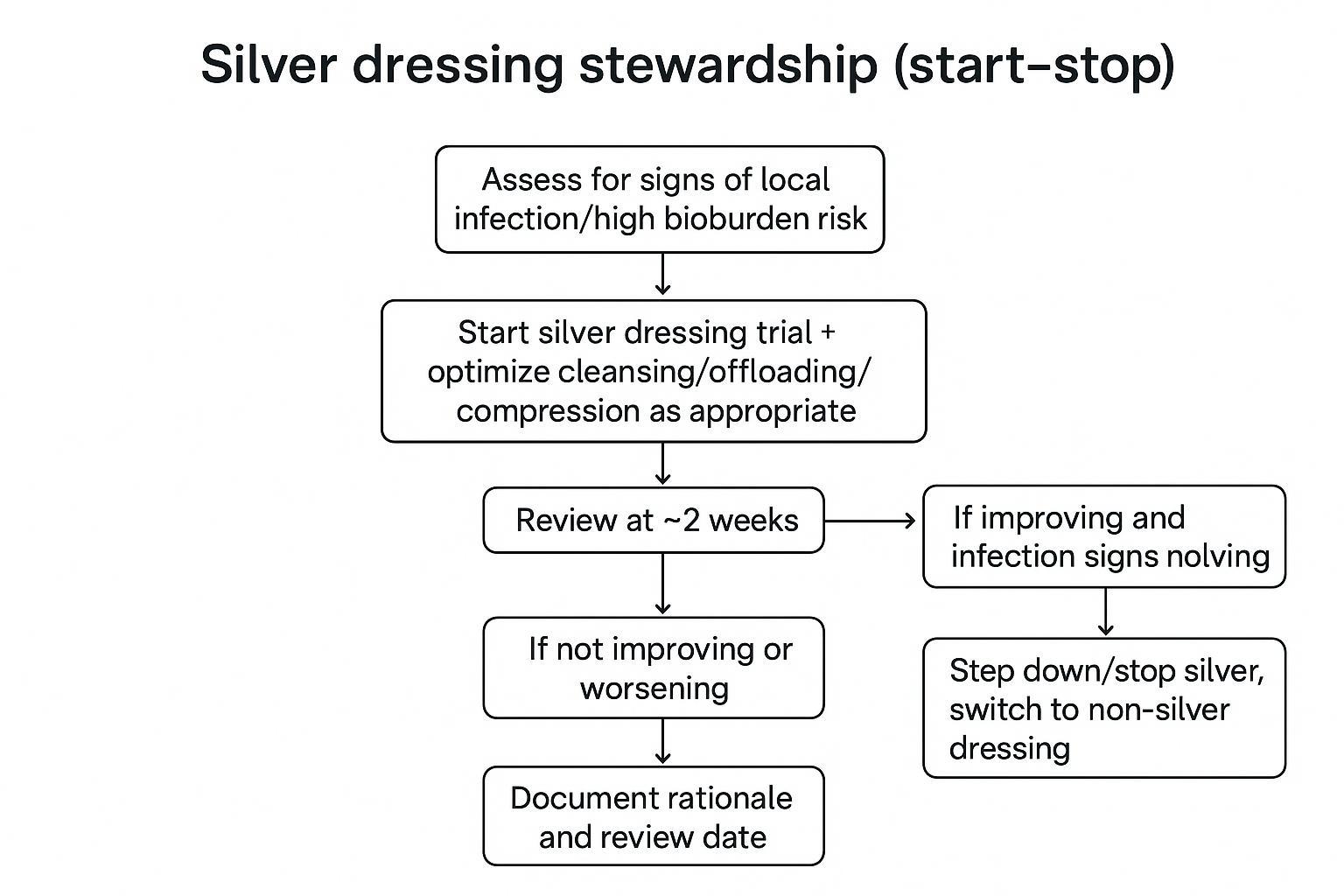
Start a silver dressing when there are signs of local infection or high bioburden risk and your wound plan supports topical antimicrobial use.
Optimize fundamentals at the same time (cleansing, offloading for DFU, compression for VLU when indicated, and peri-wound protection).
Reassess around the two-week mark and decide whether to continue, step down, or change approach.
Two useful references to align your local policy language (linked once here for stewardship teams):
Wounds UK Best Practice Statement: Use of silver dressings in wound care (PDF)
Wounds International consensus: Appropriate use of silver dressings in wounds (English)
These consensus documents support a time-limited trial approach (commonly ~2 weeks) followed by reassessment and step-down when antimicrobial control is no longer indicated.
For a foam-specific comparison discussion, a manufacturer explainer can be a practical staff reference (example: SLK Medical on silicone foam vs silver foam), but facility policy and patient-specific assessment should govern silver start–stop decisions.
Brand insertion note
If you’re standardizing foam dressings (especially silicone foam) across units, two implementation realities usually matter more than the brochure:
Consistency of removal technique and skin protection. Silicone interfaces are often chosen to support atraumatic removal, but staff technique and peri-wound barrier use are still the difference between “works well” and repeat MARSI events.
Training and rollout support. SLK Medical can support facility education for silicone foam selection and application (for example: in-service training, quick-reference cards, and product-use onboarding) as part of a broader standardization effort. The goal is fewer selection errors, fewer unscheduled changes, and cleaner documentation.
Hydrocolloid dressings: where they fit and where to avoid
Hydrocolloids are a strong option for the right wound: shallow, low to moderate exudate, and a need for longer wear with a sealed environment.
Where they fit best:
Superficial pressure injuries with low exudate when occlusion is appropriate
Selected post-op wounds where exudate is limited and infection risk is low
Where to avoid or use with high caution:
Suspected or confirmed infection (monitoring and reassessment become harder under an occlusive dressing)
Heavy exudate, where leakage and maceration risk rises
Fragile peri-wound skin, especially if frequent changes are expected
Autolytic debridement and occlusion limits
Hydrocolloids support autolytic debridement by maintaining moisture at the wound surface. That’s helpful in some sloughy wounds, but occlusion can also reduce how often clinicians visually inspect the wound.
One common operational issue: hydrocolloids can produce a yellow, malodorous gel when they absorb exudate. That “gel and smell” effect can be normal and shouldn’t automatically be interpreted as infection without other signs (described in the PMC review referenced earlier).
Adhesive considerations in fragile skin
Hydrocolloids are adhesive by design. In fragile skin (older adults, long-term steroid use, skin atrophy), consider:
minimizing change frequency when clinically safe
protecting peri-wound skin with a barrier product per facility protocol
removing at a low angle with skin support
If the patient’s skin can’t tolerate hydrocolloid removal, step down to a gentler contact layer and adjust securement strategy.
Alginate dressings: managing heavy exudate and cavities
Alginates are designed for moderate to heavy exudate and are often used in cavities or irregular wounds that benefit from conformable packing.
Clinically common scenarios include:
Venous leg ulcers with higher drainage levels
DFU with moderate to heavy exudate (with offloading and infection assessment as indicated)
Pressure injuries with depth/undermining and significant exudate
Two practical cautions:
Avoid in very dry wounds because removal can be traumatic.
Watch for lateral wicking and peri-wound maceration if the secondary cover or change cadence is insufficient.
Packing technique and complete removal checks
Packing is where alginate either helps or becomes a problem.
Lightly fill the cavity to maintain contact. Don’t pack tightly.
Leave an accessible tail (when appropriate) so removal is complete.
At each change, inspect to confirm complete removal; retained material can interfere with assessment.
Hemostatic use and secondary cover choice
Many alginates contain calcium, which supports hemostasis in minor bleeding scenarios. Operationally, they nearly always need a secondary dressing.
Secondary cover choice should match the exudate load and the need for securement:
foam cover when you need additional absorption and protection
film/other covers when exudate is controlled and securement is the main goal
Safety, stewardship, and monitoring
This is the part that makes formularies work in the real world. Without consistent monitoring and stop rules, “advanced dressings” turn into variability.
Silver start–stop (about 2-week reassessment)
Silver dressings should be used with a documented rationale and review date, not as an indefinite default.
A simple stewardship frame:
start silver when infection/bioburden indicators support it
reassess at about 2 weeks
stop/step down when signs resolve, or re-plan if the wound isn’t improving
Monitoring for leakage, maceration, and edge lift
When to escalate care (stop rules)
Escalate per your local protocol and clinician judgment when any of the following are present:
Systemic illness (e.g., fever, rigors, hypotension, tachycardia) or other signs of spreading infection
Rapid deterioration in wound appearance, new necrosis, or severe/uncontrolled pain
Suspected critical limb ischemia / poor perfusion (e.g., very cold foot, rest pain, non-palpable pulses per facility assessment pathway)
Heavy bleeding that does not stop with local measures
New malodor with increasing exudate plus peri-wound erythema/warmth suggesting worsening infection
This guide does not replace urgent evaluation, antimicrobial stewardship programs, or specialist referral pathways (e.g., vascular, infectious disease, wound/ostomy services).
Standardize what “needs a change” means:
Leakage/strike-through: the dressing is overwhelmed. Change the dressing and reconsider the family (foam → alginate/higher capacity, hydrocolloid → foam/alginate) and/or change frequency.
Maceration: treat as an exudate management failure until proven otherwise. Reassess dressing capacity, fit/shape, and peri-wound protection.
Edge lift: can indicate shear, poor fit, or exudate overload. Reassess securement and whether the dressing geometry matches anatomy.
Cost-in-use and implementation for VAF/VBP
From unit price to total cost-in-use
Procurement discussions often get stuck on unit price. A more defensible model is cost-in-use:
expected wear time (and how often unscheduled changes occur)
nursing time per change
add-ons (secondary covers, securement)
complication costs you can track operationally (leakage events, MARSI incidents, supply waste)
A lower unit price can still cost more if it drives more frequent changes, more leakage, or more skin injury-related dressing churn.
Standardization, change frequency, and data tracking
Standardization works when it is paired with simple measurement.
Implementation steps that tend to stick:
Define a small set of “default” dressing pathways by exudate level and depth (matrix + unit reference card).
Align silver stewardship language and review timing across units.
Track a few practical indicators: change frequency, leakage/maceration rates, and MARSI events.
If you need manufacturer-facing references for product families while building a foam standardization package, SLK Medical’s silicone foam product-category hub (linked once here) can support navigation: silicone foam dressing manufacturer.
Conclusion
No single dressing is superior for healing across wounds. Fit-to-wound wins.
Use decision drivers plus consistent monitoring to balance outcomes, comfort, and cost.
Next step (procurement-grade): if you’re standardizing silicone foam options, request a spec sheet/IFU pack and a sampling plan, and ask for unit in-service training so selection and removal technique stay consistent across shifts.


