


Clinical note (last updated: 2026-06-04): This article is for clinician education and does not replace local protocols or individual clinical judgment. For patient-specific decisions, follow your facility guidelines and consult an appropriate wound care specialist.
Introduction
Foam dressings sit in a practical middle ground for many facilities: more forgiving than gauze for exudate control, often more comfortable for the patient, and easier to standardize across units when staff turnover is real.
In day-to-day practice, foam dressings are commonly used for three jobs:
-
Prevention at high-risk bony prominences (as an adjunct to repositioning and offloading)
-
Exudate handling to reduce leakage and periwound maceration
-
Comfort and skin protection, especially when fragile skin or medical-adhesive–related skin injury (MARSI) risk is part of the picture
This guide is written for clinicians and teams who make selection decisions and have to live with the downstream operational effects:
-
WOC/WCC nurses and wound program leads
-
Unit-based nurses and nurse managers
-
Value analysis/procurement partners standardizing formularies and education
The goal isn’t to replace your facility protocol. It’s to make your foam-dressing choices more consistent, easier to teach, and easier to audit. When evidence is limited, use a stewardship mindset: start with the wound’s needs (exudate, periwound condition, infection risk), reassess on a schedule, and de-escalate when the “why” is no longer there.
Evidence-guided use
Practice snapshots (from bedside)
The following de-identified examples show how clinicians often apply the same selection logic in real units. Details should be adapted to local protocols and patient factors.
Case 1 — Inpatient pressure injury with moderate exudate (hip): After debridement, a standard soft silicone foam was selected for a left-hip pressure injury with moderate drainage and intact periwound. Silver was not used because there were no infection concerns. Dressing frequency was titrated to drainage: q1–2 days early, then q3–4 days, and up to ~7 days when exudate decreased and the seal remained intact. Outcome: the wound progressed well and healed without pressure-injury complications.
Case 2 — Inpatient lower-extremity arterial ulcer with maceration risk: With moderate exudate and macerated periwound, and the patient taking anticoagulants (so sharp debridement was avoided), the team used an inner alginate with silver (for autolytic debridement support and bioburden management per protocol) plus an outer foam dressing to improve exudate handling versus gauze and reduce change frequency. During the higher-drainage phase, changes were typically q2–3 days; later in epithelialization, when drainage decreased, changes extended to q5–7 days. Outcome: atraumatic changes improved comfort; while foam cost per piece was higher than gauze, fewer total changes reduced overall supply use and nursing time, supporting better total-cost-in-use.
Sacrum and heel prevention
Preventive foam dressings can help when they’re used for the right patient, at the right site, with the right expectations.
International pressure injury guidance (EPUAP/NPIAP/PPPIA) recommends considering prophylactic dressings for patients at elevated risk, and suggests a multilayer soft silicone foam when a preventive heel dressing is used. If your team is building a protocol for sacral and heel prevention foam dressing use, keep it framed as an adjunct to the rest of the bundle.
For reference, see the NPIAP international guideline resources and the International Guideline landing page for Prevention and Treatment of Pressure Ulcers/Injuries: Clinical Practice Guideline (EPUAP/NPIAP/PPPIA): https://www.internationalguideline.com/the-international-guideline.
Practical takeaways for sacrum and heel prevention:
-
Use as an adjunct, not a substitute. A dressing does not replace repositioning, support surfaces, or heel offloading.
-
Fit matters more than “brand.” Coverage over the bony prominence and resistance to edge lift drive whether the dressing stays protective.
-
Inspect at least daily. Prevention dressings can be lifted to check skin integrity, moisture, and early erythema.
-
Change when the seal fails. Edge lift, soiling, or moisture accumulation under the dressing is a reason to replace sooner.
Key Takeaway: For prevention, the safest clinical framing is “foam can be considered for high-risk sacrum/heels as part of a prevention bundle,” not “foam prevents pressure injuries on its own.”
Exudate control and comfort
When foam works well, you usually see three things: less strike-through, fewer unplanned dressing changes, and calmer periwound skin.
Match the dressing to the wound’s fluid output and the patient’s skin risk:
-
Low exudate: a foam may be more dressing than needed; consider a gentler, less absorbent contact layer or film depending on the situation.
-
Moderate exudate: foam is often a good default because it can absorb while keeping the wound environment moist (not wet).
-
Heavy exudate: foam can still be appropriate, but only if absorption capacity is sufficient. If you’re seeing leakage or repeated early saturation, step up absorbency (for example, gelling fiber/hydrofiber, alginate, superabsorbent systems) rather than stretching wear time.
Comfort isn’t a “soft” endpoint in busy units. Less pain at dressing change can translate into better patient tolerance, fewer interruptions, and better adherence to the plan of care.
Bedside assessment checklist (before choosing foam)
Use a consistent quick-check to make selection and auditing easier:
-
Wound & drainage: location, size/depth, and today’s exudate level (none/low/moderate/heavy); note any strike-through or leakage since last change.
-
Periwound skin: intact vs. macerated/denuded; consider barrier protection if moisture exposure is ongoing.
-
Pain & adherence risk: pain at rest and at removal; fragile skin or MARSI risk (consider soft silicone contact and gentle removal technique).
-
Infection concerns (local): increasing pain, malodor, new/worsening erythema, friable tissue, or unexpected exudate change—document and escalate per protocol.
-
Fit & fixation: confirm coverage over the target area, minimize wrinkles, and plan securement that won’t shear fragile skin.
Change/step-up decisions (simple rules)
-
If the foam is dry at removal and the wound is low-exudate, consider stepping down to a less absorbent option per protocol.
-
If you see edge leakage, repeated early saturation, or maceration, prioritize improved seal/securement and step up absorbency rather than extending wear time.
-
If there is a new clinical concern (pain/odor/infection signs), reassess the whole plan (cleansing/debridement/offloading/compression/systemic factors) and follow local escalation pathways.
Troubleshooting common foam “failures”
-
Leakage at edges: reassess size/shape, avoid bridging creases, and ensure securement; consider higher absorbency if saturation is driving leaks.
-
Edge lift: reduce tension/shear, check placement over high-mobility areas, and consider a product/shape designed for the site.
-
Periwound maceration: shorten change interval, protect the edge with barrier, and step up absorbency or add a more appropriate primary layer.
-
Pain on removal: consider soft silicone interfaces, slow low-angle removal, and reassess adhesive/securement choice to reduce MARSI risk.
When not to use foam dressings
Foam is not a universal dressing. Avoid forcing it into scenarios where it predictably fails.
Common situations where foam is often a poor fit:
-
Dry or minimally exuding wounds (risk of overdrying)
-
Dry, stable eschar where the plan is to keep tissue dry/intact per protocol
-
Some sinus tracts or deep tunnels where foam won’t manage dead space appropriately
-
Uncontrolled heavy exudate when foam saturates quickly and strike-through becomes frequent
If your team is standardizing, this is a useful teaching line:
Pro Tip: If the problem you’re trying to solve is “this wound is too dry,” foam is usually the wrong tool. If the problem is “this wound is too wet,” foam may be right, but only if it can keep the edge dry between changes.
Choose by wound type
Pressure injuries
For pressure injuries, foam selection should track three questions your staff can answer quickly:
-
Is the goal prevention or treatment?
-
How much exudate is there today?
-
Is the surrounding skin fragile or at risk of MARSI?
Use patterns that tend to hold up operationally:
-
Prevention (intact skin at risk): consider a multilayer soft silicone foam on sacrum/heels for high-risk patients, with daily inspection, alongside repositioning and offloading.
-
Treatment (open pressure injury): select foam by exudate level and periwound condition. If the periwound is macerated, prioritize higher absorbency and a reliable seal.
-
Fragile skin: soft silicone contact layers are commonly chosen because they’re designed for gentler removal.
Documentation that helps stewardship (and procurement) later:
-
Location and stage/category per facility standards
-
Exudate amount (none/low/moderate/heavy) and whether there’s strike-through
-
Periwound condition (intact, macerated, denuded)
-
Change trigger that prompted replacement (lift, leak, saturation, soiling)
DFU and VLU (with compression)
For venous leg ulcers, compression is the cornerstone, and dressings are selected to manage exudate and protect the skin under that compression. In other words, you’re choosing a foam dressing under compression mainly for fluid handling and periwound protection.
A helpful way to teach selection under compression:
-
Start with vascular assessment and compression plan per local protocol.
-
Pick the primary dressing based on exudate control. If a foam can maintain a moist environment without leakage, it can be used under compression. If not, step up absorbency.
-
Protect the periwound. Barrier products and friction control matter when drainage is heavy.
For diabetic foot ulcers, it’s worth keeping expectations conservative. A Cochrane review on foam dressings for healing diabetic foot ulcers (2013) found foam dressings did not show healing advantages versus basic contact dressings in the available studies. That doesn’t mean foam is “wrong.” It means you should choose it for practical indications like exudate management, comfort, and ease of securement, not because a foam category alone is expected to change outcomes.
Incisions and skin tears
Incisions and skin tears are where “gentle removal” stops being a preference and becomes a safety issue. This is also where a silicone foam dressing for fragile skin can be a sensible default when exudate is present.
Selection priorities that work across settings:
-
If skin trauma risk is high, start with the contact layer. Soft silicone interfaces are commonly used when MARSI risk is a concern.
-
Then match absorbency to exudate. Incisions and skin tears can range from dry to moderately exuding.
-
Choose wear time you can defend. Longer wear is not automatically better if it increases leakage or edge lift.
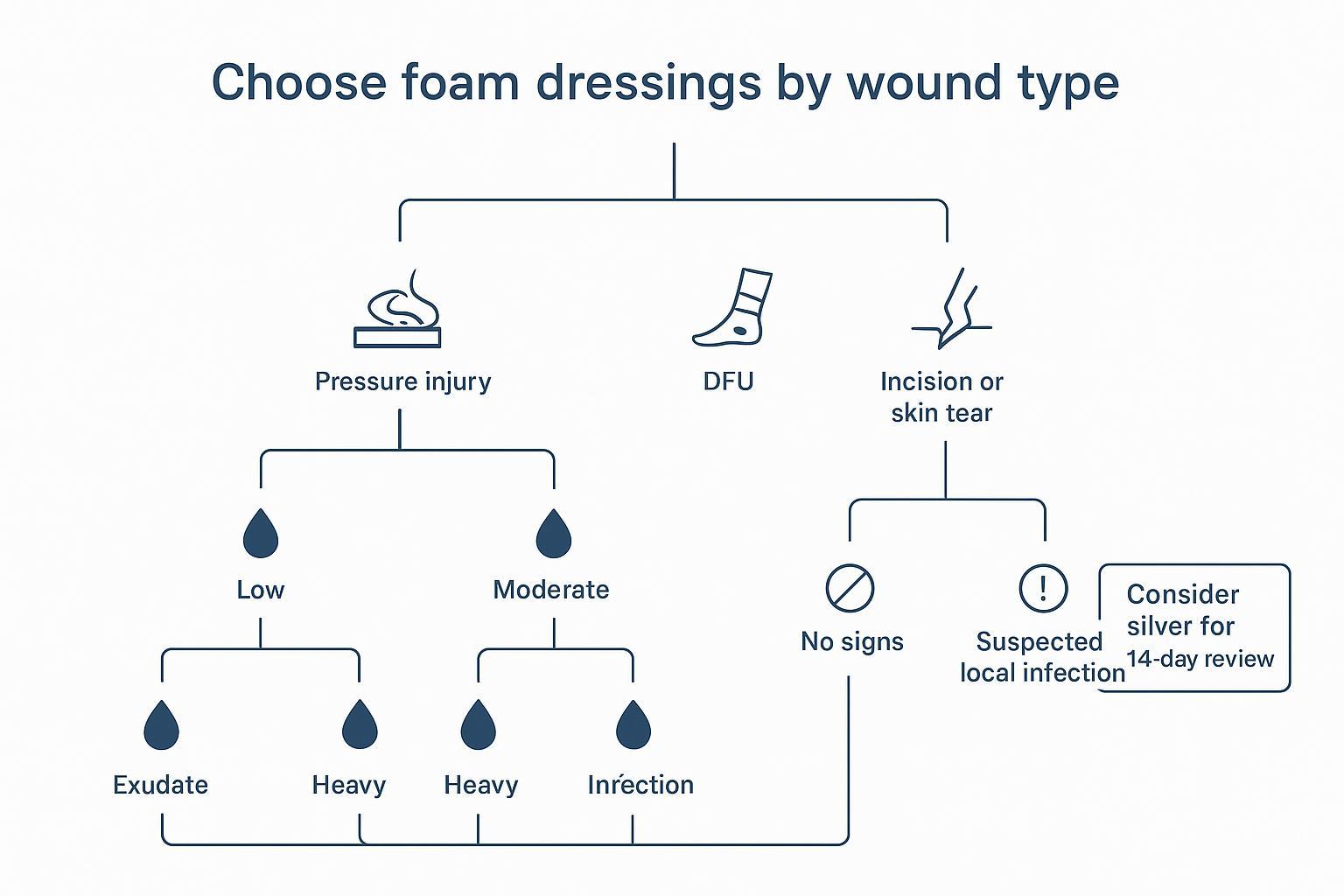
A practical, non-promotional portfolio example: if you stock both a standard silicone foam and a silver silicone foam, teach selection as an escalation decision. Use standard silicone foam when the priority is atraumatic removal and exudate control, and reserve silver foam for clinically suspected local infection or high bioburden with a documented indication and a planned review. (For a concrete example of how one manufacturer groups these options, see SLK Medical’s silicone foam dressing categories: SLK silicone foam dressings and SLK silicone foam Ag dressings.)
Stewardship and operations
Silver use and 14-day review
Silver dressings are easiest to govern when you treat them like a short, documented intervention rather than a default supply item. If you need a memorable label for staff education, call it the silver foam dressing 14-day review rule: indication documented up front, reassessment scheduled, and de-escalation when appropriate.
A widely used stewardship approach is the “two-week challenge”: use silver when there’s a clear indication, then reassess and de-escalate when the reason for silver is gone. The Wounds International consensus on appropriate use of silver dressings is a practical reference for building that policy language.
A workable unit-level rule set:
-
Start silver only with a documented indication (signs of local infection, suspected high bioburden, or high risk per protocol).
-
Set the review date at initiation (aim for a 14-day review).
-
At review:
-
If infection signs are improved/resolved, stop silver and step down to a non-antimicrobial dressing.
-
If there is no improvement, reassess the whole plan (cleansing/debridement, offloading/compression, systemic factors, need for culture/antibiotics per clinician).
-
Wear time and change triggers
Wear time should be framed as “typical range with clear triggers,” not “maximum days allowed.” That’s how you reduce leakage events and avoid dressing changes at the worst possible time.
Implementation tip: Document a target change interval (e.g., “q48–72h”) plus early-change triggers. If a trigger occurs, change early and reassess the dressing plan rather than trying to “make it last” to the scheduled time.
Common change triggers that are easy to standardize:
-
Strike-through or visible saturation
-
Leakage at edges
-
Edge lift or loss of seal
-
Increasing periwound moisture/maceration
-
New/worsening pain or odor (evaluate clinically)
If you’re writing a protocol, include one sentence that gives nursing staff permission to change early when a trigger is present.
Documentation and economics
If you want foam dressing standardization to survive value analysis review, your documentation has to connect three things: what the wound needed, what you chose, and what happened next.
A simple documentation set that supports clinical continuity and total-cost-in-use review:
-
Wound type (pressure injury/DFU/VLU/incision/skin tear) and location
-
Exudate level and periwound status
-
Dressing category and key feature selected (silicone contact layer, higher absorbency, antimicrobial silver)
-
Planned wear time range and explicit change triggers
-
Silver start date and scheduled review date (if applicable)
Economics then becomes less subjective. When you can show fewer unplanned changes, fewer leakage cleanups, and less skin damage at removal, you can discuss total cost in use without making outcome claims you can’t support.
Note: Video selection is from a public YouTube search. If you prefer a different video (or your own channel), share the link and I’ll swap it in.
Conclusion
Foam dressings earn their place when they’re selected for the job at hand: prevention support on high-risk sites, exudate control that protects the edge, and comfort/skin protection that reduces avoidable trauma at change.
Silver stewardship is the operational hinge. If your facility standardizes one thing this quarter, make it this: document indication, set a review date (often 14 days), and de-escalate when infection signs resolve.
Steps to implement standardization and track outcomes without over-claiming:
-
Publish a one-page selection algorithm by wound type, exudate level, and infection risk.
-
Define silver start/stop criteria and make the 14-day review a default order-set field.
-
Standardize change triggers and teach them at the bedside.
-
Audit basic operational measures (unplanned changes, leakage events, MARSI events) to refine the protocol.


