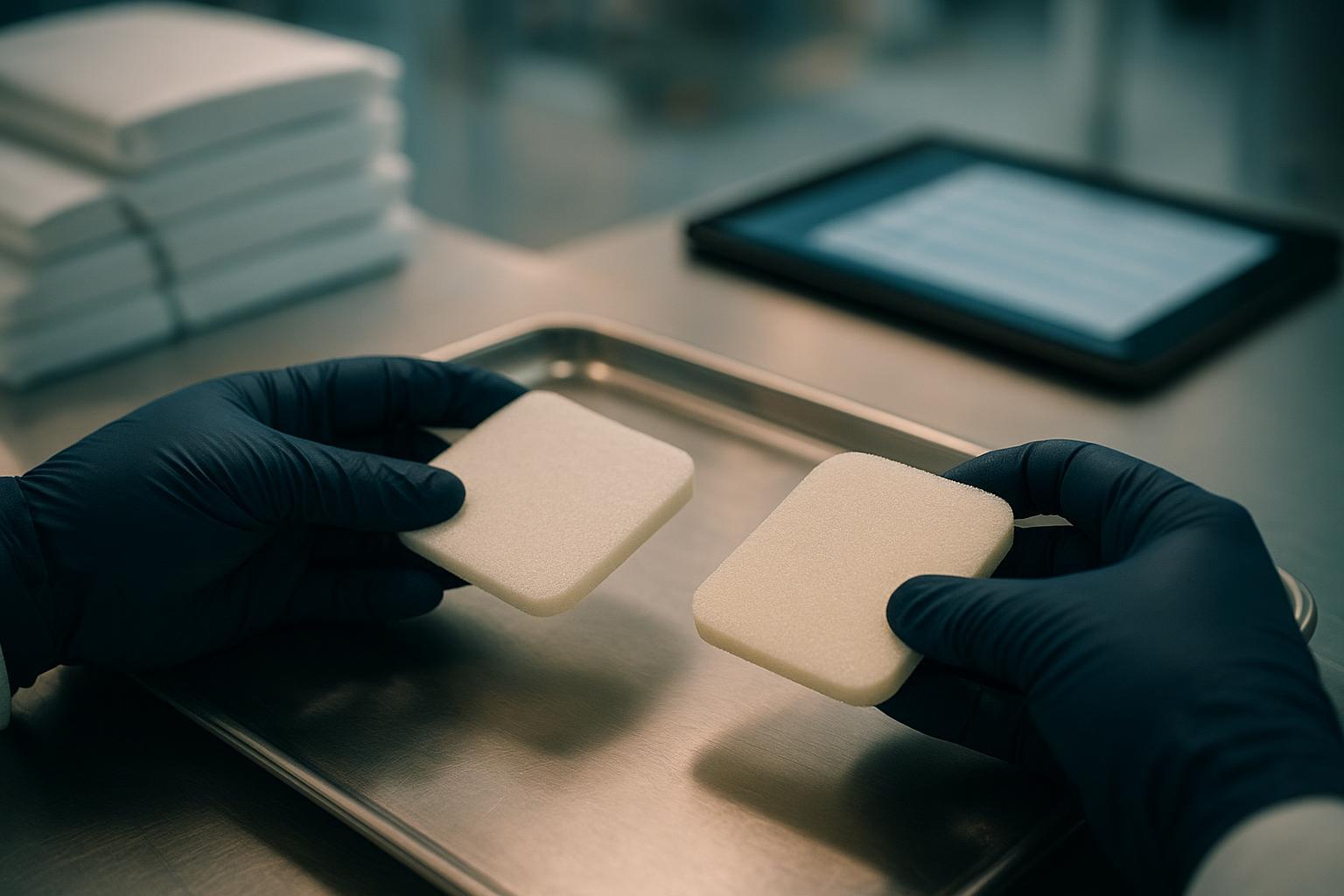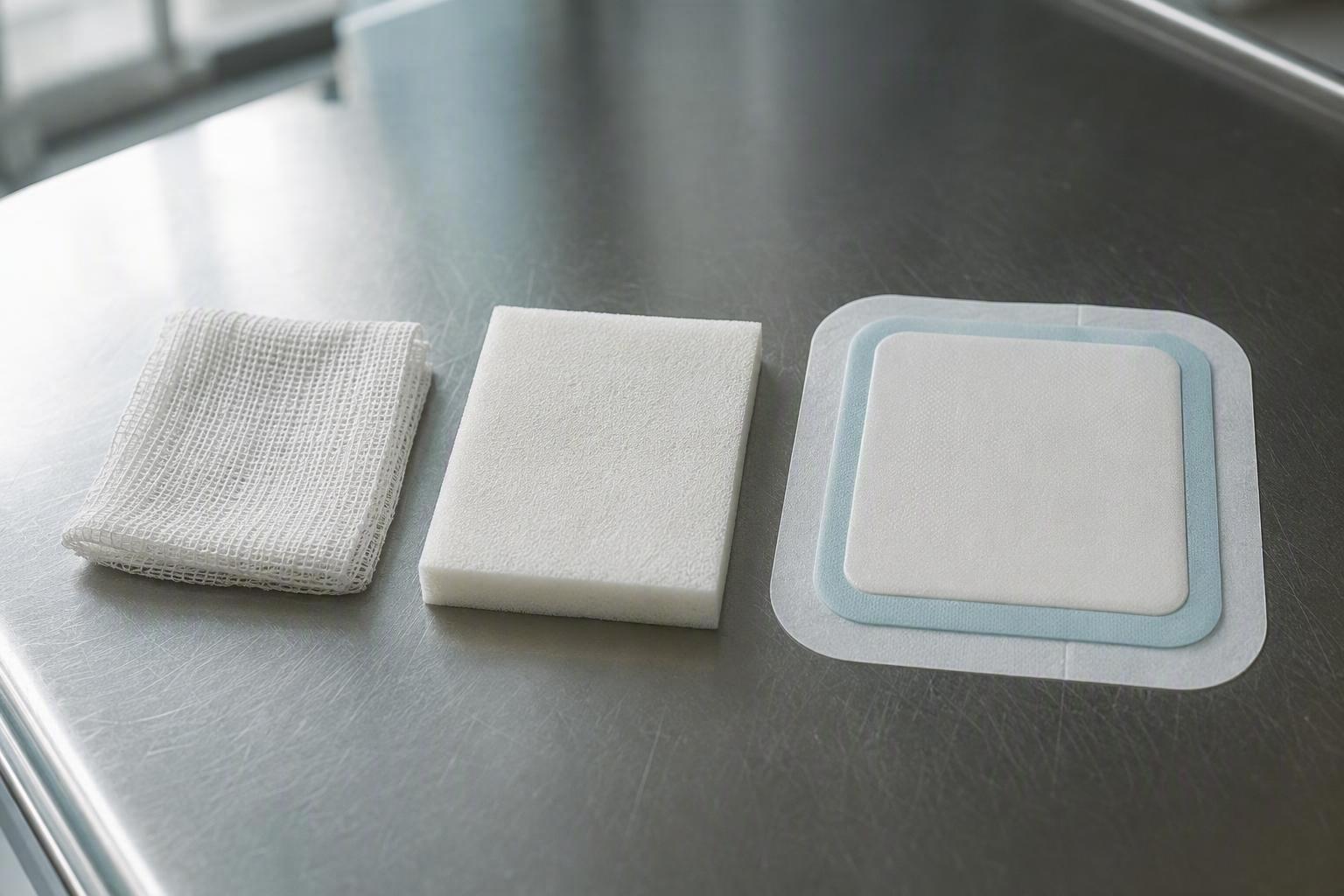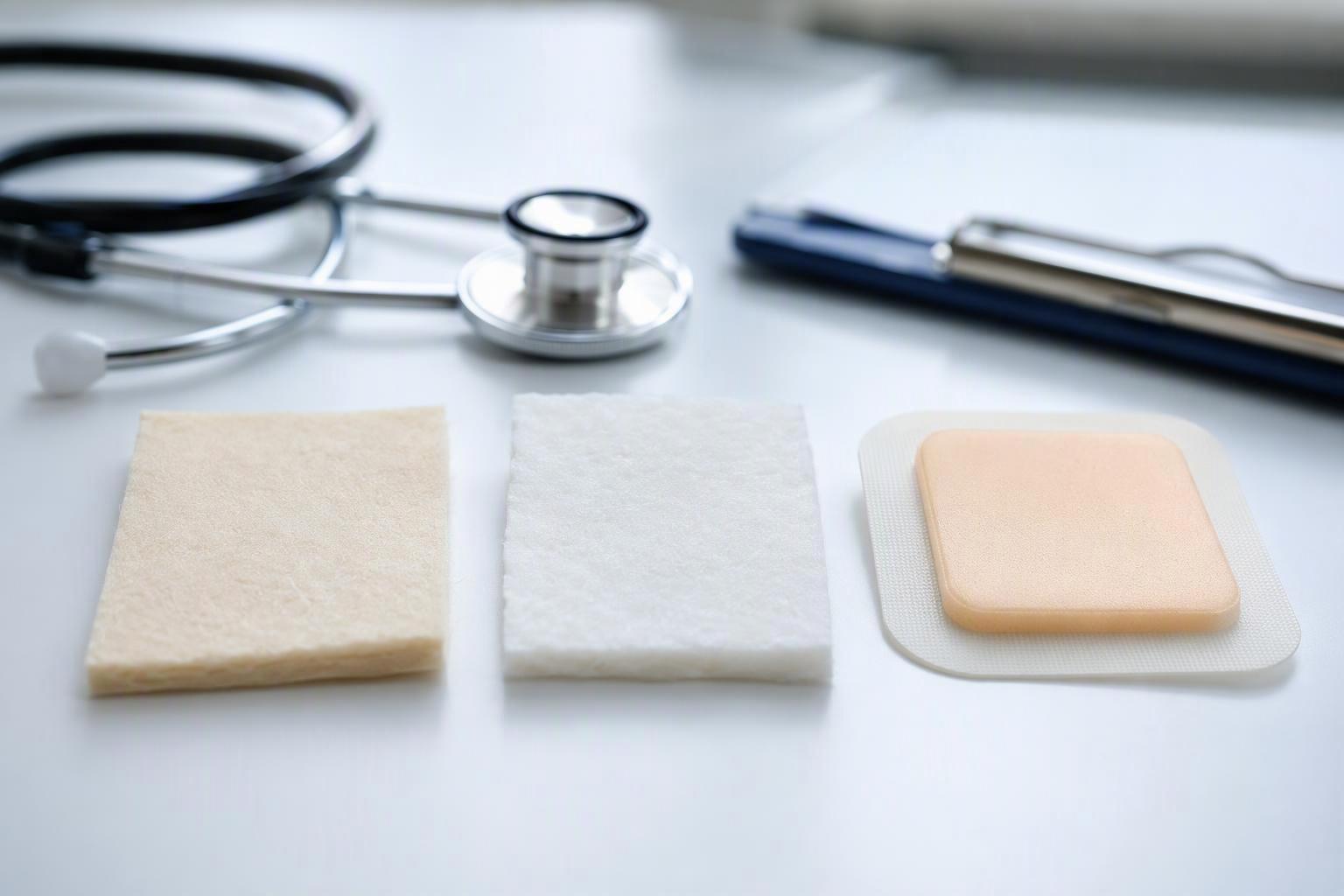
Dressing selection among alginates, gelling fibers, and silicone foams turns on four assessment axes: exudate level, wound depth or cavity, infection suspicion, and periwound skin fragility. Get those four right and the choice usually makes itself; get them wrong and a dressing that performs well in one wound fails in the next. This comparison works through each axis in turn, with the mechanisms and the failure modes behind them, so the decision holds up at the bedside and in the value analysis. The evidence base here is published trial and guideline literature rather than a head-to-head clinical study of the three classes, and no independent test data comparing all three directly was found. This article is educational and does not replace clinical judgment; consult a qualified healthcare professional before making medical decisions for a specific patient.
Cost is part of the decision, not a footnote to it. In a randomized trial of stage II pressure ulcers, foam dressings were associated with lower total cost per patient than saline-soaked gauze, at $466 lower total cost per patient and $92 lower dressing spend per patient, with fewer dressing changes (PMC, 2025). Unit price alone does not predict that result, which is why the criteria below include wear time and change frequency alongside acquisition cost. For the underlying logic of matching a dressing to exudate volume, dressing selection guidance by exudate level sets out the standard categories from dry through heavy (PMC, 2016).
Key Takeaways
Four axes decide the choice: exudate level, wound depth or cavity, infection suspicion, and periwound skin fragility.
Alginate and gelling fiber suit moderate-to-heavy exudate and cavity fill; silicone foam suits low-to-moderate exudate and fragile skin.
Pack cavities loosely, never tightly.
Silver is indication-driven, with a review at two weeks.
SLK Medical is a manufacturer of advanced wound care dressings with in-house research and development and production, and it specialises in silicone foam dressings and other specialised wound care products for the global healthcare industry. Its work covers silicone foam technology, antimicrobial silver dressings and high-capacity super absorbent dressings for exudate management, which is the product area this comparison of alginate, gelling fiber and silicone foam selection addresses.
Introduction
Dressing selection is a clinical decision with a measurable cost, not a purchasing one. In a randomized trial of stage II pressure ulcers, foam dressings were associated with lower total cost per patient than saline-soaked gauze: $466 less per patient, $92 less in dressing spend, and fewer dressing changes (Uncovering the Advantages of Foam Dressings, 2025). Unit price alone does not predict that outcome. Wear time, change frequency, and the cost of managing a failed dressing do.
This comparison covers three dressing classes used in hospital and long-term care settings: alginate, gelling fiber, and silicone foam. It follows the selection logic set out in published dressing selection guidance by exudate level, which maps dry, moderate, and heavy exudate to different dressing families, and it stays within the antimicrobial stewardship principle that silver is used when the wound indicates it, not as a default.
Four assessment axes drive every recommendation in this article: exudate level, wound depth and cavity, infection suspicion, and periwound skin fragility. Assess those four before you open a dressing pack. The sections that follow apply them to mechanism and indication, exudate handling and wear time, and removal-related skin injury, so the choice can be defended in a dressing round or a formulary review.
This article is clinical education, not medical advice. Dressing selection for an individual patient should follow your facility protocol and the judgment of the treating clinician.
Key Takeaways
Four axes decide the dressing: exudate level, wound depth and cavity, infection suspicion, and periwound skin fragility.
Alginate and gelling fiber suit moderate-to-heavy exudate and cavity filling; silicone foam suits low-to-moderate exudate and fragile periwound skin.
Cavity dressings are packed loosely, never tightly, so exudate can move into the secondary dressing.
Silver is indication-driven, with a review point at two weeks rather than open-ended use.
Practical selection algorithm
Alginate vs gelling fiber vs silicone foam dressing selection comes down to four axes, and they are decided in a fixed order: exudate volume, wound depth and cavity, periwound skin condition, and how often the dressing will be changed. Get those four right and the class is already chosen before anyone opens a product catalogue. Get them wrong and no amount of brand comparison will rescue the outcome.

The matrix below maps the three classes against the dimensions that actually change a purchasing or bedside decision. Read it as a starting filter, not a final answer: dressing selection guidance by exudate level places films, hydrocolloids, hydrogels and thin foams at the dry-to-low end, foams, hydrofibres and absorbent dressings at moderate exudate, and alginates, hydrofibres, foams, superabsorbents or combinations at the high-to-heavy end, always with periwound protection.
Criterion | Alginate | Gelling fiber (CMC) | Silicone foam |
|---|---|---|---|
Best For | Heavy exudate, shallow to moderately deep wounds | Heavy exudate with cavity, undermining or sinus tracts | Low-to-moderate exudate, fragile or intact periwound skin |
Exudate level | High to heavy | High to heavy | Low to moderate |
Mechanism | Calcium-sodium exchange converts fibre to gel | Vertical wicking with fluid locking | Soft-silicone contact layer plus absorbent foam core |
Cavity use | Loose fill only | Loose fill, best conformability in irregular cavities | Not for cavity filling; surface wounds |
Wear time | Up to 7 days | Up to 7 days | Up to 7 days, some guidance 3 to 7 days |
Secondary dressing & fixation | Required | Required, and must transfer exudate | Bordered versions self-fix; non-bordered need fixation |
MARSI risk | Moderate | Moderate | Lowest: 20.0% vs 45.3% for hydrocolloid |
Silver option | Silver alginates available | Silver gelling fibres available | Silver silicone foam available, sustained release up to 7 days |
Cost signal | Low unit cost | Low unit cost | Higher unit cost, $466 lower total cost per patient vs saline-soaked gauze |
Our verdict | Wins on cost and heavy-exudate absorption | Wins on cavity conformability | Wins on periwound safety, pain and change frequency |
Key Takeaway: Exudate volume, wound depth, periwound skin and change interval decide the class. Product selection happens after that, not before.
Mechanisms and best-fit indications
The three classes fail in different ways because they work in different ways, and the mechanism is what tells you which wound each one suits.
Alginate dressings, which need exudate to form a gel, work by calcium-sodium exchange: calcium in the fibre swaps for sodium in wound fluid, and the fibre converts into a hydrophilic gel. That dependency is also the limitation. On a dry or lightly exuding wound there is not enough fluid to complete the conversion, so the dressing dries out and adheres to the wound bed. An alginate dressing for heavy exudate is a sound choice; the same dressing on a dry wound is a removal injury waiting to happen.
Gelling fibre dressings, which lock exudate vertically, gel in the same family way but behave differently once wet. Their defining property is vertical wicking and fluid locking: exudate is held inside the fibre structure as a cohesive gel rather than spreading sideways. That lateral containment is what protects periwound skin, and it is why gelling fiber dressing cavity packing is the more forgiving option when a wound has depth, undermining or a sinus tract. The fibre conforms into irregular spaces and holds what it absorbs.
Silicone foam dressings, where the contact layer rather than the absorbent core does the work, invert that logic. The soft-silicone wound-contact layer gives gentle adherence and atraumatic contact while the foam core absorbs without gelling. Best fit is low-to-moderate exudate. Foam alone is generally insufficient on very heavily exuding wounds, and it is worth stating plainly that foam’s role here is protection and moisture balance, not pressure redistribution, and nothing in this comparison supports a pressure-injury prevention claim.
Depth changes the technique regardless of class. Wounds with depth, undermining, sinus tracts or cavities should be loosely filled rather than packed tightly, because tight packing traps fluid and can delay granulation. Fill dead space, support drainage, and let the wound close from the bottom up.
Pro Tip: If an alginate has dried onto the wound bed, moisten it and let it release before removal. Pulling it off dry defeats the reason you chose a gelling dressing.
Exudate handling and wear time
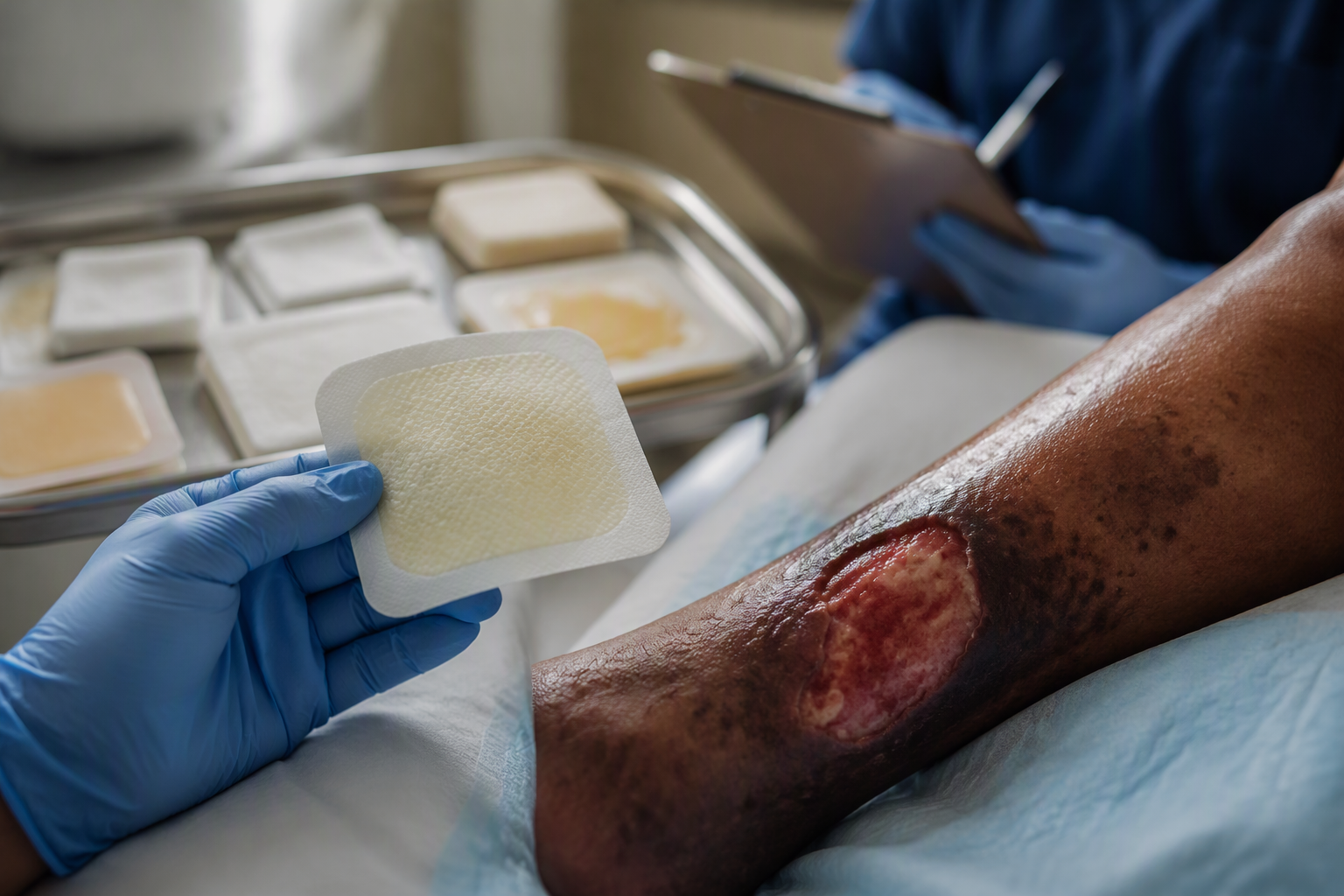
Wear time is where clinical preference meets procurement reality, and the two classes converge more than most comparison tables admit. Alginate and gelling-fibre dressings are commonly left in place for up to seven days, and silicone foam is also commonly used for up to seven days, with some guidance narrowing that to three to seven days depending on exudate and wound status.
The more useful skill is recognising the failure signatures that tell you the class is wrong. Foam on heavy exudate shows strike-through or leakage, and seal failure at the edges: bordered foams fail at the border, while non-bordered versions depend entirely on the secondary fixation holding them. Periwound maceration follows. Gelling fibre fails differently, leaving residue or debris in the wound bed, breaking down on removal, or producing a plugging effect when exudate is not transferred onward to the secondary dressing. That last one is a system failure, not a dressing failure, and it is the single most common reason a correctly chosen gelling fibre underperforms.
Cost follows change frequency rather than unit price. A randomised comparison of foam against saline-soaked gauze in acute wounds found fewer dressing changes and lower total cost per patient with foam: $466 lower total cost per patient, $92 lower dressing spend per patient, and a lower cost per ulcer healed. The mechanism behind those numbers is straightforward. A dressing that stays in place for seven days and comes off without trauma costs less in nursing time and consumables than one changed daily, even when its unit price is higher.
Stock continuity matters as much as the clinical choice. Running three classes across a ward means three SKU families, three secondary-dressing pairings and three fixation routines to train. Where a facility standardises, the practical rule is to keep one heavy-exudate gelling option and one low-to-moderate silicone foam option, and to reserve the third class for the cavities the other two cannot fill.
MARSI, pain, and atraumatic removal
Medical adhesive-related skin injury is defined as a cutaneous abnormality such as erythema, blistering, erosion or tear caused by medical adhesives that persists for 30 minutes or more after adhesive removal. Risk factors include extremes of age, fragile or compromised skin, moisture or wet skin, edema, repeated application and removal, frequent dressing changes, immunosuppression and malnutrition. Read that list against a typical long-stay wound caseload and it describes most of the patients on the ward.
The prevalence data make the case for treating this as a selection criterion rather than an afterthought. A cross-sectional survey of 344 healthcare workers using medical adhesive protective dressings found MARSI in 41.9% of respondents, with 144 reporting injury across 279 sites and severity graded 67.4% mild, 12.5% moderate and 20.1% severe. In the same cohort, prevalence by dressing type was 20.0% for silicone foam versus 45.3% for hydrocolloid. A separate daily-assessment study of 143 adults after spinal surgery recorded a 36.4% MARSI incidence, or 9.83 injuries per 100 medical adhesives, counting only injuries that persisted 30 minutes or longer.
Pain on removal tracks the same variable. In a randomised non-inferiority trial in acute wounds, a soft-silicone dressing recorded a mean VAS of 9.76 mm during primary dressing removal versus 14.8 mm for the comparator. The absolute difference is small in millimetres and large in behaviour: patients who expect pain resist dressing changes, and staff who expect pain delay them.
This is where silicone foam earns its place in the algorithm, and where SLK Medical’s silicone foam Ag dressing illustrates the mechanism rather than a marketing claim. Its silicone wound contact layer uses silicone oil and perforation technology so the layer contacts the wound without adhering to it, giving nearly painless, atraumatic removal, and the perforated texture prevents tissue from growing into the dressing. The layer does not strip away epidermal cells, and it distributes wound exudate quickly and evenly. For a patient with fragile periwound skin, that contact-layer behaviour is the deciding factor, and it is why silicone foam dressing atraumatic removal belongs in the criteria list alongside exudate handling rather than in a comfort footnote. The silver variant extends the same construction with rapid-release ionic silver and a sustained effect of up to seven days.
Two limits belong in the same breath. The evidence above is drawn from specific cohorts, including frontline staff and post-surgical patients, so prevalence figures should not be read as universal rates. And no independent test data was found comparing the three classes head to head on removal pain in a single trial; the comparisons here come from separate studies with different populations and endpoints.
Conclusion
The three classes are not competitors so much as different tools. Alginate suits heavy exudate and shallow wounds, gelling fiber suits cavity packing, and silicone foam suits fragile skin where atraumatic removal matters. The algorithm is the same each time: assess exudate level, wound depth, infection suspicion and skin fragility at every dressing change, then match the class to those findings rather than to habit or stock availability.
Key Takeaway: Switch class when the failure signature appears, not on a fixed calendar. Leakage, maceration, pain on removal or stalled progress each point to a specific mismatch, observed at the dressing change.
Silver is the clearest case for time-limited use. Wounds International’s guidance on appropriate silver dressing use sets the two-week review point for silver dressings: document the reason for use, apply an initial two-week challenge period, then reassess and stop when infection signs resolve or when there is no improvement. That documentation is also what antimicrobial stewardship reviewers ask for, so the wound record and the AMS record can be one record. Where a silver option fits, SLK Medical’s silicone foam Ag dressing is a silver silicone foam variant with a stated seven-day wear time, which keeps dressing changes and nursing time down across the challenge period. Nursing time, not unit cost, dominates the total cost of a regimen, so wear time belongs in the value calculation alongside price per unit.
Category | Winner |
|---|---|
Mechanisms and best-fit indications | Depends on wound type: alginate for heavy exudate, gelling fiber for cavities, silicone foam for fragile skin |
Exudate handling and wear time | Silicone foam for extended wear; alginate and gelling fiber for high-volume exudate |
MARSI, pain, and atraumatic removal | Silicone foam |
Overall | Match the class to exudate level, depth, infection suspicion and skin fragility at every assessment |
For procurement and clinical teams building this into a formulary, the next step is to standardise the assessment criteria and the silver review documentation, then hold stock across all three classes so the bedside decision is never constrained by what is on the shelf.
Build the selection algorithm into your formulary Get the silicone foam specification, wear-time data and a sampling plan for your wound-care committee. Request the spec sheet and sampling plan
Clinical decisions about dressing selection should be made by a qualified healthcare professional, in line with local protocol and the individual patient’s wound assessment.