



By SLK Medical Clinical Education Team (Manufacturer education).
Last reviewed: 2026-06-18.
This article is for clinical/procurement education and does not replace local policy, clinician judgment, or the product IFU. Escalate to a qualified clinician for signs of infection, ischemia, or rapid deterioration.
Introduction
Note: This article is for clinical/procurement education and does not replace facility policy or clinician judgment.
Criterion | Foam dressing (typical fit) | Gauze (typical fit) |
|---|---|---|
Exudate handling | Better for moderate–high exudate (absorb + retain) | Often saturates sooner, may leak if exudate is moderate–high |
Dressing change frequency | Often multi-day wear time when appropriate | Often daily or more when saturated |
Comfort at removal | Often less traumatic with silicone interfaces | Can adhere when dry, increasing pain/trauma risk |
Workflow impact | Fewer room entries and documentation events when wear time holds | More frequent changes increase nursing minutes |
Dressing choice is rarely “just a consumable.” It changes the wound environment (moisture, temperature, shear), the patient experience (pain at removal, skin stripping), and the operational workload (how many times a nurse has to re-enter the room, set up a sterile field, document, and dispose of waste). In tendering and formulary decisions, those downstream effects matter as much as unit price.
The practical question behind most foam-versus-gauze debates is this: when does a foam dressing’s longer wear time reduce dressing change frequency enough to save nursing minutes, without creating avoidable risk?
This review looks at that question through four lenses: (1) clinical fit by wound type, (2) wear time and exudate control, (3) operational economics (price per change vs total cost of care), and (4) guideline and procurement signals. It closes with a simple decision framework you can use for tenders and product line rationalization.
To keep this comparison useful for procurement and distribution teams, the focus is not “which heals faster” in the abstract. NICE’s evidence summary for chronic wounds, for example, notes that in the limited RCT evidence reviewed, foam and gauze did not show a statistically significant difference in complete healing in the trials it included, which is why dressing choice often comes down to wound needs, patient tolerance, and resource use rather than a blanket healing claim (see NICE’s ESMPB2 evidence summary PDF (2016)).
Key Takeaway: If the wound has enough exudate to saturate gauze daily, switching to an appropriate foam regimen often reduces the number of changes, and that is where nursing time (and total cost) is won.
Clinical outcomes by wound type
Pressure injuries: foam vs gauze
For pressure injuries, the dressing job is usually to manage moisture and shear while protecting fragile periwound skin. Foam dressings are commonly selected when exudate is moderate and cushioning is helpful. Gauze can still appear in protocols, but the risks are familiar: if gauze dries out or adheres to the wound bed, removal can be painful and can disturb new tissue.
This isn’t a niche complaint. A classic wound dressing review hosted on PubMed Central notes that gauze may be disruptive as it dries and can cause tissue damage when removed (see “Wound dressings” (BMJ) via PubMed Central). From an operations perspective, that translates into more time spent on analgesia planning, careful removal, and sometimes unplanned re-dressing.
Procurement implication: for pressure injury care pathways where the typical patient has fragile skin or high change burden, the better question is not “foam vs gauze,” but which dressing construction and adhesive profile is least likely to create MARSI while still sealing and absorbing.
DFU/VLU: role of exudate
Diabetic foot ulcers (DFU) and venous leg ulcers (VLU) often put exudate management at the center of the decision. In VLU, compression is usually part of the broader care plan; in DFU, offloading and infection surveillance are constant concerns. In both categories, exudate level is one of the main drivers of dressing selection and change frequency.
A practical way to think about it:
Low exudate: the dressing mainly protects and maintains a moist interface. Gauze may be used short term, but a non-adherent contact layer often matters more than the outer cover.
Moderate–high exudate: saturation and leakage drive extra changes. This is the scenario where foam’s absorption and retention capacity can reduce change frequency.
The “clinical outcome” question in DFU/VLU is often confounded by upstream variables (offloading, compression adherence, glycemic control). That is another reason why procurement teams should avoid making broad healing claims based on dressing class alone, and instead evaluate how reliably a dressing supports the pathway’s needs: containment, skin protection, and predictable wear time.
Surgical/trauma: comfort & skin
In surgical and trauma wounds, the day-to-day difference between foam and gauze often shows up as comfort at removal and periwound integrity. When incision sites ooze early on, a dressing that controls exudate without frequent changes can reduce handling and disturbance.
Gauze is widely available and useful as a secondary layer, but as a primary interface on open wounds, it can adhere and increase pain on removal. Reviews of wet-to-dry practice argue that mechanical debridement with gauze is non-selective and can remove healthy tissue, and is frequently discouraged in modern moist wound healing approaches (see “Wet-to-Dry Dressings Do Not Provide Moist Wound Healing” (2013)).
For additional background on foam dressing selection and use cases, see SLK Medical’s Silicone Foam Dressing Guide.
Procurement implication: if post-op protocols default to daily changes “because that’s how we’ve always done it,” a foam option that can safely extend wear time for appropriate wounds can be one of the simplest labor levers to pull.
Wear time and exudate control (foam dressing vs gauze)
Change frequency: foam vs gauze
Wear time is not a marketing number; it’s a function of exudate volume, dressing capacity, edge seal/securement, and protocol. Still, a practical, procurement-friendly generalization holds:
Foam dressings are commonly used with multi-day wear time when exudate is moderate and the dressing remains intact.
Gauze often requires daily changes (or more often) when exudate is enough to wet through, because saturation risks leakage and maceration.
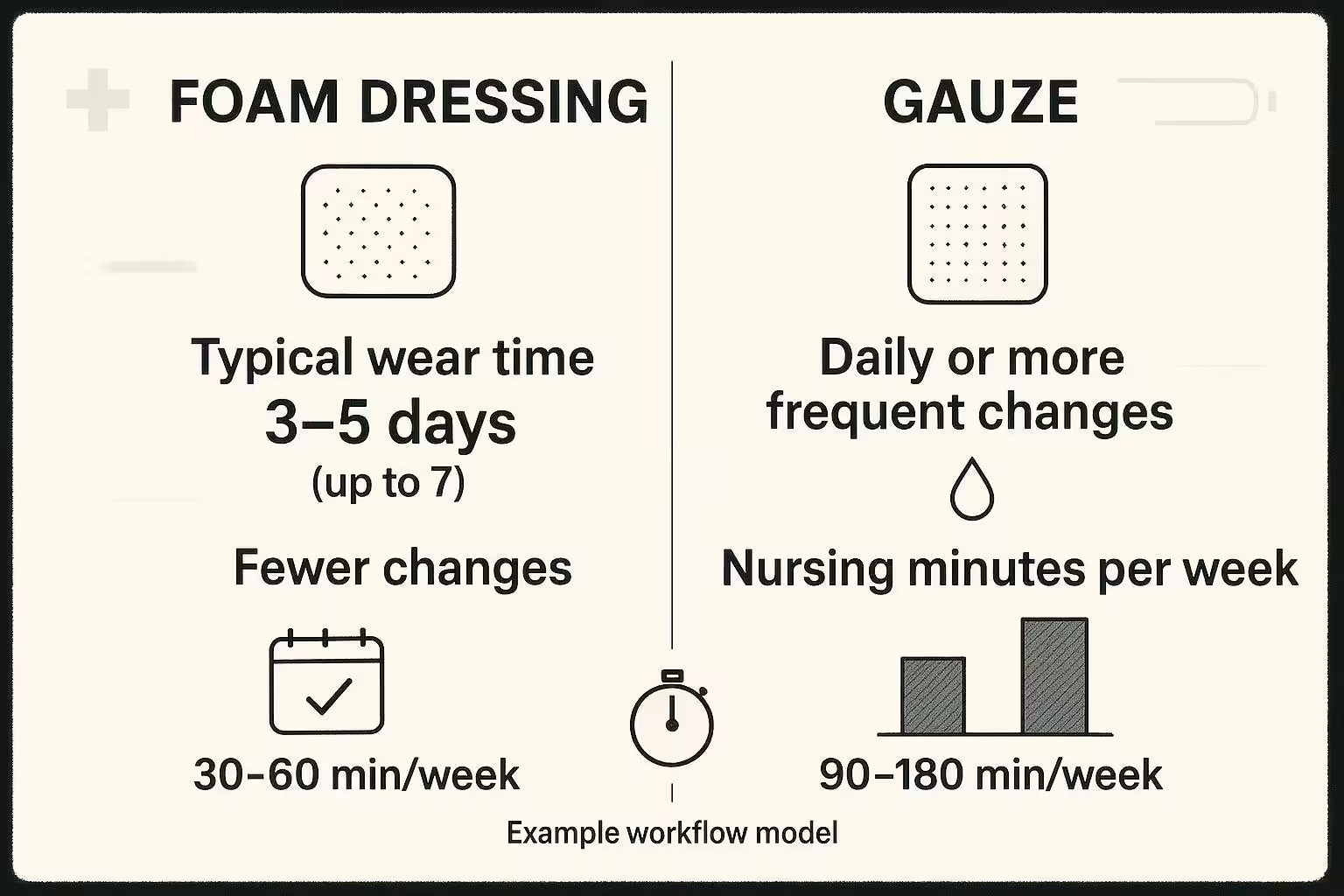
That difference in dressing change frequency is where nursing time is usually saved. Consider a simple model:
If gauze requires 7–14 changes/week (daily to twice daily)
And a foam protocol supports 2–3 changes/week (every 2–4 days) for suitable wounds
Even with conservative assumptions, the nursing minutes add up quickly, especially in high-volume units.
A second-order effect: fewer changes can reduce “wound handling events,” which can reduce incidental pain and reduce opportunities for skin stripping, especially in adhesive-heavy regimens.
Pain, MARSI, silicone layers
Pain at dressing removal is a cost. It can require pre-medication, two-person changes for anxious patients, and careful removal technique that adds minutes each time.
Dry gauze can stick as it desiccates, and removal can cause pain and tissue disruption, as summarized in the PubMed Central wound dressings review (“Wound dressings” (BMJ) via PubMed Central). Soft silicone interfaces are widely used to reduce adherence-related trauma; Wounds International’s review of soft silicone dressings discusses atraumatic removal and the link between removal trauma and pain (see Wounds International “Soft silicone dressings” PDF).
To keep documentation consistent during evaluations, you can also reference SLK Medical’s FDA, CE MDR, and ISO 13485 compliance signals alongside your local regulatory checklist.
For distributors evaluating silicone foam options, one grounded, non-sales way to describe the category advantage is this:
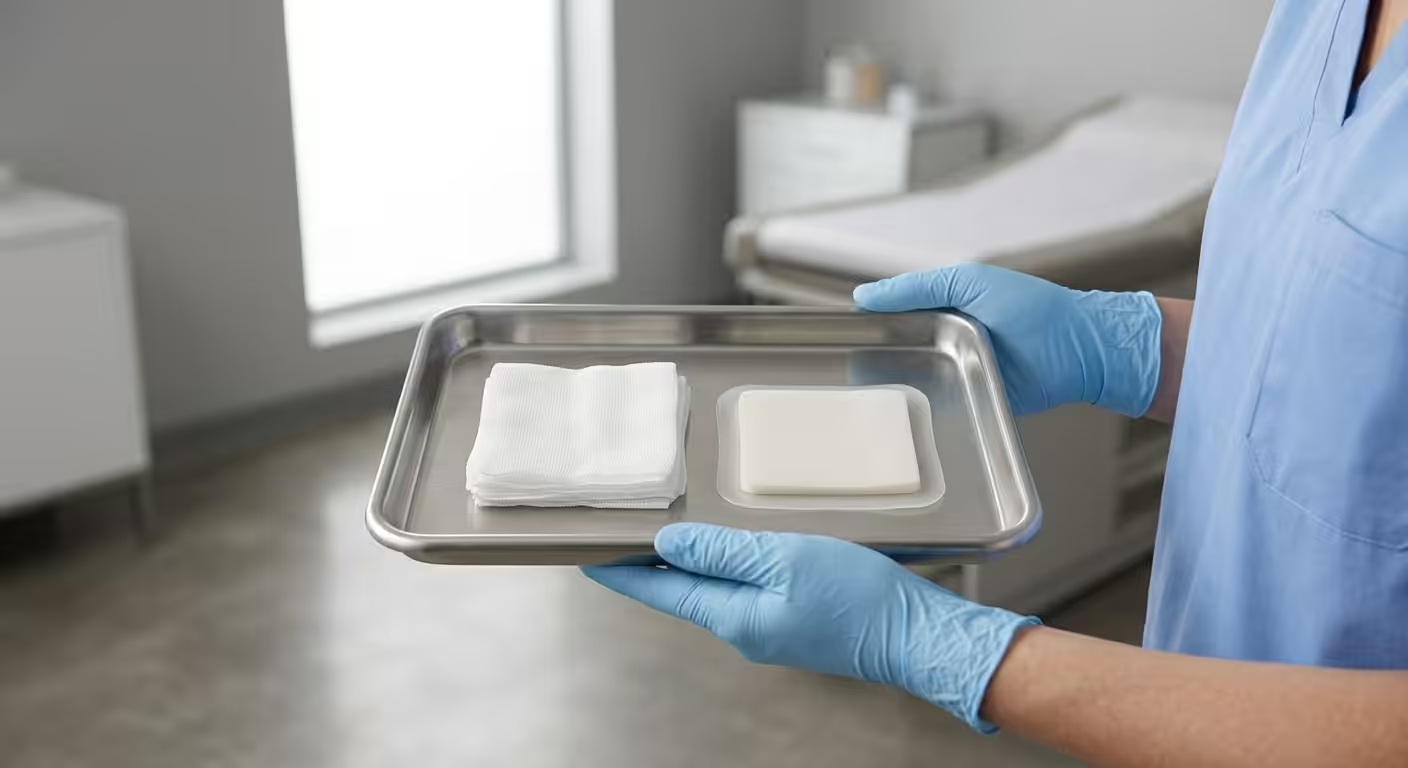
SLK Medical’s silicone foam dressings use a soft silicone contact layer designed for gentle adhesion and less traumatic removal, supporting comfort and reducing MARSI risk.
Infection risk and silver foams
“Infection risk” is not binary. Many wounds have colonization without clinical infection; some have rising bioburden risk because of location, comorbidities, or repeated leakage and dressing disturbance.
Silver-containing foams are often considered when there is concern about local bioburden management as part of a broader plan. Procurement teams should evaluate these products the same way they evaluate any antimicrobial claim:
What is the intended use and local protocol alignment?
What documentation supports the antimicrobial agent and its safe use?
What is the expected wear time in real practice given exudate and securement?
For internal education, SLK Medical maintains a comparison that can help teams structure “standard silicone foam vs silver foam” discussions without naming competitors: see SLK Medical’s Silicone vs Silver Foam comparison.
Operational economics
Price per change vs unit price
In tenders, unit price is visible. Price per change is closer to truth.
A gauze regimen may look inexpensive per unit, but if it is changed daily (or more often), it consumes:
more nursing time
more PPE and setup materials
more waste disposal
more opportunities for leakage and linen changes
Foam often costs more per unit, but if it reduces change frequency, the per-change economics can win.
A practical procurement way to frame it is to separate costs into two buckets:
Material cost per change: dressing + secondary dressing + securement
Labor cost per change: nursing minutes × loaded labor rate
Even without publishing labor rates, you can compare scenarios on minutes alone and let each facility apply its own labor cost.
Nursing minutes per week model
Below is a simple, transparent model you can use in value analysis. It is intentionally conservative.
Assumptions (edit to match your setting):
Time per dressing change (remove, cleanse/assess, apply, document): 10–15 minutes (includes documentation)
Gauze change frequency for moderate exudate: 7–14 times/week
Foam change frequency for moderate exudate: 2–3 times/week
When this model doesn’t hold (plan for more frequent changes or a different construction):
leakage/strike-through or repeated edge lift
rapidly increasing exudate, new malodor, unexpected pain, fever, or spreading erythema
concern for ischemia/poor perfusion (e.g., cool/pale limb, severe pain at rest) or dry necrotic tissue that requires specific management
inability to maintain a seal due to anatomy, shear, or compression slippage
Weekly nursing minutes:
Gauze: 7–14 × 10–15 = 70–210 minutes/week
Foam: 2–3 × 10–15 = 20–45 minutes/week
Even if your actual “minutes per change” is lower, the ratio often remains: fewer changes is fewer entries, fewer setups, less documentation.
Important boundary condition: this model only holds when foam wear time is realistic for the wound and patient. If leakage forces unplanned changes, the advantage collapses.
Unplanned changes and leakage
Unplanned changes are the hidden killer in cost-in-use.
Common drivers:
exudate exceeds dressing capacity
edge lift from shear or challenging anatomy
inadequate overlap/margins
periwound maceration compromising adhesion
Operationally, an unplanned change is more expensive than a scheduled one because it often happens at a bad time (night shift, short staffing) and can cascade into linen changes and extra skin care.
This is why the “foam vs gauze” decision is really a matching problem:
If the wound has meaningful exudate, you need a dressing that retains it.
If the skin is fragile, you need an interface that minimizes trauma at removal.
If the location is high-shear, you need securement that keeps a seal.
Guideline and procurement
NICE cost-minimization
NICE’s evidence summary on chronic wounds is a useful procurement anchor because it reinforces a point procurement teams often need to make internally: dressing class alone is not a guarantee of superior healing, and the evidence base is limited.
In the NICE review, foam versus gauze did not show a statistically significant difference in complete healing in the RCTs included (see NICE ESMPB2 “Chronic wounds: advanced wound dressings and antimicrobial dressings” (2016)). That supports a cost-minimization approach: choose the dressing that best matches the wound’s needs while minimizing total resource use (changes, leakage, and complications tied to dressing disruption).
US practice points (WHS/WOCN)
US wound care practice points tend to converge on pragmatic principles rather than one “best dressing” rule:
Match dressing choice to wound characteristics, especially exudate.
Protect periwound skin and minimize trauma at removal.
Avoid over-changing when the dressing is functioning, because frequent disruption costs time and can disturb healing tissue.
For distributor teams supporting US customers, the best tactic is to translate those principles into the materials your buyer can act on: use-case selection criteria, IFUs, and a simple nursing time model tied to change frequency.
Compliance signals (FDA/CE/MDR, ISO 13485)
In tendering, compliance is both a gate and a risk reducer. Buyers want signals that documentation exists and is auditable:
quality management system alignment (commonly ISO 13485 in this category)
market access pathways depending on region (FDA and CE MDR, where applicable)
labeling/IFU controls, traceability, and post-market processes
For an internal reference point on the SLK Medical site, the same compliance signals are referenced on the FDA, CE MDR, and ISO 13485 compliance page.
Decision framework
Stepwise matrix: exudate & risk
Use this quick matrix to structure selection without turning it into a brand argument.
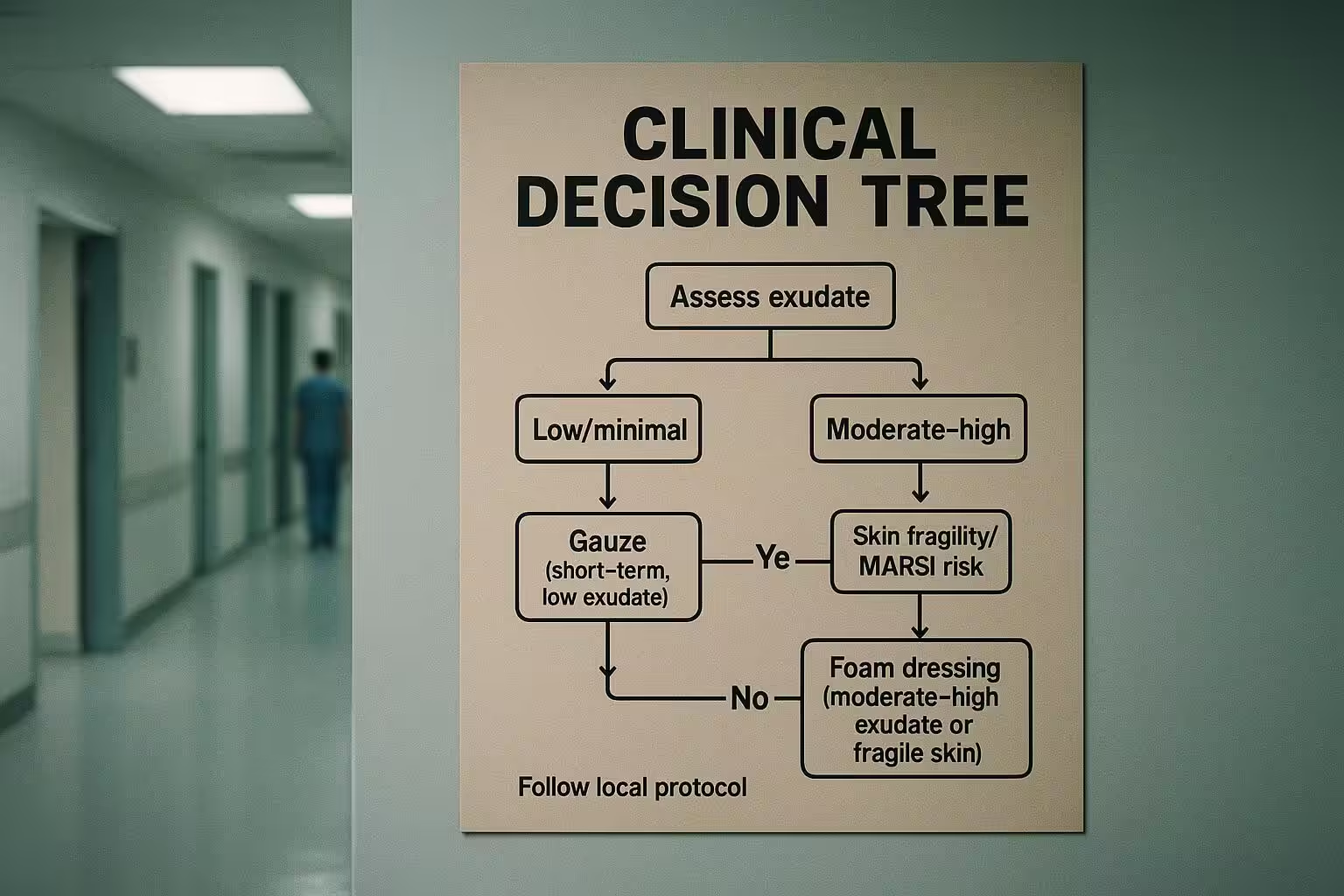
Start with exudate
Minimal/low: avoid overdressing; focus on protection and a non-adherent interface.
Moderate/high: prioritize absorption and retention to avoid saturation and leakage.
Check skin fragility and MARSI risk
Fragile skin, geriatrics, frequent dressing changes, or prior skin stripping: favor atraumatic interfaces and reduce change frequency when clinically appropriate.
Check infection risk / bioburden concerns
If risk is elevated, align product selection (including antimicrobial options such as silver foams) with protocol and documentation.
Sanity check the operational plan
If you cannot realistically keep the dressing intact for the intended wear time (shear, location, heavy exudate), plan for more frequent changes or choose a different construction.
When gauze is appropriate
Gauze still has a place when the clinical and operational requirements are simple:
low-exudate, short-term coverage
as a secondary dressing or outer wrap
packing in specific wound scenarios when directed by protocol
situations where multi-day wear time is not necessary and the priority is quick availability
The caution is the common failure mode: dry gauze directly on an open wound can adhere as it dries and can be painful/traumatic at removal, as discussed in the PubMed Central wound dressing review (see “Wound dressings” (BMJ) via PubMed Central).
When foam cuts nursing time
Foam tends to reduce nursing time when three conditions line up:
exudate is moderate to high (gauze would saturate daily)
the dressing’s construction supports retention + seal for the intended wear time
removal and periwound protection reduce disruption (comfort matters because it affects the whole workflow)
When those conditions are met, fewer changes usually means fewer nursing minutes, fewer unplanned interventions, and more predictable cost in use.
Real-world example: how fewer changes reduce nursing minutes
Below is an anonymized pathway example shared for education. It illustrates change frequency over time rather than making a universal healing claim.
Pressure injury (left hip, stage 4) with moderate exudate
Debridement + foam dressing regimen.
Early phase: dressing changed every 2–3 days due to saturation risk.
Mid phase: dressing changed every 3–4 days.
Late phase: dressing changed every 6–7 days until closure.
Operationally, the key benefit reported was fewer dressing change events versus a daily gauze regimen (which was not viable due to exudate), translating into reduced nursing workload and fewer consumables over the full course of care.
Conclusion
Foam dressings are typically a better fit for moderate to high exudate and fragile skin, where absorption, retention, and atraumatic removal can reduce disruption. Gauze can be a sensible choice for low-exudate, short-term needs and as a secondary layer.
The real economic lever is not unit price. It is change frequency. When a clinically appropriate foam regimen reduces the number of changes, it can reduce nursing time and lower total cost of care.
If you are building a tender submission or distributor line card, a practical next step is to assemble a procurement-ready pack: IFU, spec sheet, compliance statements (e.g., ISO 13485 / MDR / FDA pathway where applicable), and a simple sampling plan. For background reading on silicone foam dressings, see SLK Medical’s Silicone Foam Dressing Guide.
Disclosure and editorial policy
This educational article was prepared by a manufacturer education team for clinical/procurement audiences.
It may include links to SLK Medical educational materials for background; where possible, third-party sources are provided for clinical principles.
Content is reviewed periodically, but local protocols and individual patient factors should always take precedence.
References
National Institute for Health and Care Excellence (NICE). Chronic wounds: advanced wound dressings and antimicrobial dressings (Evidence summary ESMPB2). Published 30 March 2016.
BMJ. Wound dressings. 2006. PMCID: PMC1420733. PMID: 16507896.
Wodash AJ. Wet-to-Dry Dressings Do Not Provide Moist Wound Healing. Journal of the American College of Clinical Wound Specialists. 2013;4(3):63–66. PMCID: PMC4511549. PMID: 26236638.
Wounds International. Soft silicone dressings (review paper/PDF). Accessed 2026-06-16.