



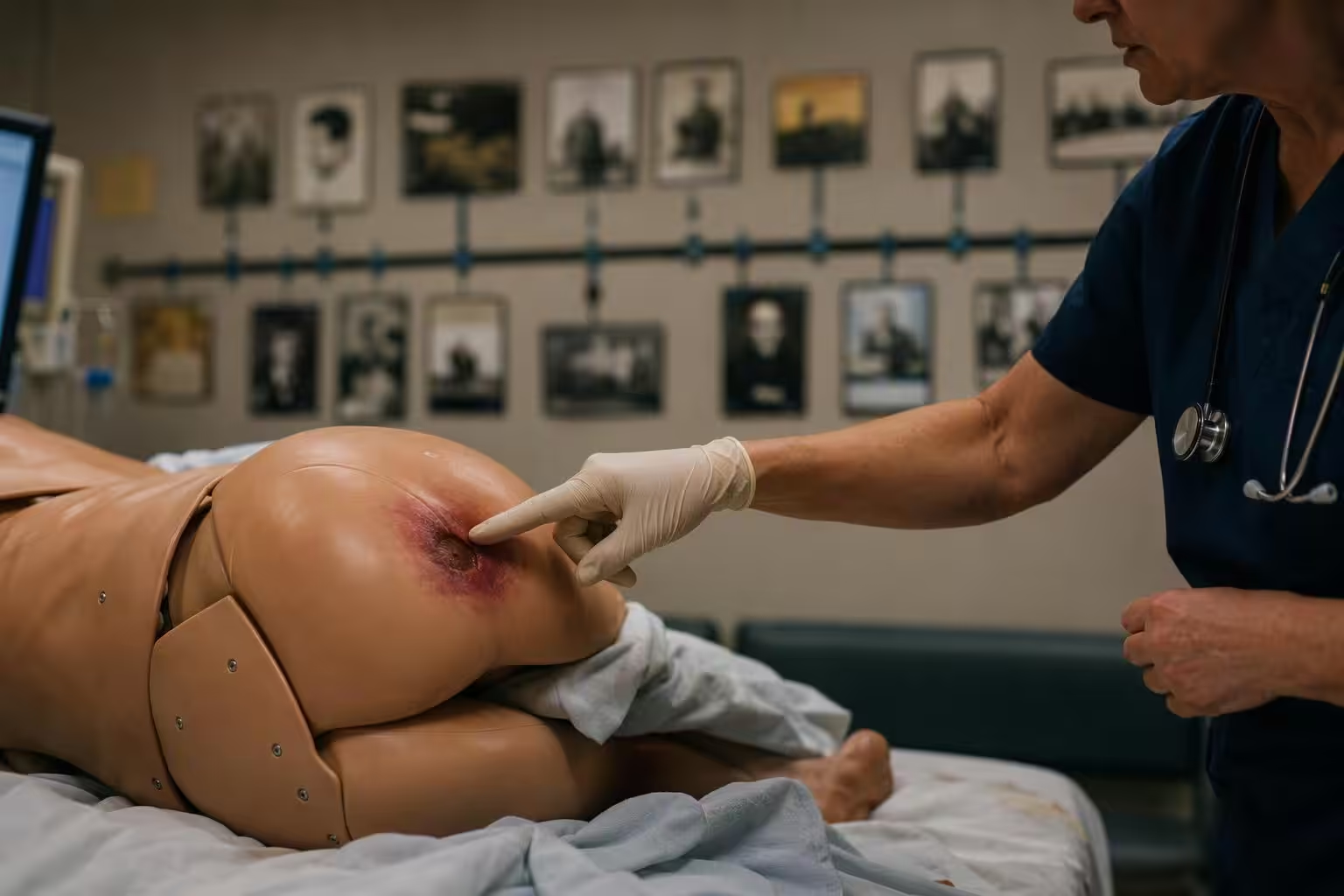
A pressure injury is localized damage to the skin and underlying soft tissue, usually over a bony prominence or related to a medical or other device, and it can present as intact skin or as an open ulcer (the current NPIAP definition, 2021). The same lesion has carried several names in the chart over the past century: decubitus ulcer, pressure ulcer and bedsore (the historical names for the same lesion, undated white paper). That naming history is not trivia. It is the reason a policy document, a wound assessment and a coding query can describe one sacral wound three different ways.
Think of the terminology the way you think of a building that has been renovated several times: the floor plan is current, but the old wiring is still behind the walls. When a chart still reads “decubitus ulcer,” the clinician is working from an earlier schematic while the reporting system expects the current one. The mismatch shows up in HAPI reporting, in staging accuracy and in documentation review.
The stakes are measurable. A 2019 US cost model estimated that hospital-acquired pressure injuries could exceed $26.8 billion nationally, with about 59% of that burden concentrated in a small rate of Stage 3 and Stage 4 full-thickness wounds (a 2019 US cost model, June 2019). Prevention has also moved well past turning schedules alone, toward multimodal bundles that combine risk assessment, skin care, nutrition, repositioning and support surfaces.
This timeline follows the milestones that produced today’s language, then connects each one to the documentation, reporting and procurement decisions a unit faces now. It is written for clinical and procurement readers, and it is not a substitute for the current guideline or for advice from a qualified wound care professional.
From Past to Practice
The clinical vocabulary in use today was assembled over roughly 150 years, and each layer left a mark on how wounds are described and staged. The nineteenth-century descriptions of deep tissue injury are the earliest layer: Charcot used the term “decubitus ominous” for sacral eschar associated with death, and Paget in 1873 may have been the first to describe deep tissue injury as a distinct phenomenon (the deep tissue injury white paper, undated). Groth in 1942 produced deep “malignant pressure sores” in animal models that originated in deeper tissue rather than at the surface, which is the observation that still complicates staging today.
Early recognition to preventability
The modern regulatory frame arrived long before the terminology caught up. For discharges on or after 1 October 2007, IPPS hospitals do not receive the higher payment when a selected condition was acquired during hospitalization, and Stage III and Stage IV pressure ulcers are listed among those hospital-acquired conditions under ICD-9-CM codes 707.23 and 707.24 (the 2007 present-on-admission policy, policy effective 1 October 2007). The same fact sheet defines present on admission as present at the time the order for inpatient admission occurs, and it counts conditions that develop during an emergency department, observation or outpatient surgery encounter as present on admission. That single definition is why a wound first documented in the ED and a wound first documented on day four of the stay land in different reporting buckets, even when the tissue looks identical.
The payment provision also created the vocabulary that quality teams still use. CMS distinguishes an avoidable injury, where the provider failed to evaluate risk factors, implement interventions consistent with recognized standards, monitor outcomes or revise the plan, from an unavoidable injury, where all of that was done appropriately and an injury developed anyway (the avoidable versus unavoidable distinction, 2020-2021 white paper citing a 2010 NPIAP expansion). NPIAP expanded the unavoidable category in 2010 to include acute-care circumstances where delivering prevention was clinically unsafe. For a unit reviewing its own numbers, that distinction is the difference between a process failure and a case that needs a documented rationale rather than a corrective action plan.
Preventability itself became an explicit standard of care through AHRQ’s hospital toolkit, whose prevention bundle has three components: comprehensive skin assessment, standardized pressure ulcer risk assessment, and care planning that addresses the identified areas of risk (AHRQ’s hospital prevention toolkit, toolkit carrying a 2011 sample action plan). The toolkit frames prevention as a standard of care and a nurse-sensitive issue, and it names zero incidence of avoidable ulcers as the goal. The bundle structure matters for procurement because it defines what a prevention program is expected to contain before any product is selected.
What a well-implemented program can change is visible in the 2024 multi-centre critical-care study from three Saudi hospitals, where overall prevalence fell from 60.9% to 28.7% and hospital-acquired prevalence from 52.9% to 21.3% after an educational intervention (a 2024 multi-centre critical-care study, data collected May 2021 and April 2022). The authors are explicit that their baseline was higher than international benchmarks and that the post-intervention rates remained higher than those reported in other international contexts, so the figures describe one pre-post programme in one country rather than a global benchmark. The direction of change is still the useful part: the intervention was education and practice standardization, not a new device.
Risk assessment tools have a longer and less comfortable evidence history than most units assume. Norton 1962 was the original pressure-ulcer risk tool and the template for later scales, followed by Gosnell 1973, Waterlow 1985 and the Braden scale published by Bergstrom and colleagues in 1987 (the risk-assessment scale lineage, review 2007-2008). The same review of seven tools validated in spinal cord injury found no reliability testing in that population for any of them, no scale with excellent validity, and only level four evidence, meaning expert opinion, supporting the use of validated risk assessment tools for prevention. It concludes that Braden is the best tool currently available while noting it would also benefit from further testing. No guideline in this evidence set mandates one scale, so a unit’s choice is a local judgement about fit and documentation, not a compliance requirement.
Terminology and staging milestones
You have probably seen charts that still say “decubitus ulcer,” and that is not a documentation failure by the nurse at the bedside. It reflects how recently the official language changed and how unevenly it has been adopted. The terminology change from “pressure ulcer” to “pressure injury” was announced by press release on 13 April 2016, four days after a consensus conference that ended on 9 April 2016 and drew approximately 400 attendees (one attendee’s published critique of how the change was made, 2016). The same revision moved staging from Roman numerals to Arabic numbers, a change recorded in a quality-improvement change package as the April 2016 shift from “pressure ulcer” to “pressure injury” (a quality-improvement change package, 2021).
The published rationale for the change is straightforward and worth quoting once, because the exact wording is what units cite in policy review: an ulcer cannot be present without an injury, but an injury can be present without an ulcer (the 2016 staging revision and its published rationale, 2016). The authors explain that “ulcer” does not accurately describe a Stage 1 pressure injury or a deep tissue pressure injury, because histopathological work shows tissue changes begin before anything is visible on examination. The revision followed months of discussion, literature review and more than 1800 stakeholder and public comments, and the board approved the definitions before the conference convened.
The federal government restated the change in its own words. CMS records that NPUAP revised the Pressure Injury Staging System following a consensus conference in April 2016 and replaced the term “pressure ulcer” with “pressure injury,” which the agency describes as more accurately describing injuries to both intact and ulcerated skin (CMS’s own summary of the change, finalized 4 April 2017). The same document shows the change was contested rather than universally welcomed: one commenter urged CMS not to adopt the terminology in the NQF #0678 quality measure or in assessment tools such as OASIS, PAI and MDS, while the American Medical Rehabilitation Providers Association and the Academy of Nutrition and Dietetics supported alignment with the new terms. Both positions sit inside one CMS document, so neither can be read as the agency’s settled position.
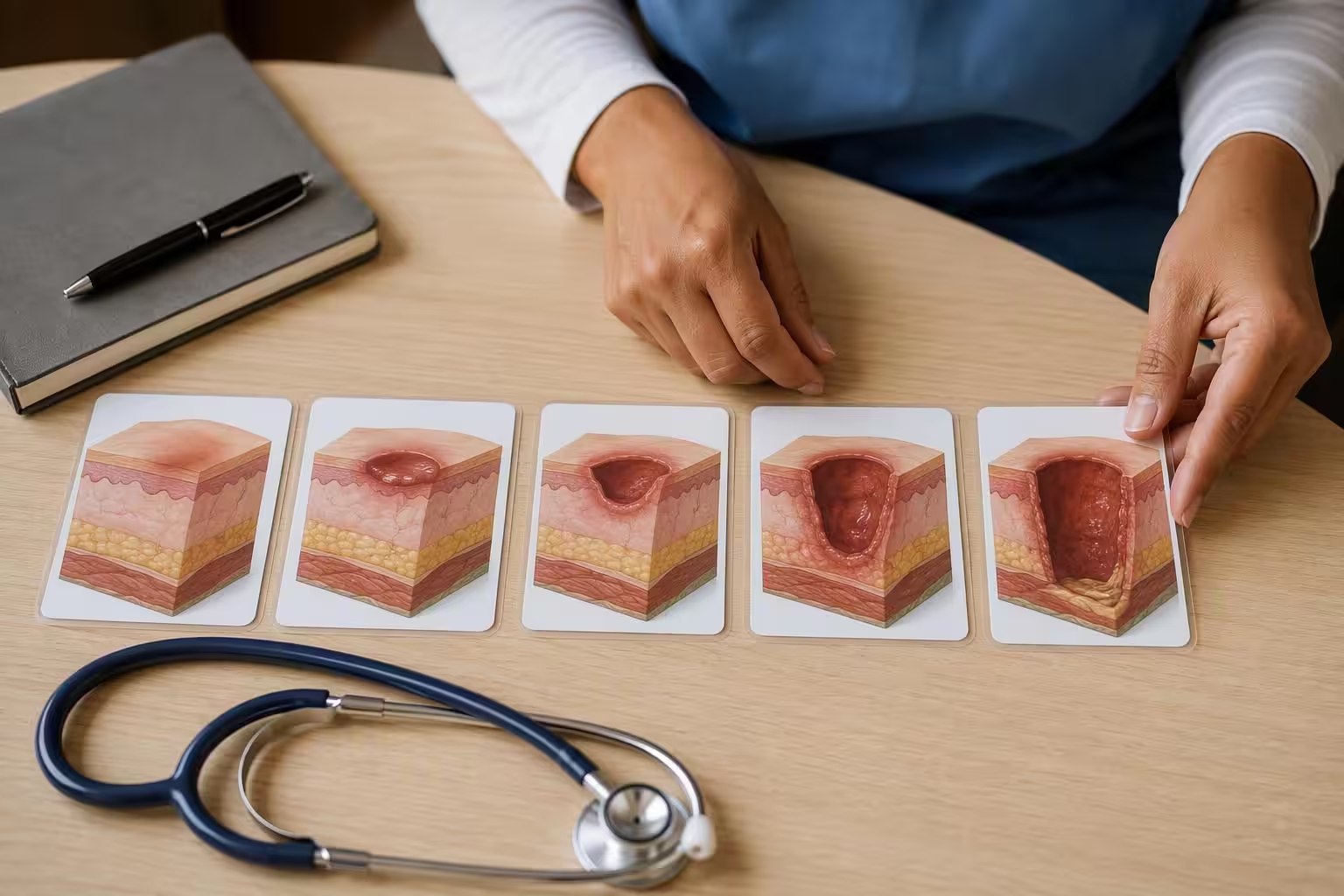
The staging system that resulted defines six categories: Stage 1, Stage 2, Stage 3, Stage 4, Unstageable and Deep Tissue Pressure Injury (the current NPIAP staging definitions, undated poster describing the 2016 system). Medical-device-related and mucosal-membrane injuries are recognized etiologies alongside those stages, and mucosal injuries cannot be staged because of their anatomy. The distinction between an etiology and a stage is the single most useful thing to carry into a chart review, because the conference data show it is where experienced clinicians diverge most.
The 2017 staging clarifications followed requests for implementation guidance and confirm that deep tissue pressure injury may evolve into a full-thickness wound despite optimal care (the 2017 staging clarifications, 24 January 2017). That sentence is the clinical basis for the avoidable versus unavoidable distinction described earlier: a wound that progresses under appropriate care is not automatically a process failure. The clarifications also record that the April 2016 consensus conference drew over 400 multidisciplinary professionals.
Not everyone accepted the process behind the change. The attendee critique reports that the staging task force predetermined which parts of the definitions would go to consensus, that the audience was permitted to vote only on preselected sentences or words and never on a complete definition, and that attendees had no input on the terminology change itself. The same account describes the photograph exercise used to validate the stages, in which 80% of roughly 318 participating attendees classified a sacral wound as a deep tissue injury while the task force called it a Stage 3. A CMS commenter cited in the public comment file states that fewer than 50% of the 400 specialists attending the conference failed the visual staging exercise. The sponsoring body’s methods paper and the attendee report do not reconcile on whether the meeting was a genuine consensus process, and both belong in a policy file that cites the 2016 revision as its basis.
Both accounts converge on one problem the revision did not solve. The NPUAP paper concedes that while the stages are assigned numbers and numbers imply progression, deterioration does not predictably follow a linear path from Stage 1 to Stage 4, and clinicians cannot state that a Stage 3 began as a Stage 1 (the 2016 staging revision and its published rationale, 2016). A 2010 international expert panel cited in the attendee critique raised the same objection years earlier, and it went further, concluding that because of validity and reliability problems in the classification systems, guidelines and protocols built on them should not be considered the legal standard of care (one attendee’s published critique of how the change was made, 2016). Changing Roman numerals to Arabic numerals did not address that criticism.
The device-related category is where the new system performed worst in the conference’s own data, and it is also the category the revised definition newly singles out. The NPUAP paper reports that ulcers due to medical devices were scored most incorrectly, with respondents choosing the etiology label instead of a stage, which is why the revised definition now directs that such injuries be staged using the staging system (the 2016 staging revision and its published rationale, 2016). The attendee report independently records the same pattern, including a necrotic neck wound classified as a medical device injury by 63% of respondents and necrotic tissue under a tracheostomy tie classified that way by 74%. Read together, the definition was revised to correct a confusion the same conference demonstrated was still present in the room.
Two practical warnings from 2016 and 2017 remain unresolved in this evidence set. The attendee critique notes that ICD-10 diagnosis code terminology for pressure ulcers was unchanged at the time and warns that using “injury” in the record would confound billing and coding, and a CMS commenter predicted that new ICD-10 codes adopting the term would need to move from the skin chapter to the trauma chapter (one attendee’s published critique of how the change was made, 2016). Those were predictions, not outcomes, and nothing in this evidence set confirms what was ultimately implemented. Treat them as open questions to verify against your own coding guidance rather than as settled facts.
The regulatory apparatus still runs on the older vocabulary. CMS lists “Pressure Ulcer Stages III & IV” with ICD-9-CM codes 707.23 and 707.24 as a hospital-acquired condition for fiscal years 2014 and 2015, with the present-on-admission indicator determining whether payment is made (the 2007 present-on-admission policy, policy effective 1 October 2007). Set beside the 2016 terminology change, this shows that the payment structure a unit reports into was built on the term the clinical field replaced. That gap is the practical reason a policy review should check both the clinical language and the coding language in the same pass.
The international guideline has tracked these changes across four editions. The third edition, published in 2019, updated its literature search through August 2018 and used “pressure ulcer” and “pressure injury” interchangeably (the 2019 international guideline, 2019). The fourth edition is now released as an online living guideline, with sections published as they are completed and a Quick Reference Guide marked as the final September 2026 version (the fourth edition, released as a living guideline, 2026). Because it is a living document, a unit that cites “the current guideline” should record the section version it relied on rather than a single publication year.
Prevention bundles and modern dressings
Prevention guidance has shifted from a single intervention to a set of components delivered together, and the evidence for that shift is recent. A 2025 systematic review of multifaceted prevention examined 37 articles and identified the recurring components as risk assessment, skin care, nutritional support, repositioning and specialized equipment (a 2025 systematic review of multifaceted prevention, 6 January 2025). The review reports that care bundles prevented pressure ulcers in 90% of patients in one study group, but that figure comes from a single small study within the review rather than from a pooled estimate, and the review reports no GRADE certainty rating in the extracted text. The component list is the durable finding; the 90% is illustrative.
That component list matches the structure AHRQ published years earlier, which is a useful consistency check for a unit building or revising a bundle. AHRQ’s three components are comprehensive skin assessment, standardized risk assessment, and care planning that addresses identified risk areas (AHRQ’s hospital prevention toolkit, toolkit carrying a 2011 sample action plan). A bundle that omits nutrition or support surfaces is not a shorter version of this model; it is a different intervention with a different evidence base.
Repositioning is the component most likely to be written into policy as a fixed number, and the current edition resists that. The repositioning recommendations in the current edition state that either two-hourly or three-hourly intervals could be implemented for most individuals at risk, and the recommendation carries a conditional rating with very low certainty of evidence (the repositioning recommendations in the current edition). A policy that mandates two-hourly turns for every patient is therefore stricter than the current evidence supports, and a policy that allows three-hourly intervals for a specific patient should document the reasoning that made it appropriate.
Prophylactic dressings are the component with the most specific recent evidence, and it comes with stated limitations. A 2025 meta-analysis of ten RCTs covering 4,817 patients found that silicone foam dressings reduced Stage 1 sacral injuries with a risk ratio of 0.18 and Stage 1 heel injuries with a risk ratio of 0.30, with smaller reductions for Stage 2 and above at both sites (a 2025 meta-analysis of ten RCTs, 13 August 2025). The authors report that allocation concealment was described in only two of the ten studies and that no study was blinded, and they call for cost-effectiveness research. For a unit weighing the spend, those limitations are the honest starting point: the effect sizes are large, the certainty is constrained by trial design, and the analysis does not answer what the dressing costs relative to what it prevents.
Dressing formats differ in what they are designed to manage, and the product documentation is the appropriate source for those descriptions rather than the prevention literature. The company’s super-absorbent non-adherent dressings are described for moderately to heavily exuding wounds and state a core that absorbs and holds up to 20 times its own weight in exudate to help minimize maceration and leakage. Those are product descriptions, not efficacy claims, and the meta-analysis above is the source for the prevention question.
The 2019 third edition remains the reference point for units that have not yet moved to the current edition, and it is still available. The issuing bodies state that the full 2019 Clinical Practice Guideline is out of print except for legal purposes but remains available as a free download, alongside a Quick Reference Guide intended for busy health professionals (the 2019 international guideline, 2019). A unit citing the third edition should note that its literature search closed in August 2018, which predates the 2025 prevention reviews described above.
Conclusion
The timeline explains most of the terminology friction a unit encounters. The lesion has been called decubitus ulcer, pressure ulcer and bedsore; the official term became pressure injury in April 2016, with staging moving from Roman to Arabic numerals (the 2016 staging revision and its published rationale, 2016). The payment apparatus still lists Pressure Ulcer Stages III and IV, so clinical and coding language will not match until both are reviewed together (the 2007 present-on-admission policy, policy effective 1 October 2007).
Four implications follow for practice. Risk tools should be chosen for fit and documented consistently, since no guideline mandates one scale and the evidence for any of them is limited (the risk-assessment scale lineage, review 2007-2008). Support surfaces, moisture management and nutrition belong in the bundle alongside repositioning, matching the component list in the 2025 review and AHRQ’s three-part structure (a 2025 systematic review of multifaceted prevention, 6 January 2025). Reassessment timing should be written as a checkpoint rather than a hard rule, because the sources in this set do not establish a definitive interval. And the avoidable versus unavoidable distinction should be documented at the time of the event, since a deep tissue pressure injury may progress despite optimal care (the avoidable versus unavoidable distinction, 2020-2021 white paper citing a 2010 NPIAP expansion).
For procurement, the practical next step is to check whether local policy documents still carry pre-2016 wording and whether the dressing formulary reflects the formats the prevention evidence actually studied. Aligning local documents with the current edition of the international guideline, and recording which section version was used, is the lowest-cost step available before any product decision.
About the publisher: SLK Medical is a manufacturer of advanced wound care dressings, including silicone foam and super-absorbent dressings, and sells these to hospitals, clinics and distributors. It therefore has a commercial interest in how wound care products are described, and its perspective should be weighed with that in mind. The guidance above does not depend on its products.