



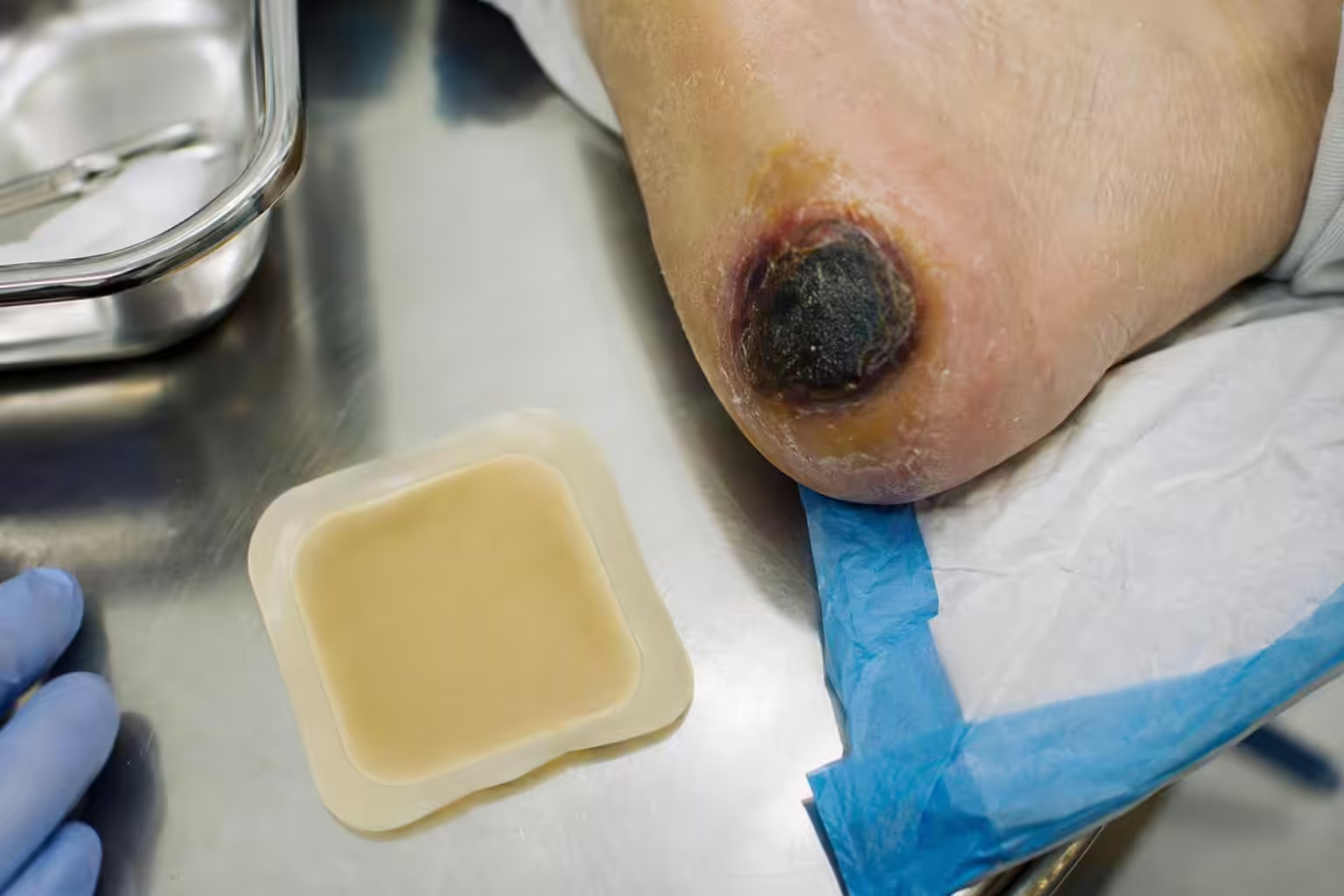
Pressure injury dressing selection by stage and exudate is a two-input decision, not a product catalogue: how deep the wound is, and how much fluid it produces. Get those two wrong and the dressing fails at the bedside, not on the order form.
The stakes are measurable. A 2020 systematic review of hospitalised adults put pooled pressure injury prevalence at 12.8%, with 61.8% of those injuries acquired in hospital (Li Z. et al., Int J Nurs Stud, reported in a 2025 PMC clinical update). An American Family Physician review estimates hospital-associated pressure injuries cost the U.S. health care system $26.8 billion annually, disproportionately at advanced stages (AFP, 2023).
This guide covers pressure injury staging, exudate management dressings, and the practical cues that make a choice defensible. You will learn how to read a wound in two passes, match a dressing category to what you find, and recognise when MARSI prevention dressing removal or an antimicrobial review should change your plan.
Key Takeaways
Two inputs drive the choice: stage (wound depth) and exudate level.
Estimate exudate from dressing-change burden, not from appearance alone.
Reassess within two weeks, or sooner if the dressing fails early.
Disclosure of commercial interest: SLK Medical manufactures the kind of dressings discussed in this article. We have a direct commercial interest in the products referenced here. To protect the clinical value of this guide, every clinical recommendation below is anchored to independent, peer-reviewed guidelines and literature that are listed and linked, and we have kept our manufacturer perspective clearly separated from those clinical conclusions wherever the two appear. Independent clinical guidance, not this article, should remain the basis for patient care. Read the note on how to interpret the two voices in this guide in the section immediately below.
Clinical decisions should follow local institutional policy and a qualified clinician’s assessment.
How to read this guide
This article deliberately holds two separate voices, and it matters which one you are reading:
Clinical voice — sourced to independent authorities. The staging definitions, exudate tiers, dressing-class recommendations, infection guidance, and reassessment intervals come from established multi-society and professional-body guidelines, principally the 2019 EPUAP/NPIAP/PPPIA International Clinical Practice Guideline and the WOCN Society guideline, with the specific evidence grades noted where they exist. These are the parts you can weigh against your own institutional protocol.
Manufacturer voice — clearly flagged. Where we describe how a specific silicone foam or silver product is designed and where it typically fits, that reflects SLK Medical’s own manufacturing perspective and product design, not an independent comparison. Every such paragraph is introduced as a practice consideration rather than a neutral recommendation.
Independent clinical guidelines, not our product range, are the reference point for clinical decisions. Where the two voices differ, follow the guidelines and your facility’s wound care policy.
Introduction
That cost sits behind a decision many teams make by habit. Pressure injuries are localised damage to skin and underlying tissue from sustained pressure, usually over a sacrum, heel or hip. Stage describes tissue loss; exudate describes how much fluid the wound produces. This guide covers pressure injury staging cues, exudate tiers, and how the two combine into a defensible pressure injury dressing selection.
Key Takeaways
Two inputs drive the choice: the stage of tissue loss and the exudate level.
Estimate exudate by dressing-change burden, not by appearance alone.
Reassess the wound and the dressing within two weeks.
Clinical decisions should follow local institutional policy and a qualified clinician’s assessment.
Staging overview
Pressure injury staging describes how deep the damage goes. It says nothing about how much fluid the wound produces. Those are two separate inputs, and dressing selection needs both. A Stage 3 wound can be barely moist or heavily exuding, and the right dressing differs completely in each case. Getting the vocabulary straight first is what stops the “too many categories” problem: once you can name the depth and the exudate level, the dressing class narrows to a small handful of options.

Key Takeaway: Stage describes tissue depth. Exudate describes fluid handling. They are independent inputs, and a dressing decision needs both before you open a package.
Stages 1–4 at a glance
The four numbered stages run from intact skin to exposed deep structures, as set out in the Merck Manual’s staging summary and, more authoritatively for practice, in the NPIAP staging system adopted by the 2019 EPUAP/NPIAP/PPPIA International Clinical Practice Guideline. Stage 1 is intact skin with non-blanchable erythema. Stage 2 is partial-thickness loss with exposed dermis and no adipose tissue, slough, or eschar. Stage 3 is full-thickness loss with fat visible but deeper structures not exposed, and it may include epibole (rolled wound edges), undermining, or tunneling. Stage 4 is full-thickness loss with fascia, muscle, tendon, cartilage, or bone exposed or directly palpable.
Stage | Tissue depth | What you see |
|---|---|---|
1 | Intact skin | Non-blanchable erythema |
2 | Partial thickness | Exposed dermis, no slough or eschar |
3 | Full thickness | Visible fat; possible epibole, undermining, tunneling |
4 | Full thickness, deep | Exposed or palpable fascia, muscle, tendon, cartilage, or bone |
Verify your result: confirm the stage against the deepest visible tissue, not the wound’s surface area. A small opening can still be a Stage 4.
Unstageable and deep tissue injury
Do not stage until the wound bed is visible. A full-thickness wound obscured by slough or eschar is unstageable, and its true depth cannot be assessed until that material is removed. Deep tissue injury is different again: persistent dark discoloration or a blood-filled blister over intact or nearly intact skin, which may evolve in either direction over the following days.
The practical error here is assigning a number anyway. A stage guessed from a covered wound drives a dressing choice built on the wrong depth, and the dressing then fails for reasons that look like a product problem rather than an assessment problem.
⚠️ Warning: Do not debride or stage an unstageable wound outside your local protocol and clinician judgement. Document what you see and escalate.
Key wound cues and peri-wound skin
Exudate level is the second input, and it can be estimated objectively from dressing-change burden. A review of dressing selection by wound characteristics defines the tiers as 1–2 changes per day for mild to mild-moderate exudate, 2–3 per day for moderate, and more than 3 per day for heavy. That gives you a defensible number to record instead of “looks wet.”
Then check the peri-wound skin, the intact skin surrounding the wound. Maceration is softening and whitening from prolonged moisture exposure. Epibole is rolled, thickened wound edges that stall closure. Undermining is tissue loss extending beneath intact skin at the wound margin. Each one changes which exudate management dressings will hold, and each is easier to prevent than to reverse.
Pro Tip: Strike-through or edge lift within the first 24–48 hours is the practical signal that the absorbency tier is mismatched. Step up or down rather than reapplying the same product.
Dressing selection
The recommendations in this section are drawn from guidelines of differing evidence strength, so it is worth knowing how those grades work before you act on any single line. The 2019 EPUAP/NPIAP/PPPIA International Clinical Practice Guideline reports each recommendation with a Strength of Evidence (A, B1, B2, or C) and a Strength of Recommendation (arrow ratings such as ↑↑ or ↑), and it used the GRADE approach to separate the certainty of the evidence from the strength of the recommendation (EPUAP/NPIAP/PPPIA, 2019). The consequences of ignoring that split are practical: much of the wound-care evidence base sits at the lower grades, so some recommendations are classified as “good practice statements” rather than high-certainty evidence. The 2026 VA/DoD pressure injury guideline, for example, issued 29 recommendations made up of 1 strong, 14 weak, and 14 insufficient, showing how often the evidence does not reach a strong recommendation (VA/DoD, 2026). Where a recommendation below is supported only at a weaker grade, treat it as a default to adapt to the individual wound rather than a rule, and check the grade in the source guideline before standardizing it in your facility.
Practical vocabulary for reading those grades: Grade A / higher strength of evidence means the body of evidence can be trusted to guide practice; Grade B means it can be trusted in most situations; Grade C or “low” means it provides some support but should be applied with caution (Australian Commission on Safety and Quality in Health Care).
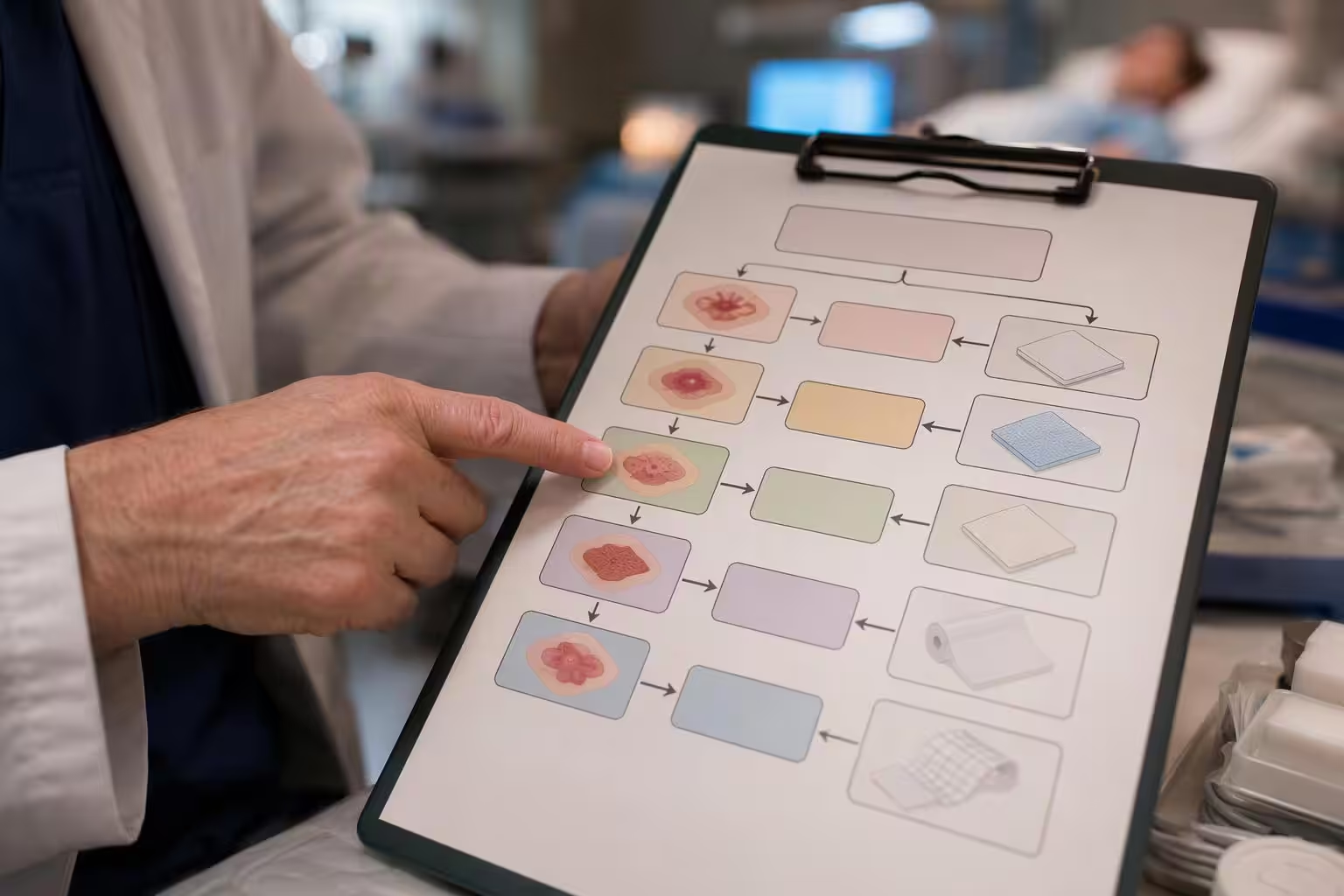
Dressing selection for a pressure injury comes down to two inputs: the stage, and how much exudate the wound is producing. Get those two right and the category choice mostly makes itself. Get them wrong and you get the two failure modes clinicians see most often, maceration from an under-absorbing dressing and a dried, adhered wound bed from an over-absorbing one.
The classes below are named by fluid-handling mechanism rather than by brand, because that is the variable you are actually matching. A review of dressing selection by wound characteristics describes how the main categories differ: alginates absorb up to 20 times their weight in wound fluid, while hydrocolloids can be worn for several days before changing. Those two facts alone explain why the same wound can call for very different products at different points in its healing.
Exudate-based picks
Match the dressing class to the exudate tier first, then check it against the stage. This is the step that prevents most leakage and maceration problems.
Assess the exudate tier. Note volume, colour, and odour at each change, and whether strike-through reached the secondary dressing.
Select by mechanism. Low exudate suits films, hydrocolloids, and thin foams. Moderate exudate suits foams and gelling fibers. High exudate suits alginates, super-absorbents, and cavity fillers under a secondary dressing. This maps closely onto the class-level recommendations in the 2019 EPUAP/NPIAP/PPPIA guideline: hydrocolloids, hydrogels, or polymeric dressings for non-infected Stage 2 injuries; hydrogel for non-infected Stage 3 and 4 injuries with minimal exudate; calcium alginate for Stage 3 and 4 injuries with moderate exudate; foam dressings for Stage 2 and greater with moderate to heavy exudate; and super-absorbent dressings for heavily exuding wounds. The WOCN Society guideline reaches the same structural logic from a different angle, selecting the primary dressing on wound depth, tunneling or undermining, and exudate volume, and the secondary dressing on exudate volume and the need for a bacterial barrier. Note one concrete contraindication the WOCN guidance flags: hydrocolloids should not be used on infected wounds or wounds covered with eschar.
Confirm the fit against the wound bed. A foam on a minimally exuding wound can overdry the bed and adhere; an alginate on a low-exudate wound leaves residue that has to be irrigated out.
Verify your result: at the scheduled change, the dressing should lift without strike-through and the borders should still be intact. If either fails, the tier estimate was wrong, not the product.
Exudate tier | Dressing class | Wear-time consideration |
|---|---|---|
Low | Film, hydrocolloid, thin foam | Hydrocolloids can stay several days; check edges daily |
Moderate | Foam, gelling fiber | Change when exudate nears the border |
High | Alginate, super-absorbent, cavity filler | Requires a secondary dressing; reassess frequency |
Stage-based picks (use cases)
Stage and exudate together narrow the choice to one or two classes. A Stage 1 or 2 injury with low exudate rarely needs more than a film or thin foam for protection. A Stage 3 or 4 injury, or an unstageable wound with heavy exudate, usually needs an absorbent primary dressing plus a secure secondary cover.
Manufacturer voice — not an independent comparison. The following paragraphs describe how SLK Medical designs and positions its own silicone foam products. They reflect the manufacturer’s perspective and are separate from the guideline-sourced clinical recommendations above. For a neutral, guideline-based view of foam dressings, refer to the 2019 EPUAP/NPIAP/PPPIA recommendations cited earlier.
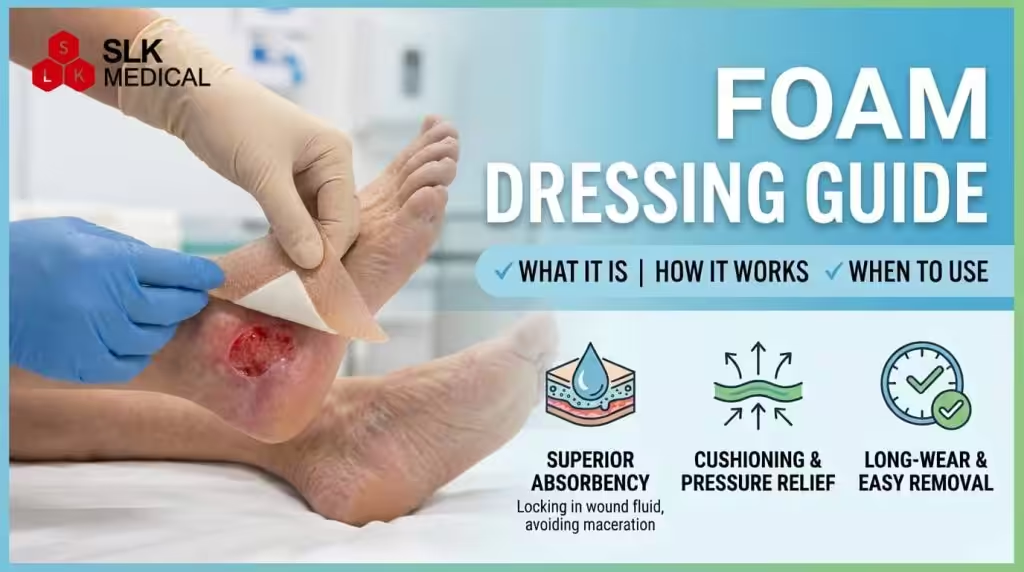
Silicone foam dressing pressure injury practice points are worth stating plainly here, since silicone foam sits in the moderate-to-high exudate tier. From a design perspective, SLK Medical’s bordered silicone foam is built as a five-layer construction: a protective backing, a breathable polyurethane foam absorbent layer, a fluid-distribution layer, and a silicone wound-contact layer that sits against the bed. In our Border Flex variant, a flex component in the absorbent layer allows the dressing to stretch in multiple directions so it stays on moving or curved areas such as the sacrum and heel. These structural choices are what the “match by mechanism” rule above translates into at the product level: the foam controls exudate, the silicone contact layer keeps removal gentle, and the border provides fixation without a separate cover in many situations.

SLK Medical is a manufacturer of advanced wound care dressings with in-house R&D and production capability in silicone foam technology, and it makes these products, so read the following as practice considerations rather than a neutral comparison. A silicone foam dressing with border is designed for moderate-to-high exudate and commonly used to cover pressure ulcers, sacral pressure injuries, post-operative wounds, and diabetic foot ulcers. A Lite version is designed for low-exuding acute and chronic wounds and can be cut to size. Silicone contact layers are commonly used to reduce trauma at removal, which matters if the same site is being redressed repeatedly. Wear time is not fixed across products; verify it on the current IFU or spec sheet rather than assuming a number.
Stage | Typical exudate | Dressing class | Practice consideration |
|---|---|---|---|
1 | None to low | Film, thin foam | Protection and shear reduction |
2 | Low to moderate | Foam, hydrocolloid | Keep peri-wound skin dry |
3 | Moderate to high | Foam, gelling fiber, filler | Confirm no dead space remains |
4 | High | Alginate, super-absorbent, filler | Secondary dressing required |
Unstageable | Variable | Depends on visible tissue | Debride before staging |
A real clinical case: Stage 4 pressure injury on the left hip
The framework above is easier to trust when you can see it applied end to end. The following case comes from SLK Medical’s own clinical documentation and is included as a real-world example, with the same manufacturer-voice caveat that it reflects our own product use rather than an independent trial.
A Stage IV pressure injury on the left hip presented with moderate exudate, approximately 25% slough and 75% granulation tissue, no tunneling, and no signs of peri-wound infection. The care plan combined regular debridement, exudate management, and a bordered silicone foam dressing to maintain a moist wound environment.
As the wound bed improved, the dressing change interval was deliberately extended from 3 days to 4 days, and then to 7 days, each step gated on the dressing lifting cleanly without strike-through. Progressive wound contraction and epithelialization were observed, and the injury reached complete closure at the final follow-up.
Case snapshot
Parameter | Detail |
|---|---|
Wound | Stage IV pressure injury, left hip |
Exudate at baseline | Moderate |
Wound bed at baseline | ≈25% slough, 75% granulation tissue |
Tunneling / peri-wound infection | None / no signs |
Treatment period | Mar 6 – Apr 30, 2025 (≈8 weeks) |
Dressing wear time achieved | 3 days → 4 days → 7 days |
Exudate control | Moderate exudate controlled throughout treatment |
Final outcome | Complete wound healing |
Wound progress over time
Date | Day | Observed change | Dressing interval |
|---|---|---|---|
Mar 6 | Start | Baseline: moderate exudate, 25% slough / 75% granulation | 3 days |
Mar 9 | Day 3 | Interval extended as dressing lifts cleanly | 4 days |
Mar 13 | Day 7 | Dressing holding without strike-through | 4 days |
Mar 28 | Day 22 | Progressive wound contraction | 7 days |
Apr 10 | Day 35 | Epithelialization under way | 7 days |
Apr 30 | Day 55 | Complete wound closure | — |
What the case illustrates: the wear-time extension is the useful lesson, because it shows the exudate tier being re-read at every change rather than fixed at the outset. The interval only moved up after the dressing proved it could stay in place without leaking, which is exactly the read-and-respond behaviour the earlier sections describe. It is a single case, so treat it as an illustration of the process rather than evidence of superior outcomes.
Cavities, offloading, and wear time
Fill a cavity loosely. Packing a wound bed tightly enough to exert pressure works against the tissue you are trying to protect, so verify fill depth against local protocol before covering.
Offload as a separate intervention. A dressing manages the wound environment; it does not redistribute pressure. The 2019 EPUAP/NPIAP/PPPIA international guideline and the 2026 VA/DoD pressure injury guideline both treat support-surface selection and repositioning as distinct from dressing choice, and no dressing substitutes for them.
Document the tier, the class, and the scheduled change interval at every dressing change, so the next clinician can tell whether the plan is working or the wound has moved to a different tier.
Warning: Do not pack a cavity so tightly that it pressures the wound bed. Verify fill against local protocol.
Infection, MARSI, and value
Antimicrobial use and reassessment
Silver is the dressing most often reached for when a pressure injury looks worse, and it is also the one most often left in place longer than the record supports. NICE’s evidence summary on antimicrobial dressings states that silver dressings should be used only when there are clinical signs or symptoms of infection, not as a precaution on a wound that is simply slow to close. The same summary notes that silver ions act in the presence of wound exudate, so exudate volume matters alongside infection status when you decide whether silver is the right choice at all (NICE Evidence Summary ESMPB2, 2016).
The practical consequence for antimicrobial stewardship is a date, not a dressing. Set the reassessment point when you initiate silver, and record it in the wound note the same way you record the dressing type. Two weeks is the working interval most ward protocols use, and it forces a decision: signs resolving, step down to a non-antimicrobial dressing; signs unchanged, escalate for wound culture and medical review rather than renewing the same order. That single habit is what turns pressure injury dressing selection by stage and exudate into an auditable process instead of a standing order.
Key Takeaway: Set the reassessment date at initiation, not at the first sign of trouble. A silver dressing with no stop date is a stewardship finding waiting to happen.
MARSI prevention checklist
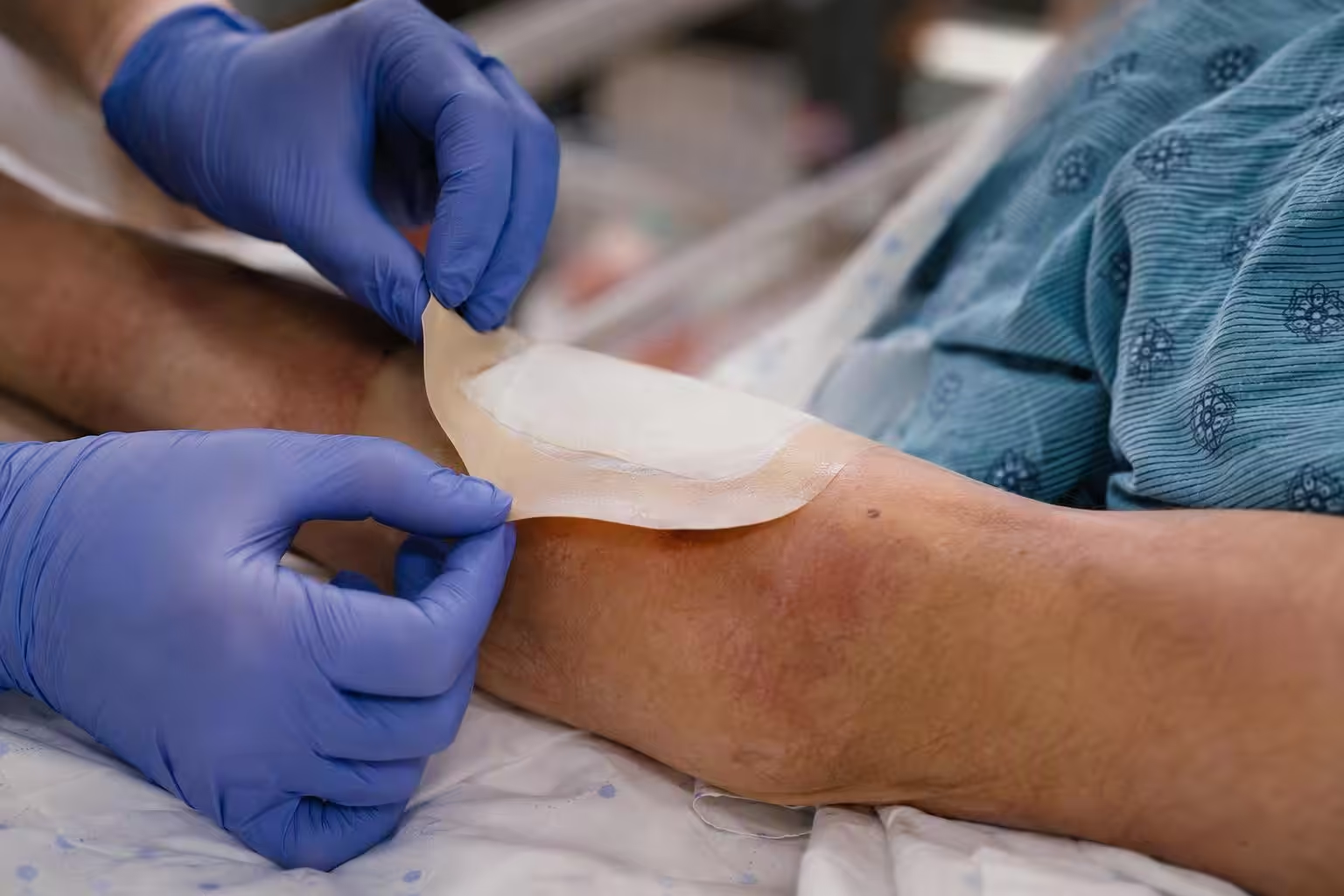
MARSI prevention dressing removal starts with knowing what you are preventing. Medical adhesive-related skin injury entered the international literature in 2013 and covers skin stripping, tension blisters, skin tears, irritant and allergic contact dermatitis, maceration, and folliculitis, though a 2025 commentary on the MARSI definition notes the umbrella term is still debated because only some of those signs meet a strict definition of injury (Kottner J., J Wound Ostomy Continence Nurs, 2025). In cohort research, the operational marker is skin injury appearing at least 30 minutes after adhesive removal (International Wound Journal MARSI cohort, 2025).
The numbers justify the attention. In a 2025 prospective cohort in spinal-surgery patients at a single 700-bed hospital in Seoul, cumulative MARSI incidence was 31.8% with silicone adhesives versus 56.8% with acrylate, mechanical injury 4.5% versus 24.3%, and contact dermatitis 30.3% versus 51.4%. In that same cohort, 45% of patients developed MARSI within 10 days of surgery. A systematised review of MARSI prevalence reports a median prevalence of 28.0% across hospitalised and critical-care settings, with a published range of 0.85% to 70.21% that reflects how differently the term is applied.
MARSI consensus guidance converges on a low-trauma removal technique, and it is short enough to teach at the bedside:
Lift one corner of the dressing rather than pulling from the centre.
Peel back slowly at a low angle, keeping the dressing close to the skin.
Support the surrounding skin with your free hand at the peel line.
Soak with sterile saline or water if the adhesive resists.
NPWT cues and value metrics
Negative pressure wound therapy (NPWT) applies controlled suction to a sealed wound to manage exudate and support the wound bed, and it belongs in the conversation once a pressure injury is deep, heavily exuding, or slow to respond to dressing changes alone. Scale is the reason it stays on the agenda: more than 3 million pressure injuries are treated in the United States each year (American Family Physician, 2023), and pooled prevalence among older people in long-term care runs at 11.6% for any stage and 7.2% excluding stage 1 (systematic review of older people living in long-term care).
Can you prove total cost falls? Not from the published record, and no dressing choice in pressure injury dressing selection by stage and exudate comes with a cost-saving guarantee attached. What you can track is process, and process is what a value analysis committee can audit:
Wear time achieved against wear time intended.
Leakage or strike-through events per dressing change.
Dressing changes per week, per wound.
MARSI events recorded after each removal.
Reassessment compliance: percentage of antimicrobial courses with a documented stop date.
Track those five for a quarter and you have a defensible case for a product change without claiming an outcome the evidence does not support.
Conclusion
Pressure injury dressing selection by stage and exudate comes down to two inputs read together: what the wound bed and peri-wound skin look like now, and how much exudate the dressing has to manage between changes. Stage tells you what the wound can tolerate. Exudate tells you what the dressing must handle. Neither answers the question alone, which is why a Stage 3 cavity and a Stage 3 shallow ulcer with the same exudate level can call for different products.
Whatever you choose, reassess within two weeks. If exudate strikes through, the peri-wound skin is macerating, or the adhesive is stripping skin at removal, the dressing is wrong for this wound at this stage, not the other way around. Track wear time and leakage at every change so the next decision rests on what you observed rather than what the last clinician assumed.
Confirm wear time, sizing, and indications against the current instructions for use and spec sheet before standardizing any product, and check the choice against your facility’s wound care policy and antimicrobial stewardship guidance. Dressing selection supports a plan of care; it does not replace offloading, nutrition, or repositioning, and a qualified clinician should make the final call for the individual patient.
Next step: Review the SLK Medical silicone foam dressing spec sheet and instructions for use, or request a sampling evaluation for your wound care committee.