


Prepared by the SLK Medical editorial team for distributor and tender workflows. This article provides general information only and does not replace local protocols or clinician judgment.
Introduction
Distributors and tender teams don’t struggle with the idea of advanced dressings—they struggle with consistent selection rules that hold up across clinicians, care settings, and audits.
This guide compares foam dressings vs alginate dressings with one goal: support evidence-led clinical and economic decisions (total cost of care), without drifting into unverified outcome claims. For clinical decisions, always follow local protocols and qualified clinician judgment.
Key Takeaway: In procurement, the “better” dressing is usually the one that reduces change frequency and prevents leakage/maceration for the specific exudate level and wound geometry—not the one with the lowest unit price.
Scope: indications, performance and wear-time trade-offs, total cost of care, antimicrobial variants, plus tender/regulatory essentials.
Audience: distributors, procurement managers, and product managers evaluating advanced wound dressings for hospitals and post-acute channels.
Evidence and method
This guide summarizes practical selection principles from publicly available wound-care references and stewardship statements published or updated from 2020–2025, plus procurement workflow considerations (change frequency, exception events, and ancillary use).
Method in brief:
We prioritized guidance that is audit-friendly for tenders: clear indications, change triggers, and secondary dressing requirements.
We avoided outcome claims that cannot be verified from the cited sources.
Where practices vary by wound etiology and local policy, we state the variability and defer to local protocols and the product IFU.
Clinical indications at a glance (foam dressings vs alginate dressings)
Exudate level and wound geometry
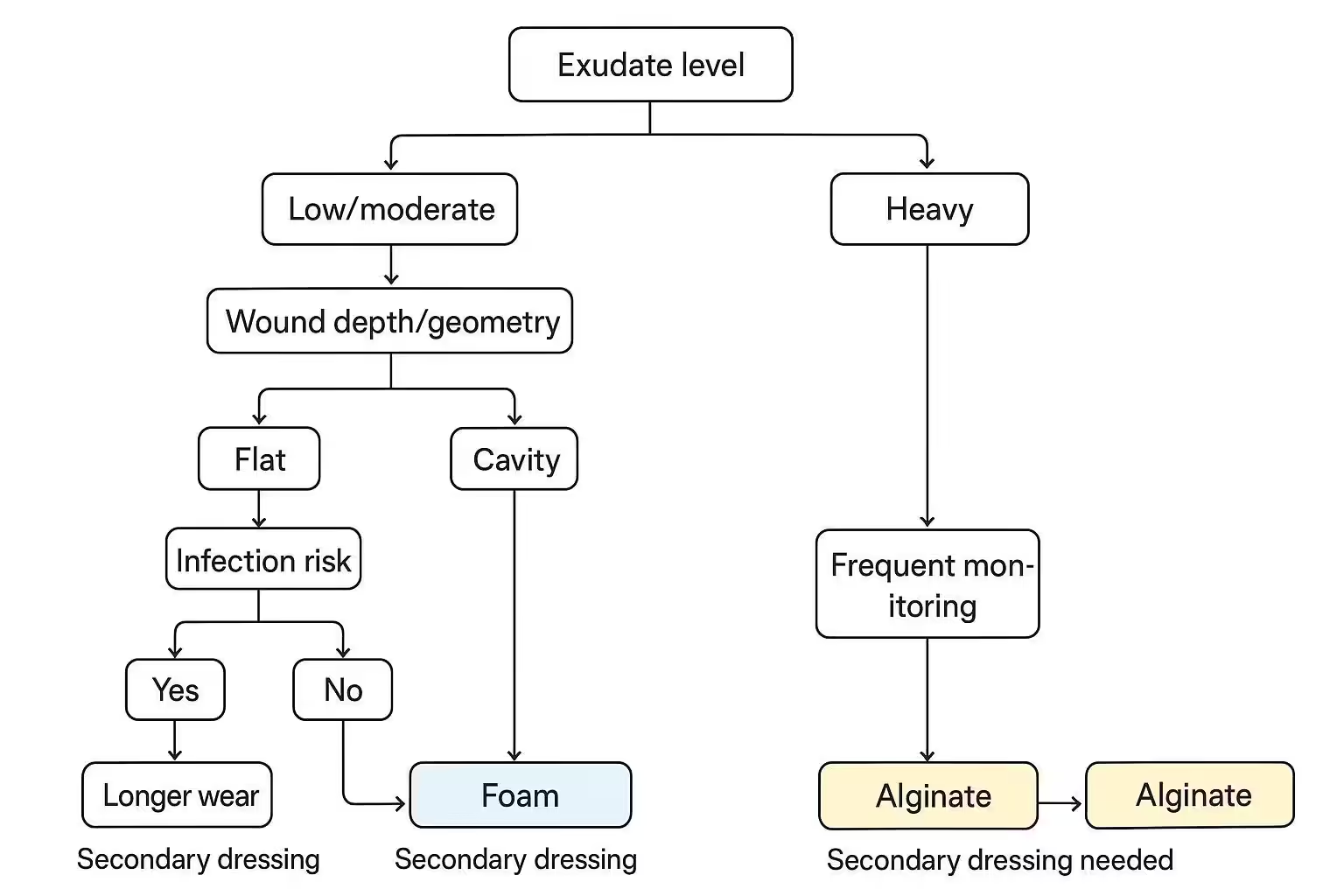
Start with exudate, then geometry. A core wound-care principle is to match the dressing to the wound environment: absorb excess exudate when discharge is high, hydrate when the wound is dry, and reassess continuously at each change.
Foam dressings are commonly used when you need moderate-to-high exudate absorption plus protection/cushioning over relatively flat wound beds.
Alginate dressings are typically chosen when exudate is high to copious, especially when the wound has depth (cavities, sinus tracts) where a conforming, gelling material helps contact the wound bed.
Procurement implication: stock foam as the “broad coverage” workhorse for moderate exudate presentations, and alginate as the specialist option for heavy exudate and cavity presentations.
Scope note (avoid overgeneralization): Dressing choice can differ by wound etiology and pathway (e.g., venous leg ulcers, pressure injuries, diabetic foot ulcers, postoperative incisions). Use exudate and geometry as first-pass rules, then confirm against the specific pathway and the IFU.
Infection and bleeding risk
Two practical rules help keep selection defensible:
If the wound is infected or heavily contaminated, expect more frequent monitoring and changes. The same NCBI Bookshelf/StatPearls guidance notes infected and high-exudate wounds often need daily monitoring and more frequent changes versus clean wounds.
If minor bleeding is a material concern, alginate dressings are often considered because some alginates are used in clinical practice where absorbency and supportive hemostasis are desired. Confirm the intended use in the product IFU and local protocol.
Clinical teams may also require an antimicrobial variant (e.g., silver or bacteria-binding options) for time-limited infection-control trials; those are covered later.
Contraindications and secondary dressing needs
Selection isn’t just “foam vs alginate”—it’s whether the regimen is complete:
Avoid over-absorptive choices on low-exudate wounds. Highly absorptive dressings can desiccate a minimally draining wound bed.
Foam dressings are commonly not recommended for dry eschar or poorly perfused ischemic/arterial presentations (clinical teams will follow local guidance).
Alginate dressings generally require a secondary dressing (cover + fixation) and should be removed fully at change to avoid residue.
Procurement implication: when you contract alginates, validate that the tender bundle includes the appropriate secondary cover/fixation options—or your “unit price” comparison will be misleading.
Performance and wear-time trade-offs
For a foam-focused overview and terminology alignment, see SLK Medical’s comparison of foam dressing types.
Exudate containment and maceration control
Operationally, the biggest failure modes are simple:
Strike-through/leakage (dressing saturated before the planned change)
Edge lift (seal failure driving leakage and contamination)
Periwound maceration (skin damage from chronic moisture exposure)
Foams tend to win when they maintain a stable moist environment with a consistent seal and enough capacity for moderate exudate. Alginates tend to win when you need high-capacity absorption and a material that can conform into depth.
For procurement teams, the key variable is not the category label—it’s capacity vs expected exudate load over the planned wear window.
Patient comfort and atraumatic removal
Comfort is not “soft”—it drives change frequency, adherence to protocols, and downstream skin injury risk.
Foams (especially silicone-contact variants) are often selected when atraumatic removal and skin protection matter (fragile skin, frequent dressing changes, sensitive anatomical sites).
Alginates can be very effective clinically, but the regimen quality depends on appropriate moisture balance and careful removal technique.
A procurement-grade way to evaluate comfort is to ask for the IFU’s guidance on removal technique and to pilot the dressing on the most complaint-prone cohorts (fragile skin, high-change-frequency units).
Change frequency and operational impact
The biggest economic lever is frequently invisible in line-item comparisons: how often the dressing must be changed in real workflows.
NCBI Bookshelf/StatPearls notes that dressing change frequency depends on wound status and exudate, with clean wounds often tolerating longer wear while infected wounds require closer monitoring and more frequent changes. Always follow local protocols and the product IFU for maximum wear time and change triggers.
Operational impact checklist (use in trial planning):
Pilot example (no outcome claims): In a time-boxed tender trial, teams often track operational metrics such as:
Unscheduled changes per 100 dressing applications
Leakage/strike-through events per 100 applications
Periwound maceration observations requiring barrier products
Minutes of nursing time per scheduled change (include skin care + fixation)
These indicators help compare regimens without implying guaranteed healing outcomes.
Expected change cadence by wound type (daily vs every 2–3 days vs extended wear)
Nursing time per change (including periwound skin care)
Leakage events requiring unscheduled changes
Waste volume (secondary dressings, fixation, disposal)
Economic analysis: total cost of care
Unit price vs change frequency and nursing time
If you compare only unit prices, you’re comparing the wrong thing.
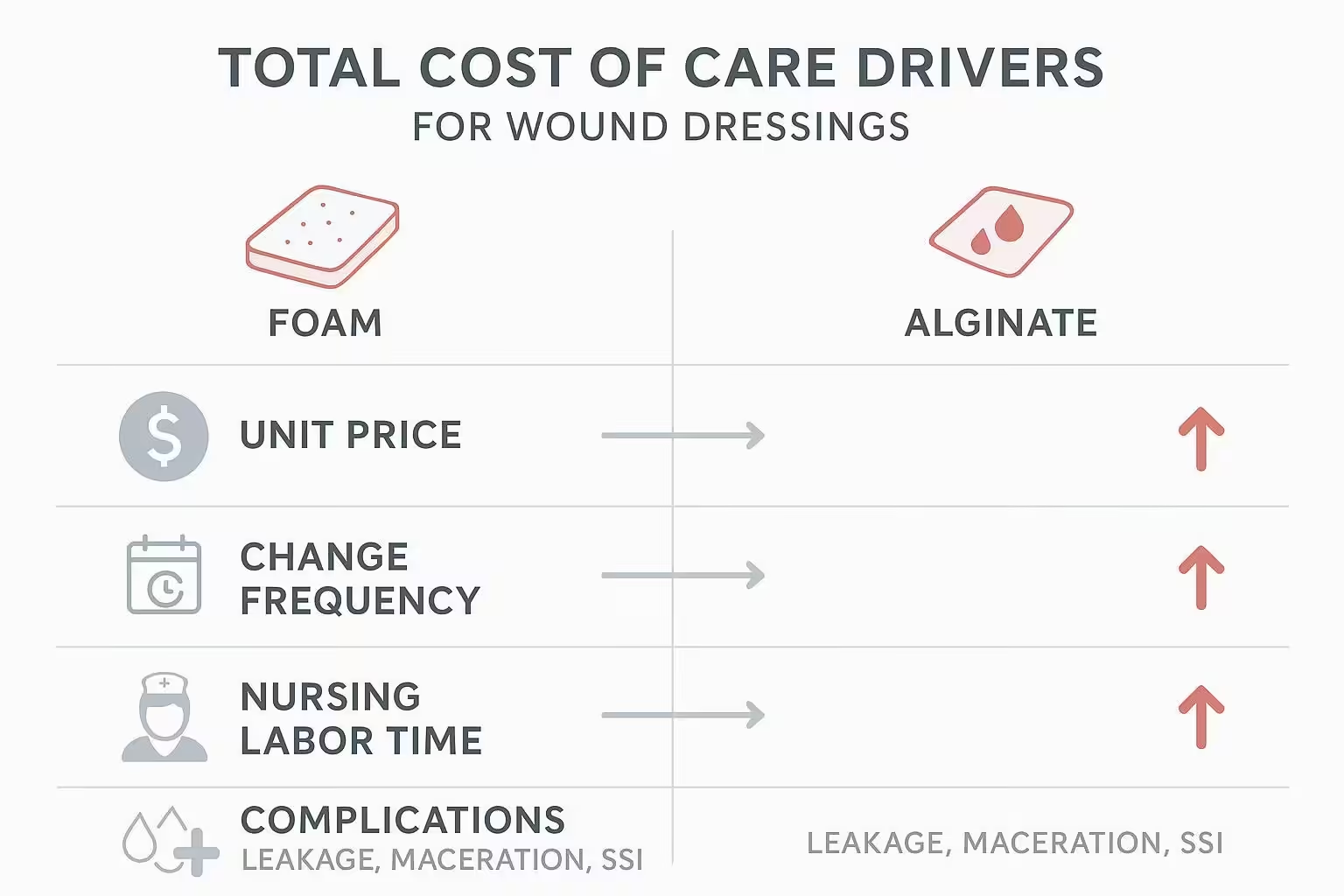
Total cost of care (TCO) for dressings is typically driven by:
Unit price × units per episode
Nursing time per change × number of changes
Ancillaries (secondary dressings, fixation, skin barriers)
A dressing that costs slightly more but holds exudate better—so it stays on schedule and reduces unscheduled changes—can be economically superior.
Complication avoidance (leakage, maceration, SSI)
Complications drive cost through extra nursing time, additional products, and longer episodes.
From a tender perspective, focus on avoidable operational complications:
Leakage/strike-through → unscheduled changes, linen changes, skin irritation
Periwound maceration → barrier products, clinician time, delayed progress
SSI risk context → antimicrobial strategy may be justified in high-risk pathways, but should be time-limited and assessed
This is why “cost per change” and “changes per week” are often more decision-useful than “cost per unit.”
Procurement levers: formulary mix, MOQ, and logistics
A practical formulary strategy is rarely “one dressing for everything.” It’s a mix designed to cover the exudate-depth spectrum with minimal SKU sprawl:
Foam: core coverage for moderate exudate and comfort-sensitive use
Alginate: targeted coverage for heavy exudate, cavities, and minor bleeding scenarios
Antimicrobial variants: restricted use with stop rules
Then pressure-test the offer commercially:
MOQ and lead time by top sizes
Consignment/VMI options for high-velocity SKUs
Packaging accuracy and multilingual label controls (to reduce customs/recall risk)
Post-award training support (to reduce misuse-driven failure rates)
Antimicrobial variants and when they pay off
Silver and DACC use cases and time-limited trials
Antimicrobial dressings should be treated like a stewardship-controlled tool, not a default upgrade.
A pragmatic procurement policy:
Use antimicrobial variants when there are clinical signs of local infection or high bioburden risk, and define a review checkpoint.
Stop or step down when there’s no objective benefit, instead of extending use indefinitely.
This aligns with antimicrobial stewardship thinking in wound care, including Wounds UK antimicrobial stewardship recommendations (2025) and the broader stewardship mindset outlined in CDC Core Elements of Antibiotic Stewardship (updated 2025).
Wounds UK stewardship guidance also reinforces structured review: antimicrobial dressings are commonly used as a time-limited trial with reassessment (often referenced as a “two-week challenge”), rather than left in place indefinitely; see the Wounds UK Best Practice Statement: Antimicrobial Stewardship (2025) PDF.
Two common variants:
Silver dressings: antimicrobial activity, but stewardship guidance supports selective, time-limited use rather than routine application.
DACC dressings: often described as working via physical binding and removal of bacteria (non-killing mechanism), which can fit stewardship goals; see the 2025 review on applying antimicrobial strategies in wound care (PMC).
Evidence signals 2020–2025 relevant to infection risk
Across 2020–2025 guidance and reviews, the consistent “signal” is not that antimicrobials always outperform standard dressings; it’s that indication discipline matters:
Define why the antimicrobial is used (local infection signs, high-risk pathway)
Define how long the trial runs before reassessment
Define what success looks like (reduced odor/exudate burden, reduced local inflammation, better trajectory)
For tender teams, this becomes a governance tool: restricted formulary status + clinical pathway + audit-friendly stop rules.
SLK Medical context
SLK Medical supports distributor and tender workflows with silicone foam and silver (Ag) dressing options, audit-ready compliance document packs, and customizable OEM/ODM packaging. Product selection remains per local protocol and IFU.
Regulatory and tender essentials
MDR/CE, FDA, ISO 13485 documentation
For distributors, the fastest way to de-risk tenders is to standardize an “evidence and compliance pack” request.
Minimum expectations:
ISO 13485 certificate (scope includes the manufacturing site and product family)
EU MDR/CE documentation and technical file index (as applicable)
FDA pathway clarity for the marketed device/claims (avoid confusing “registration” with marketing authorization)
IFU clarity, labeling, sizes, sterility, shelf life
Operational reliability often fails at the edges—literally and figuratively:
IFU must be explicit on: indications, contraindications, wear-time conditions, change triggers, removal method, and secondary dressing requirements
Labeling must match market needs: language, units, traceability/UDI, single-use/sterile status
Size range and case pack consistency should match the tender’s consumption profile
Sterility method (if sterile) and shelf-life evidence should be available for audit and risk management
Evidence packs and clinical-economic summaries
For advanced dressings, tender teams benefit from a one-page clinical-economic summary per dressing family:
Indications by exudate level + geometry
Wear-time expectations and change triggers
Secondary dressing requirements
Economic model inputs: changes/week assumptions + nursing time per change
Claims that are supported (and what evidence backs them)
Practical decision framework
Match by exudate and wound depth
Use this as a fast shortlist rule:
Moderate exudate + flat wound bed + comfort priority → start with foam
Heavy/coppious exudate and/or cavity/sinus → start with alginate
Minor bleeding risk → consider alginate (with appropriate cover)
Low exudate → avoid highly absorbent choices that can dry the bed
Operative steps for dressing change cadence
To keep change frequency under control, standardize four steps:
Set a target wear window (e.g., “on-schedule” changes unless strike-through)
Define early-change triggers (leakage, saturation, edge lift, infection escalation)
Confirm secondary dressing bundle (for alginates and high-risk sites)
Audit exceptions weekly (unscheduled changes per 100 dressings is a useful operational KPI)
Portfolio planning for hospitals and post-acute
Portfolio planning should reflect channel realities:
Hospitals: broad size coverage, fast replenishment, documentation completeness
Post-acute/home health: comfort and simplified protocols to reduce errors
Distributor planning: align top SKUs to MOQ/lead times; build a fallback size ladder for supply shocks
Conclusion
Foams are typically the better default for moderate exudate, comfort, and longer wear when the seal and capacity hold. Alginates tend to win for heavy exudate, cavity wounds, and minor bleeding/hemostasis support.
Economics hinge on change frequency, nursing time, and complication avoidance, not unit price alone. Use your trials to measure unscheduled changes, leakage, and periwound skin issues—those are the cost multipliers.
Next step for distributor shortlisting: request an audit-ready pack (ISO 13485 scope, MDR/CE or FDA pathway clarity, IFU/label set, sterility/shelf-life evidence) and run a time-boxed, protocolized trial that compares changes/week and exception events—not just comfort ratings.