



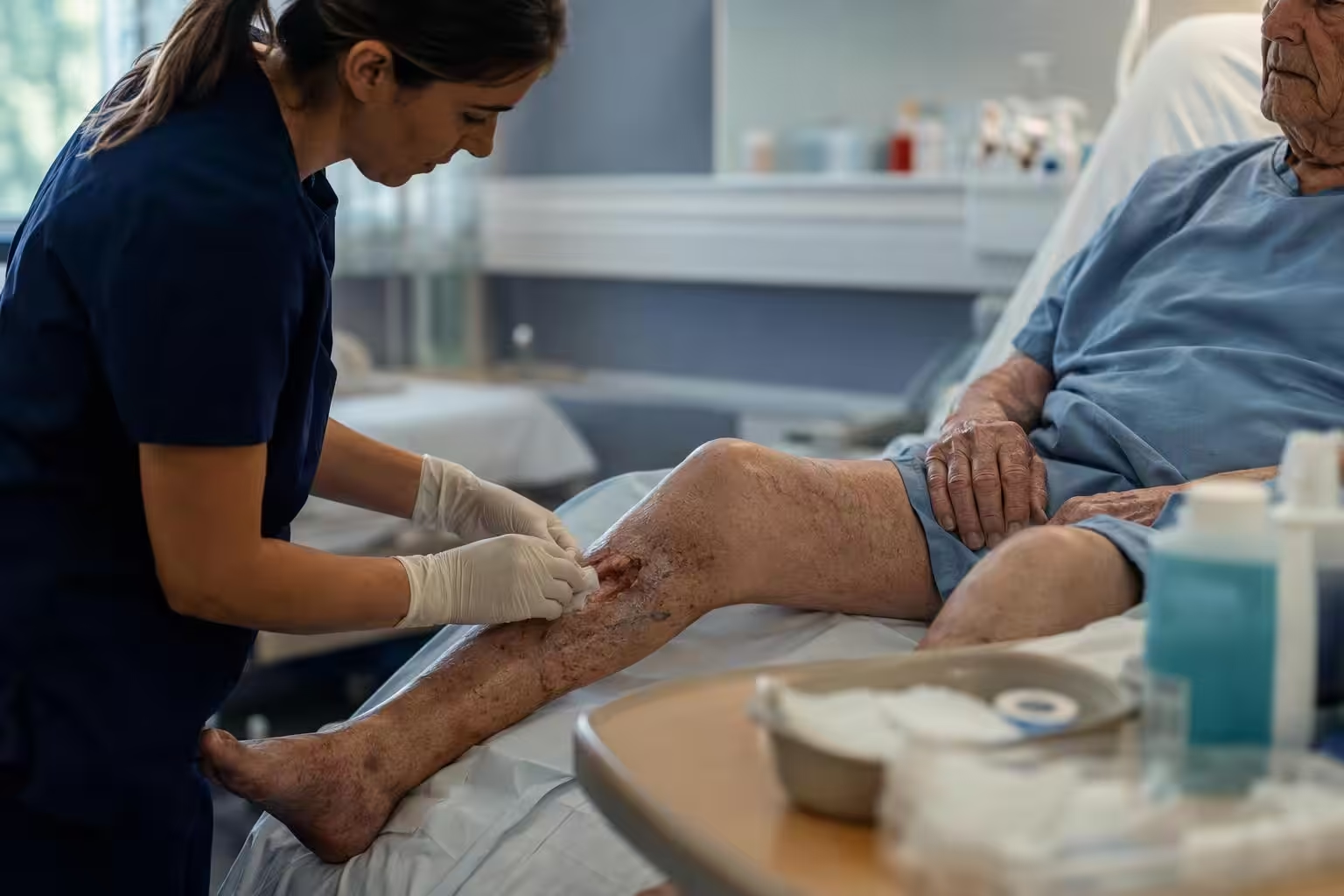
A wound that has not shrunk by roughly half at four weeks is the working definition of delayed healing: failure to reduce 20% to 50% in size within four weeks, with thresholds of under 50% for diabetic foot ulcers, under 40% for venous leg ulcers and 20% to 40% for pressure injuries (Prognostic factors for delayed healing of complex wounds, retrieved 2026-06-01). Only 9% of wounds with poor area reduction at four weeks went on to heal in the analysis cited by Frykberg and Banks (2015).
A systematic review of cost-effectiveness studies put the average cost of complete chronic wound healing at $6,435, with a median of $5,814 and an interquartile range of $3,340 to $9,311 (Marešová et al., 2026). Most of that spend is nursing time and visits rather than dressings.
Biofilm is present in most chronic wounds: specialised microscopic techniques have shown biofilm in 60% to 90% of chronic wounds (Harries, Bosanquet and Harding, 2016). This article sets out the causes and red flags to look for, the assessment and escalation steps that follow, and how to match dressing class to exudate level while keeping antimicrobial use inside stewardship limits.
Key Takeaways
Delayed healing is defined operationally as less than 20% to 50% area reduction at four weeks, and only 9% of wounds with poor reduction at that point go on to heal.
Biofilm is present in 60% to 90% of chronic wounds and can re-form within 24 to 48 hours, so debridement and cleansing are recurring tasks, not one-off events.
MARSI is a measurable, preventable harm: 45% of a spinal-surgery cohort developed it within 10 days, and acrylate adhesives carried 2.55 times the risk of silicone.
Antimicrobial dressings follow a two-week challenge: reassess at two weeks, then stop, continue or switch based on response.
Match dressing class to exudate level and inspect the wound and surrounding skin at every dressing change.
Fixing delayed wound healing
The practical starting point is the TIME framework for wound bed preparation, which organises assessment and treatment into Tissue, Infection/inflammation, Moisture imbalance and Epithelial edge advancement, and defines wound bed preparation as removing the barriers that prevent a chronic wound from following the normal healing trajectory (Schultz et al., 2004). The three subsections below follow that sequence: what is stalling the wound, what to check and when to escalate, and what to do about it with dressings and antimicrobials.

Many chronic wounds fail to progress past the inflammation stage because of imbalances of inflammatory cells, cytokines, growth factors and proteases such as matrix metalloproteinases, and a significant minority of wounds never progress through the healing steps at all (Harries, Bosanquet and Harding, 2016). The clinical task is to find which of the modifiable inputs is holding the wound in that state.
Common causes and red flags
Biofilms are implicated in up to 60% of chronic wounds compared with about 6% of acute wounds, over 90% of chronic wounds are reported to contain bacteria within a biofilm matrix, and mature biofilms can re-form within 24 to 48 hours (Shen et al., 2025). The same review notes biofilms in nearly 70% of diabetic foot infections and more than 50% of burn wounds. Conventional debridement and antiseptics reduce surface biofilm burden but rarely eradicate it completely, so a wound that improves after debridement and then stalls again is behaving as expected rather than failing treatment.
Malnutrition is linked to impaired wound healing, wound dehiscence and higher surgical site infection rates, protein needs in chronic wounds can rise by up to 250% because of protein loss, and caloric need during healing is estimated at 30 to 35 kcal/kg, rising to 40 kcal/kg in underweight patients (Seth et al., 2024). The same review is candid that the efficacy of supplementation in patients with apparent deficiencies remains contentious, so the defensible action is screening and dietitian referral rather than a supplement protocol.
The fourth edition of the international pressure-injury guideline names mobility and activity limitation, medical devices, existing pressure injuries, duration of surgery and immobilisation, mechanical ventilation, inadequate oxygenation, poor perfusion, shock states, vasopressor use, illness-severity scores, malnutrition and, at the heel, peripheral arterial disease and diabetes (NPIAP/EPUAP/PPPIA risk chapter, 4th edition 2026). Global pooled prevalence in hospitalised adults is 12.8% (95% CI 11.8 to 13.9) with an incidence rate of 5.4 per 10,000 patient-days (Li et al., 2020). One national administrative dataset shows hospital-acquired pressure injuries falling from 21.1 per 10,000 discharges in 2018 to 13.3 in 2020 and then rising again to 18.2 in 2024, though the authors caution that administrative data cannot be attributed directly to prevention quality (Sebastiani et al., 2026).
Approximately 15% of people with diabetes eventually develop a foot ulcer, and 14% to 24% of those require amputation (Raja et al., 2023). The chance of achieving successful wound closure decreases the longer the wound has been present (Harries, Bosanquet and Harding, 2016).
Escalate for spreading erythema beyond the wound margin, increasing pain, increasing warmth, swelling or induration, purulent or foul-smelling drainage, a sudden increase in exudate, dusky or friable granulation tissue, new slough, systemic illness such as fever, chills, confusion or unstable vital signs, exposed tendon, muscle or bone, and tunnelling or undermining (EWMA wound infection fact sheets, November 2025). Persistent bleeding despite pressure needs urgent escalation.
Assessment and escalation
The 2026 quick reference guide directs clinicians to assess the wound bed and edge, the periwound and the surrounding skin and soft tissue, to cleanse the surrounding skin, and to observe and inspect the physical characteristics of the wound and surrounding skin at each dressing change (NPIAP/EPUAP/PPPIA quick reference guide, 4th edition, version date 1 September 2026). The same document selects dressings to promote an optimal healing environment by balancing moisture, controlling infection and inflammation, controlling odour, supporting autolytic debridement, redistributing heat and pressure, and relieving pain.
Two numbers anchor the escalation decision: the four-week area-reduction threshold described above, and the two-week antimicrobial review covered below. No measurable improvement by two to four weeks, or less than roughly 40% to 50% area reduction at four weeks, warrants reassessment rather than another month of the same plan.
MARSI is defined as red rashes or abnormal skin symptoms such as blisters, erosions and skin avulsion that persist for more than 30 minutes after removal of medical adhesives, and it is categorised as mechanical, tension, allergic or other types including maceration and folliculitis (Global trends in MARSI research, 2026). The definition traces to the 2013 international consensus by McNichol and colleagues, updated in 2024 by a nine-expert panel producing 20 consensus statements on assessment, prevention and management (Barton et al., 2024).
A single-centre prospective study of 140 spinal surgery patients found MARSI in 45% of patients within 10 days, with contact dermatitis the most common type at 41.4% (Yang et al., 2025). The same study reports MARSI incidence of 15.5% in elderly long-term care residents, 3.4% to 25.0% in inpatient wards, 10.96% to 11.86% in ICU patients and 19.7% to 29.83% in patients with a peripherally inserted central catheter. Time to first MARSI in critical care and long-term care settings has been reported at 26 to 27.1 days, against 3.75 days in the surgical cohort, which the authors attribute to daily dressing application and removal.
The prevention bundle centres on holistic skin assessment, risk assessment before each application and removal, assessing skin before each application and removal, and choosing dressings with gentle, atraumatic removal, with silicone adhesive preferred over acrylic in at-risk or fragile skin (Wounds International MARSI prevention article, undated). Acrylate dressings carried 2.55 times the risk of MARSI compared with silicone (95% CI 1.49 to 4.34) after adjustment, and the acrylate group developed MARSI almost twice as fast, at 2.67 days versus 5.90 days (Yang et al., 2025). Silicone does not eliminate MARSI, since 31.8% of the silicone group still developed it, but it reduces incidence, delays onset and shortens duration.
The 2025 UK antimicrobial stewardship best-practice statement frames antimicrobial treatment duration around the two-week challenge: antimicrobial dressings are recommended for a minimum of two weeks, after which clinicians should discontinue if signs and symptoms have resolved, continue if the wound is progressing but signs remain, or consider an alternative antimicrobial and refer if there is no improvement (Wounds UK Best Practice Statement, 2nd edition 2025). The same statement treats antimicrobial failure and recurrence of delayed healing on cessation as established clinical indicators of biofilm, requiring debridement, cleansing and an antimicrobial with proven anti-biofilm effect or a physical mode of action.
A UK prescribing bulletin caps silver dressings at five dressings for a maximum of two weeks, changed every three days, with referral to a tissue viability nurse if there is no response within two weeks (PrescQIPP Bulletin 53, 2014). Its companion bulletin on antimicrobial dressings, which explicitly excludes silver, sets the same limit: prescribe for the shortest time required, generally one to two weeks, with a maximum two-week supply, and discontinue when signs of infection resolve, when the wound starts to heal, or if the patient experiences adverse effects (PrescQIPP Bulletin 122, 2015). NICE’s evidence summary on chronic wounds reaches the same position, that silver and antimicrobial dressings are not for routine use, are reserved for clinical signs or symptoms of infection, and should be reassessed after about two weeks (NICE ESMPB2, 2016).
A Cochrane review of 26 randomised trials with 2,066 participants concluded there is insufficient evidence to establish whether silver-containing dressings or topical agents promote wound healing or prevent wound infection, with some poor-quality evidence that silver sulfadiazine slows healing in partial-thickness burns (Cochrane, 2022). Silver is a time-limited infection-control measure with a review date, not a healing intervention.
Interventions and dressings
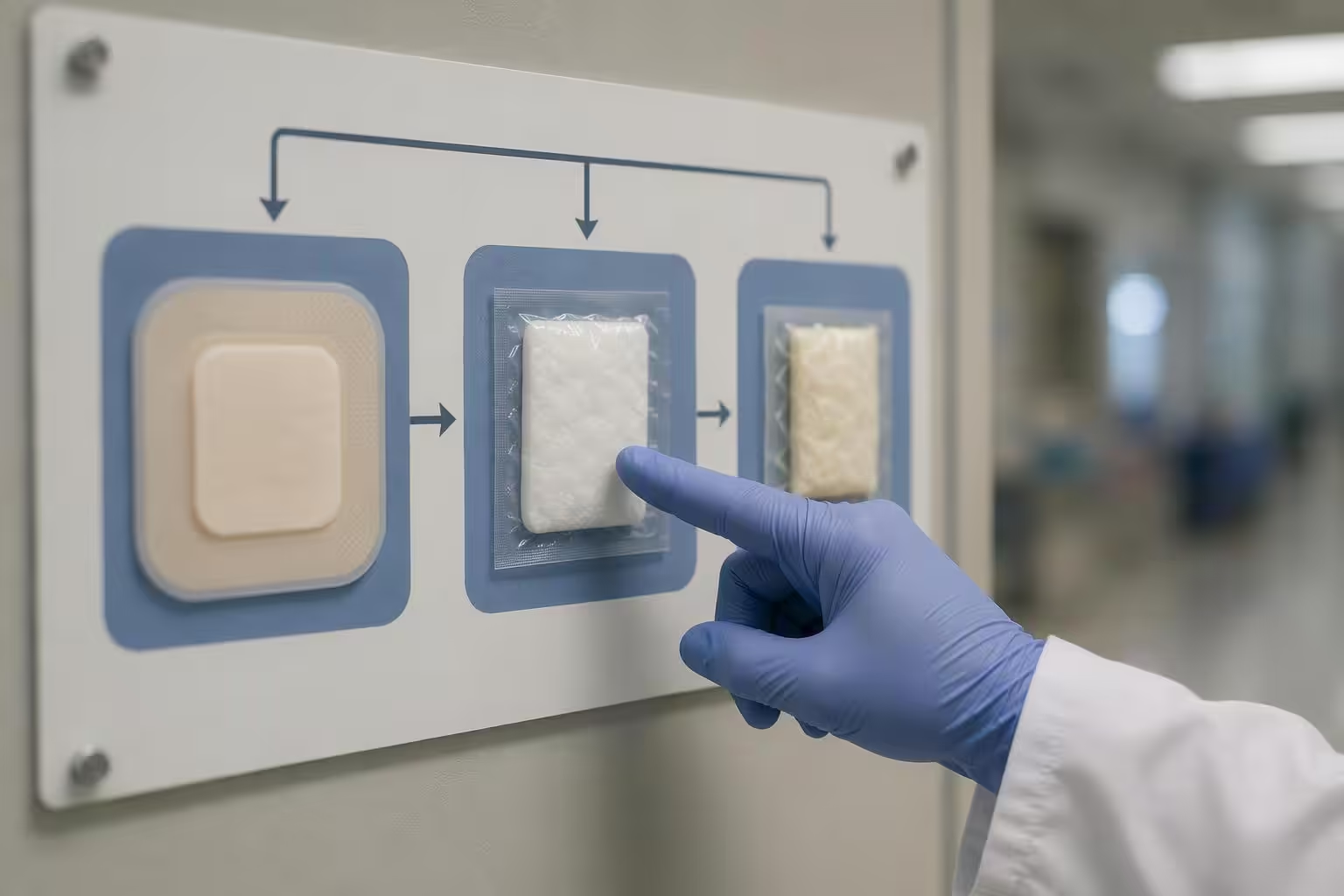
Wound exudate is assessed practically by the state of the dressing in situ, using categories of dry, moist, wet, saturated and leaking, with moist the usual management target and saturated or leaking signalling a change of dressing regime and periwound maceration risk (Wound exudate and the role of dressings, consensus document). The same consensus matches dressing selection to the exudate category of light, medium or high fluid control.
Exudate level | Dressing class to consider | Reassessment cadence |
|---|---|---|
Light | Thin foam, hydrocolloid or film over a non-exuding or dry wound bed; avoid foam on dry or eschar-covered wounds | Review at each scheduled change; confirm the wound bed is not drying out |
Medium | Silicone foam with or without border; check fit at the sacrum, heel and other contoured sites | Review at each dressing change for strike-through and edge lift |
High | Superabsorbent dressing, alginate or gelling fibre, with a foam or film secondary layer; consider protease-modulating options | Shorten the interval until strike-through stops; inspect periwound skin for maceration at every change |
The 2026 quick reference does not contain an exudate-level dressing-selection table and does not name MARSI; it expresses dressing choice as balancing moisture and controlling infection and inflammation (NPIAP/EPUAP/PPPIA quick reference guide, 4th edition 2026). The exudate mapping above therefore comes from the exudate consensus and formulary guidance, not from the pressure-injury guideline, and should be presented that way in any policy document.
The guideline suggests a multilayered soft silicone foam dressing on the sacrum and heels for individuals assessed as having a high risk of pressure injuries, where resources permit (NPIAP/EPUAP/PPPIA quick reference guide, 4th edition 2026). That recommendation is about prevention rather than treatment. For selection among foam, alginate and gelling fibre in practice, see alginate vs gelling fibre vs silicone foam dressing selection and high-exudate wound management with 5-layer silicone foam dressings.
Excessive exudate damages the surrounding skin and is thought to promote biofilm formation as a nutrient source, while low exudate promotes eschar formation and inhibits cellular activity, and chronic wound fluid has been shown to inhibit fibroblast growth and carry increased levels of pro-inflammatory cytokines, free oxygen radicals and proteases (Harries, Bosanquet and Harding, 2016). The same review notes that protease-modulating dressings may be appropriate in highly exuding wounds, and that superabsorbent dressings and skin barrier creams may be necessary to avoid periwound maceration. A dressing which is saturated at every change is a signal to change the regime, not to change the dressing more often.
Debridement remains the core intervention for the Tissue component of TIME, with a wide range of techniques available, and wound cleansing is defined as the removal of surface contaminants, bacteria and remnants of previous dressings from the wound surface and surrounding skin (Harries, Bosanquet and Harding, 2016). The same review flags an honest limitation: a Cochrane review found no strong evidence that wound cleansing either speeds healing or decreases infection risk, despite a single-blind randomised trial supporting a propylbetaine-polihexanide solution over normal saline in vascular leg ulcers and pressure ulcers. Negative pressure wound therapy is described as widely used, with mechanisms including exudate removal, oedema reduction and granulation promotion, but the review states there is currently limited evidence to support its use and that efficacy and cost-effectiveness have yet to be established across a range of wounds.
For antimicrobial dressings, start silver or an antimicrobial dressing for local infection or high bioburden, reassess at two weeks, then branch: discontinue if infection is resolved, continue if the wound is progressing with residual signs, or switch and refer if there is no improvement (Wounds UK Best Practice Statement, 2025; PrescQIPP Bulletin 53, 2014). Documenting the start date and the review date at the point of application is what makes the two-week challenge auditable.
Nursing time and hospital costs account for more than 80% of the total cost of chronic wound care, and healing time, frequency of dressing changes and presence of complications are the main factors influencing that cost (Marešová et al., 2026). A dressing that holds exudate for the scheduled interval reduces both nursing contacts and the number of adhesive applications and removals, which is where MARSI risk accumulates. For the comparison that most often comes up when a unit is standardising, see hydrocolloid vs silicone foam vs alginate and sacrum silicone foam dressings.
About this guide and our products
This guide is published by SLK Medical, a manufacturer of advanced wound care dressings, so you should read the following with that commercial interest in mind.
Our silver (Ag) foam dressings address the infection/inflammation step of the TIME framework: the absorbent layer releases ionic silver with a sustained antimicrobial effect for up to 7 days, and they are indicated for moderately to heavily exuding wounds such as pressure ulcers, diabetic foot ulcers and post-operative wounds. Silver antimicrobials are one option among several described above, and the evidence summarised in this guide does not establish silver as superior to other antimicrobial classes. Our dressings do not replace sharp debridement, offloading or the clinician’s own assessment of the wound bed, and dressing choice and wear time remain the treating clinician’s decision.
Conclusion
Delayed wound healing is a definable, measurable problem rather than a matter of clinical impression. The four-week area-reduction threshold identifies the wound that needs a different plan, and the two-week antimicrobial review identifies the dressing that needs a stop date. Between those two checkpoints, the modifiable causes worth acting on are biofilm, nutrition, pressure and perfusion, and adhesive-related skin injury, each of which has a specific bedside action attached to it.
The failure mode to avoid is continuing a plan that is not working. A wound that is saturated at every change, an edge that is not advancing, periwound skin that is macerating, or a silver dressing that has been in place for a month without a documented review are all signals that the current regime is the problem. The 2026 international guideline’s instruction to inspect the wound and surrounding skin at each dressing change is the cheapest audit tool available for catching those signals early.
Standardisation is the next step for most units, and it is a procurement conversation as much as a clinical one. A single exudate-level algorithm, a MARSI prevention bundle built around silicone adhesives, and a documented two-week antimicrobial review are the three artefacts worth agreeing locally, because each one replaces a judgement call with a check. When verifying a supplier for that standardised range, ask for the specification sheet, the instructions for use, the relevant certifications and a sampling plan for the specific sizes your unit uses, and confirm the manufacturer operates a certified quality system such as ISO 13485 certified manufacturing. Scope of practice varies by jurisdiction and by facility policy; wound assessment, debridement and dressing selection should be carried out within the clinician’s own scope, with referral to a tissue viability or wound care specialist where the wound is not responding.
Frequently Asked Questions
How long should a dressing stay on a chronic wound?
There is no single interval, because the correct answer is set by exudate level and dressing class rather than by the calendar. The dressing should maintain a moist wound bed without saturating or leaking between scheduled changes (Wound exudate and the role of dressings). If a dressing is saturated at every change, shorten the interval or move to a higher-absorbency class such as a superabsorbent, alginate or gelling fibre rather than simply changing more often.
When should a stalled wound be referred to a specialist?
Refer when there is no measurable improvement by two to four weeks, or less than roughly 40% to 50% area reduction at four weeks, and immediately when red flags are present. The red-flag list includes spreading erythema, increasing pain or warmth, purulent or foul-smelling drainage, a sudden exudate increase, dusky or friable granulation tissue, systemic illness, exposed deep structures, and tunnelling or undermining (EWMA wound infection fact sheets, November 2025).
Does silver actually help a chronic wound heal?
The best available evidence does not support silver as a healing intervention. A Cochrane review of 26 randomised trials with 2,066 participants found insufficient evidence to establish whether silver-containing dressings or topical agents promote healing or prevent infection, and noted poor-quality evidence that silver sulfadiazine slows healing in partial-thickness burns (Cochrane, 2022). Use silver as a time-limited measure for local infection or high bioburden, with a documented two-week review.
Which adhesive should be used on fragile or elderly skin?
Silicone adhesive is the preferred choice in at-risk or fragile skin. The MARSI prevention consensus recommends dressings with gentle, atraumatic removal and silicone adhesive in place of acrylic for at-risk patients (Wounds International MARSI prevention article). Cohort data support this: acrylate dressings carried 2.55 times the risk of MARSI compared with silicone (95% CI 1.49 to 4.34), and the acrylate group developed MARSI at 2.67 days versus 5.90 days for silicone (Yang et al., 2025).