


Launching private label wound dressings isn’t just about putting a logo on a box—it’s about building a clinically sound product line that ships on time, withstands real-world handling, and meets multi-market compliance. This guide walks you through the one-stop path with an OEM/ODM partner, from product design and packaging customization to sterilization, labeling/UDI, and production ramp. Along the way, we’ll keep the emphasis where it matters most: clinical-grade quality, flexible manufacturing, and end-to-end delivery.
Who Private Label Wound Dressings Are For—and Common Launch Scenarios
If you’re evaluating private label wound dressings, you likely fall into one of three patterns. Distributors often need a fast, compliant rollout for the coming season, with packaging and labeling finalized quickly and predictable lead times. Healthcare providers—hospitals and clinic groups—tend to focus on clinical fit: sizes, shapes (heel, sacrum), and validated sterile packs that present aseptically in the OR and wards. E-commerce-first brands usually care about small-batch flexibility to test multiple SKUs, retail-ready packaging, and rapid sampling before they scale. Whatever your path, the core workflow is similar: lock the product design, prove safety and performance, validate your sterile barrier system, choose and validate sterilization, finalize labeling/UDI, and then move to production and logistics.
Choosing Your Dressing Platform and OEM silicone foam dressing
Most private label wound dressings portfolios start with a few proven platforms and then branch into specialty SKUs:
Silicone foam dressings are a versatile baseline for many patient populations; they’re gentle on skin and available in bordered and non-bordered versions. For a technical primer you can reference the internal overview on foam basics in the educational library under the silicone foam dressing category, which frames indications and construction without overwhelming your team. See the product taxonomy via the Advanced Wound Dressings hub for context: advanced wound dressings category and the dedicated silicone foam dressing category.
Silver antimicrobial variants extend silicone foam or non-adhesive formats with ionic silver to help control bioburden within the dressing. Make sure any antimicrobial claim aligns with current FDA classification proposals and special controls where applicable (we’ll cover this compliance angle below).
Super-absorbent dressings support high-exudate wounds and can reduce strike-through. For background on matching exudate levels to product types, the explainer on high-exudate dressing selection provides a useful starting point for product managers.
If you’re weighing foam versus hydrocolloid as your initial private label anchor, a concise comparison in the internal library—silicone foam vs hydrocolloid—can help your team align on trade-offs without getting lost in clinical minutiae. The takeaway: begin with one or two workhorse SKUs (e.g., OEM silicone foam dressing in common sizes), then add antimicrobial and super-absorbent options to round out coverage.
Design Controls and Quality System Backbone
Private label programs run best on a shared quality language. In the United States, the FDA’s Quality Management System Regulation (QMSR) aligns closely with ISO 13485:2016, reducing duplication for organizations already working to the international standard. FDA’s QMSR became effective in February 2026 and incorporates ISO 13485 by reference while updating inspection approaches with risk-based integration across processes. For the authoritative source, see the FDA’s QMSR page: Quality Management System Regulation (QMSR). For an accessible orientation to the ISO framework itself, you can review the ISO 13485 overview that outlines documentation and product realization expectations.
In OEM–private-label models, clarify responsibilities early. The OEM typically owns manufacturing process controls, validation of special processes (e.g., sealing and sterilization), and supplier management for raw materials. The private-label legal manufacturer assumes responsibility for the technical documentation, risk management, labeling/UDI, vigilance, and post-market activities. This division only works if contracts secure the right level of access to evidence (design verification/validation, packaging validation, sterilization files) so your notified body or competent authority review is smooth.
Biocompatibility and Performance Evidence (ISO 10993 Strategy)
For external communicating dressings with prolonged duration, a risk-based biocompatibility plan is standard. Typical endpoints include cytotoxicity, irritation, and sensitization, with systemic toxicity and chemical characterization considered based on materials and contact duration. FDA’s guidance aligns with ISO 10993‑1 and provides device-category tables to help teams select the right endpoints. For the most current federal perspective, consult the agency’s living document: FDA guidance on ISO 10993‑1 biological evaluation. Pair this with a toxicological risk assessment (e.g., ISO 10993‑17 principles) if additives or process residues warrant deeper evaluation. The practical tip here is simple: freeze your bill of materials early and get your lab’s sample prep requirements in writing to avoid rework.
Medical Device Packaging Customization and Sterile Packaging that Survives Real-World Use
Your sterile barrier system (SBS) must protect the device through sterilization, distribution, and shelf life—and present aseptically in clinical use. ISO 11607‑1 defines requirements for materials and SBS design; ISO 11607‑2 governs validation of forming, sealing, and assembly processes. A strong validation plan typically combines integrity tests before and after simulated distribution, with aging studies to justify shelf life. For a practical, readable summary that aligns with what regulators expect, this independent resource offers a solid overview of the standard and common test methods: ISO 11607 packaging testing overview.
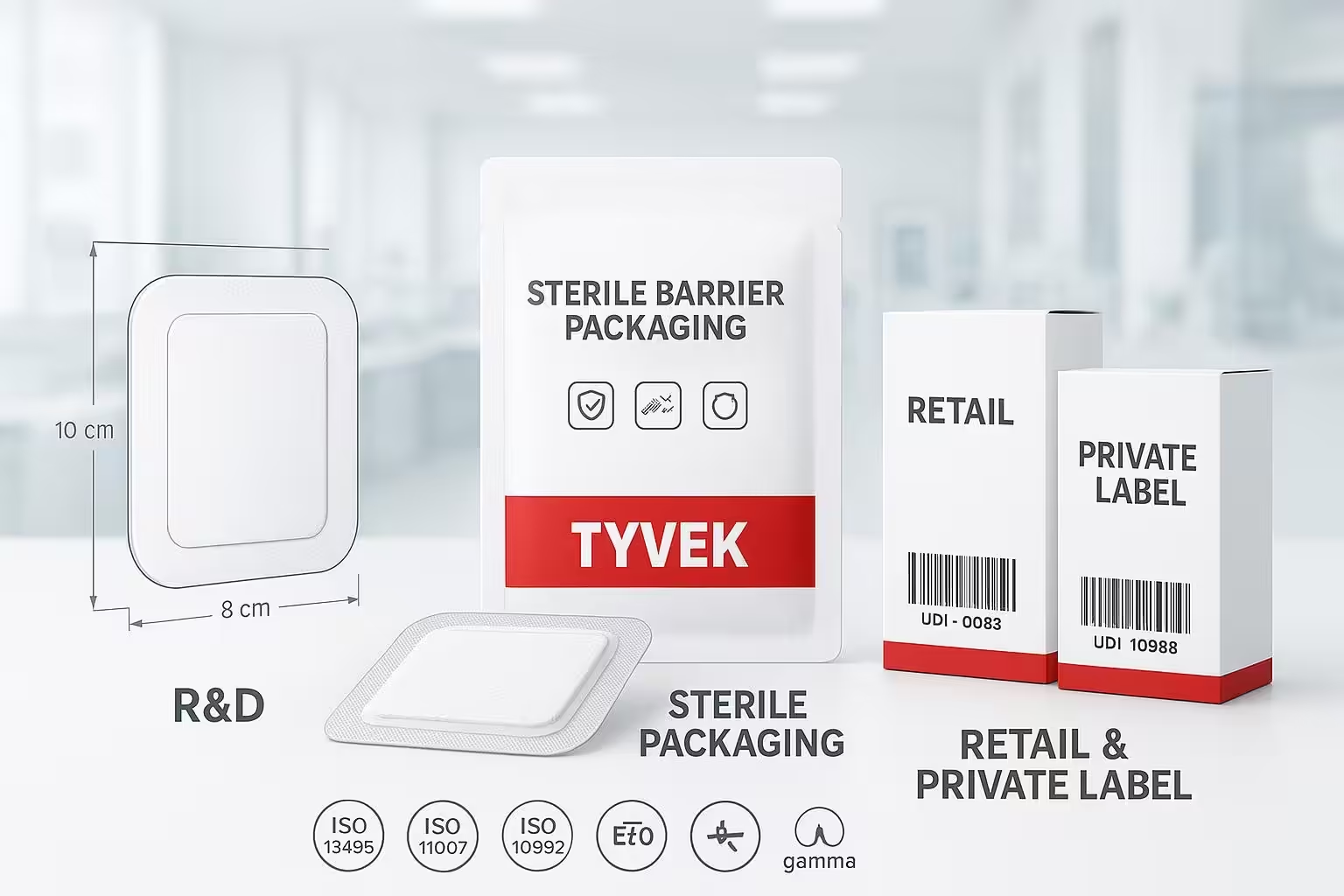
Two common SBS options for dressings are Tyvek pouches and semi-rigid blisters. Tyvek breathes for ethylene oxide sterilization and delivers robust fiber-free peeling; blisters can improve stacking and retail presentation. Design for usability: clear opening cues, adequate seal width, and visual contrast that helps nurses avoid touch contamination.
Requirement or Goal | Standard or Method | Practical Note |
|---|---|---|
Seal strength | ASTM F88 | Quantify peel force by pouch type; define acceptance criteria by risk. |
Seal channel detection | ASTM F1929 | Dye penetration for porous seals; sensitive to micro-channels. |
Whole-package leak | ASTM F2096 | Vacuum bubble test for gross leaks across the package. |
Visual inspection | ASTM F1886 | 100% visual post-seal; use AQL sampling for lots. |
Distribution robustness | ASTM D4169 | Simulate vibration/drops; retest seals after distribution. |
Accelerated aging | ASTM F1980 | Model shelf life; pair with real-time confirmation. |
IQ/OQ/PQ of sealing equipment locks in your process window and demonstrates capability under routine production. Revalidate when you change materials, sealing parameters, or sterilization partners. Think of this as insurance: robust sterile packaging avoids the jarring experience of field complaints or nonconformances tied to peel failures or compromised barriers.
Sterilization Pathways and Validation Essentials
Most private label wound dressings choose between ethylene oxide (EtO) or radiation (gamma or e‑beam) sterilization. EtO per ISO 11135 runs at low temperatures that are friendly to sensitive foams and adhesives but requires careful aeration and residuals control guided by ISO 10993‑7. Radiation per ISO 11137 is residue‑free and can speed release but may change polymer properties at higher doses; dose setting follows recognized methods (e.g., VDmax/Method 1) based on bioburden. FDA’s consolidated sterilization hub provides a regulator-backed orientation to options and oversight: Sterilization for Medical Devices (FDA).
Regardless of modality, your validation objective is a sterility assurance level of 10^-6, with routine monitoring (e.g., biological indicators in process challenge devices for EtO; periodic dose audits for radiation). Coordinate early with the sterilizer to reserve slots and align packaging breathability (for EtO) or dose mapping (for radiation) with your materials and geometry.
Labeling, UDI, and Global Readiness
Plan your artwork and UDI in parallel with design and packaging—late changes here can delay first-article runs. In the United States, labels and packages must carry a human- and machine-readable UDI, with data submission to the GUDID database; date formats and direct marking rules apply based on device type and reusability. For FDA’s detailed recommendations on UDI form/content, see: Unique Device Identification System: Form and Content of the UDI (FDA, PDF). Globally, harmonization guidance from the International Medical Device Regulators Forum helps teams align symbol-first labeling and documentation practices across markets; consult the IMDRF guidance: Principles of Labelling for Medical Devices and IVD Medical Devices (IMDRF/GRRP WG/N52, Edition 2, 2024, PDF), which complements ISO 20417.
For EU MDR products, ensure your private label entity (as the legal manufacturer) owns the technical documentation per Annex II/III, assigns Basic UDI-DI and UDI-DI/PI per Annex VI, and plans for EUDAMED submissions according to class timelines. Your OEM agreement should guarantee timely access to verification/validation records so your notified body can complete conformity assessment without gaps.
MOQs, Lead Times, and Cost Drivers—What to Expect
Exact numbers vary by OEM capability, customization level, and sterilizer capacity, but there are realistic bands you can plan around. Sampling often takes 2–6 weeks once specifications and artwork are frozen; first production lots typically require 8–12+ weeks, driven by material buys, sealing/packaging readiness, and sterilization slots. Some commodity sterile products published online show lower MOQs or quicker turns, which helps frame the floor for simpler items; for example, public listings for sterile gauze packs and accessory devices indicate small MOQs and short deliveries. Treat those as directional benchmarks rather than promises for advanced dressings.
Primary cost and timeline drivers include: SKU complexity (sizes/shapes; bordered vs non-bordered), specialty media (silver, super-absorbent cores), packaging choice and seal validation scope, sterilization method and queue time, artwork and UDI readiness, and any required design or process revalidations.
Budget not just for unit cost but for the documentation finish line: packaging validation reports, sterilization validation summaries, and labeling/UDI confirmations are essential deliverables that de-risk audits and market entry.
A Practical Workflow Example with an OEM Partner
Here’s a condensed, realistic pathway for a distributor’s fast-launch of private label wound dressings—optimized for compliance and speed.
Phase 1: Design freeze and samples. Your team aligns on an OEM silicone foam dressing in two core sizes plus one silver variant. Bill of materials is locked; risk management inputs are drafted. Samples arrive within a few weeks for internal evaluation and photography.
Phase 2: Packaging and sterilization readiness. The sterile barrier system is chosen (Tyvek pouch), sealing parameters are defined via OQ/PQ, and integrity testing is planned (F88/F1929/F2096 before and after D4169). Sterilization partner reserves capacity; EtO is selected for material compatibility and aeration windows are scheduled.
Phase 3: Labeling/UDI and first production. Artwork with UDI is approved; GUDID prep runs in parallel. First production lots flow through sealing, integrity checks, sterilization, residuals verification, and release testing. Logistics stage the launch by geography.
Typical OEM–brand handoffs: design dossier ownership and evidence sharing; packaging validation reports with pass/fail criteria; sterilization validation summary and routine monitoring plan; artwork/UDI version control; certificate of conformity and lot traceability.
If you’re looking for a concrete partner example, organizations like SLK Medical operate as ISO 13485–certified manufacturers that can support silicone foam, antimicrobial silver, and super-absorbent private label variants while collaborating on packaging and sterilization plans. The value in practice isn’t a marketing claim—it’s the ability to produce the right evidence on time while keeping options open for future SKU extensions.
Due Diligence: How to Evaluate an OEM for Private Label Wound Dressings
Begin with quality credentials and evidence access. Ask for a current ISO 13485 certificate and a summary of recent audits; request anonymized examples of ISO 11607 packaging validations, including which ASTM methods were used and acceptance criteria. Confirm sterilization partnerships and validation responsibilities for EtO (ISO 11135) and radiation (ISO 11137), and how routine monitoring is handled. Probe for labeling/UDI workflows, including data governance for DI/PI assignments and submission support. Finally, assess materials breadth—can they support silicone foam, silver antimicrobials, and super-absorbents in your target formats—and how they handle change control so your expanded private label wound dressings roadmap won’t hit revalidation surprises.
If you want a quick, audit-ready starting point, request this document set up front:
ISO 13485 certificate + most recent audit summary
ISO 11607 packaging validation summary (test matrix + acceptance criteria)
Sealing process validation evidence (IQ/OQ/PQ) or equivalent process window justification
Sterilization validation summary (ISO 11135 or ISO 11137) + routine monitoring plan
Biocompatibility summary aligned to ISO 10993 (or a rationale for leveraging existing data)
Labeling/UDI control procedure (artwork versioning, DI/PI governance, GUDID/EUDAMED support)
FAQs
Q: Do we need new packaging validation if we only change the label artwork?
A: Typically no, label-only changes without impact on materials, sealing, or sterilization do not trigger ISO 11607 revalidation; document the change and rationale in your risk file.
Q: How many SKUs should we start with for private label wound dressings?
A: Many teams begin with two to four high-velocity sizes in an OEM silicone foam dressing plus one specialty (silver or super-absorbent). Expand after six months of sales and feedback.
Q: EtO or gamma for foam dressings?
A: EtO is gentler on adhesives and some foams but needs aeration and residuals control; radiation is faster to release but requires dose mapping and material compatibility checks.
Q: What’s the most common cause of launch delays?
A: Late-breaking artwork/UDI changes and mis-scoped packaging validation plans. Freeze labeling early and align your test matrix with the distribution and shelf-life claims you intend to make.
Q: Do antimicrobial claims change our regulatory path?
A: Potentially. As of March 2026, FDA has published a proposed framework (not yet final) that stratifies certain antimicrobial wound dressings by antimicrobial-resistance (AMR) risk; some silver-ion dressings are generally discussed in the context of Class II with special controls if finalized, but the final classification can differ by product and intended use. Treat this area as time-sensitive and confirm the latest status in the Federal Register notice before planning submissions: FDA proposed classification of certain solid wound dressings (Federal Register, Nov 30, 2023).
Wrapping Up and Next Steps
Private label wound dressings launch smoothly when three pillars stay in sync: a clear design and materials plan, a validated sterile barrier and sterilization strategy, and labeling/UDI readiness that matches your markets. Line those up with a capable OEM, and you’ll move from sampling to shippable product without firefighting.
If you’d like a neutral conversation about scoping evidence and timelines for your first SKUs, teams sometimes start by reviewing a recent packaging validation and sterilization plan with an experienced manufacturer such as SLK Medical. The goal isn’t a sales pitch—it’s aligning on what it takes to deliver a safe, compliant line on a realistic schedule.
About this guide (scope and review)
This article is intended for product, quality, regulatory, and sourcing teams evaluating private label wound dressings with an OEM/ODM partner. It focuses on manufacturing controls, validation, and labeling/UDI—not clinical treatment decisions.
Content prepared by the SLK Medical Quality & Regulatory team. Last updated: 2026-03-24.
References and further reading
FDA’s overview of the 2026 Quality Management System Regulation aligning with ISO 13485: FDA QMSR page
ISO’s page describing ISO 13485 and its scope: ISO 13485 overview
FDA guidance aligning with ISO 10993‑1 endpoints: FDA 10993‑1 biological evaluation guidance
Practical overview of ISO 11607 testing and methods: ISO 11607 packaging testing overview
FDA’s consolidated sterilization resource: Sterilization for Medical Devices (FDA)
FDA guidance on UDI form/content: Unique Device Identification System: Form and Content of the UDI (FDA, PDF)
IMDRF’s 2024 labeling principles for global alignment: Principles of Labelling for Medical Devices and IVD Medical Devices (IMDRF/GRRP WG/N52, Edition 2, 2024, PDF)