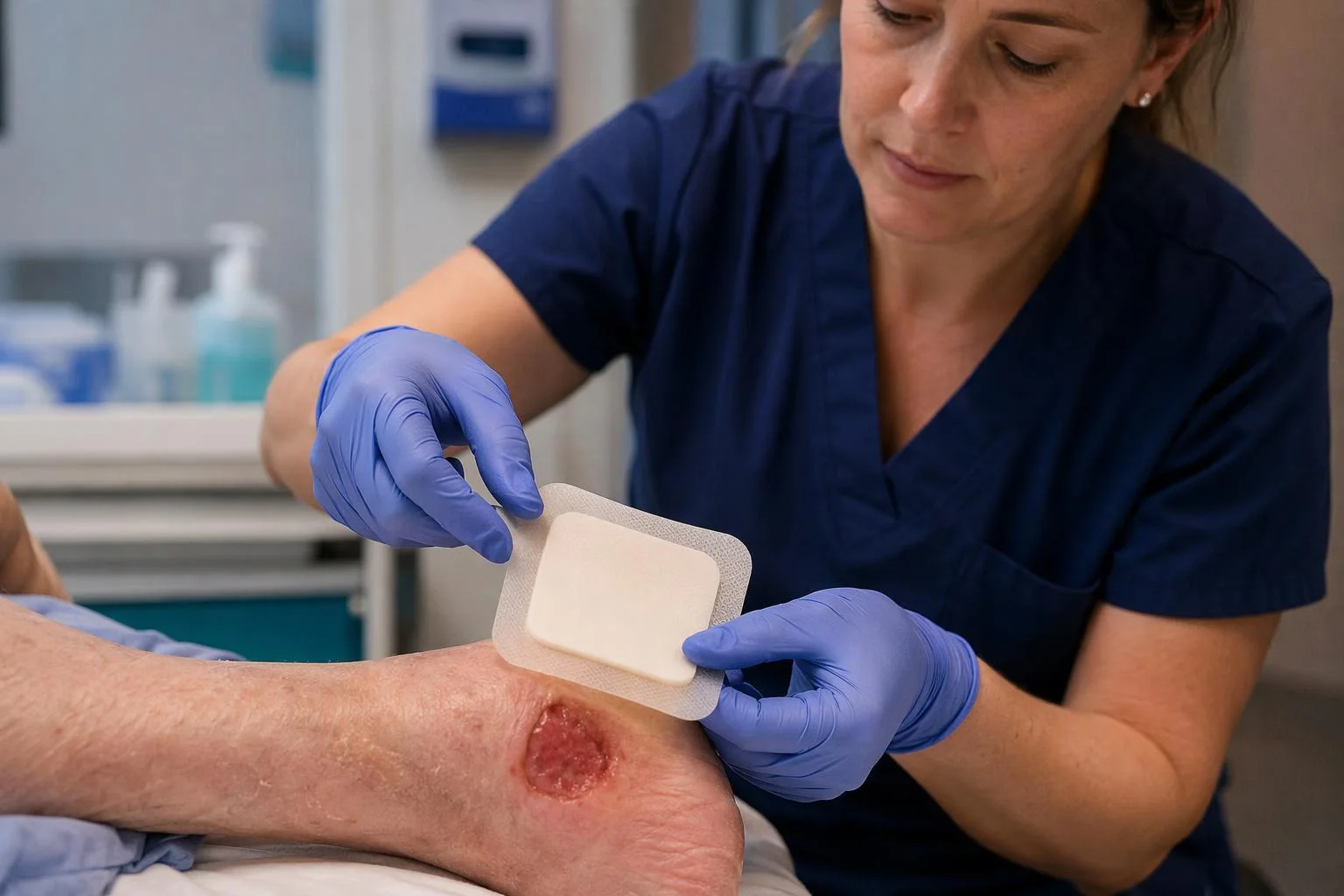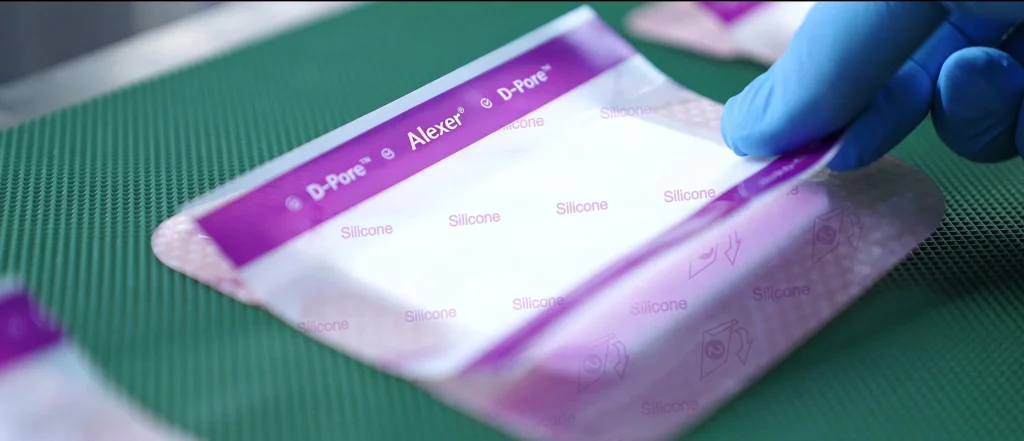


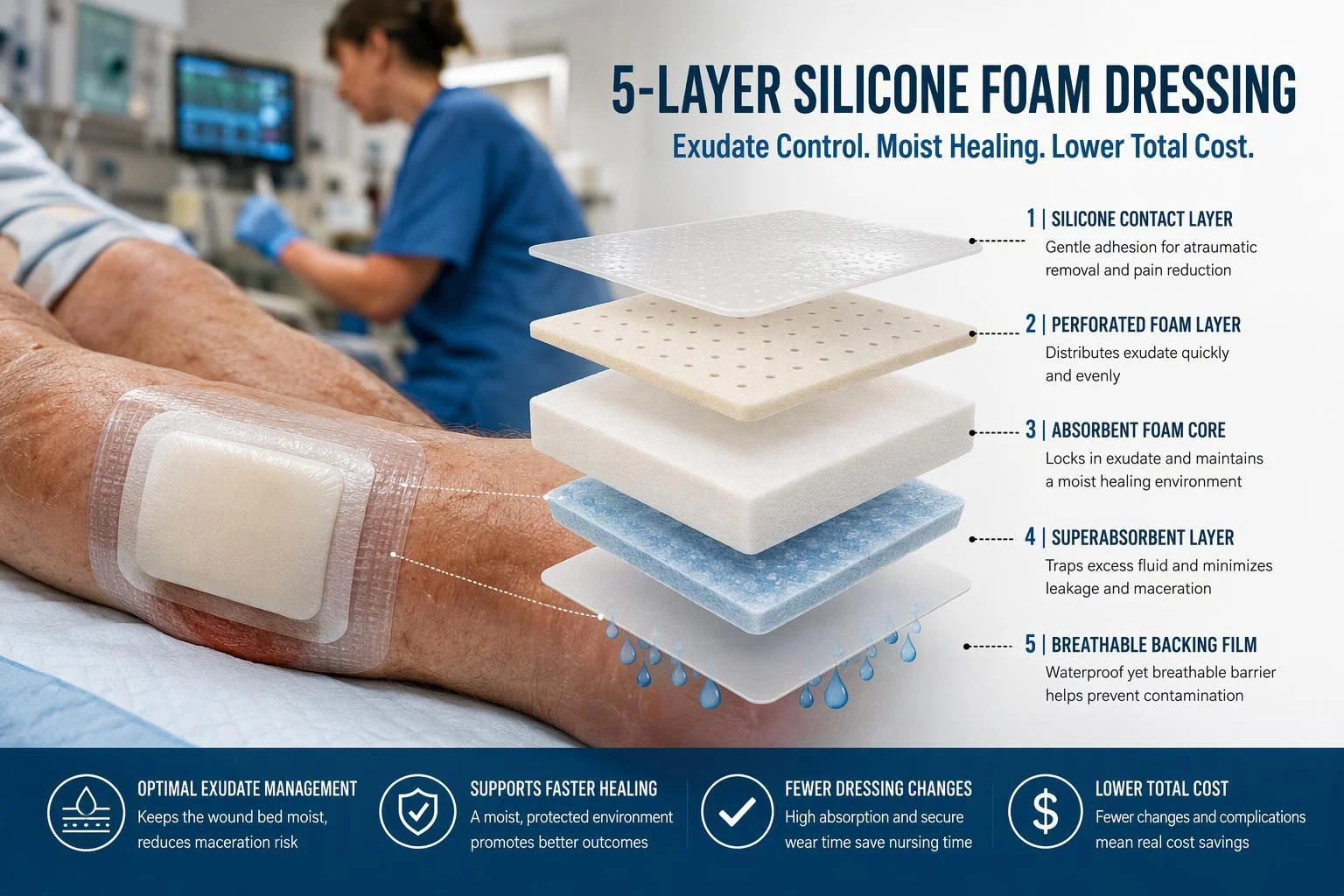
A five-layer silicone foam dressing is less like a sponge and more like a drainage system built into a single sheet. Each layer has one job — let fluid in, spread it, hold it, keep it from coming back, and let vapour out — and the dressing only performs as well as the handoffs between them. That distinction matters on wards and in long-term care units still running gauze or basic dressings on moderate-to-high exudate wounds, where the WOC nurse and the procurement lead have to justify a switch on more than the unit price line. This article follows the layers from the wound bed outward, then works through moisture balance and maceration, removal pain and skin injury, wear time, total cost of care, variant selection, and what to verify in a supplier’s certificate pack.
If you want the manufacturer’s own description of the construction before reading the mechanism, SLK Medical’s five-layer silicone foam dressing overview sets out the stack in the same order used below.
Key takeaways
Each of the five layers has a distinct job, and the dressing’s performance comes from how they work together rather than from absorbency alone.
A moist wound environment supports healing, but unmanaged excess moisture causes maceration, so the clinical goal is balance rather than maximum uptake.
Soft silicone contact layers are associated with less removal pain and less skin stripping than acrylate adhesives in the comparative studies cited below, within the populations those studies actually examined.
Longer wear time reduces change frequency and clinician time, but saturation, leakage, odour, increased pain, infection signs, loss of integrity or maceration risk override any nominal wear time.
Total cost of care, not unit price, is the correct procurement comparison for an exudate-management dressing.
SLK Medical is a China-based OEM manufacturer of silicone foam and related advanced dressings, with stated international certifications and a stated monthly capacity of 10 million units.
The five layers, from wound bed outward
Read the stack in the direction fluid travels. Exudate leaves the wound bed, enters the contact layer, is taken up by the foam, is spread sideways, is locked into the retention layer, and finally leaves as vapour through the backing film. The order is not arbitrary: each layer assumes the one beneath it has already done its part.
Layer 1: the silicone wound contact layer
The innermost layer is a perforated soft silicone mesh. Exudate passes through the perforations into the pad, while the silicone surface adheres to dry intact skin but not to a moist wound bed — silicone coatings produce a lower surface tension and a broader contact interface than acrylate adhesives, which is why removal is gentler (skin tear review describing this mechanism). In a study of 22 healthy volunteers and nine patients, electron micrographs showed large numbers of skin cells attached to an acrylate dressing surface and few to a soft silicone one, with significantly more protein recovered from the acrylate dressings (cell attachment study). Gentle is a design property, not a guarantee: fragile or ageing skin still needs slow, supported removal technique.
Layer 2: the foam absorbent layer
The polyurethane foam core is the primary reservoir. Its open-cell structure draws fluid vertically away from the wound bed by capillary action, and pore size, shape, connectivity and pore gradient govern how fast and how completely that happens — which is why foam dressings vary widely between manufacturers and category-level claims do not transfer to every product (fluid-handling review). SLK Medical attributes its foam structure to a proprietary D-Pore™ dual-dimensional pore foaming technology, described by the manufacturer as tuning the micro-nano foam structure to balance pressure relief and fluid management; that is a first-party design description, not an independently verified clinical result.
Layer 3: the non-woven distribution layer
The distribution layer spreads incoming exudate laterally across the pad instead of letting it pool at the point of entry. That improves use of the available absorbent area and lowers the chance of strike-through at a single spot, and it hands a more even fluid load to the retention layer above it.
Layer 4: the SAF absorption and retention layer
Super-absorbent fibre locks fluid in place so it does not flow back to the wound or leak onto periwound skin, including under compression and body weight. SLK Medical’s product documentation states that the SAF layer absorbs up to 10 times its own weight, while the separate super-absorbent dressing line states up to 20 times (super-absorbent dressing page). Retention, not absorbency, is what protects periwound skin — and it is the distinction between true foams built on hydrophilic polyurethane air spaces and pseudo-foams that embed superabsorbent polyacrylate particles to expand (Sussman classification, discussed in the fluid-handling review).
Layer 5: the polyurethane film backing
The outer film is a semi-permeable barrier: waterproof and bacteria-barrier on the outside, while allowing proportional moisture vapour transmission so the dressing does not become a sealed wet chamber. Transmission rate depends on the backing, exudate composition, wound and periwound temperature, ambient conditions and any secondary covering (fluid-handling review). On the bordered variant, a soft silicone adhesive border runs around this backing, which is what makes the dressing self-adherent without tape.
Why the layers work as a system, not a stack
Absorption without retention leaks; retention without transmission macerates; a strong adhesive without a silicone contact layer strips skin. The five-layer design is an attempt to satisfy four fluid-handling jobs — uptake, distribution, retention, evaporation — plus atraumatic fixation at once. It is a design logic, not a class guarantee: published reviews stress that bordered foam dressings cannot be treated as a generic class because each product’s materials and construction differ (foam dressing review).
Moist wound healing and the maceration boundary
The case for a moist wound bed dates to Winter’s 1962 work in Nature, which found that moist conditions supported epithelialization better than dry ones and moved wound care toward moist dressings (moist wound healing review). The same literature carries the boundary condition. If a wound is too moist and exudate is not actively removed, the excess leaks into periwound skin, causing maceration and reduced cellular turnover, which delays granulation and inhibits epithelization (five-layer foam cohort analysis). WUWHS draws a further distinction worth knowing at the bedside: hyper-hydration is reversible with early intervention, whereas maceration reflects destruction by the enzymes in exudate plus prolonged moisture exposure, and predisposes skin to breakdown (WUWHS 2026 consensus). So the dressing’s job is balance, not maximum absorption — and the cost of getting it wrong is real: a UK study in 2014 estimated a single occurrence of maceration at £175 per incident, equivalent to £235 in 2024 terms (as reported in the foam dressing review).
Pain, skin trauma and MARSI: what the contact layer changes
Medical adhesive-related skin injury (MARSI) is the clinical problem the silicone contact layer is designed to address, and the comparative evidence is reasonably consistent. In a prospective observational study at a single 700-bed hospital in Seoul between September 2021 and September 2022, 140 spinal surgery patients received daily dressing changes with either acrylate or silicone adhesives and were assessed daily for 10 days. Cumulative MARSI incidence was 56.8% in the acrylate group versus 31.8% in the silicone group (p = 0.003); mechanical damage was 24.3% versus 4.5% (p < 0.001); and the acrylate group had a 2.55-times higher risk of MARSI (MARSI study). The authors state the limits plainly: the study was non-randomised, single-centre and restricted to spinal surgery patients, so generalisability is limited. The volunteer and patient study cited earlier adds the mechanism — no difference in measured peel force, but significantly lower pain on removal and less erythema for the soft silicone dressing (cell attachment study). Pain and tissue stripping remain difficult to measure objectively, and adhesion varies with sebum, dryness, sweating, hair and body site, so adhesive choice should be matched to the patient rather than applied as a blanket rule (skin adhesives review).
Cumulative MARSI incidence within 10 days of spinal surgery, by dressing adhesive type. Single-centre prospective observational study, Seoul, 140 patients (silicone n=66, acrylate n=74), daily dressing changes, non-randomised; findings are limited to this surgical population and are not a head-to-head comparison of dressing brands.
Wear time, change frequency and the undisturbed wound
Every dressing change disrupts fragile granulation and epithelial tissue, re-exposes the wound to external contaminants and temperature drops, and adds a pain event plus clinician time. Minimising changes when clinically appropriate is therefore a clinical objective, not merely a convenience (five-layer foam cohort analysis). The evidence on five-layer foam dressings is observational but consistent: a field study of 53 wounds reported a mean treatment period of 23.83 days with dressing changes every 2 to 3 days on average, and the dressing’s change indicator was used to guide change frequency in 98% of cases (McFee et al.). A separate analysis noted that in post-acute settings change frequency is often driven by visit schedules rather than clinical necessity, and that visual change indicators may support more objective decision-making (cohort analysis). The limits are firm: wear time is exudate-dependent, and saturation, leakage, odour, increased pain, signs or symptoms of infection, loss of dressing integrity or maceration risk are triggers to change regardless of the calendar. Longer wear time is appropriate only when the wound and exudate level support it.
From unit price to total cost of care
An episode of care carries at least five cost components: dressing units consumed, clinician time per change, secondary dressings and fixation, management of maceration and other complications, and the cost of delayed healing. Unit price touches only the first. WUWHS guidance is explicit that a dressing should be judged cost-effective when considering the overall episode of care rather than the unit cost of the dressing alone (WUWHS 2026 consensus).
A worked comparison makes the arithmetic visible. These figures are illustrative only, not a measured result: take a 10 cm × 10 cm wound over a 14-day episode, and assume a basic dressing changed daily at a unit cost of 1.00, with 0.50 of secondary fixation and 4.00 of clinician time per change. That is 14 changes, 21.00 in dressings and fixation, and 56.00 in clinician time — 77.00. Now assume a bordered foam dressing at 4.00 per unit changed every three days, with no secondary fixation and the same 4.00 of clinician time: five changes, 20.00 in dressings and 20.00 in clinician time — 40.00. The higher unit price produces the lower episode cost because change count, not price per piece, drives the total.
The arithmetic breaks down in identifiable conditions: very high exudate that saturates the pad before the nominal interval, wounds small enough that dressing cost is trivial next to clinician time, and settings where change frequency is fixed by visit schedules rather than clinical need. Run the comparison with your own labour cost and your own observed change interval before it goes into a value analysis file.
Questions worth putting to any supplier’s submission: What wear time do you claim, and under what exudate level? What is the evidence for that claim, and what design was it generated in? What is the per-change labour assumption behind your cost model? What happens to periwound skin when the dressing reaches capacity? Which sizes cover our most common wound dimensions without trimming? And what is your documented lead time and safety stock for our volume?
Choosing the right variant: bordered skin-colour, sacral and heel
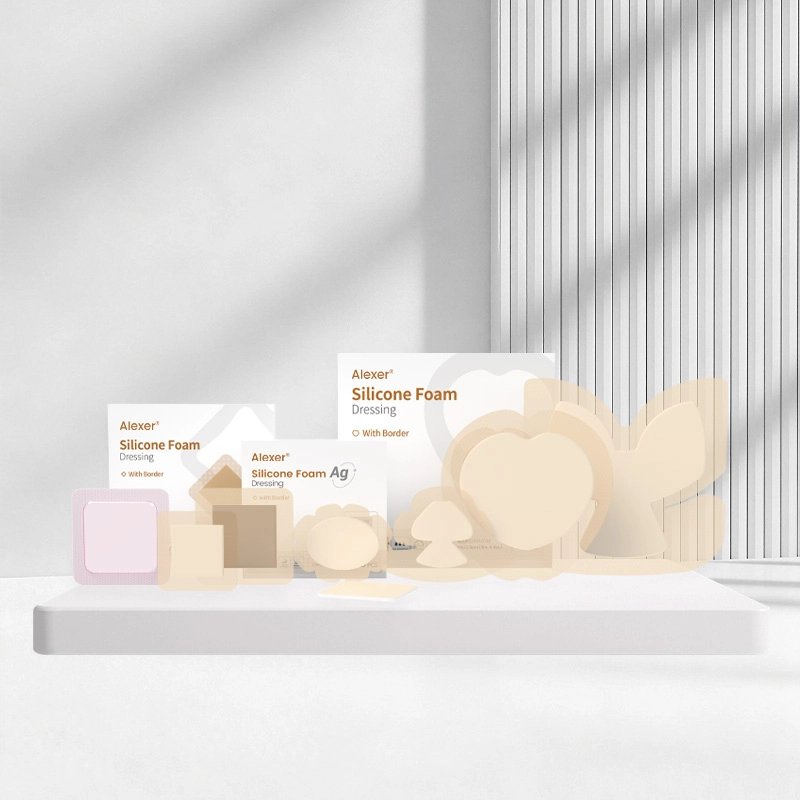
SLK Medical’s bordered skin-colour variant is stated for moderately to highly exuding wounds including post-operative wounds, pressure ulcers, diabetic foot ulcers, venous leg ulcers, neuropathic ulcers, arterial ulcers and I–II degree burns, and is listed in square sizes from 5 × 5 cm to 20 × 20 cm, rectangles at 10 × 20 cm, 10 × 25 cm, 10 × 30 cm and 15 × 20 cm, multiple shapes at 7.8 × 10 cm, 13 × 16 cm and 15 × 19 cm, sacrum shapes at 18 × 18 cm, 22.5 × 22.5 cm and 23 × 23 cm, and heel shapes at 12.5 × 20 cm, 17.5 × 22.5 cm and 21 × 21 cm (product page). The anatomical sacral and heel shapes exist for contour fit and stay-put on high-friction, high-shear body sites — the sacrum and heel are where dressings lift and roll — not because they work by a different mechanism. Shape choice is about fit and fixation; the five-layer fluid-handling logic is the same across variants.
Wound type and exudate level | Variant to consider | What to check |
|---|---|---|
Moderate-to-high exudate, flat site, no contour challenge | Bordered skin-colour, square or rectangular | Border margin clear of macerated skin; size covers wound plus margin without trimming the border |
Pressure ulcer or post-operative wound over the sacrum | Sacral shape | Contour fit under body weight; no lifting at the anal margin |
Heel ulcer or heel pressure-injury prevention | Heel shape | Coverage of the plantar and posterior heel; stays put with offloading |
Cavity or deep wound with moderate exudate | Non-bordered foam as primary, with secondary fixation | Whether a bordered variant can conform at all, or whether separate fixation is needed |
High exudate with maceration risk or compression therapy | Super-absorbent dressing line | Retention under compression; periwound protection |
Certifications, capacity and OEM supply: what to verify
Certificate packs are frequently misread, so it helps to know what each document actually covers. ISO 13485 is a quality management system standard for medical devices, certifiable by an accredited third-party body; conformance supports MDR and IVDR conformity assessment but does not by itself deliver it, because device-specific technical documentation, post-market surveillance and notified body involvement remain separate obligations (ISO 13485 explained). The EU MDR quality management system certificate under Regulation (EU) 2017/745 Annex IX Chapter I is a related but distinct document. On the FDA side, devices are classified into Class I, II and III, with most Class II devices requiring premarket notification and firms subject to establishment registration and device listing (FDA device regulation overview). TGA, ANVISA and SFDA are national market authorisation routes with their own requirements.
SLK Medical’s first-party account states that the company was founded in 2018, operates a 10,000㎡ plant in Tianchang, Anhui, plus a Suzhou sales office, and holds certifications including FDA, CE MDR, ISO 13485, TGA, ANVISA and SFDA (about page). Separately, the manufacturer states that it runs two production lines, has a monthly capacity of 10 million units and ethylene oxide sterilization capability, and offers OEM customization of product size, shape and outer packaging. All of these are the manufacturer’s stated facts; request current certificate copies and confirm that the scope covers your specific device and your specific market before you rely on any of them in a tender.
Why SLK Medical as an OEM partner
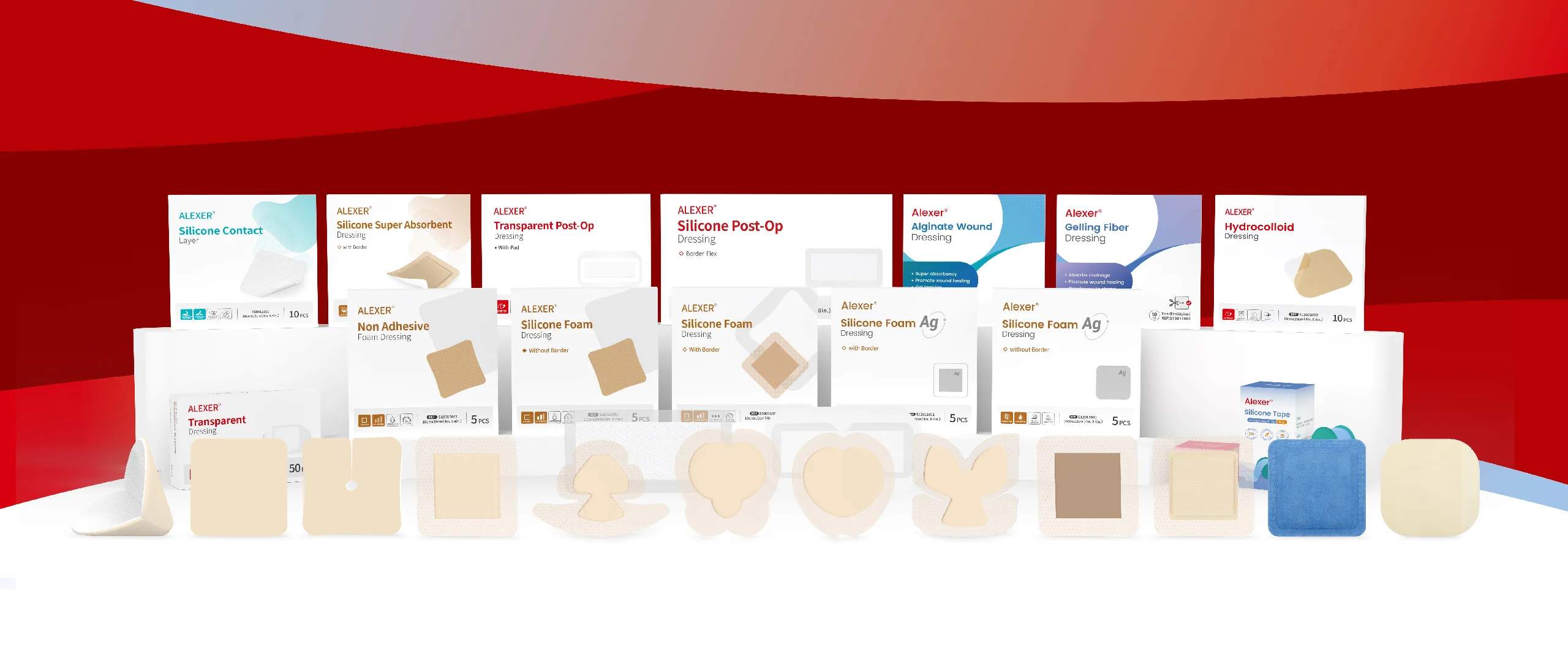
For a buyer qualifying a new dressing category, the practical question is rarely whether one product exists — it is whether one supplier can carry the range, the paperwork and the volume. SLK Medical presents itself as a China-based OEM contract manufacturer for exactly that position: silicone foam dressings as the core line, with silver antimicrobial, super-absorbent and PHMB dressings available from the same qualified source, so a hospital standardisation project or a distributor catalogue does not need a second factory audit for every adjacent SKU.
The first-party facts are the ones to build a qualification file around. The company states it was founded in 2018 and operates a 10,000㎡ plant in Tianchang, Anhui, with a Suzhou sales office; it describes two production lines and a stated monthly capacity of 10 million units, in-house ethylene oxide (EO) sterilisation, and OEM customisation covering size, shape and outer packaging. Its stated certificate portfolio covers FDA, CE MDR, ISO 13485, TGA, ANVISA and SFDA. The ISO 13485 certificate is issued by TÜV SÜD, and the EU MDR quality management system certificate is issued under Regulation (EU) 2017/745 Annex IX Chapter I — both are checkable against the certificate numbers on TÜV SÜD’s verification page, which is the fastest way to confirm a supplier’s claims before a value analysis committee sees them.
The OEM offer is deliberately ordinary, in the good sense: complimentary samples, size and shape customisation, private-label packaging, and a certificate pack supplied during qualification. What it does not claim is clinical superiority over other manufacturers, and nothing here should be read that way. The case for SLK Medical is a supply case — one qualified source, a documented quality system, capacity that can absorb a tender, and a product family broad enough to cover the ward’s actual mix of pressure injuries, diabetic foot ulcers, post-operative wounds and chronic exudative wounds. Whether that case holds for a given institution depends on the specification sheet matching the wound types in use, the certificate scope covering the specific device and market, and the sampling evaluation confirming handling and wear behaviour on your patients. Those three checks are the ones worth running before any price conversation.
Conclusion
The five-layer construction is best understood as a coordinated answer to four fluid-handling problems — uptake, distribution, retention and evaporation — plus one fixation problem: keeping the dressing in place without stripping the skin underneath. No single layer delivers that. A highly absorbent pad without retention leaks onto periwound skin; retention without vapour transmission turns the dressing into a sealed wet chamber; and an aggressive adhesive without a soft silicone contact layer converts every change into a skin injury event. The value of the design shows up in change frequency, periwound skin integrity and clinician time, which is why the unit price line is the least informative number in the comparison.
Two conditions decide whether a switch works. The first is patient and wound selection: moderate-to-high exudate, intact or appropriately protected periwound skin, and a care plan that reviews the wound on a defined schedule rather than on a calendar. The second is supplier qualification: current certificate copies, scope confirmed for your device and market, and capacity that survives a tender rather than a brochure. If both hold, the episode-cost arithmetic usually follows. If either fails, a cheaper dressing will look cheaper for exactly as long as it takes the first maceration event to reach the budget line.
The next step is concrete: request the specification sheet, the instructions for use, the certificate pack and a sampling plan, then run a small evaluation on your own ward mix before committing to a standardisation decision.
Frequently asked questions
How often should the dressing be changed?
Wear time is exudate-dependent, not fixed. Manufacturer documentation for this product family describes wear time of up to seven days, and published field data on five-layer foam dressings report mean change intervals of roughly two to three days in routine practice. Treat any nominal maximum as a ceiling, not a schedule. Change earlier if the dressing is saturated, fluid is leaking at the edges, odour develops, pain increases, infection signs appear, the dressing loses integrity, or the periwound skin shows maceration.
Can it be used on infected wounds?
A plain silicone foam dressing is not an antimicrobial product. Where local infection or biofilm is suspected, management should follow local protocols and antimicrobial stewardship principles, and an antimicrobial variant may be considered when clinically indicated. SLK Medical lists silver foam and PHMB foam dressings in its range; both should be used with a defined review point and a stop date rather than continued indefinitely.
Is the adhesive suitable for fragile or ageing skin?
Soft silicone contact layers are generally chosen for fragile skin because they adhere to dry intact skin but not to a moist wound bed, and comparative studies associate them with less removal pain and less skin stripping than acrylate adhesives. That is a design property, not a guarantee. Ageing skin varies in sebum level, hydration and body site, so technique still matters — support the skin during removal and avoid repeated reapplication to the same area.
Can it be cut to shape?
Cutting a bordered dressing compromises the sealed edge and the adhesive border, so it is generally not recommended for the bordered variants. Non-bordered formats are the more usual choice where shaping is needed. Confirm with the instructions for use before cutting any variant.
How do the sacral and heel shapes differ from the standard bordered dressing?
The mechanism is the same; the difference is fit. Sacral and heel variants are contoured for high-friction, high-shear body sites where a flat square lifts at the edges. The skin-colour bordered range lists sacral sizes at 18×18cm, 22.5×22.5cm and 23×23cm, and heel sizes at 12.5×20cm, 17.5×22.5cm and 21×21cm, alongside square, rectangular and multiple-shape options.
What documentation should be requested from an OEM supplier?
Ask for the current ISO 13485 certificate and its scope, the EU MDR quality management system certificate, evidence of the FDA establishment registration and device listing, the declaration of conformity, the instructions for use, the specification sheet, sterilisation validation information and a sampling plan. Verify certificate numbers directly with the issuing body rather than relying on a PDF.
Can it be used under compression?
Foam dressings are commonly used beneath compression in venous leg ulcer management, and retention under compression is one of the properties clinicians value. Compression levels must be prescribed according to the patient’s vascular assessment and local protocol; the dressing choice does not determine the compression bandage system.
Request a specification pack and sample
If the five-layer mechanism fits the wound mix in your ward or facility, the next step is a documentation and sampling review rather than a purchase order. SLK Medical invites procurement and clinical teams to request the specification sheet, the instructions for use, the certificate pack and a sampling plan for evaluation.
A useful request names the variants you actually intend to trial — bordered skin-colour in the sizes that match your pressure injury and post-operative wound profile, plus sacral and heel shapes if those sites are in scope — and states the market you will place the device in, so the certificate scope can be confirmed against the correct regulatory route. If your formulary also covers antimicrobial or high-output wounds, ask for the silver, PHMB and super-absorbent ranges in the same request so the qualification covers the whole category rather than one SKU.
The invitation is conditional on your own evaluation and approval process. Certificate scope, pricing, lead times and availability should be confirmed directly with the manufacturer for your specific device and market before any commitment.