

Last updated: 26 October 2026. This page is a documentation-reading aid for procurement and regulatory teams. It is not clinical advice and does not replace the IFU, the safety data sheet or a clinician’s judgement.
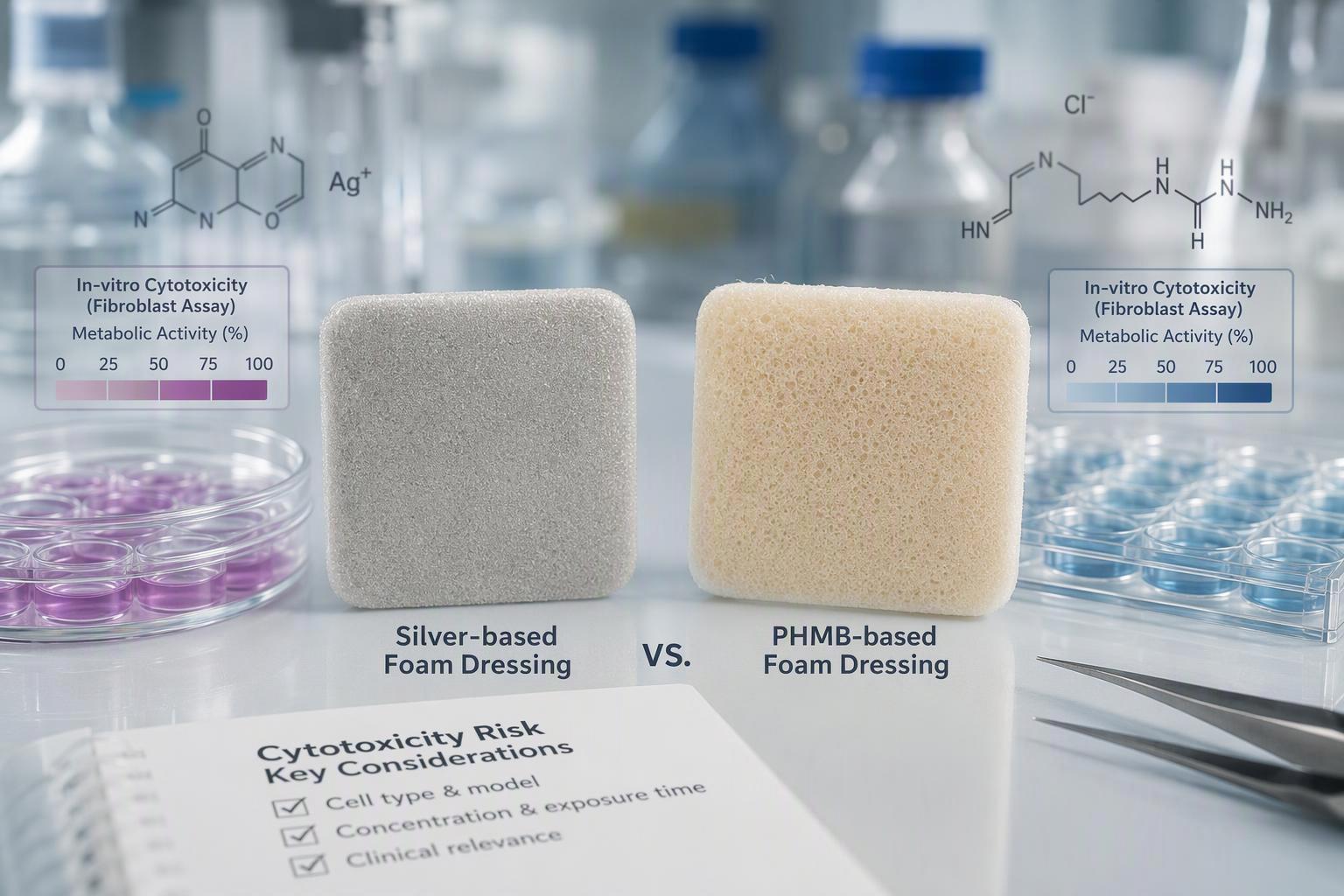
Both silver and PHMB foam dressings carry documented in-vitro cytotoxicity signals, and neither agent can be ranked as “more cytotoxic” in the abstract. The result depends on the finished dressing’s formulation, its release kinetics, the extract dilution tested, the cell type used and the exposure time. For a distributor, that matters in three places: the IFU wording you file with the product, the ISO 10993-5 report you cite in a tender, and the safety data sheet you hand to a hospital’s occupational health or waste team.
This page answers the questions that come up most often when a customer or a tender reviewer raises cytotoxicity, grouped into four areas: comparing the two agents, reading the evidence, safe-use windows and stop rules, and stewardship. Examples are drawn from SLK Medical’s published PHMB foam documentation and certification records alongside the published literature cited throughout.
Key takeaways
There is no universal ranking between silver and PHMB. Product-level formulation and release data decide, so compare SKUs, not molecules.
An ISO 10993-5 “non-cytotoxic” pass describes a specific extract, cell line and endpoint. It is a biocompatibility screen, not a statement about the wound bed.
In-vitro cytotoxicity has repeatedly failed to predict clinical healing trajectories, in both directions.
Wear time is set by the individual IFU. Published examples range from three days to seven, and they belong to different products.
A documented reassessment point — commonly around two weeks for silver — turns an open-ended antimicrobial course into a bounded one.
Comparing silver and PHMB: which is more cytotoxic?
Which agent is more cytotoxic — silver or PHMB — and why is there no single answer?
Neither can be ranked as a class. Cytotoxicity is a property of the finished dressing’s release profile and the extract concentration it produces, not of the active substance’s name.
A 2020 review in International Wound Journal tabulated in-vitro findings for both agents across the same three cell types. For PHMB, it records complete destruction of human skin fibroblasts, time-dependent cytotoxicity in human dermal fibroblasts, and concentration- and time-dependent cytotoxicity in human dermal keratinocytes. For silver-containing products, it records cytotoxic effects of silver-based dressings, silver nitrate and silver ions in fibroblasts and keratinocytes, plus reactive oxygen species formation and apoptosis in endothelial cells with silver nanoparticles. Concentration- and time-dependence appears on both sides of that table (Alves et al., Int Wound J 2020).
A separate study of PHMB at 0.01%, 0.04% and 0.1% — concentrations chosen to represent clinical use — found concentration- and time-dependent toxicity across human epidermal keratinocytes, dermal fibroblasts and osteoblasts (Hiro et al., Eplasty 2012).
Two cautions follow. First, a single dressing can carry cytotoxicity signal from non-antimicrobial components. The same review notes that EDTA and benzethonium chloride in one silver hydrofiber formulation may themselves cause cytotoxicity, and that a silver-free PEG gel containing benzalkonium chloride, citric acid and sodium citrate showed severe cytotoxicity towards fibroblasts (Alves et al. 2020). Attributing every signal to the named agent is therefore unsafe. Second, the practical consequence for a distributor is simple: compare products, not molecules.
What does each agent’s mechanism of action imply for host-cell exposure?
The mechanisms differ, but neither is selective between microbial and host cells.
Silver in its ionic form reacts with thiol groups in enzymes and proteins, affecting enzyme function, cell replication and energy generation in a non-specific manner; silver ions also interfere with electron transport and membrane ion-exchange systems. PHMB disrupts cell membranes by interacting with acidic, negatively charged membrane phospholipids, increasing permeability, and inhibits internal metabolic processes (Alves et al. 2020).
Because both act on structures and processes that human cells share with bacteria, the therapeutic margin is a dosing question rather than a property of the molecule. The honest inference is not that one mechanism is intrinsically gentler. It is that the difference between a helpful and a harmful exposure lies in release kinetics and the concentration retained at the wound bed — which is exactly what varies between products.
Does the carrier dressing change the cytotoxicity picture?
Yes, substantially. Foam construction, the chemical form of the silver (ionic, nanocrystalline, silver sulfate, silver-organic complexes) and the release medium all shift measured toxicity.
A 2020 Scientific Reports study applied dressings with various silver forms to porcine skin ex vivo. The amount of silver released into culture medium varied among the dressings and correlated with in-vitro toxicity; the dressing whose extract carried the lowest silver concentration was the least toxic in the MTT assay (Scientific Reports 10:15454). The Antibiotics 2024 review makes the same point in tabular form: release into broth over 24 hours ranged from roughly 8 to 28 µg/mL across commercial silver dressings, and the review’s own proposal of a 10–40 ppm sustained release target is qualified by the observation that the wound environment’s proteins will alter release (Shrestha et al., Antibiotics 2024;13:910).
The procurement implication is that the technical file’s extract and release data belong to the specific SKU. A release figure or cytotoxicity verdict from one dressing does not transfer to another, even within the same manufacturer’s range.
Reading the evidence: what in-vitro and clinical signals can and cannot tell you
Silver released into culture medium over 24 hours by commercial silver dressings, from the review’s tabulated release data. Release is measured in broth (TSB) and is a property of the individual dressing, not of silver as a class; the review’s proposed 10–40 ppm sustained-release target is its own proposal, qualified by the observation that wound proteins alter release.
How should I read an ISO 10993-5 “non-cytotoxic” result on a dressing datasheet?
The pass applies to the tested extract, at the tested concentration, on the specified cell line, against the standard’s viability threshold. It is a biocompatibility screen that supports market access; it is not a wound-bed safety guarantee.
The logic is extract-based: the 100% extract is intended to concentrate extractable components so that a cytotoxic potential, if present, will show up. An interlaboratory study of 52 laboratories testing two standard materials — non-cytotoxic polyethylene and cytotoxic PVC — found that the test specifications were not explicit enough to produce comparable results for the same material, and that outcomes depended strongly on the material under investigation. The authors note that the assumption behind the 100% extract — that it gives a secured finding of extractable components with cytotoxic potential — “is not always true” in practice (Gruber & Nickel).
Before repeating a “non-cytotoxic” claim in a tender, check which extract concentration, cell line and endpoint the report names. A verdict without a method summary is not comparable with another product’s verdict.
Why do extract dilution and cell-line choice change the cytotoxicity result?
Two levers move the result.
Dilution moves the extract below or above the toxicity threshold. In the porcine-skin study, undiluted extracts induced a highly acute toxic response in both keratinocytes and fibroblasts, while the least-toxic dressing’s extract simply carried the lowest silver concentration (Scientific Reports 2020).
Cell type changes sensitivity. The same study found keratinocytes generally more sensitive to the extracts than fibroblasts — probably, the authors suggest, because of their higher proliferation rate — with at least one exception: at the lower dilution of one extract, fibroblasts were more affected (Scientific Reports 2020).
A third variable sits in the protocol: serum supplementation. The interlaboratory comparison identified test parameters of this kind as relevant influences on outcome, which is why two “non-cytotoxic” reports on different products are only comparable if the methods match (Gruber & Nickel). Request the method summary, not just the verdict.
Do in-vitro cytotoxicity findings predict clinical harm?
Not reliably — and the evidence cuts in both directions, which is why the answer needs its limits stated.
The clearest demonstration comes from a comparative study of silver-containing dressings tested both in vitro and in vivo. Despite in-vitro cytotoxicity, all of the silver products except two accelerated wound healing in the in-vivo model. The authors’ conclusion is explicit: “in vitro cytotoxicity tests do not fully predict the effect of an agent on wound healing trajectories” (Hiro et al., Eplasty 2012).
A narrower but more mechanistic signal comes from the ex-vivo porcine work: all tested silver dressings elevated the DNA-damage marker γ-H2AX and stress-related gene expression in explanted skin relative to control, in proportion to the amount of silver in the skin, and reduced cell viability (Scientific Reports 2020). That narrows the gap between laboratory and tissue, but it is still not a clinical outcome.
On the clinical side, the Cochrane review of 26 trials (2,066 participants) concluded there is not enough evidence to support the use of silver-containing dressings or creams, as they generally did not promote healing or prevent infection; most studies were small and of poor quality (Cochrane CD006478).
The reason the extrapolation fails is exposure. A culture well presents cells with a fixed volume of extract and no exudate, no protein binding and no clearance; an exuding wound presents a moving, protein-rich environment in which silver binds and release slows. That is an argument against treating in-vitro cytotoxicity as a clinical verdict — not a claim that clinical risk is zero.
What clinical signs should I document that might reflect local toxicity or intolerance?
Record at every dressing change: peri-wound erythema, maceration, pain or stinging on application, new or worsening eczema-like reactions, and any change in wound-bed appearance. Distinguish these from infection signs rather than folding them into one category.
Two agent-specific points belong in that record. PHMB contact allergy was reported in 19 of 1,760 patch-tested patients — 1.1% — higher than earlier estimates of 0.5% and 0.8%, with a further 2.1% of doubtful reactions (Sukakul et al. 2021). For silver, known sensitivity is an IFU-listed contraindication: a representative silver foam IFU states the dressing “should not be used on patients with a known sensitivity to silver” (Biatain Ag IFU).
Treat the list as a surveillance habit that generates the evidence a distributor needs for complaint handling and CAPA — not as a diagnostic protocol.
Safe-use windows and stop rules
Stated maximum wear times from published instructions for use and prescriber guidance. Each figure belongs to the named product and is conditional on exudate level, wound condition and secondary dressing; the values are not interchangeable across the class.
How long can a silver foam dressing stay on, and how long a PHMB foam?
Wear time is set by the individual product’s IFU and cannot be generalised across the class. The published examples below belong to different products with different instructions.
Product type | Stated wear time | Source |
|---|---|---|
Silver foam (silver complex in foam) | Ionic silver release continues for the recommended wear time up to 7 days; may be left in place up to 7 days depending on exudate, dressing condition and wound type; clinical assessment recommended for silver use beyond 30 days | Biatain Ag IFU |
PHMB hydrobalance dressing | Up to 7 days depending on wound condition, level of infection, exudate and secondary dressing | Suprasorb X+PHMB prescriber guide |
PHMB dressing (cellulose-based) | Should not remain on the wound longer than three days; daily changing recommended for infected wounds | CelluDress-PHMB guidance |
SLK Medical PHMB foam | Antimicrobial protection for up to 7 days; sustained antimicrobial release and effectiveness for up to 7 days | SLK Medical PHMB silicone foam, non-border |
Read the seven-day figures for what they are: a dressing-level release or protection claim. They are not a licence to leave any foam on any wound for a week. Exudate level, dressing condition and wound type govern the actual change interval in every one of these documents.
What do SLK Medical’s own product documents say about wear time and cautions?
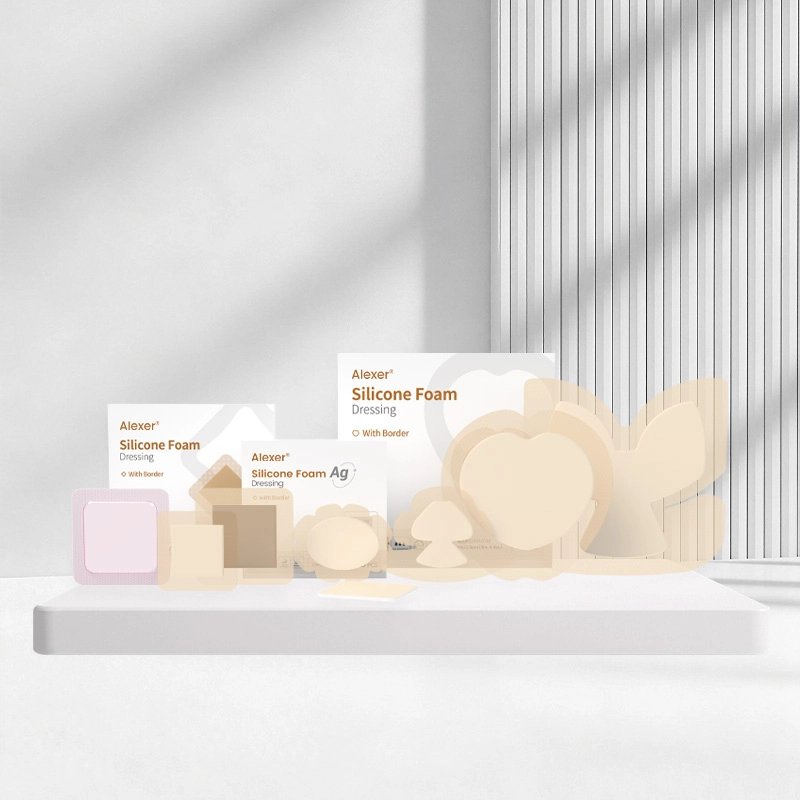
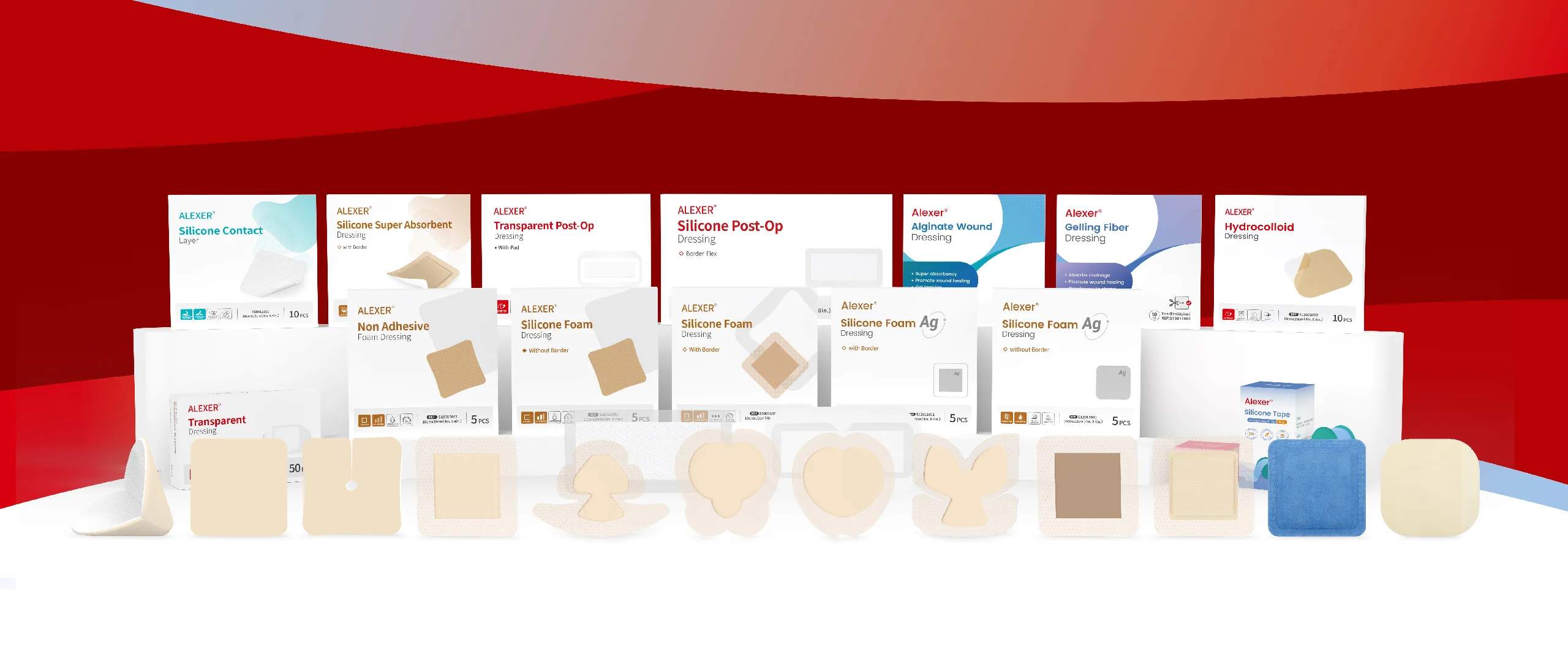
SLK Medical’s published PHMB foam product pages describe a foam absorbent layer containing PHMB that “provides antimicrobial protection for up to 7 days” and “sustained antimicrobial release and effectiveness for up to 7 days,” alongside a silicone contact layer intended for sensitive skin and a waterproof polyurethane film backing (PHMB silicone foam, non-border; PHMB foam, non-adhesive; PHMB silicone foam with border). The company also lists silver silicone foam variants in its advanced wound dressing range (SLK Medical).
On quality systems, SLK Medical holds ISO 13485:2016 certification covering design, development, production and distribution of sterile dressings, and an EU MDR Annex IX Chapter I quality management system certificate (No. G15 112764 0002 Rev. 00, valid 2025-09-23 to 2030-09-22) covering Class IIb adhesive dressings with absorbent pad. Both certificates evidence a quality management system. Neither is a cytotoxicity result for any individual product.
The specific IFU cautions and the safety data sheet content for each SKU should be requested from SLK Medical and read before use. They are product-specific documents, and paraphrasing them here would risk separating a caution from the product and configuration it was written for.
When should an antimicrobial foam be stopped?
The international silver consensus recommends an initial two-week “challenge” period, after which the wound, the patient and the management approach are re-evaluated. The consensus sets out three branches: where there is improvement but persisting signs of infection, continue without change; where there is improvement but no signs of infection, discontinue all topical antimicrobials including silver; where there is no improvement, consider changing to a different antiseptic dressing, lavage or gel, or, if the patient is unwell, consider systemic antibiotics and re-evaluate underlying comorbidities (Appropriate Use of Silver Dressings in Wounds).
PHMB guidance runs on a shorter cycle: reassess the suitability of the dressing at each dressing change, with continuation decided on an individual basis, and initiate systemic antibiotic therapy where there is suspicion of deep or spreading infection (CelluDress-PHMB guidance). Prescribing guidance adds that silver dressings should be used for a short duration and not on repeat prescription (PrescQIPP Bulletin 53).
For a distributor, the checklist item is one question: does the customer’s protocol name a review date? If it does not, the stop rule has nowhere to land.
When is an antimicrobial foam appropriate at all?
Antimicrobial foams are for wounds with clinical signs of localised infection or critical colonisation — not for prophylaxis. A review of antimicrobial wound dressings states that silver dressings may inhibit the host fibroblast activity required for wound healing because of their cytotoxic property and are therefore not recommended for infection prophylaxis (antimicrobial wound dressing review). Prescribing guidance points the same way: NICE states there is no robust clinical or cost-effectiveness evidence for antimicrobial dressings over non-medicated dressings in chronic wounds and advises avoiding overuse over concerns with resistance and toxicity, while the BNF restricts silver dressings to situations where clinical signs and symptoms indicate a localised infection (PrescQIPP Bulletin 53).
There is a counterweight worth carrying into customer conversations. The international consensus document records clinicians’ concern that arbitrary withdrawal of silver dressings could increase morbidity and prolong treatment through uncontrolled wound bioburden (International consensus document). The answer is targeted use, not avoidance.
Selection logic, in order: confirm infection signs; confirm the exudate level matches the foam’s absorbency; confirm the IFU covers the wound type; set the review date before the first application.
What this means for distributors specifying antimicrobial foams
Four documents should be in hand before an antimicrobial foam goes into a tender file or a catalogue.
The product-specific ISO 10993-5 report, with its method summary. Extract concentration, cell line and endpoint determine what the verdict means. Without them, the claim is not comparable with a competitor’s.
The current IFU in every language the destination market requires. Check that the wear-time figure in your marketing material matches the IFU, and that contraindications — known silver sensitivity, for example — survive translation intact.
The safety data sheet for the SKU. This is the document a hospital’s occupational health or waste-handling team will ask for, and it is separate from the IFU.
The technical file’s support for every cytotoxicity and antimicrobial statement the sales team will repeat. If a claim cannot be traced to a document, it should not be repeated.
SLK Medical supplies both PHMB and silver silicone foam variants, so a portfolio can be built across the two agents rather than resting on one. Request the specification sheet, IFU, safety data sheets and certification pack for the specific SKUs under evaluation.
Related resources
Hiro et al., Eplasty 2012 — comparative in-vitro and in-vivo evaluation of silver-containing dressings, including the conclusion that in-vitro cytotoxicity does not fully predict healing trajectories.
Scientific Reports 10:15454 — ex-vivo porcine study of silver penetration, DNA damage and the correlation between silver release and in-vitro toxicity.
Gruber & Nickel, interlaboratory comparison of ISO 10993-5 testing — 52-laboratory study of protocol-dependent variation in cytotoxicity results.
Appropriate Use of Silver Dressings in Wounds: International Consensus Document — the two-week challenge period and reassessment branches.
Alves et al., Int Wound J 2020 — review of antiseptic mechanisms and in-vitro cytotoxicity across cell types.
Shrestha et al., Antibiotics 2024;13:910 — review of commercial silver dressings, release characteristics and toxicity.
Cochrane review CD006478 — summary of the trial evidence for silver-containing dressings.
Sukakul et al. 2021 — patch-test prevalence of PHMB contact allergy.
CelluDress-PHMB guidance and the Suprasorb X+PHMB prescriber guide — published PHMB wear-time and reassessment examples.
Biatain Ag IFU — published silver foam wear-time, contraindication and 30-day assessment wording.
PrescQIPP Bulletin 53: Wound care — silver dressings — NHS prescribing guidance on duration and repeat prescription.
To request SLK Medical’s IFU, safety data sheets and certification pack for the PHMB or silver foam SKUs under evaluation, use the contact route on slkmedical.com.
Still have questions?
For the PHMB or silver foam SKUs you are evaluating, you can request the specification sheet, IFU, safety data sheets, certification pack and a sampling plan through SLK Medical. If your question is about a specific document — a method summary in an ISO 10993-5 report, a translated caution in an IFU, or a wear-time statement that needs to match a tender response — send that question with the SKU reference and the destination market, and it can be answered against the actual document rather than a general description.
FAQs
Is silver more cytotoxic than PHMB?
No ranking can be made at the level of the active substance. Both carry documented in-vitro cytotoxicity across fibroblasts, keratinocytes and endothelial cells, and the result for any given product depends on its formulation, release profile and the test method used (Alves et al. 2020).
Does a “non-cytotoxic” ISO 10993-5 result mean the dressing is safe on any wound?
No. It means the tested extract, at the tested concentration, on the specified cell line, met the standard’s viability threshold. It is a biocompatibility screen for market access, and results vary with protocol parameters even for standard materials (Gruber & Nickel).
Can a dressing be cytotoxic in vitro and still help a wound heal?
In one comparative study, most silver dressings showed in-vitro cytotoxicity yet accelerated healing in vivo, and the authors concluded that in-vitro cytotoxicity tests do not fully predict an agent’s effect on healing trajectories (Hiro et al., Eplasty 2012). That does not make in-vitro data irrelevant; it limits what they can be used to claim.
How long can I leave a silver or PHMB foam on?
Whatever the individual IFU says. Published examples range from a three-day cap with daily changes for infected wounds in one PHMB dressing to seven days for certain silver foams and PHMB dressings, each conditional on exudate, wound condition and secondary dressing.
When should an antimicrobial foam be stopped?
The international silver consensus uses a two-week initial challenge period followed by reassessment: continue if improving with persisting infection signs, discontinue all topical antimicrobials if improving without them, and change agent or escalate if not improving (consensus document). PHMB guidance reassesses at every dressing change.
Should antimicrobial foams be used to prevent infection?
Not according to a review of antimicrobial dressings, which states silver dressings are not recommended for infection prophylaxis because they may inhibit host fibroblast activity (review); fibroblast inhibition is also reported for specific silver dressings (Shrestha et al. 2024). They are for wounds with clinical signs of localised infection or critical colonisation.
How common is PHMB allergy?
In a patch-test population of 1,760 patients, 1.1% had positive reactions to PHMB, with 2.1% doubtful reactions — higher than earlier estimates (Sukakul et al. 2021).
What documents should a distributor request before listing an antimicrobial foam?
The product-specific ISO 10993-5 report with its method summary, the current IFU in every required language, the safety data sheet, and the technical file support for every cytotoxicity and antimicrobial claim the sales team will repeat.