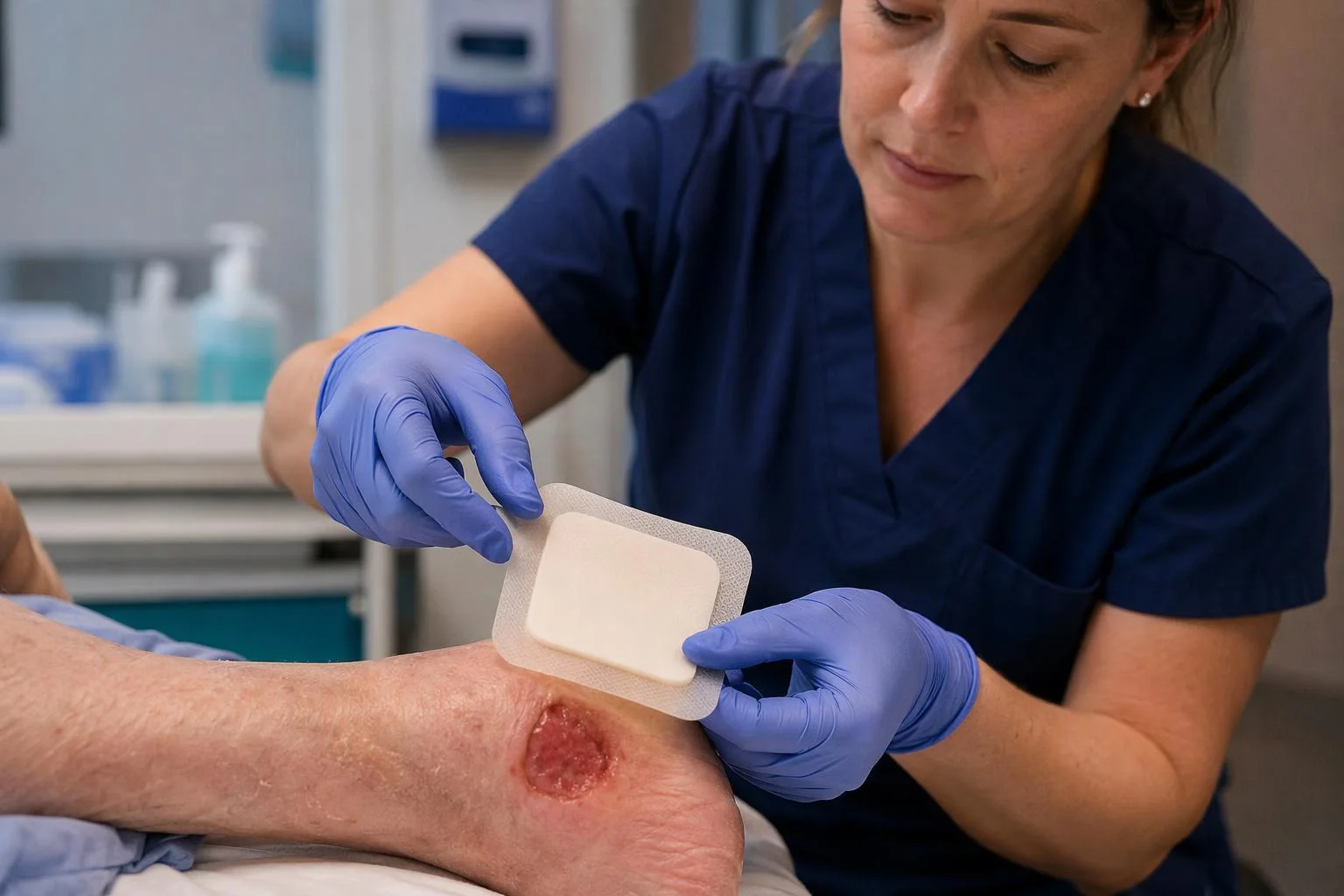


A 2024 meta-analysis of 22 studies covering 10,510 subjects put the prevalence of medical adhesive-related skin injury (MARSI) among adult inpatients at 16% and its incidence at 25%, with wet skin, oedema and a prior history of MARSI among the identified risk factors (PubMed 39462698). Those are the two conditions this guide addresses at once: skin fragile enough that an ordinary adhesive can strip it, and a wound wet enough that the surrounding skin is at risk of maceration.
The sequence below is written for wound-care clinicians at the bedside and for the distributors who support them — the people who are asked to defend a dressing conversion to a formulary or tender committee. It covers selection, application, wear-time decisions and removal of silicone foam on fragile or exudate-exposed periwound skin. Each step is tied to published consensus guidance and named trials rather than to product marketing; SLK Medical’s published product descriptions appear only where labelled as manufacturer design examples.
Key takeaways
Exudate level and periwound condition drive dressing choice, not wound type alone.
Silicone adhesive is recommended over acrylic for at-risk or fragile skin, but atraumatic removal technique still determines whether the skin survives the change.
Wear time should be set by named triggers — saturation, leakage, maceration — rather than by habit.
Trial evidence supports specific, scoped claims (for example, less periwound maceration with one silver foam versus one hydrocellular comparator in colonised venous leg ulcers); it does not support silicone foam as a class being superior for healing.
Documentation of exudate, periwound status and change triggers is what makes a protocol auditable.
Before you begin: prerequisites and scope
This guide addresses dressing selection, application, wear-time decisions and removal on fragile or exudate-exposed skin. It does not cover wound-bed debridement, infection diagnosis, compression prescribing or pressure-redistribution decisions; those remain separate clinical judgments and, where relevant, separate protocols.
Have the following ready before starting:
A completed wound and periwound assessment: exudate volume and type, periwound colour, texture and integrity, and any signs of infection.
Access to the dressing range being evaluated: standard silicone foam, a higher-capacity or superabsorbent option, and a gelling fibre or alginate where a co-primary is needed.
A skin protectant and an alcohol-free adhesive remover, where local protocol permits their use.
A documentation template covering the fields in Step 7.
The guide assumes comfort with basic wound-assessment terminology. Local formulary requirements, the product’s instructions for use (IFU) and regulatory labelling always take precedence over anything written here.
Step 1: Assess exudate level and periwound skin before selecting a foam
Every later decision depends on this assessment, so complete it before opening a dressing. By the end you should hold two documented descriptors: an exudate descriptor and a periwound status.
The WUWHS exudate consensus pairs conventional volume terms — low, moderate, high — with a control descriptor: controlled, partially controlled or uncontrolled (WUWHS, Wound Exudate, 2nd edition). The pairing exists because volume terms alone are subjective; the same document notes that no single approach to assessing exudate level has been found ideal. The control descriptor carries the clinical meaning: partially controlled signals some leakage, a dressing nearing capacity or early periwound changes; uncontrolled signals leakage, strike-through, periwound skin damage or insufficient change frequency.
Then inspect the periwound. The WUWHS assessment framework lists maceration signs as reddening or loss of colour, spongy texture and loss of skin surface. The presence of periwound maceration is itself an instruction: it should trigger immediate reassessment of exudate control, dressing performance, wear time and oedema management.
Verification checkpoint: before proceeding, state in one sentence the exudate volume, its control status and the periwound integrity — for example, “moderate exudate, partially controlled, periwound hyperhydration at the inferior edge.” If you cannot complete that sentence, the assessment is not finished.
Step 2: Match dressing capacity to exudate level — standard foam, superabsorbent, or foam over gelling fibre
The Step 1 descriptor converts into a configuration decision. Record the configuration and the reason for it, because that record is what a later audit or formulary review will read.
Two randomised trials in leg ulcers, plotted on the same axis because both report the share of wounds or changes with leakage. They are not pooled: different comparators, different denominators (dressing changes vs wounds at weekly assessment) and different trial eras. Neither trial isolates the silicone adhesive as the variable.
The decision logic runs as follows:
Low-to-moderate, controlled exudate: a standard silicone foam.
Moderate-to-high, uncontrolled exudate, or reduced wear time: WUWHS guidance points to evaluating superabsorbent polymer (SAP) dressings, which are described as rapidly absorbing and locking away large volumes, including under compression.
Wound bed needing a gelling co-primary: a foam can sit over an alginate or gelling fibre. Note the accompanying caution — WUWHS advises that layering or “sandwiching” of dressings should generally be avoided, and that the dressing or combination selected should have sufficient fluid-handling capacity on its own to maintain a moist wound environment without leakage or periwound damage.
A scoped trial example. In a randomised controlled trial in critically colonised chronic venous leg ulcers, 34% of patients treated with a silver-releasing foam developed periwound maceration at week 1 versus 55% with a hydrocellular foam comparator (P=0.008); at end of treatment the figures were 37% versus 48% (Jørgensen et al.). The same trial reported significantly fewer leakages in the silver-foam group at the final visit (19% versus 49%). Read the scope carefully: this compares two specific products in one population, under mandatory compression therapy, with maceration judged subjectively by study personnel on dressing removal. It is not evidence that silicone foam as a class outperforms other foams.
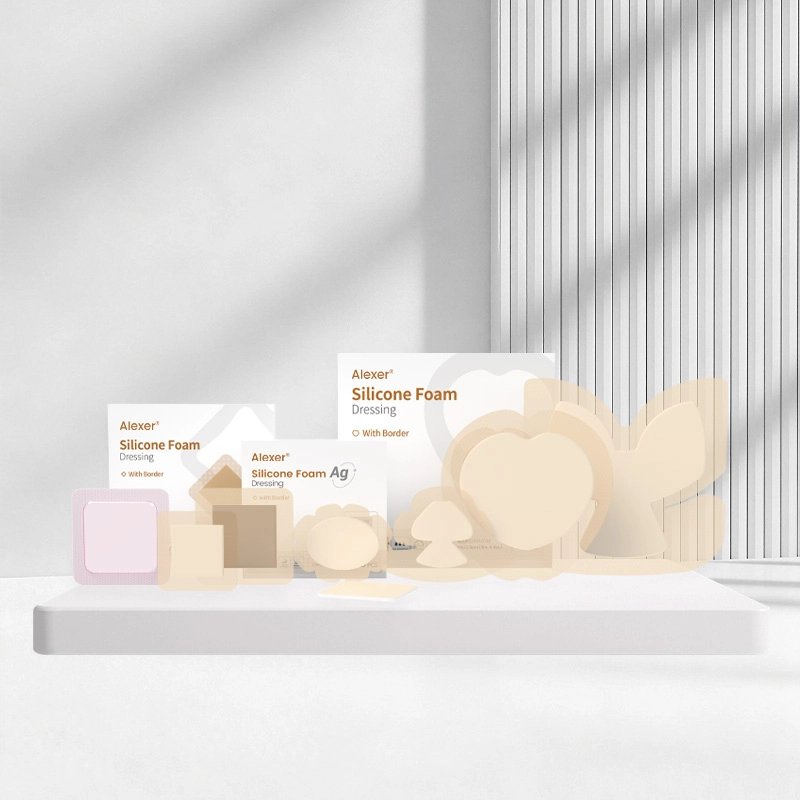
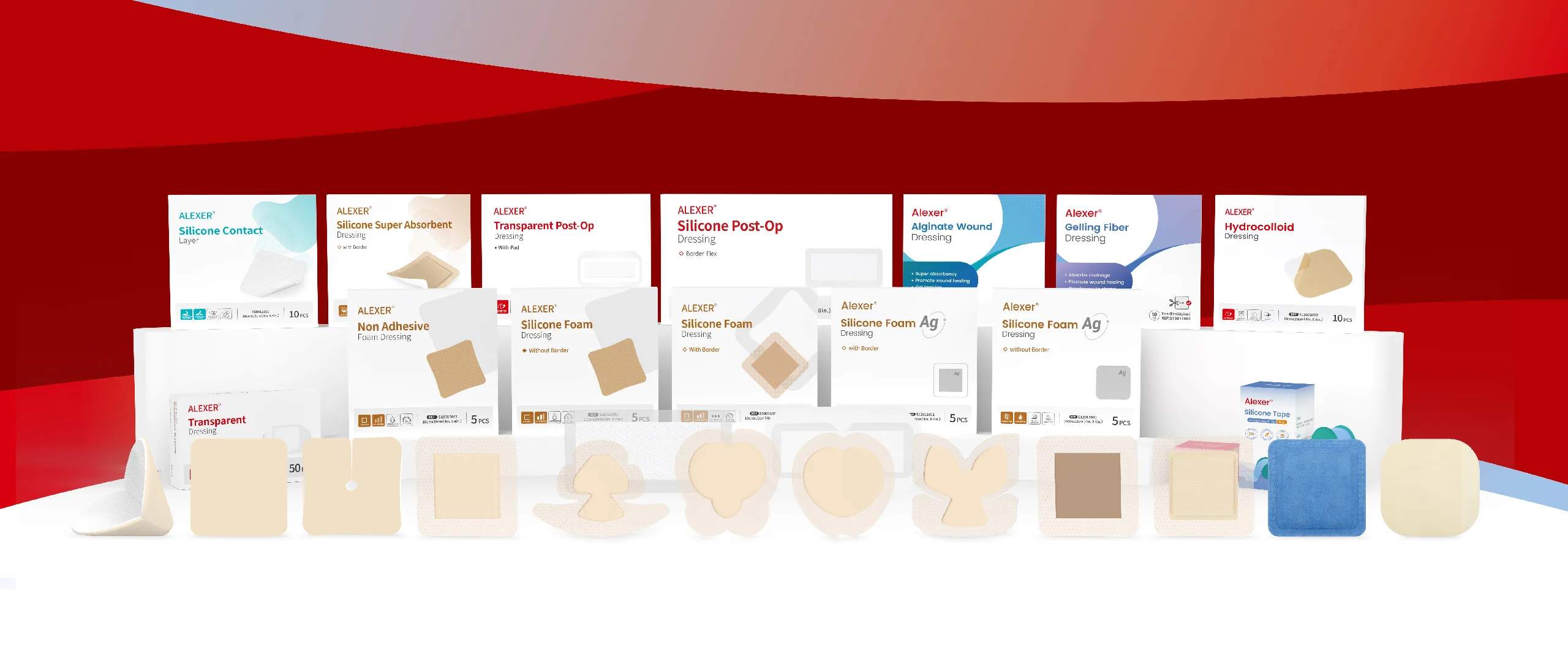
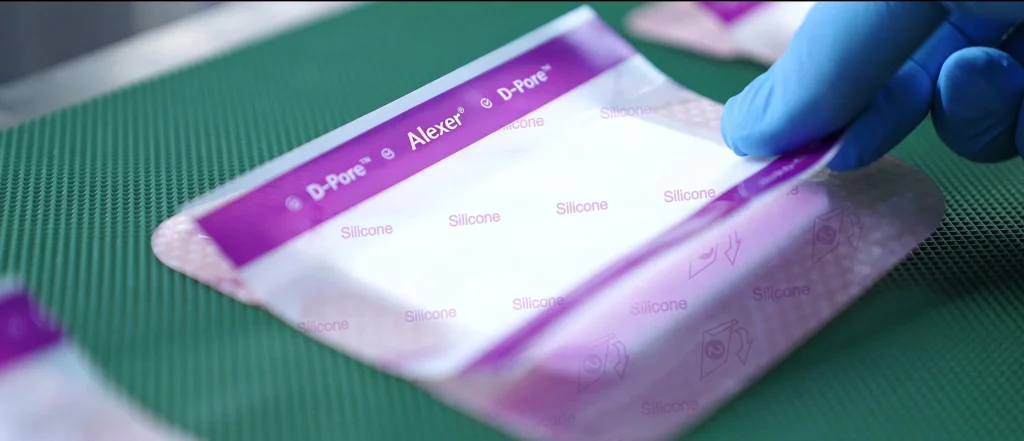
Manufacturer design example. SLK Medical’s published range describes a Lite silicone foam for low-exuding acute and chronic wounds, a standard silicone foam dressing for moderate to highly exudating wounds, and a separate super absorbent dressing line indicated for moderately to heavily exuding wounds. These are manufacturer indications, not trial outcomes, and should be matched against the specific IFU before use.
Step 3: Prepare and protect the periwound skin before adhesion
Moisture and adhesive insults begin before the dressing is opened. By the end of this step the periwound is cleansed, dried and, where indicated, protected.
The sequence:
Cleanse per local protocol, gently, without vigorous rubbing.
Pat dry, paying attention to skin folds.
Assess for hyperhydration — overhydrated skin is more susceptible to mechanical damage.
Apply a skin protectant where maceration risk is high. ISTAP guidance is specific here: any film-forming skin protectant must be fully dry before the dressing is applied so that the adhesive bond is not exacerbated (ISTAP Best Practice Recommendations 2021).
The MARSI consensus position supports routine rather than exception-based thinking: every patient requiring a medical adhesive should be considered potentially at risk. That does not mean every patient needs a barrier film, but it does mean protection is a deliberate decision recorded at the bedside rather than a reaction after an injury.
Verification checkpoint: protectant dry to touch, with no tacky residue bridging the wound edge.
Step 4: Apply the foam with correct sizing, centring and hand pressure
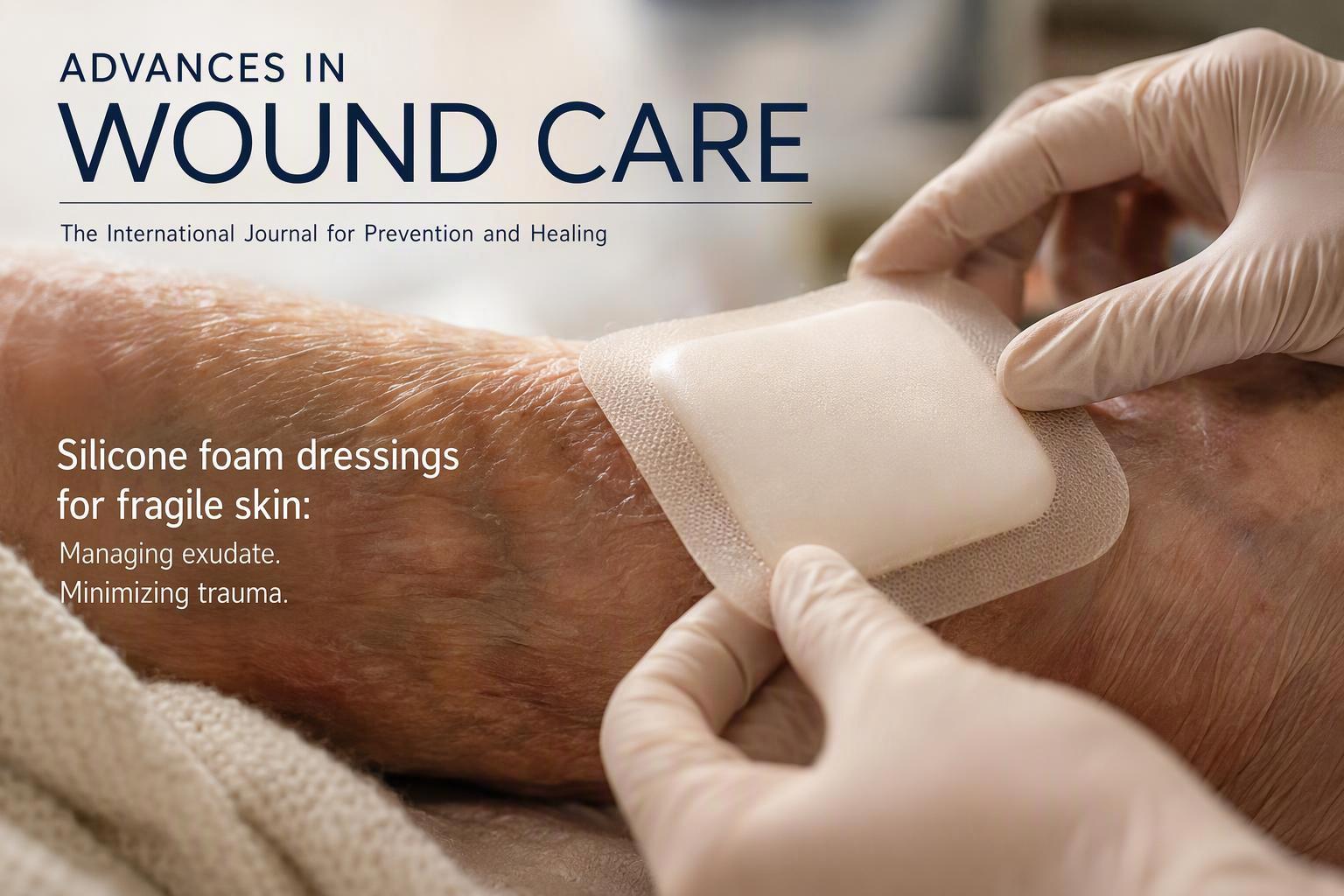
Application technique determines whether the dressing performs as designed and whether the edges seal. ISTAP gives the concrete actions:
Select a size so that the central padded area covers the whole wound.
Apply from the centre to the edges without stretching, to avoid shear.
Use gentle warming hand pressure to initiate adhesion.
Press the edges in place without stretching, to avoid breaking the adhesive bond, and without folds that allow leaks.
Cutting to size is appropriate for some configurations and not others. SLK Medical’s Lite product page states that the Lite dressing can be easily cut to size; bordered or cavity configurations generally should not be cut, because doing so opens the absorbent core or removes the sealing border. Treat cuttability as a design feature to confirm against the specific IFU rather than a general rule for the category.
Verification checkpoint: no lifted edges, no tension lines in the foam, dressing centred with its margin intact.
Step 5: Set wear time by trigger, not by fixed schedule
WUWHS describes the tension plainly: unnecessary dressing changes may disrupt healing, increase pain and anxiety, damage the wound bed or periwound skin and raise costs, while under-changing leaves exudate in contact with skin and risks maceration. The plan therefore balances undisturbed healing against exudate control, and it is written down.
Set the plan using the WUWHS monitoring red flags. Any of these should prompt an earlier change and a reassessment of the configuration chosen in Step 2:
Sudden increase in exudate volume
New leakage or strike-through
Dressing saturation before the scheduled change
Reduced or inappropriate wear time
New or worsening odour or pain
Patient-reported leakage
A trial protocol is not a clinical rule. The Contreet trial asked centres to leave dressings on for as long as clinically possible, to a maximum of 7 days — a trial-specific ceiling, not a universal wear time. Extending wear is justified only when the dressing is intact, the seal is holding and the periwound remains stable.
Verification checkpoint: for this patient, you can state what would prompt an earlier change and what would justify extending wear.
Step 6: Remove the dressing without stripping fragile skin
Removal is where fragile skin is most often lost. The Wounds UK MARSI report is direct on mechanism: mechanical trauma, particularly skin stripping during adhesive removal, is the most common mechanism of injury, with skin tear, tension blister and irritant dermatitis among the recognised outcomes (Wounds UK MARSI report).
The ISTAP removal sequence:
Remove the dressing as soon as possible if it is saturated with exudate or contaminated by stool or urine.
If the dressing is stuck, wet the wound-contact surface rather than pulling.
Do not pick or scratch at the dressing edge to lift it.
Consider an alcohol-free adhesive remover to minimise trauma, and rinse the skin afterwards to avoid irritation.
Remove slowly — the “low and slow” technique.
Using two hands, pull the adhesive at a low angle parallel to the skin while supporting the skin with the other hand at the adhesive–dressing interface.
Silicone adhesive lowers the force required, but it does not remove the need for technique. The soft-silicone literature describes these dressings as adhering gently to dry surrounding skin while not sticking to the moist wound bed, which is why they are designed to minimise trauma on removal — a design property that a fast, upward peel can still defeat.
Verification checkpoint: periwound intact, with no new erythema tracking along the adhesive footprint.
Step 7: Document each change so the protocol can be audited and defended
Steps 1 to 6 are clinical decisions; Step 7 makes them visible. A completed change record should contain:
Date and time
Exudate type and volume, with control status
Periwound status: intact, hyperhydration, maceration, erythema, excoriation, fragile
Wear time achieved versus planned
Reason for change: scheduled or trigger
Pain score at removal
Product and size used
Any escalation decision
For a distributor audience, this record is the commercial argument. A dressing conversion evaluated on unit price alone cannot show whether it reduced change frequency, extended wear time or preserved periwound integrity. The same fields, collected consistently, let a conversion be compared on wear time, changes per week and periwound outcomes — the measures that determine total cost in use.
Verification checkpoint: a second clinician could reconstruct the decision trail from the note alone.
What the evidence supports — and what is manufacturer design
Tender documents and clinical training both need the same thing: a clean separation between what guidance recommends, what trials observed, and what a manufacturer states about its own design. The three tiers below are not interchangeable.
Tier 1 — guideline-level support. The 2026 NPIAP/EPUAP/PPPIA guideline suggests a multilayered soft silicone foam dressing on the sacrum and heels for individuals assessed as high risk of pressure injuries, where resources permit — a conditional recommendation supported by very low certainty evidence (Quick Reference Guide). That is a prevention statement about two anatomical sites in a defined risk group; it is not a treatment claim for exuding wounds generally. Separately, ISTAP 2021 recommends considering silicone adhesive in place of acrylic adhesive in at-risk or fragile skin.
Tier 2 — trial-level support, with scope attached. The LeBlanc 2022 pragmatic randomised trial in two Ontario long-term care facilities randomised 126 residents with skin tears by unit to soft silicone dressings (contact layer and/or foam) or non-adhesive dressings; 96.9% of skin tears in the silicone group healed over three weeks versus 34.4% in the control group, with 89.2% versus 27.9% healed at week 2 (LeBlanc et al., Int Wound J). The unit-level allocation, the long-term care population and the specific comparator set the boundaries of that finding. The Contreet trial described in Step 2 is the other named RCT here, and its scope is equally specific: one silver foam against one hydrocellular foam in colonised venous leg ulcers under compression.
Tier 3 — manufacturer design, which is not an efficacy claim. SLK Medical’s published description of its silicone foam lists a polyurethane film backing (waterproof, bacteria barrier, external friction management), a foam absorbent layer, and a hydrophobic silicone contact layer intended for sensitive skin (product page). The stated aims — minimising the risk of maceration, minimising pain during dressing changes, avoiding secondary damage — describe design intent. On quality systems, the company holds ISO 13485:2016 certification and an EU MDR Annex IX Chapter I quality management system certificate covering Class IIb adhesive dressings with absorbent pad. Both speak to quality-system conformity and regulatory pathway, not to clinical performance in a given patient.
The honest limit. Foam-to-foam comparisons summarised in the Wounds UK review frequently found similar healing and similar wear time between products (Bianchi review). Foam selection should therefore rest on exudate handling, adhesion behaviour and periwound tolerance — the things Steps 1 to 7 actually measure — rather than on an assumption of healing superiority.
Common mistakes to avoid
Choosing foam by wound type instead of exudate level. It happens because wound aetiology is the first thing written in the note, so it feels like the selection variable. The correction is to select from the Step 1 descriptor — volume plus control status plus periwound condition — and record that reasoning.
Layering absorbent dressings instead of stepping up capacity. Extra layers feel like extra absorbency, but WUWHS advises that layering or sandwiching generally be avoided and that the chosen dressing or combination carry sufficient fluid-handling capacity on its own. The correction is to move to a higher-capacity product rather than adding a second absorbent layer.
Applying protectant and dressing back to back. Staff are time-pressed, and a barrier film looks dry before it is. ISTAP is explicit that a film-forming protectant must be fully dry or the adhesive bond is exacerbated. The correction is to build a drying pause into the procedure and check by touch.
Peeling upward and outward from a corner. It is the fastest way to open a dressing and the most reliable way to strip skin. The correction is the ISTAP two-handed, low-angle, low-and-slow removal with the skin supported at the adhesive interface.
Extending wear past saturation to “protect undisturbed healing.” The undisturbed-healing rationale is real, but it applies to an intact, functioning dressing. Strike-through and leakage are mandatory change triggers, not signs to hold on longer.
Frequently asked questions
With heavy exudate, how do I choose between standard foam, superabsorbent and foam over gelling fibre? Start from the control status, not the volume word. Moderate-to-high uncontrolled exudate, or a wear time that keeps falling short, is the signal WUWHS gives for evaluating a superabsorbent polymer dressing. A gelling co-primary under foam is for a wound bed that needs gel formation, and the combination must still carry enough fluid-handling capacity on its own — layering is generally to be avoided. Step 2 sets out the full logic.
What tells me a dressing is failing rather than simply due for change? A dressing that is due for change is at the end of a planned interval with the seal intact and the periwound stable. Failure looks like leakage or strike-through before the planned change, saturation early, reduced wear time, new or worsening odour or pain, or periwound changes appearing under the adhesive footprint. The first set is a schedule; the second is a trigger.
Fixed schedule or trigger-based changes? Trigger-based, with a documented plan. WUWHS frames the trade-off directly: unnecessary changes disrupt healing and damage skin, while under-changing risks maceration. A fixed interval can serve as a default only if the red flags in Step 5 override it.
How should I prepare periwound skin when maceration risk is high? Cleanse gently, dry thoroughly including folds, assess for hyperhydration, and apply a protectant where indicated — then let it dry completely before adhesion. Step 3 gives the sequence and the ISTAP drying requirement.
Which claimed silicone foam benefits rest on RCTs? The scoped trial findings are the maceration and leakage results for one silver foam against one hydrocellular foam in colonised venous leg ulcers, and the skin-tear healing results for soft silicone versus non-adhesive dressings in long-term care. Design statements such as a hydrophobic silicone contact layer reducing pain on change are manufacturer descriptions of intent. Step 9 sets out the three tiers in full.
Conclusion and next step
The sequence is short enough to hold in mind: assess exudate and periwound, match capacity to what you found, protect the skin, apply without tension, set triggers rather than a habit, remove low and slow with the skin supported, and document the decision. Each step exists because the one before it produces the information the next one needs — which is why skipping the assessment or the record undermines the rest.
For the clinician, the payoff is fewer adhesive injuries and better-controlled maceration on skin that cannot afford either. For the distributor, the payoff is a conversion argument built on wear time, change frequency and periwound outcomes rather than unit price — the kind of record that stands up to a formulary review or an audit.
To evaluate the range against your own caseload, request the specification sheets, IFU and certification pack for the silicone foam range, and arrange a sample evaluation that uses the Step 7 documentation fields as the comparison template. Running both the current dressing and the candidate through the same record is what makes the comparison defensible.