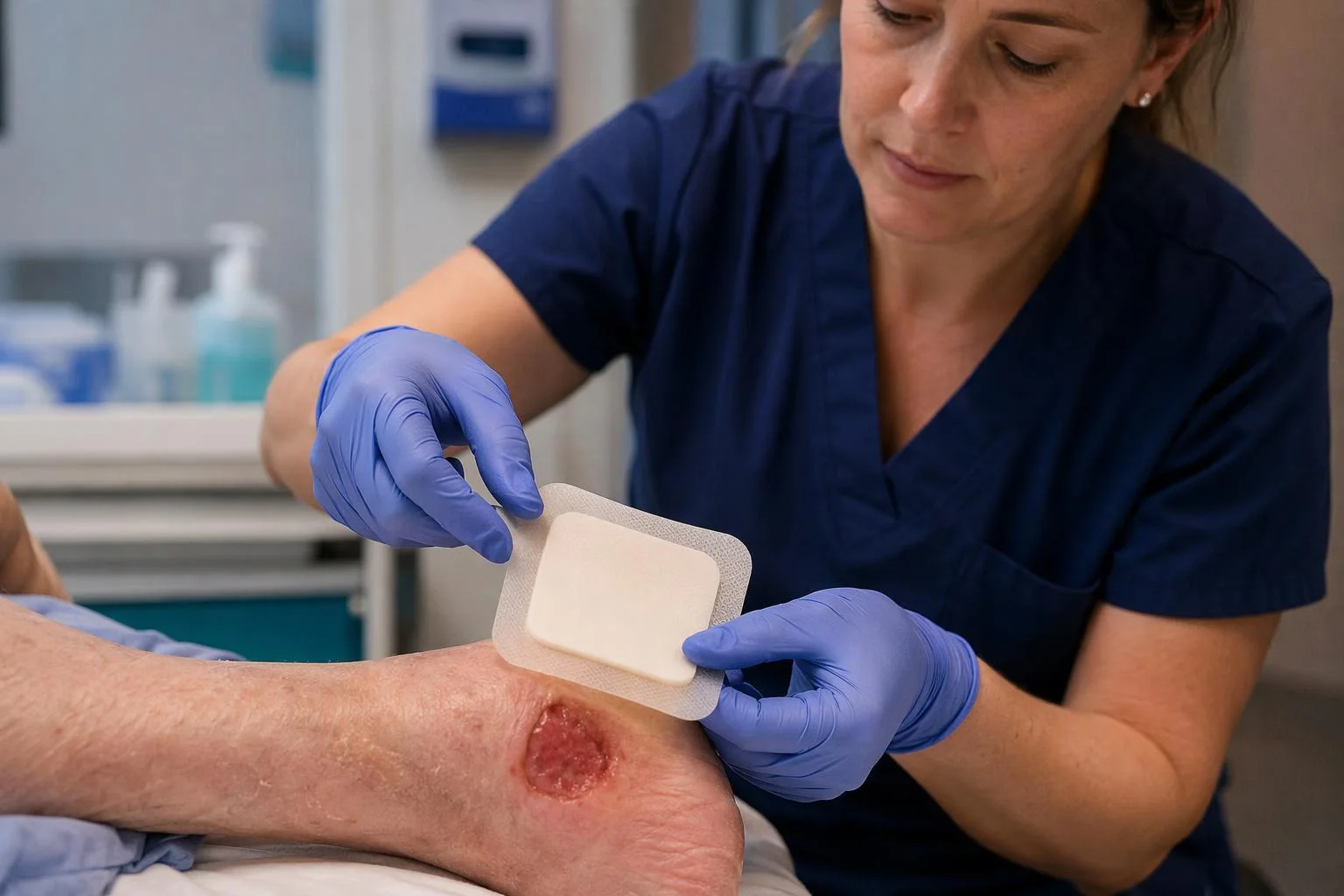


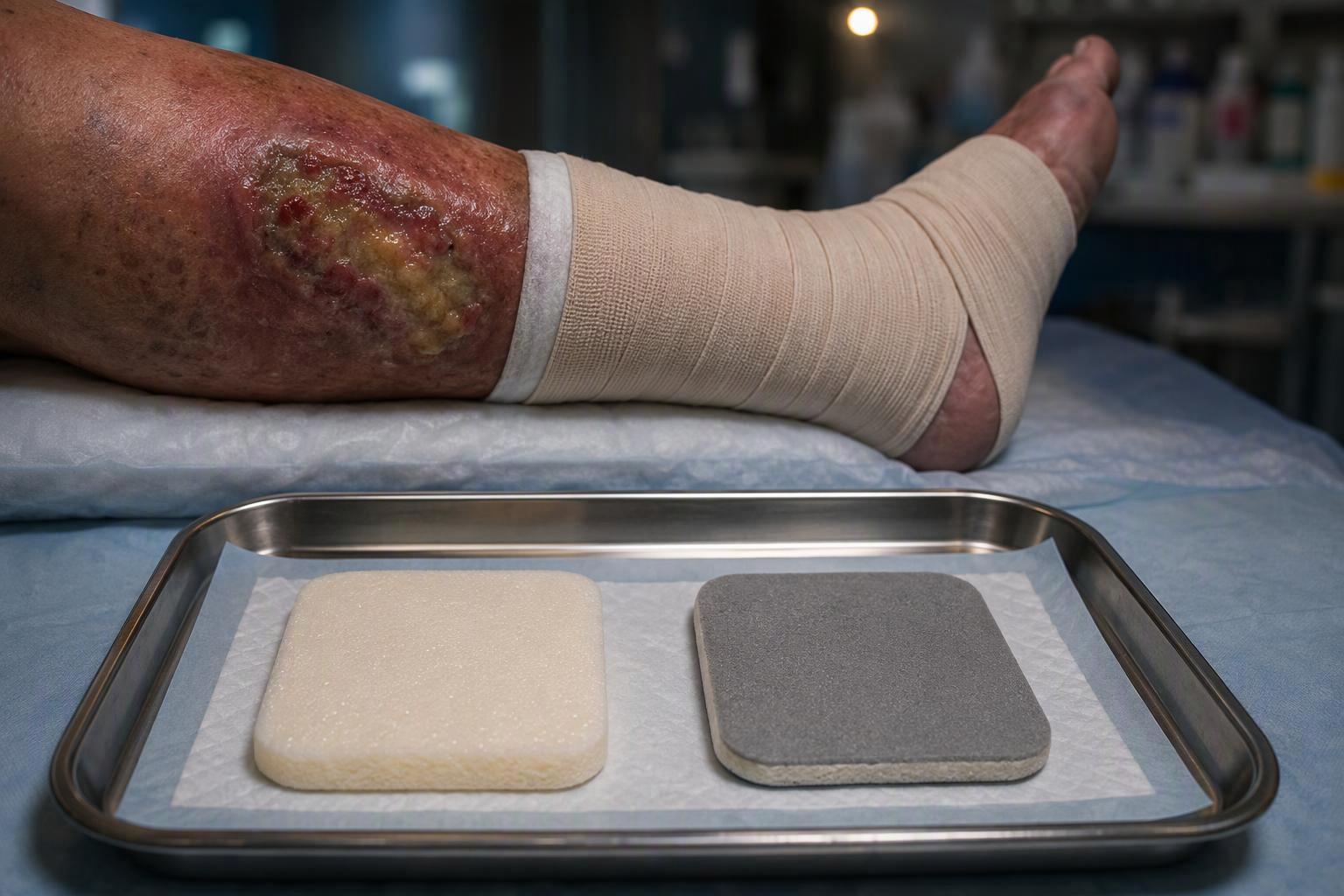
A colonized venous leg ulcer with compression already planned is a formulary decision, not a diagnosis. The clinician has usually settled the compression question — multilayer bandaging where exudate is copious, limb shape abnormal or skin fragile, per the NWCSP leg ulcer recommendations — and what remains is which antimicrobial foam sits under the bandage: a PHMB foam or a silver foam.
The honest starting point is that neither agent has a high-certainty evidence base in this indication. The Cochrane network meta-analysis of dressings and topical agents for venous leg ulcers treats the whole network as low-certainty evidence, and NICE’s late-stage assessment of topical antimicrobial dressings for locally infected leg ulcers concluded there is not enough evidence to determine whether price differences between antimicrobial agents are justified. So the choice turns on agent-level trade-offs — the healing signal, odor control, cell toxicity, and how the dressing behaves under compression — rather than on a proven winner.
This comparison works through those four dimensions, then maps SLK Medical’s PHMB and Ag foam families to protocol scenarios a distributor can carry into a formulary or tender pack. It is built from published reviews, consensus documents and SLK product documentation; it is not a head-to-head trial.
Key takeaways
No guideline establishes superiority of either agent for healing venous leg ulcers; compression remains the dominant healing intervention.
PHMB has a healing and bacterial-load signal against silver in one comparative trial and in the IWII 2022 consensus evidence tables — promising, but thin.
Silver’s cytotoxicity concern is formulation- and release-dependent, not a class constant; PHMB is not exempt from the same concern.
Under compression, dressing construction — adhesive versus non-adhesive, absorbency, periwound protection — matters as much as the agent.
Quick comparison: PHMB foam vs silver foam at a glance
Dimension | PHMB foam | Silver (Ag) foam | Edge | Condition |
|---|---|---|---|---|
Healing | Higher chronic-wound healing rates versus a silver dressing in the IWII 2022 evidence table; superiority for complete healing in only one of six RCTs in the WHAM summary | Mixed: no difference versus non-silver dressings in Greer’s two-RCT meta-analysis; possible increase in healing probability versus non-adherent dressings in the Cochrane NMA, at low certainty | Depends | The PHMB signal rests on a single comparative trial plus a consensus table, not a meta-analysis |
Odor | No dedicated venous-ulcer odor trial; odor evidence in the WHAM summary comes from a fungating-wound comparison against metronidazole | Odor reduction at one week in 83% of a silver-foam group versus 53% of controls in a critically colonized VLU trial; IWII table entry on improved odor, exudate and pain | Silver | Where malodour is the presenting complaint in a colonized VLU |
Cytotoxicity | In vitro cytotoxic at commercially used concentrations in some assays | Toxicity tracked silver ion release rather than total silver content in an ex vivo study; most studies in a release review exceeded a cited cytotoxic blood threshold without reporting cytotoxicity data | Tie (shared concern) | Controlled by release profile, exposure duration and dressing construction, not by class |
Compression fit | Non-adhesive and bordered silicone-foam formats; sustained antimicrobial release described up to 7 days | Non-adhesive and bordered silicone-foam formats; sustained ionic silver release described up to 7 days | Depends | Decided by exudate level, limb shape and periwound condition rather than by agent |
Best fit | Bioburden-led rationale with mild odor and moderate exudate | Odor-led rationale, or where silver’s exudate and maceration data are the deciding factor | Depends | See the protocol mapping below |
Evidence certainty | Low, with one comparative trial and consensus tables | Low overall; the venous-ulcer record is mixed across reviews | Tie | Neither agent supports a formulary claim of superiority |
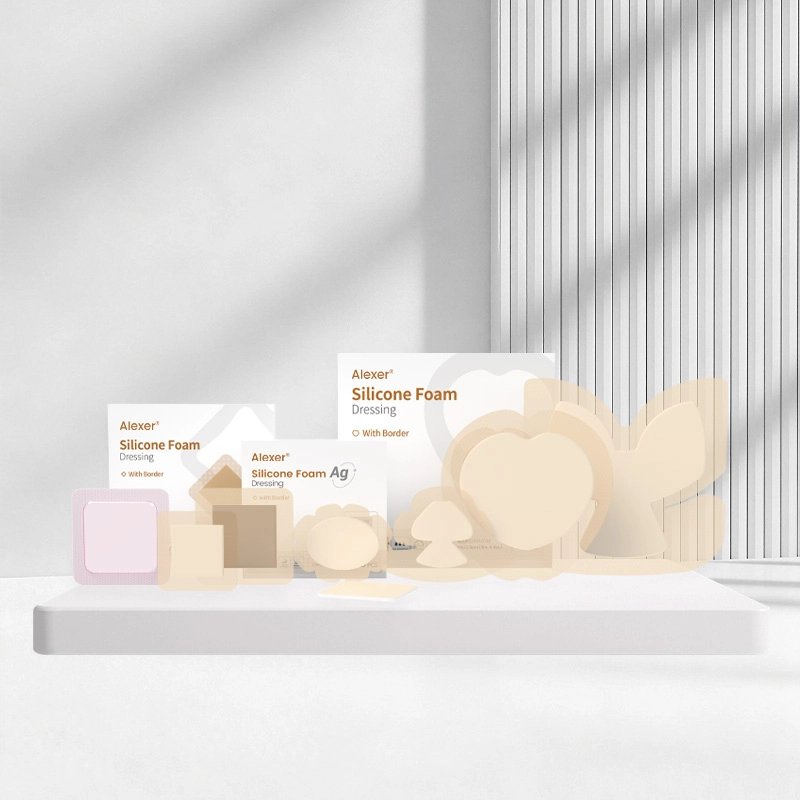
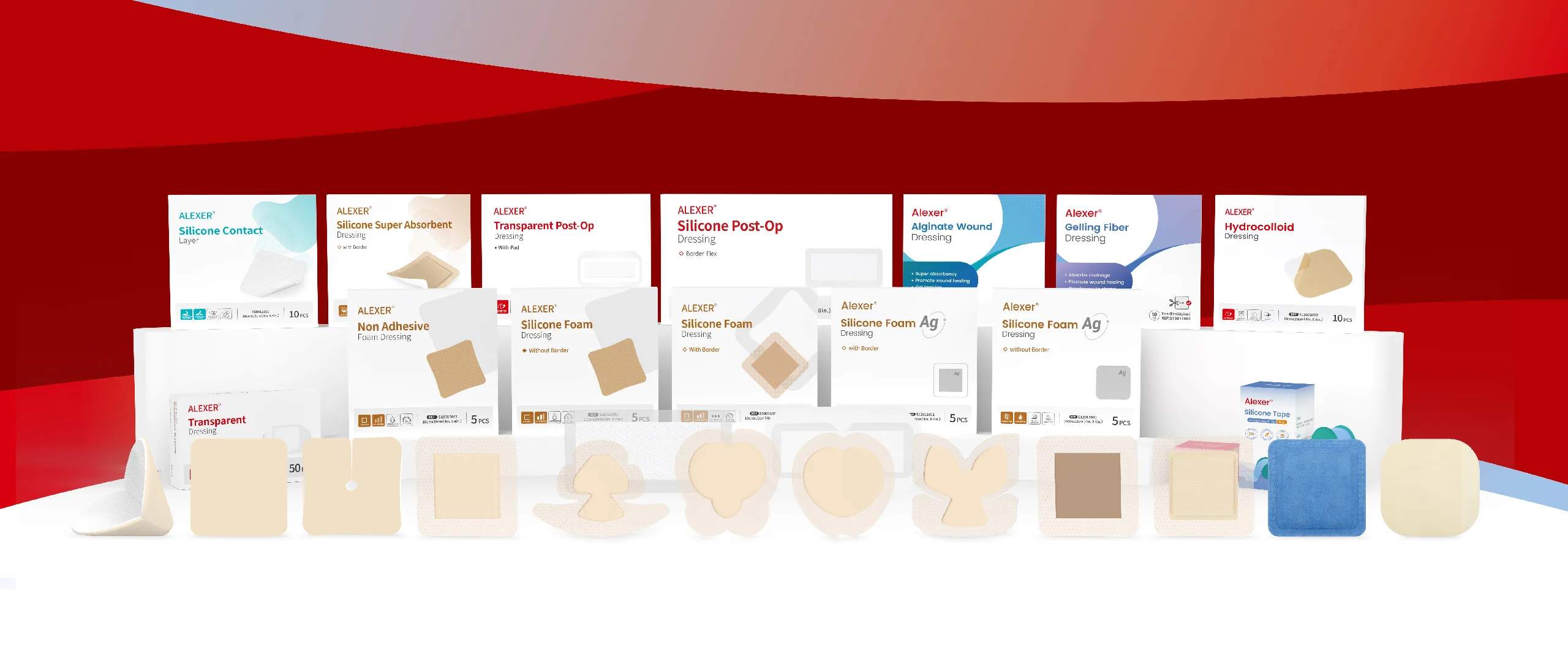
Dressing formats | Non-adhesive PHMB foam; PHMB silicone foam without border; PHMB silicone foam with border | Non-adhesive Ag foam; Ag silicone foam without border; Ag silicone foam with border | Tie | Format availability, not agent, drives most protocol fit |
Wear time | Manufacturer describes antimicrobial protection up to 7 days | Manufacturer describes sustained ionic silver effect up to 7 days | Tie | Actual wear time follows exudate assessment and the IFU, not the maximum claim |
Read the table as a comparison of agent-level evidence and dressing families. No row is a rating of any individual SLK SKU, and no row should be quoted to a tender committee as a clinical claim without the underlying citation.
How do you tell colonization from infection before choosing an antimicrobial?
Both agents are antimicrobials, and antimicrobials are not the default dressing for a leg ulcer. The IWII 2022 consensus sets out a wound infection continuum running from contamination through colonization to local infection — covert and overt — and then to spreading and systemic infection. The 2022 update removed the older term “critical colonisation,” which had been used to describe the point at which microbial burden overwhelms host defences; the continuum now places that clinical picture within local infection.
For chronic leg ulcers specifically, the consensus lists wound observations that are independent predictors of infection: an ulcer area of 10 cm² or larger, wound bed slough, and heavy wound exudate — with the caveat that exudate level should be read in the context of whether leg volume reduction through compression has been achieved. Depression, chronic pulmonary disease and anticoagulant use are also predictors.
The practical consequence is a three-way split. A colonized wound that is progressing under compression is not automatically an antimicrobial case. Local infection is where a topical antimicrobial is considered. Spreading infection needs systemic antibiotics — NICE NG152 sets out the oral and intravenous regimens for infected leg ulcers — with topical antimicrobials as an adjunct rather than the treatment. The PHMB-versus-silver question therefore only arises once an antimicrobial is indicated; before that point, the comparison is premature.
Healing: does either dressing actually speed closure?
The PHMB case is real but narrow. The WHAM evidence summary reports that in a systematic review of six primarily low-quality RCTs, PHMB dressings were superior to comparator for complete wound healing in only one study. The IWII 2022 table on topical antiseptics and complete healing records higher rates of chronic wound healing with a PHMB dressing versus a silver dressing, citing the same comparative work. That trial also found a significantly greater reduction in superficial bacterial burden at week 4 with PHMB foam versus foam alone, and a 35% median reduction in wound size versus 28% in the control group.
Median relative ulcer-area reduction at 4 weeks in the same Jørgensen 2005 RCT (n=129): 45% with the silver-release foam versus 25% with the plain hydrocellular foam. This measures area reduction, not complete healing, and compares silver with a non-antimicrobial foam rather than with PHMB.
The silver case is genuinely mixed. NICE’s evidence summary reports that Greer’s meta-analysis of two RCTs (n=255) found no difference between silver dressings and non-silver dressings in venous leg ulcers, while Leaper’s meta-analysis of four RCTs (n=1,055) found a specific brand reduced ulcer area over four weeks in hard-to-heal VLUs — with limitations NICE says affect its interpretation. The Cochrane network meta-analysis notes silver dressings may increase the probability of healing compared with non-adherent dressings, but the network as a whole is low-certainty evidence. The VULCAN economic modelling found silver dressings carried an incremental cost of £97.85 versus control, partly from more frequent dressing changes.
The conclusion a formulary committee can act on: neither agent has demonstrated a reliable healing advantage over the other across the literature, compression is the dominant healing intervention, and dressing choice should not be sold on a healing claim. The PHMB signal is worth noting as a differentiator in a clinical discussion; it is not a basis for a superiority statement.
Odor: which agent controls malodour better?
Silver has the more direct evidence in this wound type. In the multicentre trial of a sustained silver-release foam versus a plain hydrocellular foam in critically colonized venous leg ulcers with delayed healing (n=129), a decrease in odor after one week was reported for 83% of the silver-foam group versus 53% of controls. The IWII 2022 table on reducing signs and symptoms of local infection also records improved exudate, odor and pain management in chronic wounds for silver-releasing dressings versus comparators.
Odour outcomes from the Jørgensen 2005 multicentre RCT (n=129) comparing a sustained silver-release foam (Contreet Foam) with a plain hydrocellular foam (Allevyn) in critically colonised venous leg ulcers with delayed healing. Values are the percentage of patients with odour present at each assessment; lower is better. This is a single trial of one silver foam against a non-antimicrobial foam, not a PHMB-versus-silver comparison.
The PHMB odor case is indirect. The WHAM summary’s odor evidence comes from a trial of PHMB versus metronidazole in malignant fungating wounds — a different wound type, a different clinical problem, and a comparator that is itself an antimicrobial aimed at odor. PHMB’s odor rationale in a venous ulcer therefore rests on its bacterial-load reduction rather than on dedicated odor trials.
The practical implication is narrow but useful. Where malodour is the presenting problem in a colonized venous ulcer, silver has the more direct evidence in this wound type. Where odor is mild and the clinical concern is bioburden, the distinction between the agents narrows considerably, and the dressing’s exudate handling and periwound behaviour become the deciding factors.
Cytotoxicity: how much should silver’s cell toxicity worry you in a colonized ulcer?
Cytotoxicity is a formulation and exposure question, not a class verdict. A systematic review of silver ion release from commercial dressings found that 80% of the included studies exceeded the blood silver level currently considered cytotoxic (>0.01 ppm) — but no study provided specific cytotoxicity data, and methodological variability across studies limits comparison. The same review notes silver elimination is slow, with a mean residual permanence of 46 days.
The ex vivo work sharpens the point. Nešporová and colleagues compared four commercial silver dressings and found toxicity was only partially driven by total silver content and more so by the ability to release Ag+. The least toxic dressing in their panel still performed well in the antimicrobial assay, suggesting antimicrobial effect and cytotoxicity are not directly linked.
PHMB is not exempt. A review of topical antiseptics in chronic wound care reports an in vitro study in which PHMB was 100% cytotoxic at the commercially available concentration of 0.04%, below the estimated minimum bactericidal concentration — a finding from cultured cells, not from clinical use, but one that keeps PHMB inside the same debate.
For a colonized ulcer, the controllable variables are duration and dressing construction. The IWII practice point is to use a topical antiseptic for at least two weeks before evaluating efficacy; the corollary is to stop when the infection signs resolve rather than continuing indefinitely. Choosing a formulation with a measured release profile, and reviewing at the two-week mark, does more for the cytotoxicity question than switching class.
Compression fit: will the foam stay put and manage exudate under multilayer bandaging?
Under multilayer compression the foam has three jobs: hold exudate, protect periwound skin, and stay comfortable through the wear interval. The evidence here is about dressing behaviour rather than agent. The silver-foam trial reported lower maceration at four weeks in the silver group (37%) than in controls (48%). The IWII consensus adds the interpretive caution that exudate level should be read alongside whether compression has achieved leg volume reduction — a heavily exuding limb that is still swollen is a compression problem before it is a dressing problem.
The NWCSP recommendations are blunt: no robust evidence supports the superiority of any dressing type over another for non-healing leg ulcers, simple low-adherent absorbent dressings with sufficient absorbency are first-line, and strong multi-component compression bandaging is preferred over hosiery where there is chronic oedema not reduced by elevation, abnormal limb shape, copious exudate or very fragile skin.
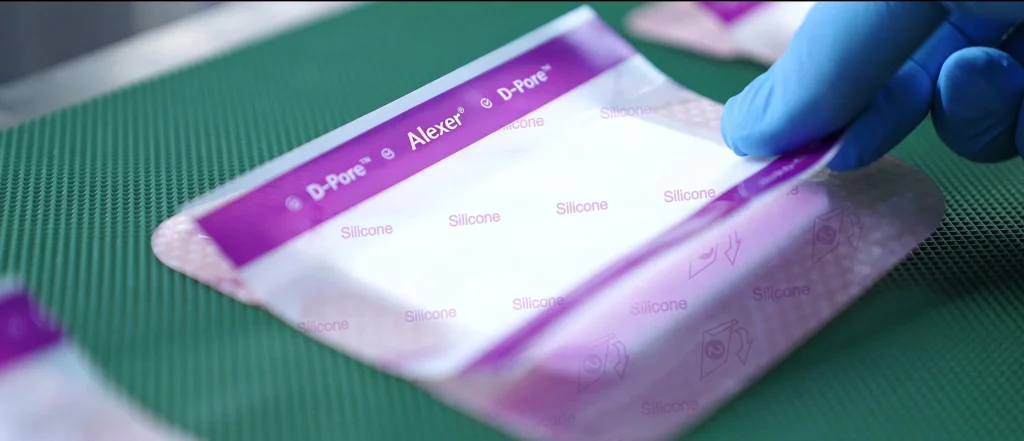
Within that frame, SLK’s formats split on construction rather than agent. The non-adhesive PHMB foam and the non-adhesive Ag foam suit use under bandaging where a separate retention layer is applied. The bordered silicone-foam versions — PHMB with border and the Ag silicone foam with border — suit a self-adherent dressing where limb shape and periwound condition allow it, with a silicone wound contact layer described as distributing exudate and allowing atraumatic removal. SLK product pages describe sustained antimicrobial release up to seven days for both families; actual wear time under compression should follow the clinician’s exudate assessment and the IFU rather than the maximum claim.
Mapping SLK Medical PHMB and Ag foams to protocol scenarios
These mappings translate the four dimensions into protocol scenarios. Each is framed as a fit between dressing design and clinical situation, not as a clinical recommendation; final selection follows local protocol and the treating clinician.
Scenario one — colonized ulcer, mild odor, moderate exudate, multilayer bandaging. The non-adhesive PHMB foam or the PHMB silicone foam without border suits this profile. The rationale is bioburden-led: PHMB’s bacterial-load signal and its tolerability profile carry the argument, and the absence of a dominant odor complaint means silver’s odor advantage is not the deciding factor.
Scenario two — colonized ulcer where malodour dominates. The Ag silicone foam without border or the non-adhesive Ag foam suits this profile, because silver has the more direct odor evidence in venous leg ulcers. The dressing is designed to deliver sustained ionic silver release while managing exudate.
Scenario three — fragile or macerated periwound skin needing an atraumatic bordered dressing. The bordered silicone-foam versions of either family — PHMB with border or the Ag silicone foam with border — are designed for this, with a silicone contact layer intended to minimise epidermal stripping on removal. The agent choice then follows scenarios one or two.
Scenario four — heavily exuding limb where absorbency drives change frequency. SLK’s super absorbent range is the escalation option alongside the antimicrobial foam, with silicone-adherent and non-adherent versions. This is a construction decision, not an agent decision: the antimicrobial addresses bioburden while the absorbent component addresses wear time and maceration risk.
When should you stop the antimicrobial and switch to a plain foam?
The exit rule is the same for both agents, which is precisely why it belongs in any protocol built around either. The IWII practice point is to use a topical antiseptic for at least two weeks before evaluating its efficacy in managing wound infection. NICE’s evidence summary is firmer on silver: silver dressings should be used only when there are clinical signs or symptoms of infection. The silver-absorption study of elderly patients recommends against long-term silver dressing use given slow elimination and the potential for cumulative exposure.
In practice, the switch criteria are resolving signs of local infection, falling exudate, and a healing trajectory — a shrinking ulcer area, improving tissue type, less slough. At that point a plain silicone foam or a low-adherent absorbent dressing takes over under continued compression, consistent with the NWCSP first-line recommendation and with the IWII stewardship position that a non-antimicrobial dressing should be considered once bioburden is under control and the wound is improving.
Because this rule does not differentiate PHMB from silver, it should not be presented as a reason to choose one. It is a reason to write a review date into the protocol, document the rationale for antimicrobial use, and make the step-down explicit so that the dressing is not continued by inertia.
What documentation should procurement request before adding either family?
For a distributor building a tender pack, the documentation question is where the comparison stops being clinical and becomes commercial. The checklist below is worth putting to any supplier; SLK’s own certificate scope is the worked example.
ISO 13485 certificate and scope. SLK holds a TÜV SÜD certificate (No. Q5 112764 0001 Rev. 01, valid 2026-06-30 to 2028-05-08) covering design, development, production and distribution of sterile polyurethane dressing, sterile gelling fiber dressing and sterile super absorbent dressing, and production and distribution of sterile foam dressing, sterile polyurethane transparent dressing, sterile waterproof dressing, sterile hydrocolloid dressing, sterile alginate dressing and sterile silicone absorbent fiber dressing, among other categories.
EU MDR Article 10 QMS certificate. SLK holds certificate No. G15 112764 0002 Rev. 00 (valid 2025-09-23 to 2030-09-22) under Regulation (EU) 2017/745, Annex IX Chapter I, with a Class IIb device group and an intended-purpose annex covering exuding wounds including leg and foot ulcers.
IFU in the required languages, matched to the markets the distributor serves.
Product specification sheet with sizes and reference numbers for each SKU in the proposed range.
Antimicrobial performance test reports held for the specific SKU, not for the family as a whole.
Be precise about what these documents establish. A QMS certificate covers the quality system and, for Class IIa/IIb devices, representative technical documentation assessed on a sampling basis — it is not a clinical claim for a specific product, and it does not certify that any individual dressing outperforms another. Check validity dates so buyers can confirm currency, and ask for the annex pages, not just the certificate front sheet.
Verdict: which antimicrobial foam for which scenario
Healing: no reliable advantage for either agent on current evidence. The PHMB signal against silver is promising but thin — one comparative trial and a consensus table. Odor: silver has the more direct venous-ulcer evidence. Cytotoxicity: a shared concern driven by release profile and exposure duration, not a reason to exclude either class. Compression fit: decided by dressing construction and exudate level more than by agent.
The scenario-based summary follows from that. PHMB where bioburden and tolerability lead the rationale; Ag where odor leads it; bordered silicone foam where periwound fragility leads it; and the super absorbent range where absorbency, not antimicrobial action, is the limiting factor.
For distributors evaluating either family, the practical next step is a documentation and sampling review: request the spec sheet, IFU, certification pack and a sampling plan for a protocol pilot, where these are available for the SKUs under consideration. That gives a clinical team something to evaluate against local protocol — and gives a tender committee documentation rather than a claim.
Frequently asked questions
Is PHMB better than silver for venous ulcers?
No guideline establishes that. The Cochrane network meta-analysis treats the whole evidence network as low-certainty, and NICE found insufficient evidence to determine whether price differences between antimicrobial agents are justified. PHMB has a healing and bacterial-load signal against silver in one comparative trial and in the IWII 2022 tables, but that is not the same as demonstrated superiority.
Can PHMB and silver be used sequentially in one treatment course?
Yes, and the switch logic is the same in either direction. Start with the agent whose evidence matches the presenting problem — silver where odor dominates, PHMB where bioburden and tolerability lead — review at two weeks per the IWII practice point, and step down to a non-antimicrobial dressing once infection signs resolve and exudate falls. Sequential use is a review decision, not a rotation schedule.
Are silver dressings still worth stocking given the safety debate?
The restrictions some healthcare settings have placed on silver reflect concerns about efficacy, cost-effectiveness and safety, and NICE positions silver for use only when clinical signs of infection are present. Within that scope, silver remains a legitimate formulary line — particularly where odor is the presenting problem in a colonized ulcer. Stocking decisions should reflect the local restriction status and the documentation held for the specific SKU.
How should a distributor pitch either family to a tender committee without a healing claim?
Lead with documentation, wear time and total cost in use rather than healing. The QMS and MDR certificates, the IFU in the required languages, the spec sheet with reference numbers, and any SKU-specific antimicrobial test reports answer the compliance questions a committee actually asks. Wear time and change frequency drive the cost comparison; the VULCAN finding that silver’s incremental cost came partly from more frequent dressing changes shows why change frequency belongs in the model.