

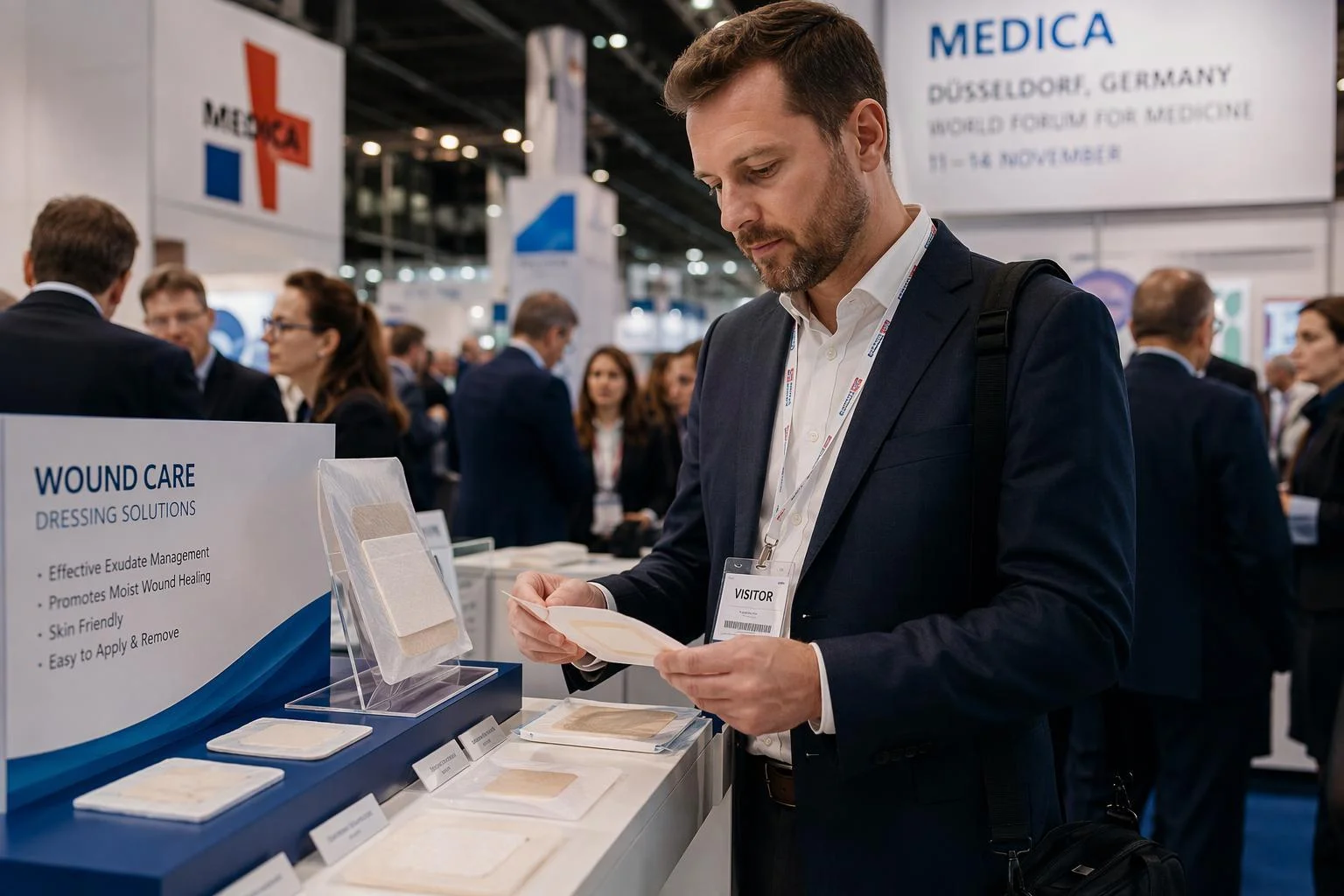
MEDICA 2026 runs 16–19 November 2026 at the Düsseldorf fairground, and if you are a hospital or group purchasing lead, a distributor, or a private-label brand owner sourcing wound dressings, those four days are a compressed negotiation window. You will walk past hundreds of stands, hear the same absorbency language at each one, and come home with a stack of brochures that are hard to compare. The useful work is not collecting brochures. It is separating manufacturers from trading companies, reading certificates for what they actually say, and leaving with a shortlist you can defend to clinical, finance and supply-chain colleagues.
This guide is a framework for building that shortlist, not a list of booths to visit. It covers what to prepare before you travel, what to ask at the stand, which documents to take away, and how to score suppliers on total value rather than unit price. The final section applies the checks to one supplier, SLK Medical, as a worked example of how a manufacturer’s evidence reads — a demonstration of the method, not a substitute for your own due diligence.
Scope and disclosure. This guide is about sourcing and documentation, not clinical dressing selection; that decision belongs with your wound care leads. It does not cover national registration routes outside the EU and US. Certificate details quoted in the worked example were checked in November 2026 and should be re-verified before you rely on them. This guide is published by SLK Medical, which is the supplier used as the worked example — read that section with that commercial interest in mind.
Why MEDICA 2026 matters for dressing sourcing
The organiser’s own facts and figures page sets the practical frame: 16–19 November 2026, Messe Düsseldorf, organised by Messe Düsseldorf GmbH. Visitor hours run 10:00–18:00 Monday to Wednesday and 10:00–16:00 on Thursday, so the final day is roughly two hours shorter than the others — plan your must-see stands for Monday to Wednesday and leave Thursday for follow-ups and documents you still need to collect.
COMPAMED, the supplier fair for medical technology components, materials and manufacturing processes, runs on the same dates alongside MEDICA and shares the ticket. If you are evaluating a private-label programme, the COMPAMED side is where converting, packaging and material suppliers sit, and the organiser describes the two events together as mapping the MedTech ecosystem from development and production through to application.
Scale is the argument for preparation. Messe Düsseldorf reports that the previous edition drew around 5,300 exhibiting companies from 70 nations and 78,000 trade visitors from 165 countries. Those figures describe the prior edition, not a forecast for 2026, but they explain why an unstructured walk-through rarely produces a comparable shortlist.
Wound care and consumables sit within the Home Care, Consumables & Hygiene focus, one of the thematic clusters the organiser uses to structure the halls. The interactive hall plan lets you search exhibitors by name or filter by country of origin, and it includes a tour-planning feature that maps the fastest route between selected stands with estimated walking times. Build that route before you fly. A realistic plan is eight to twelve substantive conversations a day, not thirty.
One planning note: the organiser has been repositioning exhibitors more closely around clinical requirements and application scenarios, and the grounds are under a long-term modernisation programme that includes work on Hall 9 and the North Entrance. Check the current hall plan close to the show rather than relying on last year’s map.
Build your sourcing brief before you travel
The single most useful document you can carry is a one-page sourcing brief. Without it, every stand conversation resets to generalities and you end up comparing suppliers on the order in which you visited them.
Write down, in this order:
Wound types and exudate levels in scope. Separate your moderate-exudate pressure injury business from your high-exudate leg ulcer and cavity work. They point to different product families and often to different suppliers.
Product formats. Foam, silicone foam, silver foam, PHMB foam, superabsorbent, alginate, gelling fibre, absorbent fibre, functional gauze, hydrocolloid. Mark which are core to your catalogue, which are opportunistic, and which you would only add if a supplier already covers the rest.
Sizes, shapes and anatomical formats. Sacral and heel formats are not interchangeable with standard bordered rectangles, and a supplier who lists foam dressings may not tool the anatomical shapes you need.
Target markets and the regulatory route each implies. A CE-marked Class IIb dressing for the EU and a 510(k)-cleared product for the US are different evidence packages. Write down which you need first, because it determines which questions matter at the stand.
Expected volumes and MOQ tolerance. Give a realistic annual range and a first-order quantity. Suppliers calibrate their answers to whatever you signal, so signal accurately.
OEM and private-label requirements. Artwork, packaging format, labelling languages, sterilisation format, shelf-life target, and whether you need your own brand on the pouch or a neutral label.
The outcomes you must demonstrate internally. Clinical, economic or both — wear time, change frequency, stock-keeping unit reduction, landed cost per patient day. These become the columns in your scorecard later.
Keep it to one page. It is the filter for every conversation and the reason two suppliers can be compared on the same terms.
Tell a manufacturer from a trading company
A trading company can sell you a good dressing. The problem is that when a specification changes, a batch is questioned or an audit arrives, a trader has to go back to someone else for the answer. You want to know which of your shortlisted suppliers can answer from their own records.
Check the certificate holder against the facility. ISO 13485 certificates name a holder and list the facility or facilities covered. Read both fields. If the holder is a trading entity and the facility is a third-party plant, the certificate tells you the quality system of the entity that holds it, and you need to understand the relationship before you treat the supplier as the manufacturer.
Check the address. The facility address on the certificate should be a real production site, not a registered office or a mailbox. Compare it with the address on the supplier’s website and with the address they give you verbally.
Ask them to walk you through their own process. Pick one product and ask how it is made: which steps happen in-house, which are subcontracted, where converting and packaging take place, how the foam or the adhesive is sourced. A manufacturer answers with process detail and names the steps they do not perform themselves. A trader tends to describe the product rather than the process.
Ask a technical question that requires ownership. Why a particular backing film, how the adhesive is pattern-coated, what happens to absorbency under compression, how a change in raw material supplier is validated. Deferral is not proof of anything on its own, but a pattern of deferral across several questions tells you where the technical knowledge sits.
Ask who signs the declaration of conformity. Under Regulation (EU) 2017/745, Article 10, the manufacturer is the economic operator that places the device on the market under its own name, and the obligations — including drawing up the technical documentation and the EU declaration of conformity — sit with that legal entity. Ask directly which legal entity will appear on the DoC for the product you are buying.
No single check proves manufacturing status. Together they tell you whether the organisation in front of you can carry the regulatory and quality obligations you are about to depend on.
Read the certificates correctly: ISO 13485 and CE/MDR
Two certificates come up in almost every dressing conversation, and they prove different things. Buyers who conflate them either over-credit a supplier or reject a good one.
ISO 13485: what the certificate covers
An ISO 13485 certificate certifies that the organisation has established and maintains a quality management system meeting the standard. Read five fields:
Holder — the legal entity certified.
Facility — the site or sites covered.
Scope — the activities and product types. A scope limited to sterile foam dressings does not cover an alginate you are also buying.
Standard version — ISO 13485:2016, with any amendments listed.
Validity dates — the from and until dates, and whether the certificate is a revision that supersedes an earlier issue.
What it does not do: it does not certify the performance of any individual product, and it is not a product approval. It says the quality system is in place and audited.
The standard itself is published by ISO as ISO 13485:2016, and the certification bodies that audit against it are listed with their designated scopes in the IAF CertSearch database, which is the quickest way to confirm that the body named on a certificate is accredited for medical devices. The detailed field-by-field reading of a real certificate is set out in the worked example further down — read that scope against your own product list, because that is the exercise.
The EU MDR quality management system certificate
A certificate issued under Regulation (EU) 2017/745, Annex IX Chapter I, is a quality management system certificate issued by a notified body. Read:
Notified body name and number — the four-digit identification number matters; you can check the body’s designation and scope in the Commission’s NANDO database.
Manufacturer and SRN — the legal manufacturer and its Single Registration Number.
Authorised representative — required for manufacturers outside the EU.
Device group and class — the certificate lists the device groups and risk classes covered.
Validity dates and revision history.
The Commission’s NANDO database is the authoritative place to check that a notified body is designated for the specific regulation and for the device group on the certificate — a body designated only for other directives cannot issue a valid MDR certificate. The notice on how notified bodies conduct conformity assessment, including the sampling of technical documentation, is set out in MDCG 2022-4, and it explains why a QMS certificate tells you about the system and the sampling regime rather than about every article number.
What neither certificate proves
Neither certificate is a declaration of conformity for the specific product in your hand, and neither is a technical documentation assessment certificate for every article number you might order. A QMS certificate confirms the system; the DoC confirms the individual device’s conformity; the technical file is what supports the DoC. Ask for all three, and ask which article numbers the DoC covers.
One classification point worth knowing when you compare suppliers: under MDR Annex VIII, Chapter II, Rule 4, non-invasive devices that are used as a mechanical barrier, for compression or for absorption of exudate are generally Class I, while non-invasive devices intended for wounds that have breached the dermis and can only heal by secondary intent are Class IIb. The classification rule applies according to the intended purpose, and where a device performs several functions the applicable classification is the one that governs its use. The class on a supplier’s certificate should match the intended purpose on their label and IFU — if it does not, ask why.
Documents and test reports to request at the booth
A supplier who manufactures should be able to hand over, or commit to sending within a stated period, a defined document pack. Ask for it as a list and tick it off:
EU declaration of conformity for the specific product and article numbers, naming the manufacturer, the Basic UDI-DI, the risk class and the notified body where applicable.
Instructions for use, in the languages of the markets you serve, with intended purpose, indications, contraindications, warnings and change-frequency guidance.
Technical file summary — not the full file, but a summary showing the structure and the standards applied.
Biocompatibility test reports for patient-contacting materials.
Performance test reports, including the absorbency and fluid-handling data behind any claim in the brochure.
Sterilisation validation where the product is sterile, including the sterilisation method and dose or cycle parameters.
Shelf-life and stability data supporting the claimed expiry.
Packaging validation and transport testing where relevant to your market.
Reading EN 13726 absorbency data
Many dressing brochures quote an absorbency figure in g/10cm² or g/g. The number is only comparable if you know which method produced it. EN 13726:2023 defines several distinct tests, and a 2025 review of laboratory standards for wound dressings summarises what each annex measures:
Annex | Test | What it measures |
|---|---|---|
B | Free-swell absorptive capacity | Fluid absorbed after soaking the specimen until fully saturated |
C | Fluid retention capacity | Fluid retained after temporary compression of a saturated specimen |
D | Absorbency under compression | Fluid absorbed while the specimen is under compression |
E | Fluid handling capacity | Absorption plus moisture vapour loss |
J | Waterproofness | Waterproofness of the outer backing film |
K | Extensibility and permanent set | Resistance to stretching and deformation |
L | Test solution A | Composition of the standard test solution; laboratories may use other fluids that simulate wound exudate |
The same review notes the standard’s own limitations: the tests are saturation-based, use a simple saline-based solution, and do not replicate gravity, compression bandaging or curved body surfaces as they occur in use. That does not make the data useless — it makes it necessary to ask which annex, which test solution and which conditions produced the figure. Two suppliers quoting “absorbency” may be quoting Annex B and Annex D, which are not the same measurement.
When you get back to the office, put the quoted figures side by side with the annex and conditions noted. Where a supplier cannot state the method, treat the figure as unverified rather than as a comparison point.
Substantiate antimicrobial claims: PHMB and silver
PHMB and silver dressings carry claims that need more scrutiny than a passive foam, because the active agent is doing work the buyer cannot see. Before you shortlist, get answers to the following, in writing where possible:
Active agent and concentration — the specific substance, its concentration in the dressing, and whether it is released into the wound or bound in the dressing.
Test method and organisms — which standard or in-house method was used (for example a log-reduction test), which organisms were tested, and at what inoculum.
Contact time — how long the dressing was in contact with the organisms before the result was measured.
Whether the result is in vitro — almost all antimicrobial dressing data is laboratory data. Ask explicitly, and do not let a laboratory log-reduction figure be presented as a clinical outcome.
Intended wear time and change frequency in the IFU, and whether that matches the contact time in the test.
Labelling limits and contraindications — for example, use on patients with known sensitivity to the agent, use on certain wound types, or restrictions on duration of use.
The regulatory frame is straightforward: under the MDR, claims in labelling, instructions for use and advertising must not mislead the user or patient about intended purpose, safety or performance, and the intended purpose stated on the label and IFU is what the clinical evaluation must support. A supplier whose brochure claims more than its IFU states has a documentation problem you will inherit.
This section is a method for demanding evidence, not a verdict on any product or supplier. The right output from a booth conversation is a set of documents and a list of open questions, not a yes or no.
Match dressing type to exudate level and scenario
Once you have a shortlist, the product conversation turns on fit. The table below is a starting frame for matching format to exudate level and wound scenario. It is descriptive, not prescriptive — final selection is a clinical decision made with your wound care leads.
Exudate level / scenario | Formats commonly considered | What to check |
|---|---|---|
None to low; intact or fragile peri-wound skin | Hydrocolloid, thin foam, silicone-faced foam | Adhesion to fragile skin, frequency of change, whether the format is designed for prophylaxis |
Moderate exudate; pressure injuries, surgical wounds, skin tears | Foam, silicone foam, bordered foam | Fluid handling capacity, wear time, anatomical shapes available |
Moderate exudate where antimicrobial function is being evaluated | Silver foam, PHMB foam | Agent, concentration, test method, organisms, IFU limits (see previous section) |
High exudate; leg ulcers, heavily exuding pressure ulcers, dehisced surgical wounds | Superabsorbent dressings, absorbent fibre | Absorbency under compression, retention, frequency of change, bulk under compression bandaging |
Cavity wounds, sinus tracts, bleeding wounds | Alginate, gelling fibre | Gelling behaviour, ease of removal, whether the format is designed for packing |
Lighter exudate, packing, or where gauze is the incumbent | Functional gauze | Conformability, linting, whether the product is intended as a primary or secondary dressing |
Two practical points. First, format and exudate level interact with wear time and change frequency, which drive your total cost per patient day more than unit price does. A dressing changed every three days at a higher unit price can cost less than one changed daily. Second, anatomical formats — sacral, heel, tracheostomy, drain site — are often the difference between a supplier who can cover your catalogue and one who cannot. Ask specifically which anatomical shapes are tooled, not just which product families are listed.
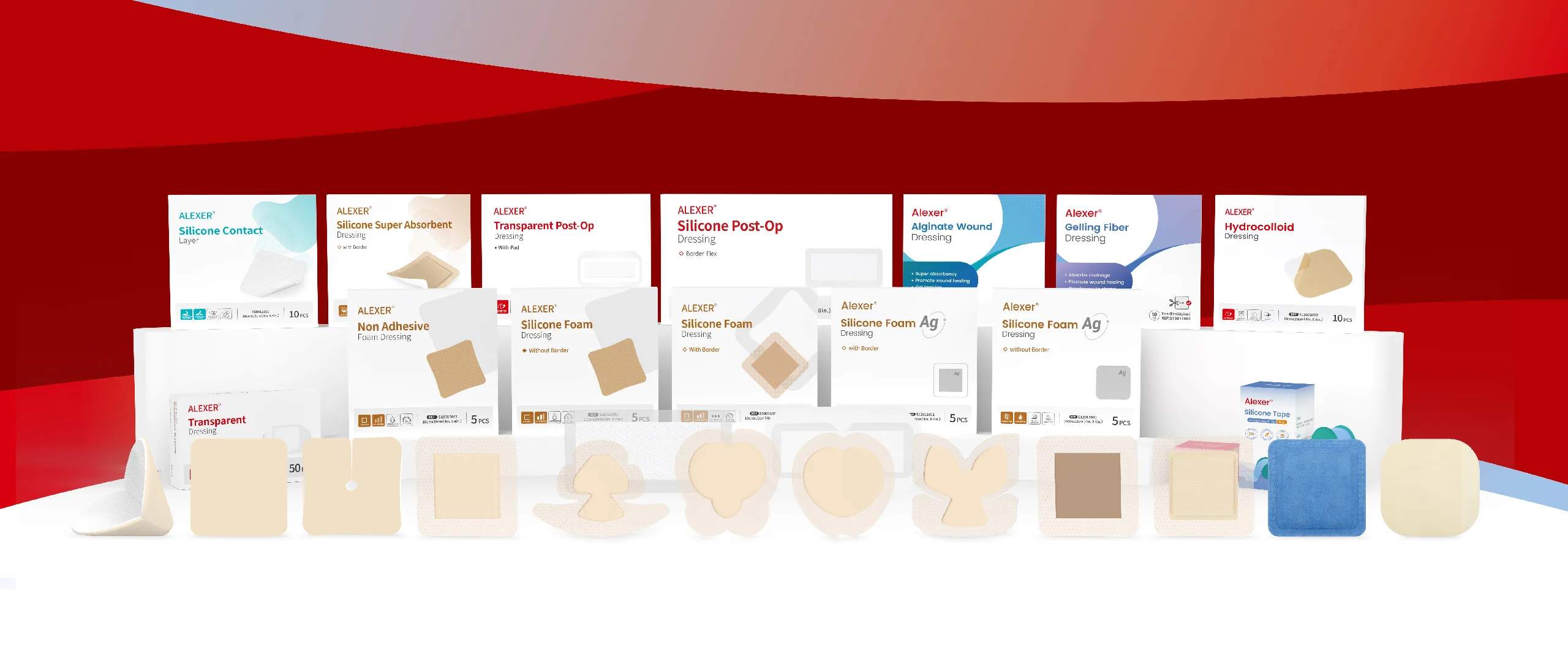
As one example of a supplier covering several of these rows, SLK Medical’s portfolio spans silicone foam, PHMB foam, silver foam, superabsorbent, alginate, absorbent fibre and functional gauze; the same coverage question — which rows, which anatomical shapes, which article numbers — is what you should put to any supplier against your own brief.
Red flags and deal-breakers
Separate the criteria that disqualify a supplier from the signals that should make you slow down.
Must-haves — treat as disqualifying if absent:
Certificate holder and facility match, and the facility is a production site.
Certificates are valid on the date you check them, not on the date they were printed.
Scope covers the specific product types you are buying.
IFU and declaration of conformity available for the article numbers in scope.
Traceability and UDI in place for the products you would order.
Lead times and MOQ stated in writing, with a named contact for escalation.
Warning signs — investigate, do not accuse:
Certificates that name a different legal entity than the manufacturer on the website or the DoC.
Expired certificates, or certificates whose scope does not reach the product you are discussing.
Reluctance to share test methods, or absorbency figures quoted with no annex or conditions.
Antimicrobial claims with no organisms, no contact time and no statement that the data is in vitro.
MOQ and lead-time answers that shift when you ask a second time, or that change when you mention a competitor’s price.
A technical question answered by a salesperson who then has to “check with the factory” for every item.
No clear answer on who handles complaints, vigilance and field safety actions.
None of these is proof of a problem. They are reasons to ask a sharper question and to hold the supplier at the sample stage rather than the shortlist stage until the answer is in writing.
Using the criteria to decide: a shortlist scorecard
A scorecard turns the show into a decision. Weight the criteria to your own priorities — the weights below are a starting point for a hospital or distributor buyer where regulatory readiness and supply reliability dominate.
Criterion | What you are scoring | Suggested weight |
|---|---|---|
Regulatory readiness | Holder/site match, scope, validity, DoC coverage, UDI, IFU quality | 25% |
Evidence quality | Test methods stated, reports available, antimicrobial data complete | 20% |
Product fit | Formats, sizes, anatomical shapes, private-label capability | 20% |
Supply reliability | Lead time, capacity, MOQ flexibility, stock policy, escalation contact | 20% |
Total cost in use | Landed cost per patient day at your expected change frequency, not unit price | 15% |
Score each supplier 1–5 per criterion, multiply by the weight and total. The value of the exercise is less in the number than in the discipline: you cannot score evidence quality without the documents, so the scorecard forces the document request.
A filled-in example
Three suppliers are scored against the weights above, after the document requests have come back. Scores are out of 5; the weighted column is score × weight.
Criterion (weight) | Supplier A | Supplier B | Supplier C |
|---|---|---|---|
Regulatory readiness (25%) | 4 → 1.00 | 2 → 0.50 | 5 → 1.25 |
Evidence quality (20%) | 3 → 0.60 | 2 → 0.40 | 4 → 0.80 |
Product fit (20%) | 5 → 1.00 | 4 → 0.80 | 3 → 0.60 |
Supply reliability (20%) | 3 → 0.60 | 4 → 0.80 | 4 → 0.80 |
Total cost in use (15%) | 4 → 0.60 | 5 → 0.75 | 3 → 0.45 |
Weighted total | 3.80 | 3.25 | 3.90 |
How to read the result:
Supplier B scores best on cost in use and supply reliability, but a regulatory readiness score of 2 — certificate scope did not reach two of the article numbers requested, and the DoC was outstanding at the day the score was closed — is enough to keep it at the sample stage rather than the shortlist, whatever the price. A high total cannot buy back a fail on a must-have.
Supplier A is the strongest on product fit because it tools the sacral and heel formats the brief requires, but the evidence quality score reflects two absorbency figures quoted without an annex being named. The fix is a follow-up request, not a rejection.
Supplier C has the highest total and the cleanest documentation, and the lowest score is on cost in use — which is exactly the column to negotiate on, because landed cost per patient day at your own change frequency is a commercial conversation, not a compliance one.
Two habits make the table usable. Close the score on the day the documents are due, not while you are still collecting goodwill at the booth, and write one line of justification next to every score of 1 or 2, so a colleague who inherits the shortlist can see why.
From long list to sample request
Use the show in three moves. On day one, walk the long list and score only regulatory readiness and product fit — enough to eliminate. On day two, return to the survivors with the document pack request and the technical questions. On day three, agree a sample plan: which article numbers, how many units, what evaluation period, and what data you will collect during the evaluation.
What to confirm after the show
Before you commit, confirm in writing: the exact article numbers and DoC coverage; the certificate validity dates at the time of order; lead time for a first order and for a repeat order; MOQ and price breaks; the named quality and regulatory contact; the complaint and vigilance process; and the audit arrangements — whether you can visit the site, and what a supplier audit would cover. A sample evaluation without a follow-up audit answers the product question but not the supplier question.
SLK Medical as a worked example
A note before you read this section: SLK Medical publishes this guide, so this is a self-assessment, not an independent evaluation. The point is to show what the checks in this guide look like when they are applied to a set of documents, so that you can run the same checks on any supplier — including this one.
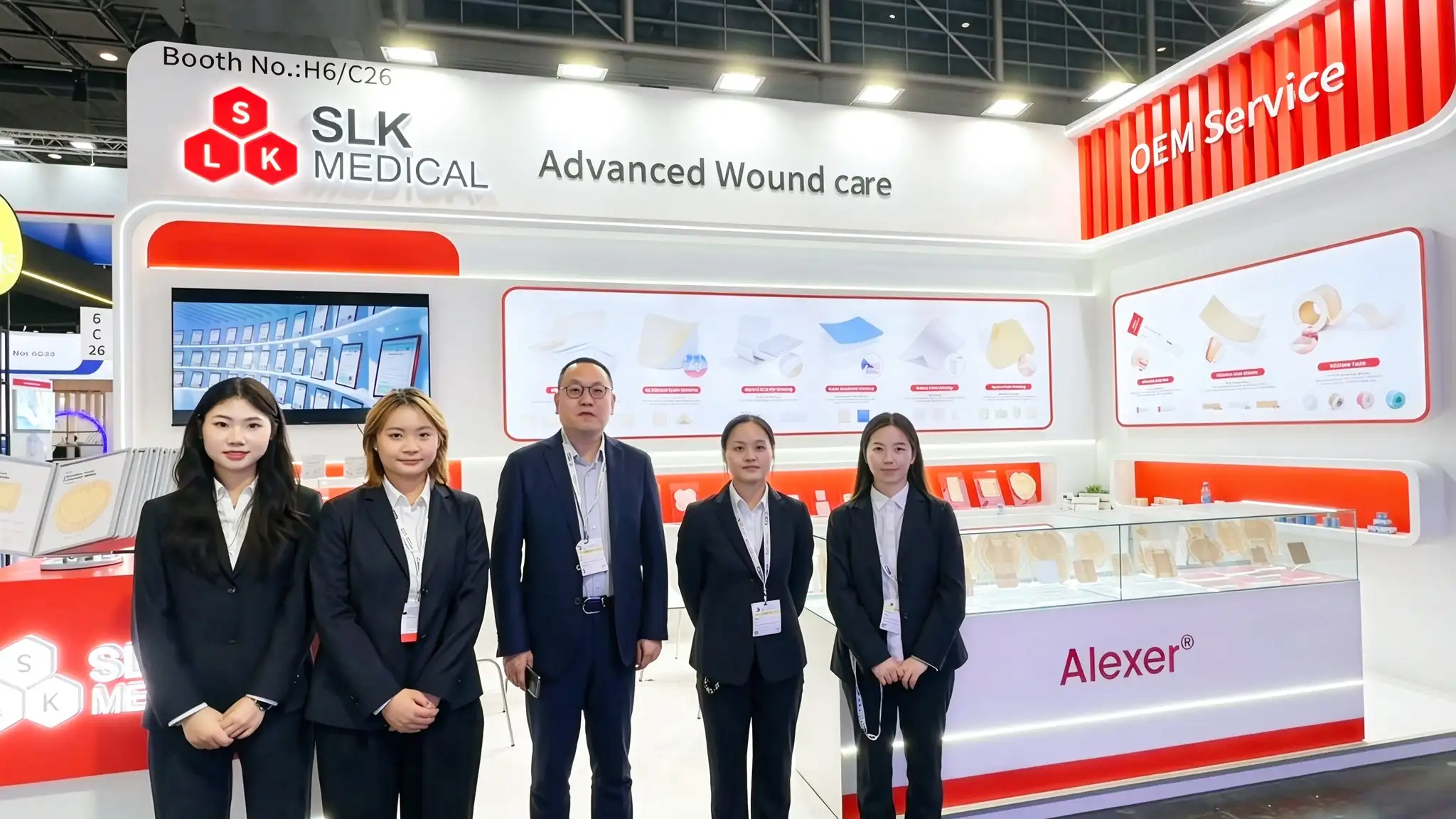
SLK Medical is a useful case study because its evidence can be read against the checks above. The company describes itself as a leading manufacturer of advanced wound care dressings, with silicone foam as a core strength and a portfolio that also covers PHMB foam, silver foam, superabsorbent, alginate, absorbent fibre and functional gauze. That positioning is the company’s own description; it is not an independent ranking, and you should treat it as you would any supplier’s self-description.
What can be checked against documents, as at November 2026:
Holder and facility. The ISO 13485 certificate is held by SLK Medical Material (Tianchang) Co., Ltd., with the facility listed at the same address in Tianchang, Anhui. The MDR QMS certificate names the same legal manufacturer. Holder and facility match, and the address is a production site.
Certification body and validity. Both certificates are issued by TÜV SÜD Product Service GmbH. The ISO 13485 certificate (Rev. 01) runs from 2026-06-30 to 2028-05-08, superseding the Rev. 00 issue that ran from 2025-05-09. The MDR QMS certificate, issued under Annex IX Chapter I by notified body 0123, runs from 2025-09-23 to 2030-09-22, and states that for Class IIa and IIb devices the QMS assessment was accompanied by assessment of technical documentation on a representative basis, with further assessment by sampling during surveillance.
Scope. The ISO 13485 scope covers design, development, production and distribution of sterile polyurethane dressing, and production and distribution of sterile foam, polyurethane transparent, waterproof, hydrocolloid, alginate, gelling fibre, superabsorbent and silicone absorbent fibre dressings, plus non-sterile scar gel, medical tape and silicone gel sheets and tapes. The MDR QMS certificate covers Class IIb, device group M040101 — adhesive dressings with absorbent pad.
Authorised representative. The MDR certificate lists Shanghai International Holding Corp. GmbH (Europe), Hamburg, as the authorised representative for the EU.
Now apply the same five readings to this data: does the holder match the facility, is the address a production site, is the scope wide enough for the article numbers you want, are the dates current, and is the class consistent with the intended purpose on the label and IFU. Those are the questions, and they are the same for every supplier you meet.
What the documents do not establish, and what you should still ask for: the declaration of conformity for the specific article numbers you would order; the technical file summary and test reports behind any absorbency or antimicrobial claim; the sterilisation validation for sterile formats; and the lead time and MOQ for your volumes. The certificates answer the quality-system question. They do not answer the product, capacity or commercial questions, and no supplier’s certificates should be treated as if they did.
Key takeaways
Prepare a one-page brief before you travel. Wound types, formats, sizes, target markets, volumes, MOQ tolerance, private-label needs and the outcomes you must demonstrate internally. It is the filter for every conversation.
Check holder against facility. Read the certificate holder and facility fields, compare the address with the production site, and ask which legal entity will sign the declaration of conformity.
Read certificates for scope and validity, not just presence. A valid certificate with a scope that does not reach your product is not a pass.
Know what the certificates do not prove. ISO 13485 certifies a quality system; the MDR QMS certificate confirms the system under Annex IX Chapter I. Neither is a declaration of conformity for the specific device.
Demand the method behind absorbency claims. Ask which EN 13726 annex, which test solution and which conditions produced the figure, and note that saturation-based tests differ from clinical use.
Scrutinise antimicrobial claims. Agent, concentration, organisms, contact time, in vitro status, wear time and IFU limits — in writing.
Match format to exudate and scenario, then check anatomical shapes and wear time, because change frequency drives cost per patient day more than unit price.
Score on total value. Regulatory readiness, evidence quality, product fit, supply reliability and cost in use, weighted to your priorities.
Frequently asked questions
When and where is MEDICA 2026? 16–19 November 2026 at the Düsseldorf fairground, organised by Messe Düsseldorf GmbH. Visitor hours are 10:00–18:00 Monday to Wednesday and 10:00–16:00 on Thursday. COMPAMED runs on the same dates alongside it.
What documents should I request at a dressing booth? The EU declaration of conformity for the specific article numbers, the IFU, a technical file summary, biocompatibility and performance test reports, sterilisation validation where sterile, and shelf-life data. Ask for them as a written list with a delivery date.
What do ISO 13485 and MDR QMS certificates prove? ISO 13485 certifies that the organisation maintains a quality management system meeting the standard, for the holder, facility and scope named on the certificate. An MDR Annex IX Chapter I QMS certificate confirms the quality management system has been evaluated against the regulation by a notified body, for the device groups and classes listed. Neither is a declaration of conformity for a specific product, and neither certifies the performance of an individual dressing.
How do I compare absorbency claims across suppliers? Ask which EN 13726 annex produced the figure — free-swell capacity, retention, absorbency under compression and fluid handling capacity measure different things — and which test solution and conditions were used. Where a supplier cannot state the method, treat the figure as unverified.
How should I evaluate PHMB and silver dressings? Ask for the active agent and concentration, the test method and organisms, the contact time, whether the data is in vitro, the intended wear time and change frequency, and the IFU limits and contraindications. Check that the brochure claims do not exceed what the IFU states.
How do I tell a manufacturer from a trading company? Check that the certificate holder and facility match, that the facility address is a production site, that the supplier can describe their own production and converting steps, and that they can answer technical questions about materials and processes. No single check is conclusive; the pattern across several is what matters.
Next step: request the specification pack
If you are building a shortlist for foam, PHMB, silver foam, superabsorbent, alginate, absorbent fibre or functional gauze supply, bring your sourcing brief to the conversation. SLK Medical can provide specification sheets, instructions for use, a certification pack and a sampling plan on request, and the most productive first conversation starts from your requirements — target markets, volumes, formats and the regulatory route you need — rather than from a catalogue.
Ask for the documents listed in this guide by name, and ask which article numbers each one covers. The certificates answer the quality-system question; the specification pack and sampling plan are where the product and commercial questions get answered.