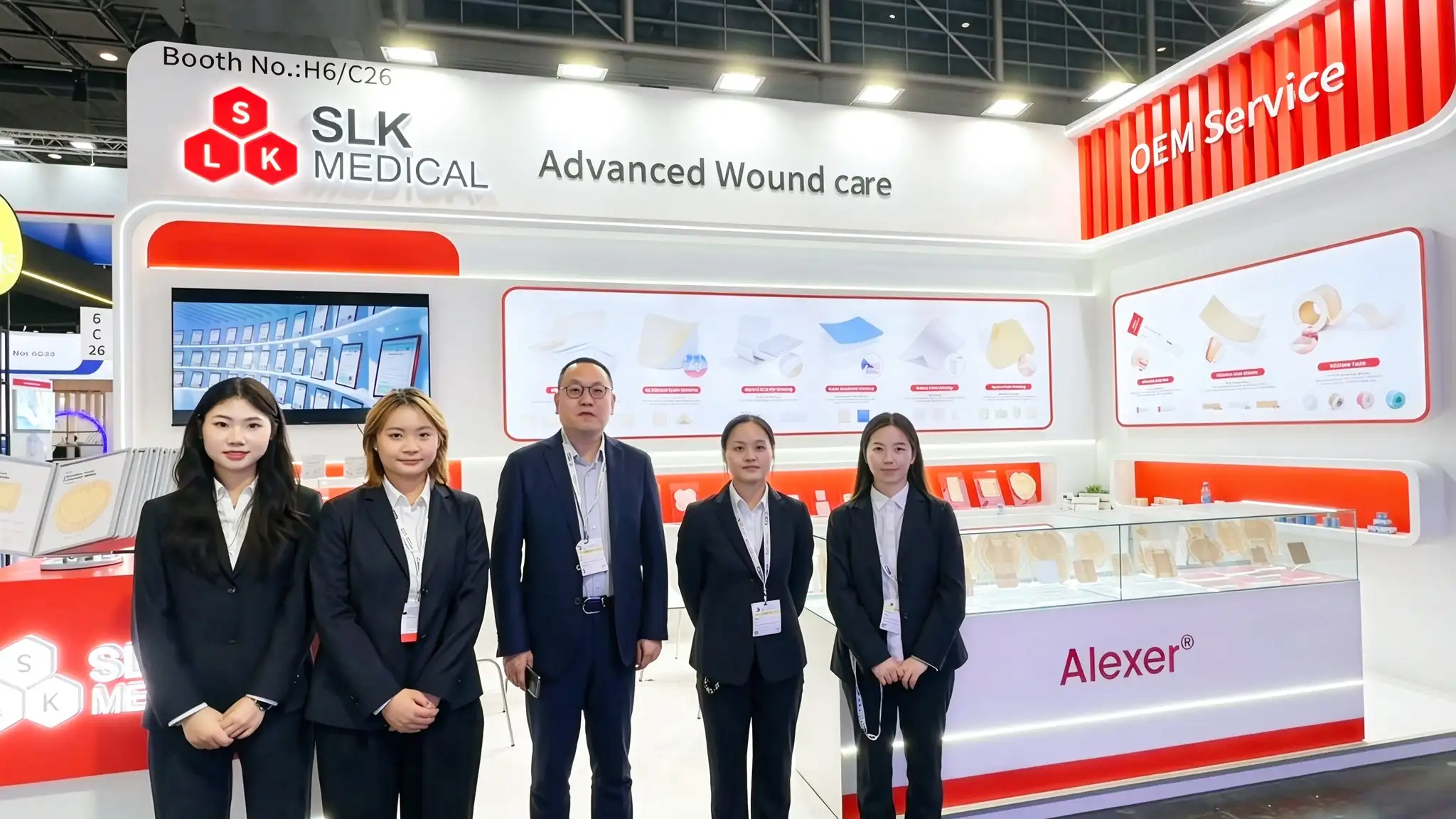


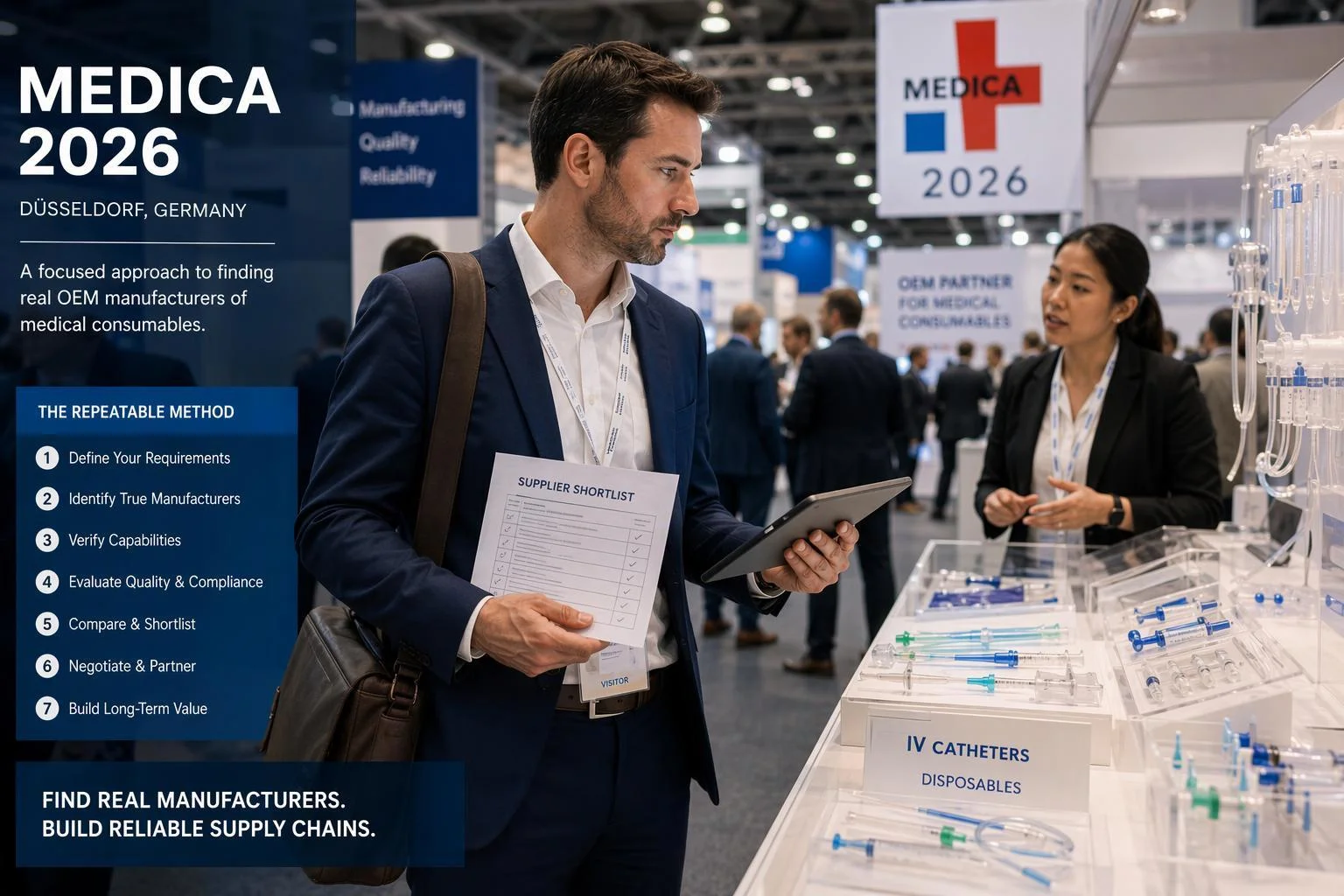
MEDICA 2026 in Düsseldorf runs 16–19 November, and if you are a consumables distributor or importer, you will walk in with two jobs: build a shortlist of wound-care and hygiene suppliers, and qualify the ones you might take into an OEM or private-label programme. The exhibitor list will not do that work for you — a stand number tells you nothing about who owns the plant.
This guide gives you a repeatable method: filter the directory before you travel, ask where the specific product is made rather than whether the company is a manufacturer, read certificates for the facility and scope instead of the logo, and use a compact on-site Q&A checklist to test answers on the stand. A worked example from SLK Medical shows what a genuine production site’s paperwork looks like when you trace it properly.
One thing to state up front, because it changes how you should read the rest. This article is published by SLK Medical, a wound-dressing manufacturer, and the worked example further down is our own plant in Tianchang. We are not a neutral party here — we benefit if you shortlist us. That’s exactly why the method below is written to be run against our paperwork as hard as anyone else’s. If the checks don’t hold up for SLK Medical, they shouldn’t hold up for any supplier.
Start with the directory, not the hall floor
The exhibitor database is preliminary for 2026 and will keep changing until the show opens on 16 November, with exhibitors still being added — so treat any list you build in October as a working draft, not a fixed itinerary.
Start in the Exhibitors & Products search, which lets you filter by keyword, product category, country and hall. For consumables, work through the relevant categories rather than browsing the A–Z: the fair’s thematic structure includes Home Care, Consumables & Hygiene, and the category tree lets you narrow to dressing and hygiene segments before you look at a single company name.
Then use the tools that save walking time. MyOrganizer lets you bookmark exhibitors and attach notes, so each candidate gets a page you can revisit. The interactive hall plan goes further: you enter stand numbers, and it plots the fastest route between them with estimated walking times. Cluster your shortlist by hall and build a route that follows the halls rather than criss-crossing the grounds.
The output of this stage is one page per candidate: company name, hall and stand, country of the exhibiting entity, product categories claimed, and the specific models you want to discuss. That page becomes the file you test on the stand — and the file you check documents against afterwards.
Separate the trading company from the production site
Under the MDR, a “manufacturer” is the person who manufactures or fully refurbishes a device, or has it designed or manufactured, and markets it under their own name or trademark (Article 2(30)). That definition is about legal responsibility for the device, not about who runs the extruder. A company can hold the certificate and the liability while a different entity operates the plant — and a distributor that puts its own name on the box can become the manufacturer itself under Article 16.
So the useful question is not “are you a manufacturer?” but “where is this specific product made, and who controls that site?”
Certificates answer that if you read them correctly. An ISO 13485 certificate is issued to a named holder for a named facility and a defined scope (ISO). Look for the facility address on the certificate, then compare it with the address the salesperson gives you and the address on the label. If the certificate names a site in one country and the product ships from another, ask which entity performs which step. An EU quality management system certificate under MDR Annex IX works the same way: it names the manufacturer, the production site and the device groups covered. A logo on a brochure is not a scope statement.
Five signals that distinguish a factory from an intermediary
None of these signals proves a factory on its own, and a genuine manufacturer can fail one of them on a bad day. Read them as behaviours you can observe in a directory profile, a website or ten minutes of conversation, and weigh them together.
The certificate’s facility and scope match the product. The address on the certificate is the site being discussed, and the scope wording covers the dressing type you are buying — not just “medical devices” in general.
The company describes its own process steps. Ask how the dressing is built. A producer talks about foaming, coating, lamination, converting, punching, packaging and sterilization as steps it controls, with equipment and parameters it can name. An intermediary describes finished goods, cartons and lead times.
It names its sterilization method and cleanroom class. Ethylene oxide, for instance, with a validation standard and a cleanroom classification to ISO 14644 — stated plainly, not deferred.
It can discuss raw-material sourcing and change control. Which materials, from where, and what happens — including notification to you — if a supplier or specification changes.
Technical questions get technical answers. Ask about absorbency testing, adhesion or shelf life and see whether the reply comes from the room or from a forwarded email three days later.
Worked example: tracing our own paperwork
SLK Medical is useful here because its paperwork can be traced the way you would trace any supplier’s — and because it is our own, you can hold it to a higher standard than a stranger’s. The company describes itself as a wound-dressing producer with a plant in Tianchang, Anhui, running foaming, coating, punching, forming and packaging lines (about page).
Now apply the checks. Its ISO 13485 certificate (TÜV SÜD, certificate Q5 112764 0001) names SLK Medical Material (Tianchang) Co., Ltd., No. 33 Zhenglong Road, Qinlan Town Industrial Park, Tianchang, as both holder and facility, with a scope covering sterile foam, polyurethane, hydrocolloid, alginate and silicone dressings plus non-sterile silicone gel sheets and tapes. Its EU quality management system certificate under MDR Annex IX (G15 112764 0002, notified body 0123) names the same Tianchang entity as manufacturer, with SRN CN-MF-000012390 and a Hamburg authorised representative, and lists Class IIb adhesive dressings with an absorbent pad.
The Declaration of Conformity closes the loop: it lists specific Basic UDI-DIs for bordered and non-bordered silicone foam dressings, cites Class IIb under Rule 4, and references the same CE certificate number. That is the chain to look for — certificate number, notified body, facility address, device group and UDI all pointing at one site. Read it knowing we wrote this page: check the certificate numbers against TÜV SÜD’s own lookup rather than trusting our summary of them.
Two anonymised cases where the file doesn’t close
A file that passes is useful; a file that fails teaches you what to look for. These two patterns turn up often enough at European fairs that they’re worth memorising. Both are composites drawn from typical distributor experiences, with no company identifiable.
The sterile claim outside the certificate’s scope. A supplier offers a sterile post-operative dressing and presents a valid ISO 13485 certificate — real, current, issued by a reputable body. The certificate’s scope, though, describes non-sterile dressings and converting only. Sterilization is subcontracted to a plant that does not appear on any document in the pack. Nothing here is forged. The problem is that the document you were shown doesn’t cover the product you’re buying, and the step that makes it sterile sits with an entity you’ve never assessed. Ask for the certificate covering sterilization, and for the name of the contractor that runs it.
The own-brand supplier who is legally the manufacturer. A European importer shows a dressing in its own packaging and describes itself as “just the brand — the factory does everything.” Under Article 16, putting its name on the device can make it the legal manufacturer, with the technical documentation, vigilance reporting and liability that follow. When you ask who signs the EU declaration, the answer is its own regulatory manager. That’s a legitimate business model, and it may suit you. But if you’re sourcing for your own label, you now know who carries the responsibility — and it isn’t a factory in Asia.
Neither case is a scandal. Both are ordinary situations where a single document, read carelessly, would have led a distributor to sign for the wrong thing.
The on-site Q&A checklist
Ask these on the stand and write the answers down. The weak-answer column is what should make you slow down.
|
Question |
What it verifies |
A weak answer sounds like |
|---|---|---|
|
Which legal entity and facility address hold your production licence and certificates? |
Holder and site are the same entity you are buying from |
“Our group has several factories” with no address |
|
What cleanroom class do you run, and how is it monitored? |
Controlled-environment production, not just assembly |
A class quoted with no monitoring reference |
|
Which sterilization method do you use, and to which standard is it validated? |
Sterility is controlled in-house or by a named contractor |
“Sterile” with no method named |
|
Can you show the Declaration of Conformity and Basic UDI-DI for this exact model? |
The document covers the device in front of you |
A company brochure with a CE logo |
|
How is each batch released, and can I see a factory inspection report? |
Batch-level QC exists and is documented |
“We test everything” with no record offered |
|
Where do your raw materials come from, and how do you handle a supplier change? |
Traceability and change control |
Vague sourcing, no notification process |
|
What are your OEM/private-label terms, and who signs the EU declaration? |
Who carries manufacturer responsibility under your brand |
Silence on who signs |
A supplier who cannot answer one item is not automatically out; a supplier who cannot answer three, or who deflects every technical question to someone who is not there, is telling you what the relationship will feel like after the contract.
Common mistakes that cost distributors a season
The expensive errors are rarely about product quality on the stand. They are about what distributors accept as evidence.
Shortlisting by booth size or brand familiarity is the first. A large stand is a marketing budget; it says nothing about who owns the plant. The second is accepting a company-level certificate as proof for a specific model — a QMS certificate covers a scope, and the model you want may sit outside it or be covered only through a representative sample. The third is reading a CE mark on a brochure as a valid certificate for the exact device; the mark belongs to a device with a Declaration of Conformity behind it, and you should see that document. The fourth is treating a distributor’s own-brand label as evidence of a factory — under Article 16, that label may mean the distributor is the manufacturer, which is a legal role, not a production capability. The fifth is leaving document requests until after the show, when the person who promised them is back at a desk with a full inbox and your follow-up competes with everyone else’s.
Verify before you leave Düsseldorf
Before you leave Düsseldorf, run one closing check per shortlisted supplier. Confirm that the facility address on the certificate matches the site discussed on the stand. Confirm that the Declaration of Conformity covers the exact model and class you intend to buy, with its Basic UDI-DI listed. Confirm you hold copies of the certificate, the DoC and the current instructions for use revision — not promises to send them.
Two public routes help you verify rather than trust. EUDAMED hosts the Notified Bodies and Certificates module, where notified bodies can enter certificate information; it has been voluntary since October 2021 and becomes mandatory to use from 28 May 2026, so coverage will improve but may still be incomplete when you check. The notified body’s own certificate lookup — TÜV SÜD publishes one, for example — lets you search by certificate number and see validity dates directly.
If a document is missing on the last day, ask for it in writing before you fly home and set a date. A supplier who cannot produce a DoC for the model within a week is giving you an answer.
Key takeaways
-
Build the shortlist from the official exhibitor database and category search, not from the hall floor, and treat the 2026 list as preliminary until the show opens.
-
Ask where the specific product is made and who controls that site, rather than whether the company calls itself a manufacturer.
-
Read certificates for the facility address and scope wording, and check the Declaration of Conformity for the exact model and Basic UDI-DI.
-
Watch for the two common failures: scope that excludes the product you want, and an own-brand supplier who is legally the manufacturer.
-
Use the Q&A checklist on the stand and note which answers were deferred.
-
Verify documents before you leave Düsseldorf, using the notified body’s certificate lookup and EUDAMED where coverage exists.
-
Remember who wrote this guide: SLK Medical is a manufacturer, and the worked example is our own plant.
-
Keep the pre-show sourcing brief per candidate; it becomes the audit trail for your OEM decision.
FAQ
Can a trading company be a legitimate supplier? Yes. Many importers and distributors add real value in logistics, registration support and local stock. The point is to know which role you are buying, so that responsibility for the device is clear in the contract and on the label.
What if the certificate holder differs from the brand on the box? Ask who holds the certificate, who operates the site, and whose name appears on the label as manufacturer. If your own name is the only one on the label, you may have taken on manufacturer obligations under Article 16 — check that before you print packaging.
Does a Class I self-certified product need the same checks? The conformity route differs, but the questions do not: facility, scope, DoC and the exact model still need to line up. Sterile Class I devices also bring cleanroom and sterilization validation into scope.
How far in advance should I request documents? Ask at the stand and set a deadline before you leave. Certificates and DoCs are standard documents; a supplier who needs weeks to produce them is telling you something about how they will handle a change request later.
Next step
If you are shortlisting wound-care or consumables suppliers for OEM or private-label work, the practical next step is a document request rather than a sales conversation: the spec sheet, the instructions for use, the certificate pack and a sampling plan for the specific models you are considering. Send it to your shortlist with a deadline and compare what comes back against the checklist above.
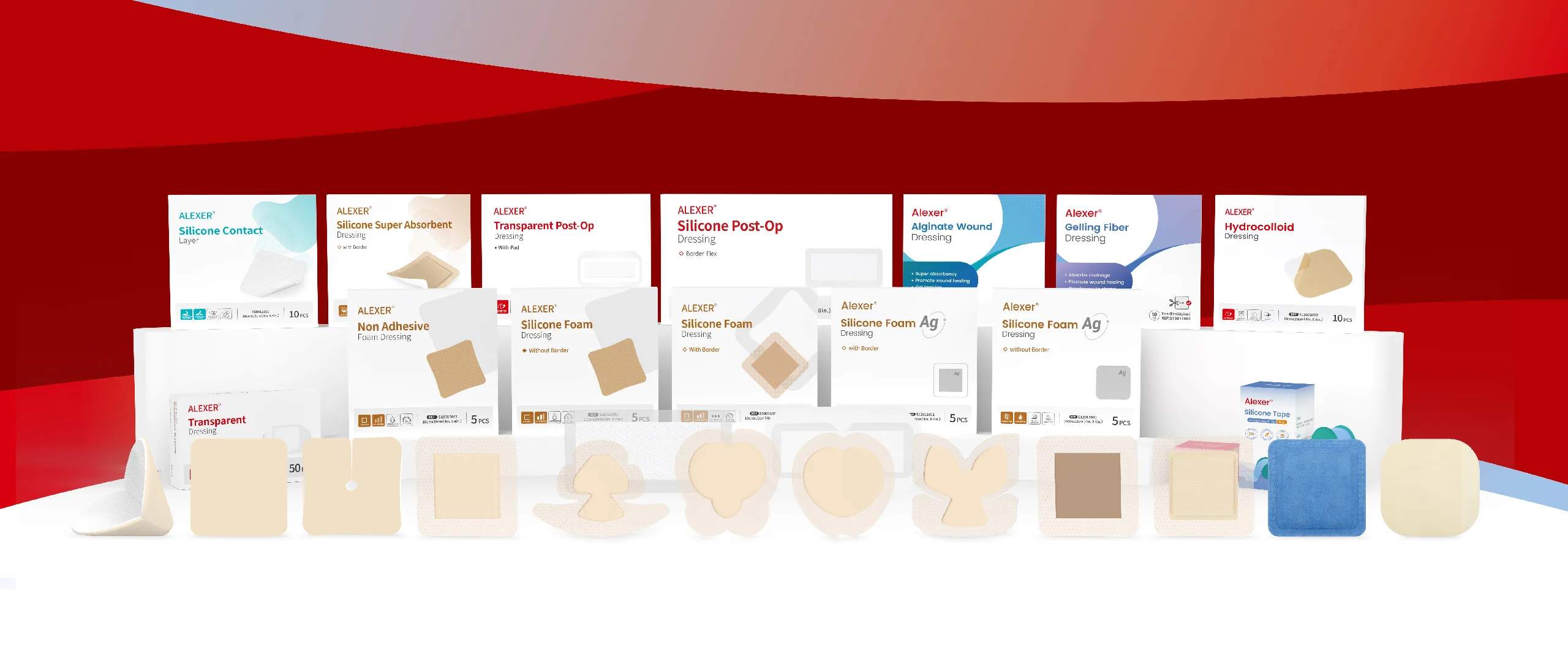
If SLK Medical is on your list, its silicone foam dressing range and private-label programme are the places to start, and the certificate and DoC details in the worked example give you the reference points to verify. We make money if you buy from us — that’s the reason to treat our own example as the first file you audit, not the last. Whether you buy from SLK Medical or elsewhere, the method is the same: trace the document to the facility, and the facility to the product.