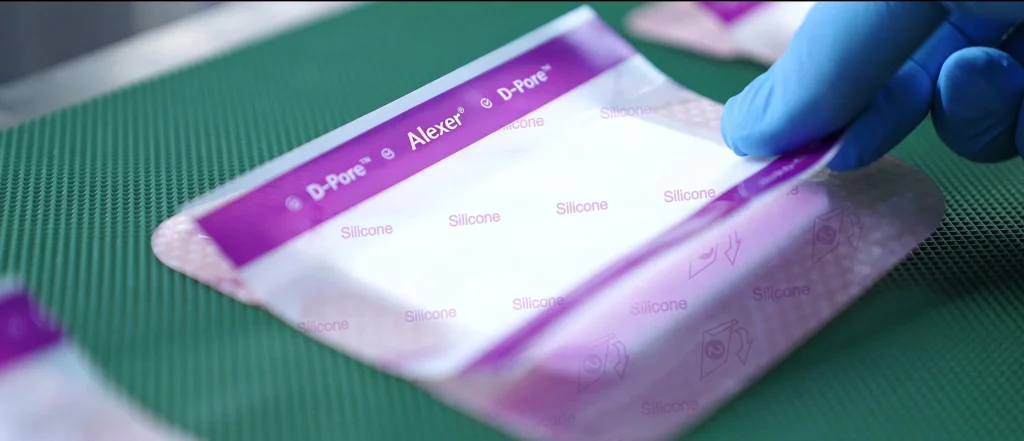


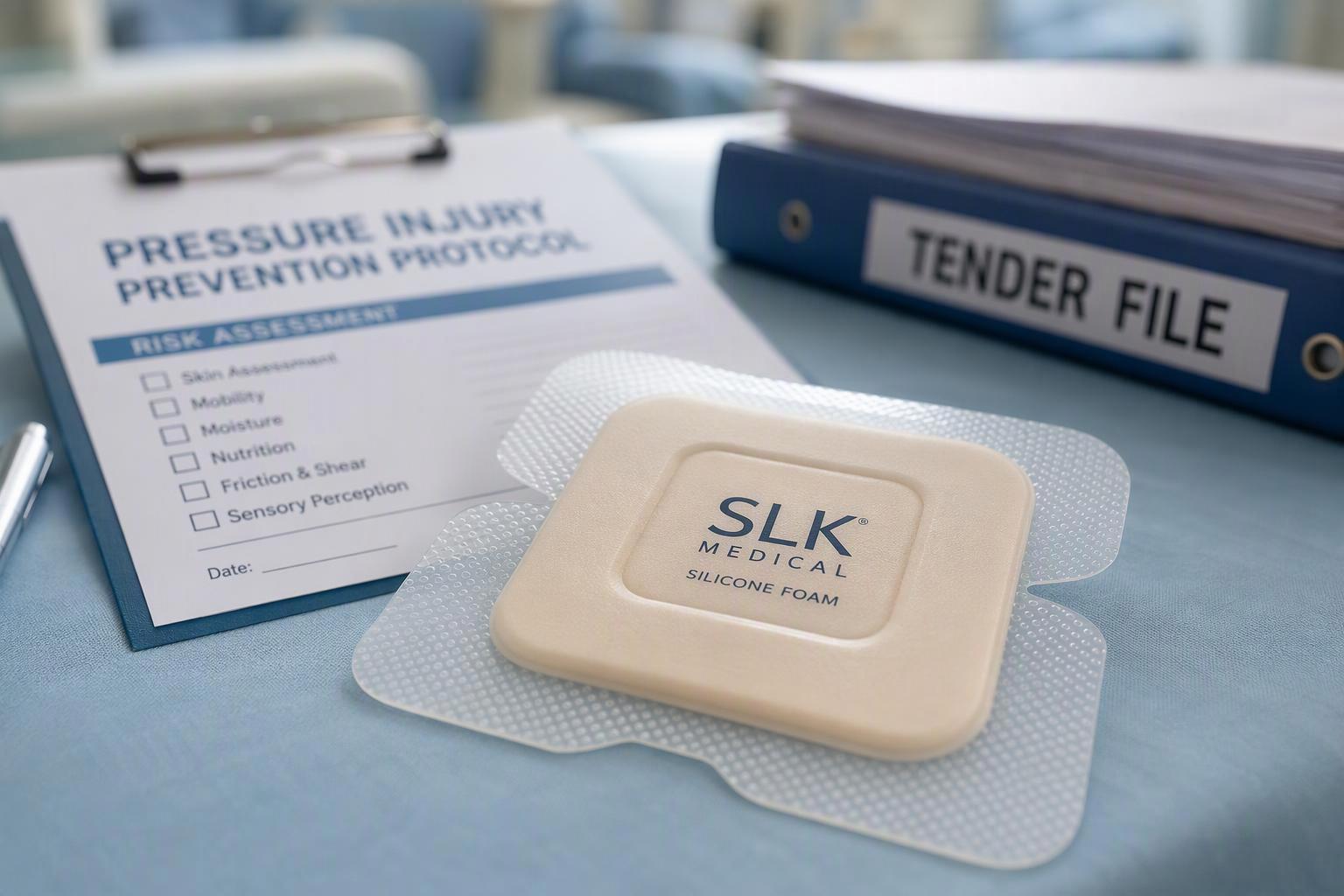
The question a distributor actually has to answer is narrower than “is this a good dressing.” It is whether SLK Medical’s silicone foam range can be written into a pressure injury (PI) prevention protocol and defended in a tender file — with the right variant, the right change policy and the right document pack behind it.
On the four criteria this review measures — absorption, wear time, atraumatic removal and PI-bundle fit — the published SLK material supports a conditional yes. The conditions are specific: absorption figures are manufacturer-stated and variant-dependent; the seven-day wear claim is a ceiling, not a schedule; the removal claim rests on a design description plus adjacent adhesive evidence rather than SLK outcome data; and the certificate pack covers the quality system, not automatically each SKU.
This is a documentation audit, not a hands-on clinical trial. It compares what SLK publishes on its product pages, guides and certificates against what the International Guideline, Fourth Edition (2026) and the wider dressing literature actually recommend. Supplier-reported clinical summaries are labelled as such throughout, and where the supplied material cannot decide a question, that is stated rather than filled in.
The verdict in brief
The short version: SLK’s silicone foam line is usable as an adjunct prophylactic dressing on sacrum and heels in high-risk patients, inside a bundle, provided the tender response carries variant-level test data, a documented change-trigger policy and device-level conformity documents.
Protocol criterion | What SLK publishes | External benchmark | Status |
|---|---|---|---|
Absorption and retention | Foam core stated to absorb around 10× its own weight; SAF absorption-and-retention layer on some bordered variants; separate super-absorbent range stated at up to 20× | EN 13726:2023 as a starting point, with acknowledged limits on lateral spread and real-exudate behaviour | Conditional — figures are manufacturer-stated; method and conditions not supplied |
Wear time | Up to 7 days, exudate-dependent, across foam and silver foam variants | Guideline change triggers: dislodged, loosened, excessively moist, soiled, or per manufacturer’s instructions | Supported as a ceiling — not as a fixed interval |
Atraumatic removal | Silicone oil and perforation contact layer, non-adherent to wound bed, intended not to strip epidermal cells | Silicone vs acrylate MARSI evidence; Cochrane findings on pain at change | Conditional — design description plus adjacent evidence, no SLK outcome data |
PI-bundle fit | Sacral and heel shapes across bordered skin-colour and pink ranges, with published size tables | Multilayered soft silicone foam on sacrum and heels for high-risk individuals, where resources permit | Supported — shape and sizing exist; selection remains clinician judgement |
Compliance documents | ISO 13485:2016 certificate (Rev. 01) and EU QMS certificate under MDR Annex IX Chapter I | Device-level CE marking, Declaration of Conformity, IFU in required languages | Needs confirmation — QMS certificate is not a product certificate |
“Conditional” here means the claim holds only under stated conditions — a named variant, a stated exudate level, a documented change trigger — not that the product is unproven. The distinction matters when a tender evaluator reads the response.
What a PI protocol actually asks of a dressing
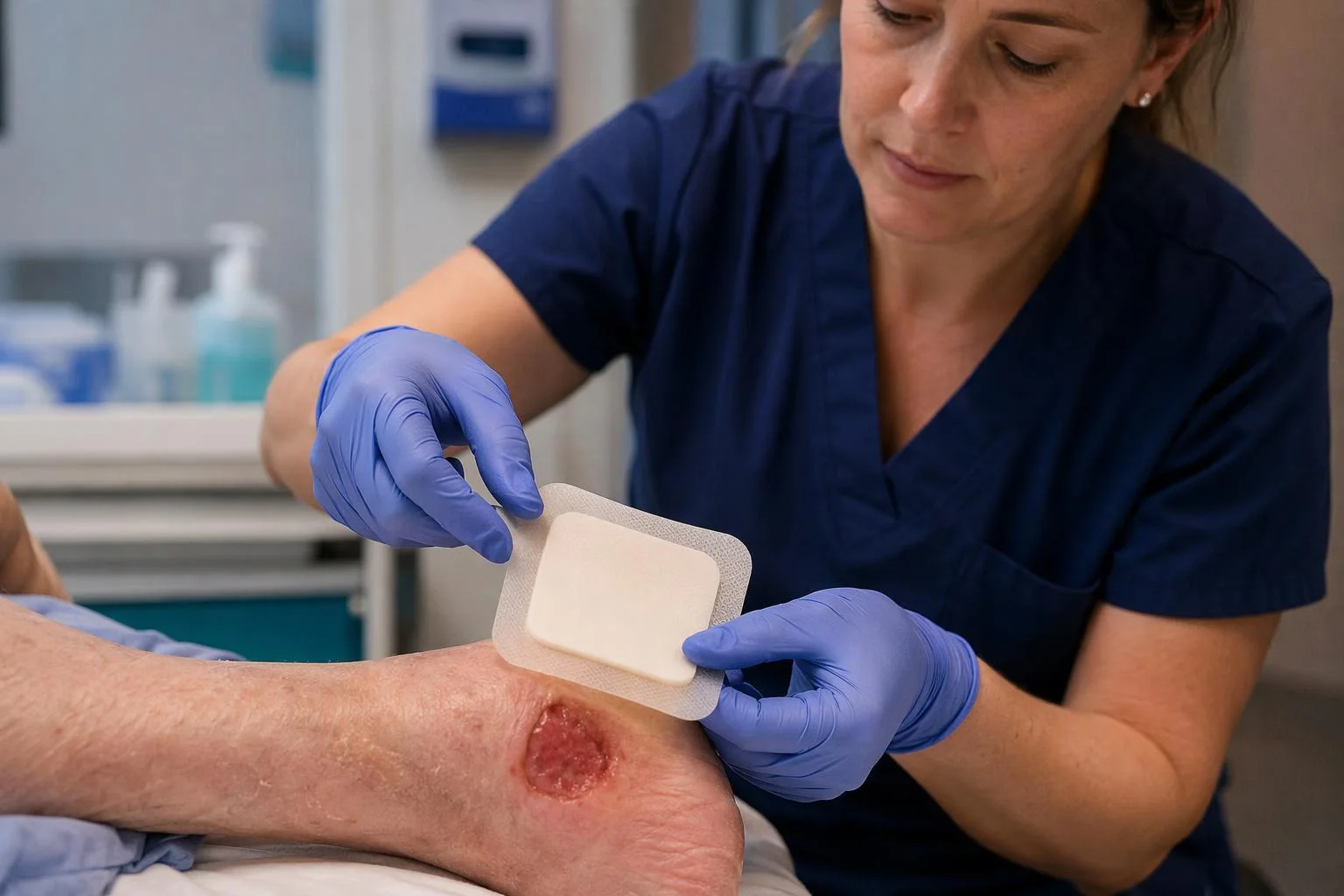
Before judging the product, it helps to be precise about what the protocol asks. The International Guideline makes a conditional recommendation, with very low certainty of evidence, to use a multilayered soft silicone foam dressing on the sacrum and heels for individuals assessed as having a high risk of pressure injuries — where resources permit. That qualifier is part of the recommendation, not a footnote, and a tender response that quotes the recommendation without it is misrepresenting the guideline.
The same guideline sets the change rule: replace the dressing if it becomes dislodged, loosened or excessively moist, if the dressing or the skin underneath becomes soiled, and according to the manufacturer’s instructions. Those are clinical triggers, not a calendar.
The guideline is also explicit that a dressing is an adjunct. Repositioning, support-surface selection, nutrition and skin assessment remain the core interventions; a foam dressing sits alongside them. The Cochrane review of dressings and topical agents for prevention reinforces how thin the underlying evidence is: across 18 trials and 5,903 participants, silicone foam versus no dressing gave a risk ratio of 0.50 (95% CI 0.33 to 0.77), but on low or very low-certainty evidence, and the review’s overall conclusion is that it remains unclear whether any of the included dressings make a difference.
That is the benchmark. It is external, it is modest, and it is what a well-drafted PI protocol should be built on.
Absorption and retention: what SLK publishes, and to what standard
SLK publishes absorption figures at two different levels, and conflating them is the most common error in a tender response.
The silicone foam line is described on the bordered skin-colour product page as having a foam pad that can absorb 10 times its drainage, with an SAF absorption-and-retention layer listed as a construction element. The silver foam variants add a non-woven distribution layer and a foam layer containing ionic silver, with rapid sustained silver release stated up to 7 days. The non-bordered foam is described as a three-layer construction without the SAF layer named.
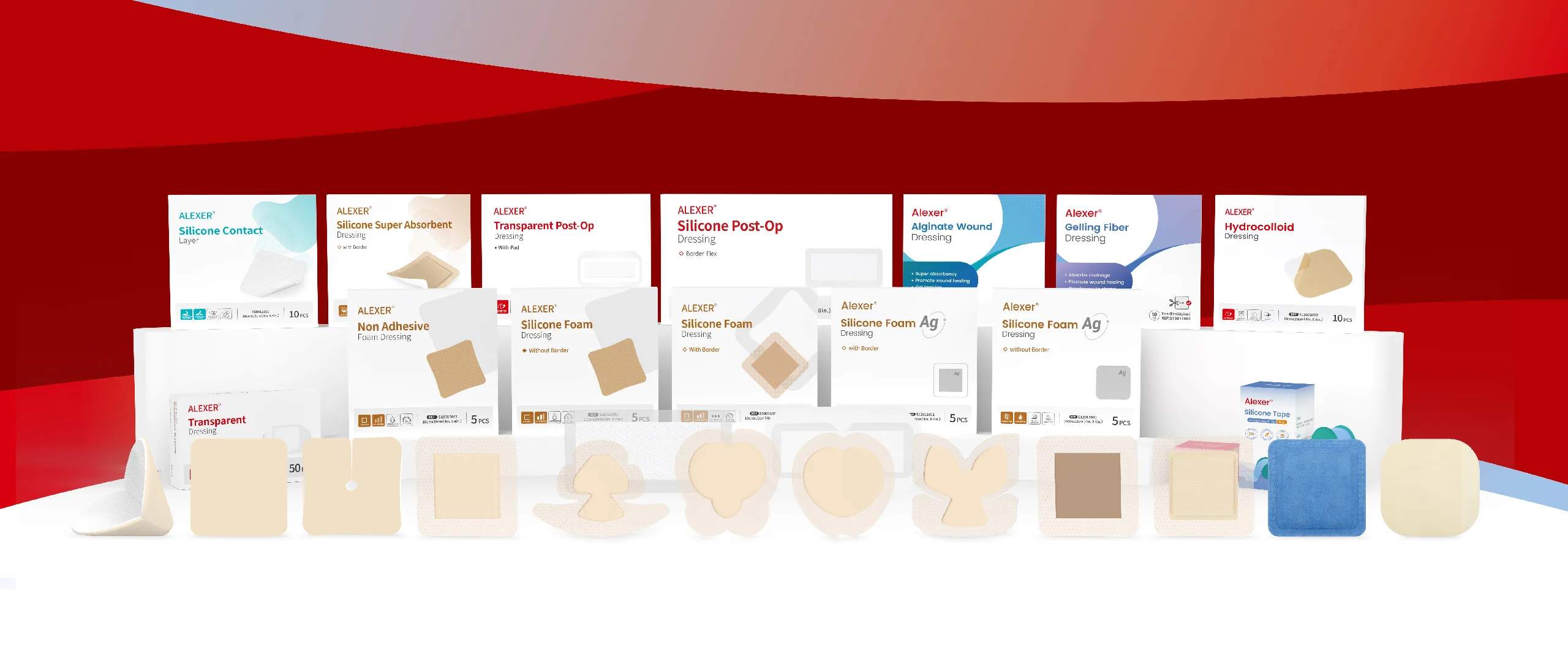
The super-absorbent range is a different product class. The non-adherent super-absorbent dressing is stated to absorb and lock up to 20 times its own weight through a super-absorbent polymer core. That is a distinct indication set — moderately to heavily exuding leg ulcers, pressure ulcers, diabetic foot ulcers and dehisced surgical wounds — and it should not be presented as the absorption figure for the foam line.
Two cautions apply to every figure above. First, these are manufacturer-stated numbers from product pages and spec PDFs; the supplied material contains no independently verified test report and no EN 13726 report for these SKUs. Second, a single absorption number is a weak comparator in any case. The review of foam-dressing fluid handling notes that EN 13726 tests based on fully saturated dressings give only a gross maximum, and do not capture lateral spread within individual layers, the interaction between moisture vapour loss through the backing film and the capacity to absorb more exudate over time, or the effects of gravity, ambient conditions and exudate viscosity. The same review points out that small differences in foam porosity between manufacturers change permeability and therefore fluid handling — which is precisely why a category-level claim cannot stand in for a variant-level test.
For a tender file, the practical ask is threefold: the test method, the standard version applied (EN 13726:2023 superseded the earlier edition in September 2023), and whether retention under compression was tested at all. A supplier who can answer those three questions has given you something an evaluator can score.
Wear time: planning a change interval you can defend
SLK’s product pages describe a wear time of up to 7 days for the foam and silver foam variants, qualified as exudate-dependent. The bordered pink product page attributes this to the highly absorbent polyurethane foam core; the silver non-bordered page states the dressing can be worn up to 7 days and that the ionic silver has a sustained effect over the same period.
Read that as a ceiling, not a schedule. The manufacturer figure sets the outer limit under stated conditions; the guideline’s clinical triggers set the actual change point. The two are compatible, and a protocol should say so explicitly: change at 7 days at the latest, and sooner if the dressing is dislodged, loosened, excessively moist, soiled, or if the skin underneath is compromised.
This is where distributor diligence earns its keep. A protocol that writes “change every 7 days” with no triggers will not survive a wound-care audit, because it converts a maximum into a routine and removes the clinical judgement the guideline requires. The dressing’s own IFU wording should be quoted in the tender response rather than paraphrased — a paraphrase is what an evaluator will challenge, and it is also what creates a mismatch between the submitted document and the label on the box.
One further point for planning: wear time interacts with absorption. A dressing that reaches saturation before day 7 has effectively reached its change point regardless of the calendar, which is why the fluid-handling literature treats evaporation through the backing film as part of the wear-time calculation rather than a separate property.
Atraumatic removal and fragile skin
SLK’s removal claim is a design description, and it should be presented as one. The silver non-bordered product page describes a silicone wound contact layer using “unique silicone oil and perforation technology” that does not stick to the wound bed, does not strip away epidermal cells, and provides “nearly painless, atraumatic removal.” The non-bordered foam page describes a hydrophobic silicone contact layer suitable for sensitive skin that reduces pain at dressing change and avoids secondary damage. These are mechanism claims from the manufacturer, not measured outcomes.
Single-centre prospective observational study in spinal surgery patients, 140 analysed (66 silicone, 74 acrylate), dressing type selected by surgeons not involved in the study. This is a class-level adhesive comparison, not a trial of any SLK product, and it does not establish an SLK outcome claim. Time to first MARSI was 5.90 days with silicone versus 2.67 days with acrylate (acrylate HR 2.55, 95% CI 1.49–4.34).
The adjacent evidence is more useful, provided it is kept separate. A single-centre prospective observational study in spinal surgery patients reported a cumulative MARSI incidence of 31.8% in the silicone dressing group versus 56.8% in the acrylate group (p = 0.003) among 140 participants. Its limits are plain: non-randomised, one centre, one surgical population, with dressing type selected by surgeons not involved in the study. It supports the general proposition that silicone adhesives are gentler on fragile skin. It says nothing about SLK’s specific product, and it must not be converted into an SLK outcome claim.
The Cochrane review adds a further caution. Two trials reported pain at dressing change, and the differences between silicone foam and no dressing were not clearly established — in one trial, 68.4% of the silicone foam group reported pain versus 59.5% of the no-dressing group; in the other, median pain scores were 2.1 versus 1.8. “Pain-free” should therefore be treated as a design intent, not a demonstrated comparative advantage. What a distributor can defensibly write is that the contact layer is designed for atraumatic removal and is intended for fragile skin, with the mechanism described and the IFU cited.
Fitting the PI bundle: sacral and heel variants
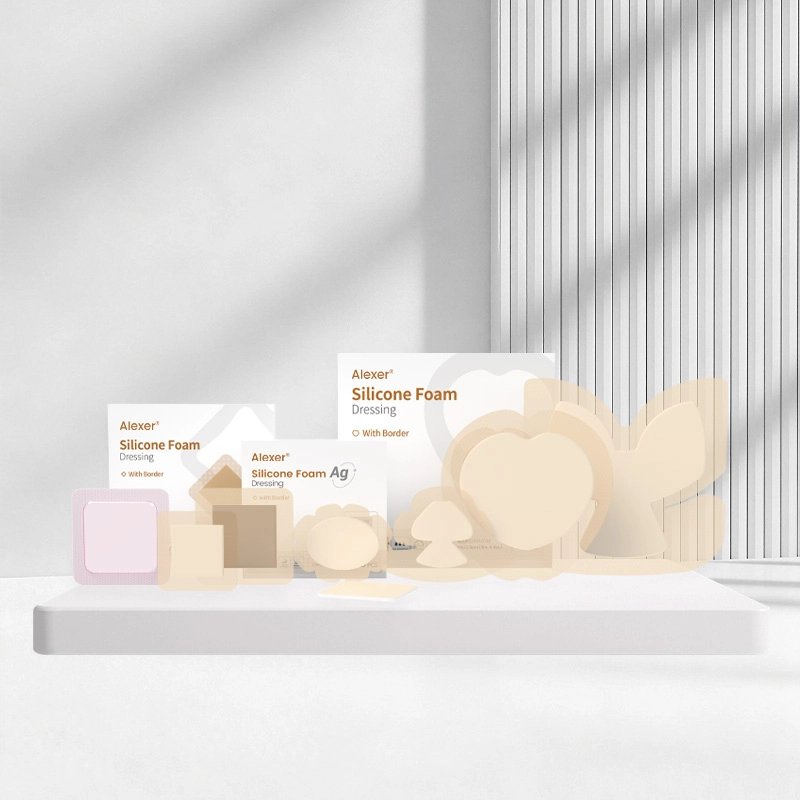
Component performance only becomes protocol fit when the shape is right. SLK lists anatomical variants across its bordered ranges: the skin-colour bordered range includes sacral sizes at 18×18 cm, 22.5×22.5 cm and 23×23 cm, plus heel sizes at 12.5×20 cm, 17.5×22.5 cm and 21×21 cm; the pink bordered range lists sacral sizes at 16.8×17.1 cm and 21×21 cm and a heel at 21×21 cm. The square sizes in each range run from 5×5 cm up to 20×20 cm and beyond.
Shape and sizing affect the two things a PI protocol actually cares about. Coverage must extend beyond the at-risk zone — a sacral dressing needs enough wing area to lie flat on the buttocks without bunching, and a heel dressing needs to cup the calcaneus while clearing the malleoli and the Achilles without creating folds. Edge seal must hold under motion; on the heel, a small wrinkle can become a pressure point, which is why crease-free application should be a procurement requirement rather than a nice-to-have.
SLK publishes its own sacral-versus-heel selection guide as a first-pass scoring matrix covering anatomical conformity, edge seal integrity under motion, adhesive gentleness and repositioning, moisture tolerance, backing-film claim clarity, offloading compatibility, sizing coverage and procurement proof-pack readiness. It is a supplier-authored framework, useful for structuring a shortlist trial and for making the evaluation criteria explicit, but it is not a validated instrument and should not be presented to a tender evaluator as one.
What the dressing does not replace belongs in the same section of the protocol: repositioning schedules, support-surface selection and skin assessment. A protocol that lists the dressing without those is not a PI protocol.
Clinical evidence: how strong is the SLK summary?
SLK’s site presents a clinical summary built around a 64-patient observational sub-analysis. The figures are: 48.4% of wounds healed at follow-up, 25.0% progressing to healing, a median 22.5 days to follow-up, significant reductions in exudate level (p<0.0001) and exudate pooling, significant improvements in wound edges (p≤0.0001) and periwound skin (p<0.01), 62.3% of patients with re-epithelialising wounds, nurse reports of improvement in 88.3%, patient reports of improvement in 85.0%, and dressing conformity reported at 93.5% of removals. A separate cost figure — 33% savings attributed to 3DFit™ technology — is also presented.
Class-level findings for multilayer silicone foam dressings, not SLK-specific results. The 2025 meta-analysis pooled 10 RCTs (4,817 patients; 2,670 dressing / 2,147 conventional care), predominantly neurological, postoperative and ICU populations; allocation concealment was reported in only two trials, blinding in none, and concurrent pressure-redistribution mattress use was not documented. The 2026 guideline suggestion is conditional on very low-certainty evidence and on resources permitting. The Cochrane review’s overall conclusion is that it remains unclear whether any included dressing makes a difference.
That summary needs to be identified accurately. The 64-patient sub-analysis is the VIPES real-world observational study of a named competitor’s silicone foam dressing in a French community nursing setting. It is not a trial of SLK’s own product, and the cost figure is attributed to a technology rather than to a controlled comparison. The design limits follow from that: no comparator arm, observational, single-country community nursing, outcomes reported through a smartphone application.
For a tender, this supports the category, not the specific device. What it demonstrates is that a silicone foam dressing can perform in real-world community use — which is useful context — not that SLK’s SKU will reproduce those numbers.
The stronger external anchor is the 2025 meta-analysis of ten RCTs, which pooled 4,817 patients and reported reduced stage I PI incidence in the sacral region (RR 0.18, 95% CI 0.09–0.33) and heel region (RR 0.30, 95% CI 0.14–0.66), with reductions in stage II and more severe injuries at both sites. That analysis also notes that allocation concealment was reported in only two of the ten trials and that blinding was not reported in any, and that concurrent use of pressure-redistribution mattresses was not documented — so it supports the category with caveats, not the individual product without them.
If SLK-specific clinical data exists, request it with the design, comparator and sample size stated. Treat any supplier-reported summary as one input alongside the meta-analytic evidence, not as a substitute for it.
Certificates: what the ISO 13485 and MDR documents cover
This is where distributor diligence most often slips, because a quality-management-system certificate looks like a product certificate and is not one.
The supplied TÜV SÜD documents show two things. First, an ISO 13485:2016 certificate, No. Q5 112764 0001 Rev. 01, valid from 2026-06-30 to 2028-05-08, held by SLK Medical Material (Tianchang) Co., Ltd. Its scope covers design, development, production and distribution of sterile polyurethane dressing, sterile gelling fibre dressing and sterile super absorbent dressing, and production and distribution of sterile foam dressing, sterile polyurethane transparent dressing, sterile waterproof dressing, sterile hydrocolloid dressing, sterile alginate dressing, sterile silicone absorbent fibre dressing, non-sterile scar gel, non-sterile medical tape, non-sterile self-adhesive silicone gel sheets and non-sterile self-adhesive silicone tapes. Second, an EU Quality Management System Certificate under Regulation (EU) 2017/745, Annex IX Chapter I, No. G15 112764 0002 Rev. 00, issued by TÜV SÜD Product Service GmbH as notified body 0123, naming the manufacturer’s SRN (CN-MF-000012390) and an EU authorised representative, Shanghai International Holding Corp. GmbH (Europe), Hamburg.
Both are QMS documents. Neither is, by itself, evidence that a given SKU is CE marked. The distinction matters because a distributor placing a device on the EU market must verify that the device is CE marked, that an EU Declaration of Conformity has been drawn up, and that labels and instructions for use are provided in the required languages — obligations summarised in the MDR distributor guidance and in the MDCG guidance on conformity documents.
The earlier Rev. 00 ISO 13485 certificate (valid 2025-05-09 to 2028-05-08) has been superseded by Rev. 01, and buyers should confirm which revision is current at the time of submission — a tender pack carrying a superseded revision is an avoidable finding.
What a distributor still needs for a complete tender file: the device-specific Declaration of Conformity, the applicable risk class and conformity route, the IFU in the languages required by each market, and the test reports behind the absorption and retention claims. The list of standards referenced in the supplied Declaration of Conformity record includes EN 13726:2023 and the ISO 10993 biological evaluation series, which is a useful indicator of what the technical file covers — but a standard appearing on a list is not the same as a test report for a named SKU.
Nurse feedback: what can be cited, and what cannot
The request asks for nurse feedback, and the honest answer is that the supplied material does not contain a citable SLK-specific nurse feedback document.
What it does contain is nurse-reported outcomes inside the observational study described above: conformity reported at 93.5% of dressing removals, and nurse reports of wound improvement in 88.3% of cases. Those are study outcomes from a named competitor’s dressing, collected in a French community nursing setting, and they can be cited as such — with the study, design and product identified. They cannot be presented as SLK user feedback.
What would make nurse feedback usable in a tender: a stated collection method, the sample and setting, the date range, and written permission to cite. Without those four elements, a quote is an anecdote, and an evaluator who asks for the source will find nothing behind it. The right move is to request a documented feedback summary from SLK rather than to paraphrase unattributed quotes or to present a testimonial as existing.
This is not a criticism of the product. It is a gap in the evidence pack, and gaps are closed by asking for the document — not by writing around them.
Where SLK fits, and where it does not
What the published data supports now. Adjunct prophylactic use of SLK’s sacral and heel silicone foam variants in high-risk patients, inside a bundle that includes repositioning, support surfaces, nutrition and skin assessment, with documented change triggers and the IFU quoted in the protocol. The shape and sizing range is real, the construction is described in enough detail to score, and the guideline recommendation the product is being mapped to is a conditional one that a well-drafted protocol can reflect honestly.
What needs confirmation before a protocol writes it in. Variant-level absorption and retention test reports, with method and standard version stated. Device-level CE documentation — the Declaration of Conformity, class and conformity route — for each SKU in the tender. SLK-specific clinical data, if it exists, with design, comparator and sample size. And a documented nurse-feedback summary if the tender scores user experience.
What should be avoided entirely. Healing rates, PI incidence reduction, and “proven” language applied to SLK’s own product. The category evidence is low to very low certainty; the SLK-reported clinical summary is a competitor’s observational study; and the MARSI evidence is from a different population. None of these supports a device-specific outcome claim, and a tender evaluator who checks will find the gap.
The next step is a document request, not a decision: the spec sheet and IFU for each variant, the current certificate revisions, the device Declaration of Conformity, the test reports behind the absorption and retention figures, and a sampling plan for the sacral and heel codes so the shortlist trial can be run on the sizes you will actually stock.
Key takeaways
The answer is a conditional yes. SLK’s silicone foam range can be written into a PI prevention protocol as an adjunct on sacrum and heels, provided the tender response carries variant-level data, a change-trigger policy and device-level conformity documents.
Absorption figures are manufacturer-stated and variant-dependent. The foam line is described at around 10× its own weight, with an SAF layer on some bordered variants; the super-absorbent range at up to 20× is a different product class and should not be conflated with it.
Seven days is a ceiling, not a schedule. The guideline’s change triggers — dislodged, loosened, excessively moist, soiled, or per the manufacturer’s instructions — set the actual change point, and a protocol that ignores them will not survive audit.
Atraumatic removal is a design claim supported by adjacent evidence. The silicone-versus-acrylate MARSI study is single-centre and non-randomised; the Cochrane review did not clearly establish a pain advantage for silicone foam over no dressing. Treat “pain-free” as design intent.
A QMS certificate is not a product certificate. The ISO 13485 and EU QMS documents cover the quality system; each SKU still needs its Declaration of Conformity, class and conformity route, and IFU in the required languages.
The clinical summary is category evidence, not device evidence. The 64-patient observational sub-analysis concerns a competitor’s dressing; the nurse-reported outcomes sit inside that study, and no citable SLK-specific nurse feedback document was supplied.
Reader questions
Can SLK silicone foam be written into a PI prevention protocol? Yes, as an adjunct. The guideline recommends multilayered soft silicone foam on sacrum and heels for high-risk individuals where resources permit, as part of a bundle with repositioning, support surfaces, nutrition and skin assessment. The protocol should name the variant, the size range and the change triggers.
What absorption figures does SLK publish, and are they independently tested? The foam line is described at around 10× its own weight, with an SAF absorption-and-retention layer on some bordered variants; the silver variants add a distribution layer and ionic silver; the separate super-absorbent range is stated at up to 20×. These are manufacturer-stated figures. No independently verified test report or EN 13726 report for these SKUs appears in the supplied material, so ask for the method, the standard version and whether retention under compression was tested.
How long can the dressing stay in place, and when must it be changed? Up to 7 days is the stated maximum, exudate-dependent. Change sooner if the dressing is dislodged, loosened, excessively moist or soiled, or if the skin underneath is compromised — and quote the IFU wording in the tender rather than paraphrasing it.
Are the ISO 13485 and MDR certificates enough for a tender submission? No. They are quality-management-system certificates. A tender also needs the device-specific Declaration of Conformity, the applicable class and conformity route, the IFU in the required languages, and the test reports behind the performance claims. Confirm which certificate revision is current at submission.
Is there SLK-specific clinical evidence? The supplied clinical summary is a 64-patient observational sub-analysis of a competitor’s silicone foam dressing in French community nursing — useful category evidence, not a trial of SLK’s product. If SLK-specific data exists, request it with design, comparator and sample size stated.
Is nurse feedback available to cite? Not in the supplied material. Nurse-reported outcomes appear only inside the observational study described above. A citable feedback document needs a stated collection method, sample, setting and date, with permission to cite — request it from SLK rather than paraphrasing unattributed quotes.
To move any of these forward, request the spec sheet, IFU, current certificate revisions, device Declaration of Conformity and a sampling plan for the sacral and heel codes through SLK Medical.