


Selecting a foam dressing is rarely just “pick a size.” For OEM buyers, private-label teams, and hospital-channel procurement, shape and size drive three practical outcomes: coverage, conformability (especially on curved anatomy), and whether the dressing stays sealed without edge lift.
This guide maps mainstream foam dressing sizes and shapes—including sacral and heel options—to typical wound locations and use scenarios. (Clinical decision-making should always follow local protocols and the product IFU.)
Key Takeaway: Start with location and contour (flat vs. curved), then choose a size that gives a secure border margin. Exudate level and securement method come next.
Foam dressing sizes and shapes: key takeaways
Square and rectangle foams cover most flat or gently contoured areas; they’re the backbone SKUs for standardization.
Sacrum and heel shapes are designed to reduce folding and edge lift on high-shear, curved anatomy.
A practical sizing rule: choose a dressing that can extend beyond the wound margins enough to maintain a seal and manage exudate distribution—without bunching into creases.
Consider bordered vs non-bordered formats based on fixation needs, fragile skin, and wear-time goals.
For programs that need product evaluation, requesting size sets as samples is often faster than debating a single “perfect” SKU on paper.
A fast way to choose the right size and shape
Use this quick sequence when matching a foam dressing SKU to a wound profile:
Location & contour: flat (torso), jointed (knee/elbow), or highly contoured (sacrum/heel).
Coverage requirement: wound size + a practical margin for seal and fluid distribution.
Exudate level: light, moderate, or high (drives absorbency needs and change frequency).
Fixation strategy: bordered silicone, secondary fixation, or non-adhesive.
Friction/shear exposure: high-risk zones (sacrum/heel) may benefit from anatomical shapes.
Silicone foam dressing shapes: mainstream options
Most formularies and OEM catalogs start with a core set of “flat-area” shapes. This section is intentionally practical: it’s the bordered foam dressing size chart logic you can use to build a starter SKU set.
Square foam dressings
Best for: compact, localized wounds on relatively flat surfaces.
Typical use examples:
smaller post-op sites
limited-area pressure injuries
focal trauma or abrasions where you want a balanced, centered footprint
Mainstream sizes commonly stocked range from smaller squares to mid/large squares. For example, SLK Medical lists square options including 5×5 cm, 7.5×7.5 cm, 10×10 cm, 12.5×12.5 cm, and 15×15 cm.
Rectangle foam dressings
Best for: elongated wounds or areas where you need length more than width.
Typical use examples:
linear surgical incisions
venous leg ulcer zones where coverage needs to follow limb contours
donor sites or split-thickness graft protection (per protocol)
The same size table includes rectangular options such as 10×20 cm, 10×25 cm, 10×30 cm, and 15×20 cm.
Multi-shape / contour-friendly formats
Some catalogs include intermediate “multi” shapes intended to fit common curved or transitional areas (e.g., around joints) without stepping up to full anatomical sacrum/heel designs. The same SLK Medical listing includes “multiple” sizes such as 7.8×10 cm, 13×16 cm, and 15×19 cm.
For a concrete size list that includes square/rectangle/multiple/sacrum/heel options in one place, see Silicone Foam Dressing with Border – Skin Color.
Sacral foam dressing size: why shape matters + mainstream sizes
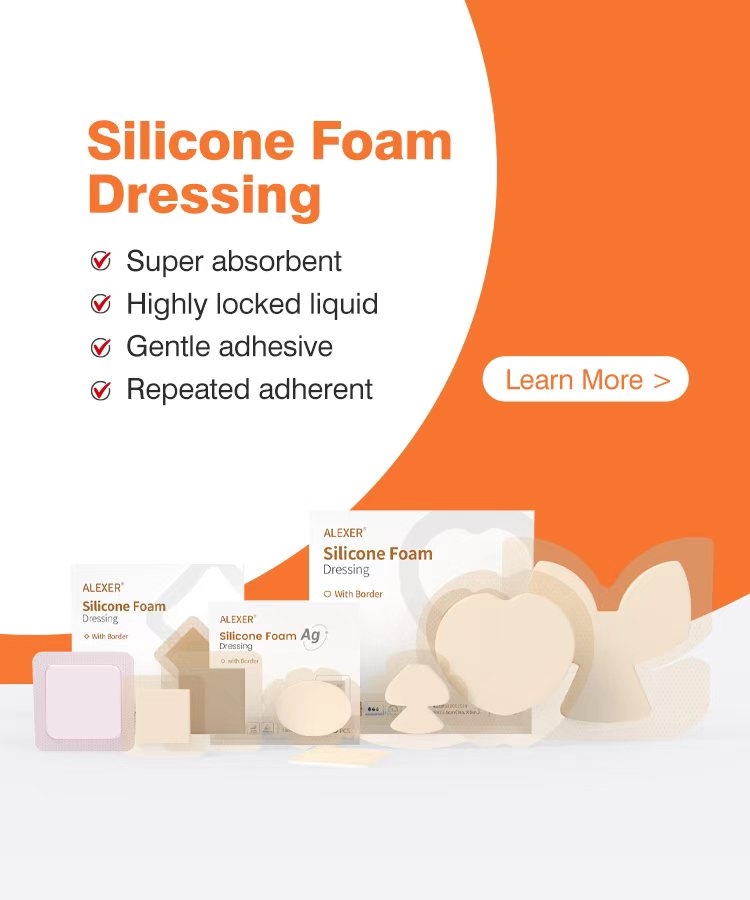
The sacral area is a classic failure zone for flat dressings because of curvature, moisture, and shear, plus the risk of folding into the gluteal crease.
Sacral foam designs typically use a “clover” footprint to improve conformability and reduce edge lift. In SLK Medical’s range, sacrum-shaped options are listed at 18×18 cm, 22.5×22.5 cm, and 23×23 cm.
When a sacral shape is usually considered:
sacral pressure injury risk management programs
coccyx/sacrum wounds where a rectangular dressing tends to wrinkle or peel
patients with frequent repositioning where shear forces are higher
Pro Tip: If your team reports frequent “corner lift” on the sacrum, it’s often a shape/contour mismatch—not just an adhesive issue. Trial an anatomical sacral shape before changing the entire foam specification.
Heel foam dressing size: why shape matters + mainstream sizes
Heels combine a small contact area with high pressure exposure and frequent friction from bed movement, footwear, or transfers. A heel-shaped foam is designed to wrap and cushion without leaving exposed edges that lift.
SLK Medical lists heel-shaped sizes such as 12.5×20 cm, 17.5×22.5 cm, and 21×21 cm.
When a heel shape is usually considered:
pressure injury prevention bundles for immobile or high-risk patients
heel wounds where flat foams “bridge” and lose contact
situations where secure fit matters more than maximizing a rectangular footprint
A practical sizing rule (and common failure modes)
A workable approach—especially when standardizing SKUs—is to size for stable coverage first:
Choose a dressing that extends beyond the wound margins enough to maintain a seal and distribute exudate into the absorbent area.
On high-motion or high-shear areas, prioritize fit (conformability) over “bigger is always better.” Too large can create folds; folds can become lift points.
Common size/shape failure modes to watch:
Undersizing: borders sit too close to the wound edge, increasing leak risk and reducing wear time.
Oversizing on contoured anatomy: creates wrinkles/folds, which can cause edge lift.
Using flat shapes on sacrum/heel: increased likelihood of lift where the body contour changes rapidly.
Not accounting for secondary fixation: if your protocol uses additional fixation, a slightly smaller primary dressing may be acceptable—but document it.
Bordered vs non-bordered (and where “lite” can fit)
Bordered silicone foam
Best for: when you want an “all-in-one” dressing that’s easier to apply and standardize.
SLK Medical describes its bordered silicone foam construction with a film backing and a silicone contact layer on product pages like Silicone Foam Dressing with Border – Skin Color, which can help procurement teams evaluate consistency across SKUs.
Non-bordered / non-adhesive foam
Best for: fragile skin, frequent inspection needs, or when a clinician prefers separate fixation.
“Lite” silicone foam
A lighter-structure foam can be useful when exudate levels are lower or bulk is a concern (always align with protocol and IFU). For SLK Medical’s lighter option, see Silicone Foam Dressing – Lite.
When Ag (silver) foam is considered
Silver (Ag) foam dressings are commonly evaluated when antimicrobial activity is desired as part of an infection risk management approach (selection should follow clinician judgement and local policy).
Mainstream size & shape map (quick reference)
Below is a procurement-friendly reference map you can use to build a starter SKU set (examples reflect mainstream options listed by SLK Medical).
Shape | Common sizes (examples) | Typical wound locations / scenarios | Notes for procurement standardization |
|---|---|---|---|
Square | 5×5, 7.5×7.5, 10×10, 12.5×12.5, 15×15 cm | small-to-medium wounds on flatter areas | Core SKUs; easy to forecast; good for kits |
Rectangle | 10×20, 10×25, 10×30, 15×20 cm | linear incisions; limb/leg coverage | Reduces need to overlap two squares |
Multi-shape | 7.8×10, 13×16, 15×19 cm | transitional contours, some joint-adjacent areas | Often reduces edge lift vs rectangles |
Sacrum | 18×18, 22.5×22.5, 23×23 cm | sacral area, coccyx region; prevention programs | Designed for contour; helps reduce folding into creases |
Heel | 12.5×20, 17.5×22.5, 21×21 cm | heel protection and heel wounds | Wrap-friendly footprint; useful in prevention bundles |
Procurement checklist: how to standardize a foam dressing SKU set
Use this as a quick, cross-functional checklist for OEM/private label programs and hospital-channel line reviews:
Agree on a core shape set: square + rectangle first.
Add anatomical shapes: sacrum and heel if your use mix includes prevention programs or high-shear anatomy.
Define exudate bands: lite vs standard vs super-absorbent (as applicable).
Decide fixation philosophy: bordered vs non-bordered SKUs to reduce duplication.
Plan compliance and labeling: UDI/traceability, IFU alignment, packaging configuration.
Run a sampling plan: clinical evaluation across 2–3 sites and the most common wound profiles.
For manufacturer context and OEM capability discussions, you can reference SLK Medical as a starting point.
FAQ
How much larger should the dressing be than the wound?
There isn’t a single universal number that fits every protocol. A practical approach is to size for stable coverage and a secure border margin, then validate wear time and leakage performance in your evaluation plan.
Do sacral and heel shapes replace squares and rectangles?
Usually not. Most programs keep squares/rectangles as the “workhorse” SKUs and add sacrum/heel shapes to reduce dressing failures on highly contoured, high-shear anatomy.
Should we standardize on bordered or non-bordered foams?
If your goal is application simplicity and SKU reduction, bordered foams can be easier to standardize. If fragile skin and frequent inspection are dominant concerns, non-bordered options may be prioritized. Many formularies keep both, but with clear indications to prevent duplication.
When should we consider a silver (Ag) foam dressing?
Silver foams are commonly evaluated when antimicrobial activity is desired as part of infection risk management. Selection should follow clinician judgement, local policy, and the product IFU.
Next steps: request a sample size set (to validate fit on your top wound profiles)
If you’re building or refreshing a private-label foam dressing line, a fast way to reduce risk is to evaluate a sample size set (square + rectangle + sacrum + heel) against your most common wound locations.
Request samples from SLK Medical:
Share the shapes/sizes you want to trial (including sacrum/heel)
Tell us your target exudate range and fixation preference (bordered vs non-bordered)
Specify private-label packaging needs and target markets (US/EU)


