

Introduction
The question a clinician actually faces at the bedside is rarely “which dressing is best.” It is narrower and more practical: given this wound’s bioburden, this volume of exudate and this periwound skin, which of the three classes in front of me fits — and what would make me switch?
This article answers that question as a sequenced pathway rather than a head-to-head contest. Bioburden comes first, because it determines whether an antimicrobial belongs at all. Agent choice follows. Exudate handling and periwound skin status come next, and either can override an otherwise correct agent decision. Exit criteria close every branch. The structure follows the IWII 2022 wound infection continuum, the Wounds UK best practice statement on silver, and ISTAP periwound best practice recommendations.
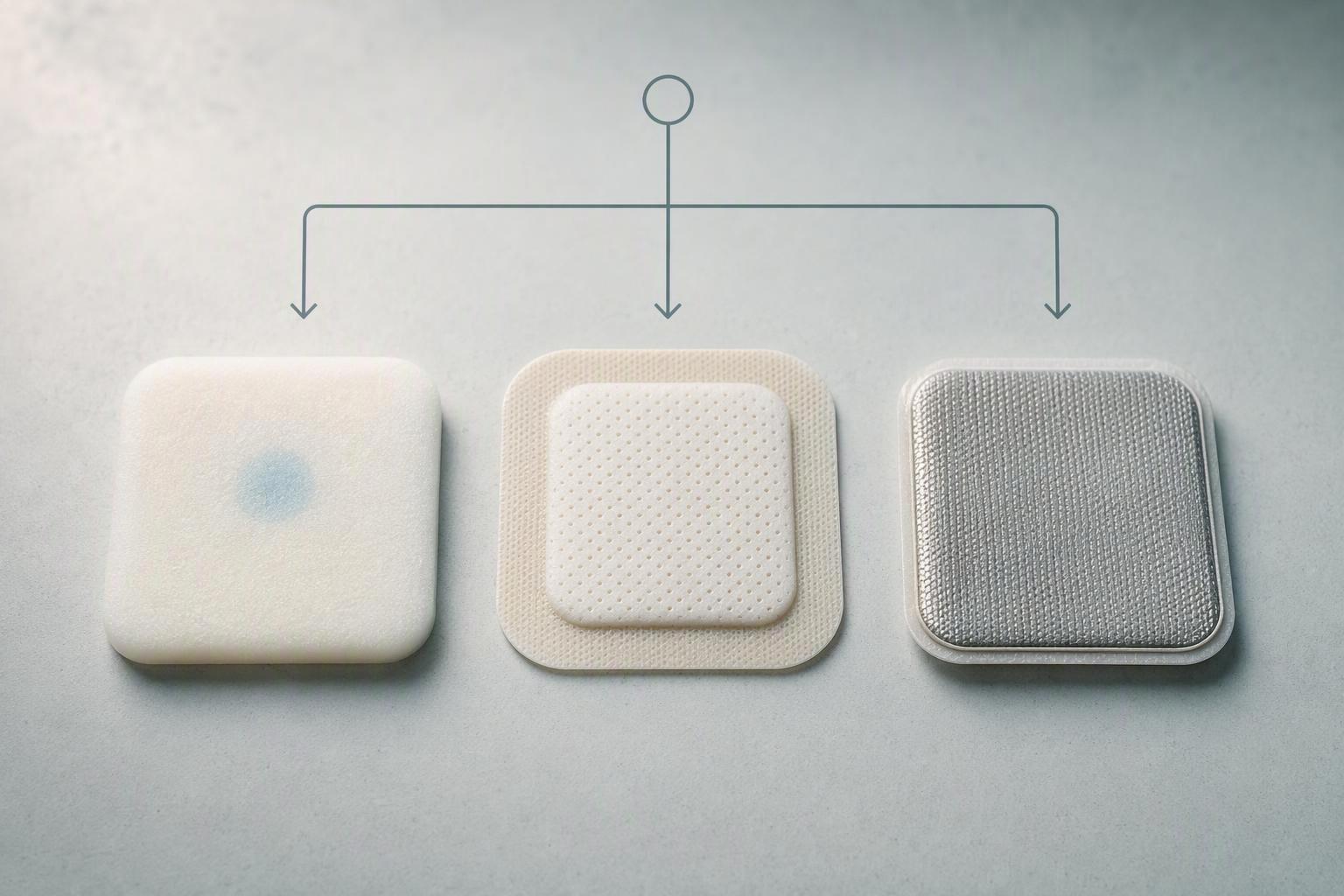
No class is established in current guidance as universally superior. What the guidance does establish is that each class has an indication, a set of cautions, and a point at which it should be stopped. SLK Medical’s PHMB foam, silicone foam and silicone foam Ag classes appear in the matrices below as neutral examples of each format — not as recommendations.
One scope note: this is a research-based synthesis of published guidance and product documentation. It is not a hands-on comparative test, and it does not report clinical outcomes from any product named here.
Key takeaways
Antimicrobials are time-limited and indication-bound. Silver and PHMB belong to a defined clinical situation, not to routine dressing changes.
Bioburden stage decides whether an antimicrobial belongs at all. Contaminated and colonised wounds without host reaction are the default territory of plain silicone foam.
Exudate and periwound skin can override the agent decision. A correct agent in the wrong format, or in a wound too dry for silver to release ions, is still the wrong dressing.
Every branch has a review or stop point. The two-week point is a review, not an automatic stop; failure to reduce the wound bed by 40% at four weeks (50% for diabetic foot ulcers) triggers full reassessment.
The three questions that decide the dressing
Three clinical variables carry most of the decision weight, and they are assessed in a fixed order.
Bioburden status determines whether the wound needs an antimicrobial agent or only an antimicrobial-aware dressing environment. The IWII continuum runs from contamination through colonisation to local infection (covert and overt), then spreading and systemic infection. The continuum is a conceptual model and teaching tool rather than a validated diagnostic instrument, and the IWII notes that individual clinical signs and symptoms have been reported as inaccurate and unreliable. The practical consequence is that staging is a clinical judgement built on multiple signs, not a single finding.
Exudate level determines whether the chosen format can actually do its job. A silver dressing needs moisture to release ions; a foam that saturates in a day cannot deliver a seven-day wear claim; and very high exudate is itself a signal to reassess for infection, inflammation or oedema rather than simply to step up absorbency.
Periwound skin status determines whether the adhesive and border construction are safe. Fragile, macerated or denuded skin can veto an otherwise correct agent choice, because the harm from repeated adhesive removal may exceed the benefit of the antimicrobial.
Format — bordered versus non-bordered, adhesive versus non-adhesive — is a fourth decision, and a subordinate one. It is settled only after the first three axes point to a class. Criteria come first; products are mapped onto them afterwards. This ordering matters for distributors as much as clinicians, because it is the logic a formulary committee or tender specification will follow when it asks why a given SKU sits in a given category.
Comparison matrix: decision axes, not performance scores
The matrix below is a self-location tool. Each cell states an indication or a caution; none states a score, a ranking or a preference.
Decision axis | PHMB foam | Plain silicone foam | Silver foam |
|---|---|---|---|
Bioburden stage | Local infection (overt or covert), or bioburden delaying healing; used within antimicrobial stewardship limits | Contamination or colonisation without host reaction; no antimicrobial indication | Localised infection, suspected biofilm, or clear high risk of infection/re-infection |
Exudate level | Low to high, depending on format; SLK Medical’s PHMB foam is documented for moderate to heavily exuding wounds | Low to high, depending on format; SLK Medical’s silicone foam range spans bordered, non-bordered and lite constructions | Needs moisture to release ions; not effective in dry wounds; select a silver format with exudate handling matched to the wound |
Periwound skin condition | Available with silicone wound contact layer and bordered or non-bordered construction; border choice follows skin status, not agent | Silicone adhesive is the preferred adhesive type in at-risk or fragile skin | Agent may be right while an aggressive border is wrong; choose the least adhesive format that retains the dressing |
Wear time and review point | Product documentation states antimicrobial protection up to 7 days; clinical review still applies at two weeks | Wear time set by exudate volume and dressing condition | Generally short-term; two-week review, not automatic stop |
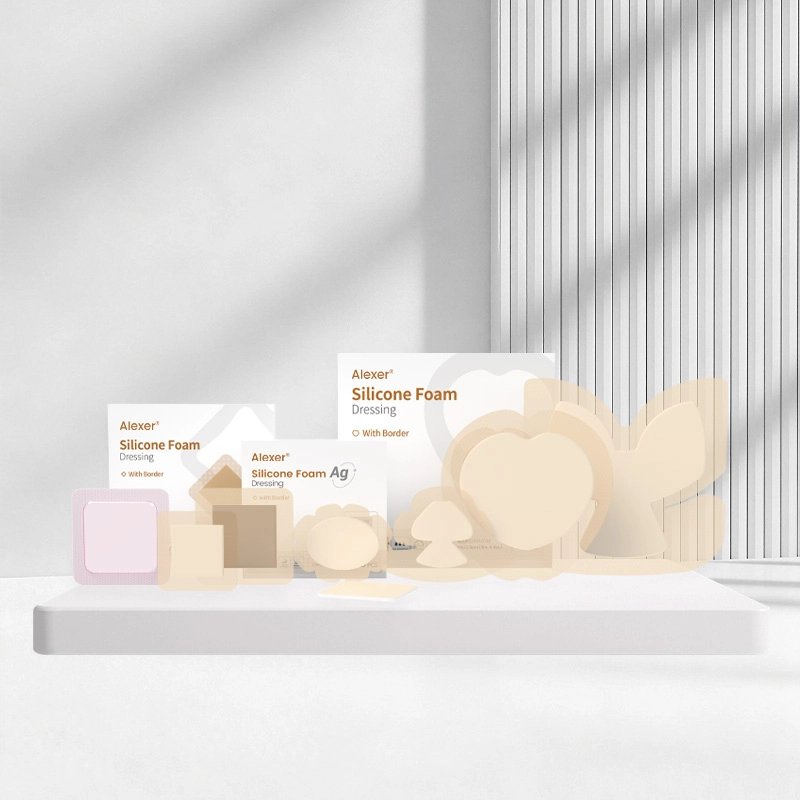
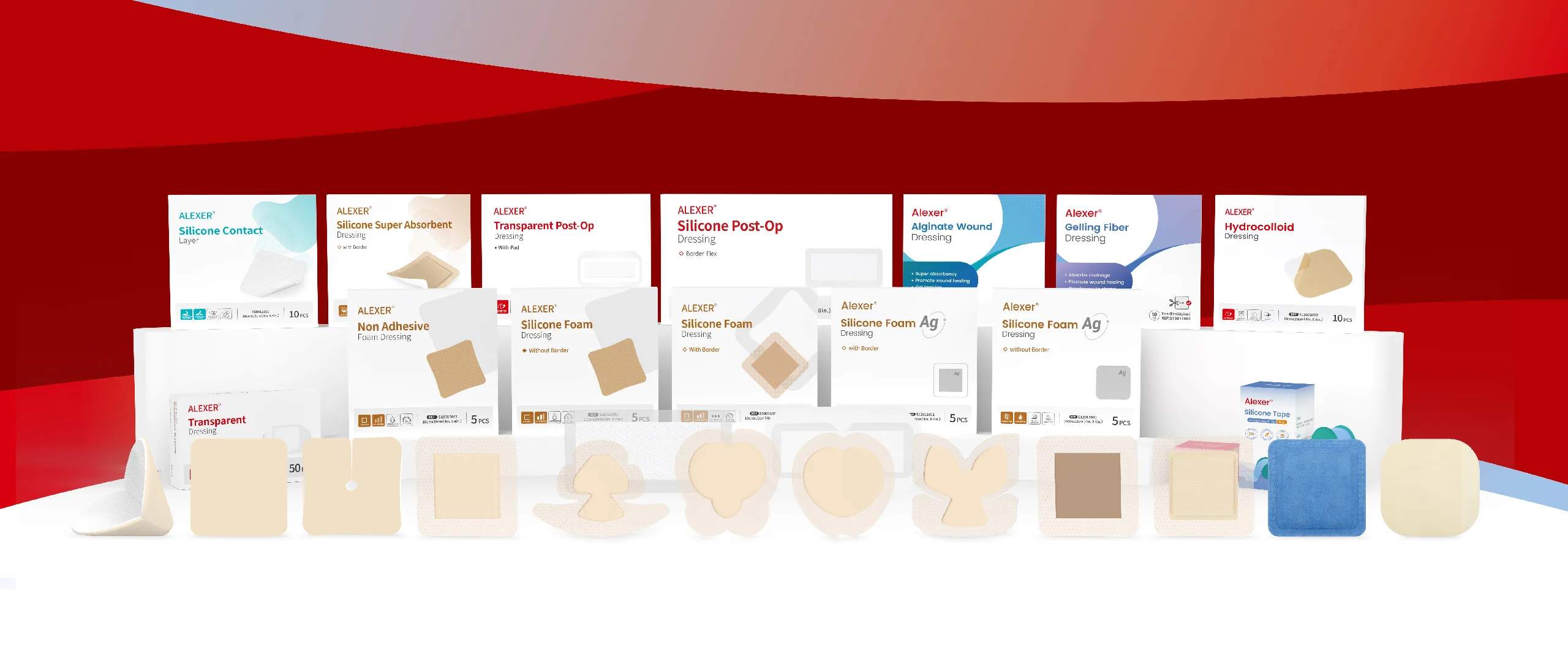
Format options | Bordered, non-bordered and non-adhesive PHMB foam constructions | Bordered, non-bordered, lite, transfer and composite constructions; SLK Medical’s silicone foam Ag range sits alongside these | Bordered and non-bordered silver foam formats, plus other silver carriers outside the foam comparison |
Key cautions | Contact allergy is reported; monitor periwound skin; evidence certainty varies by outcome | No antimicrobial action — do not use where local infection is present | Not for prophylaxis without clear risk indicators; restrictions in pregnancy, lactation, newborns, hepatic/renal impairment for SSD-containing products; MRI and radiotherapy restrictions |
Two readings of this table are wrong. The first is to treat the PHMB and silver columns as interchangeable alternatives to be chosen on preference. The second is to read the plain silicone foam column as the “basic” option — it is the correct default for the largest share of wounds, and the antimicrobial columns are the exceptions.
Branch one: bioburden status — when does an antimicrobial belong?
The IWII continuum is the backbone of this branch, and it is worth walking stage by stage because each stage maps to a different dressing decision.
Contamination. All open wounds carry microorganisms from the time of wounding. Host defences normally manage this without intervention beyond standard wound bed preparation and cleansing.
Colonisation. Microorganisms are present and proliferating to a limited degree without evoking a host reaction. This is the default territory of plain silicone foam: the wound needs a moist, protected environment and exudate management, not an antimicrobial agent. The Wounds UK silver statement is explicit that silver dressings should not be used in the absence of localised, spreading or systemic infection unless there are clear indicators of high infection or re-infection risk, or biofilm is suspected.
Local infection — covert and overt. Covert signs are subtle and easily missed; overt signs are the classic picture. This is where PHMB or silver enters, and where the “multiple signs, not one sign” principle applies. The IWII reports that the sensitivity and specificity of individual signs and symptoms vary widely across populations, so a single finding — a little erythema, a change in odour — is not sufficient grounds on its own. The clinical judgement is built from the pattern.
Spreading and systemic infection. Signs extend beyond the wound border (spreading erythema greater than 2 cm from the wound edge, lymphangitis, crepitus, wound breakdown) or the patient shows a systemic response. This is not a dressing decision. The British National Formulary wording cited in the NICE scope for antimicrobial dressings is that an antimicrobial dressing may be used for local wound infection “to reduce the level of bacteria at the wound surface but will not eliminate a spreading infection.” Escalation to systemic therapy and appropriate referral is the correct action.
The branch therefore reads: no host reaction → plain silicone foam; local infection or bioburden delaying healing → antimicrobial agent, then go to branch two; spreading or systemic → escalate, do not select a dressing.
Branch two: PHMB or silver — which antimicrobial agent?
Once an antimicrobial is indicated, the choice between PHMB and silver turns on four things: the licensed indication language, the format range available, the sensitisation profile, and the strength and certainty of the comparative evidence.
Three framings of the same antimicrobial review window, each with a different scope. NICE HTG751 describes local formulary practice for antimicrobial dressings in infected leg ulcers; Wounds UK (2021) frames the two-week point as a review rather than an automatic stop; IWII (2022) sets a minimum of two weeks before efficacy is judged and notes treatment may run to four weeks. None is a mandated national stop rule, and the bars show stated review windows, not measured outcomes.
Silver’s indication language. The Wounds UK best practice statement frames silver around localised infection, suspected biofilm, and clear indicators of high infection or re-infection risk. It also carries an explicit “when not to use” list, and a set of practical restrictions: silver dressings are not effective in dry wounds, cannot prevent infection and are not cost-effective if used prophylactically, should not be used during radiotherapy or MRI scanning, and SSD-containing products should be avoided in sulfonamide sensitivity, hepatic or renal impairment, pregnancy, lactation and newborns. Silver’s primary function is to reduce bioburden and treat local infection; it is not a healing-rate intervention, and the Wounds UK statement notes it will have no impact on wounds that are not infected.
PHMB’s position. A 2010 Wounds UK review of PHMB describes it as available in a number of wound care formats — irrigation fluid, gauze and foam-impregnated dressings — with a broad antimicrobial spectrum, good cell and tissue compatibility, and a low risk of contact sensitisation. That review is now more than fifteen years old, and its sensitisation claim should be read alongside newer patch-test data rather than instead of it.
The sensitisation counterweight. A retrospective analysis of 1,760 patients patch tested in Malmö, Sweden reported positive patch test reactions to PHMB in 19 patients (1.1%), higher than earlier reported figures of 0.5% and 0.8%, and 1.5% among female patients. The tested population was patients with suspected contact dermatitis attending a dermatology clinic, not the general wound-care population, so the figure describes allergy prevalence in a selected referral group rather than an expected reaction rate in clinical use. The same paper cites reported peri-ulcer dermatitis associated with PHMB in wound care products. The practical implication is monitoring, not avoidance: watch the periwound skin during PHMB use, particularly in patients with a history of contact dermatitis.
The comparative evidence. The IWII 2022 review tables report higher rates of chronic wound healing with a PHMB dressing versus a silver dressing, and a greater reduction in chronic wound critical bacterial load over 28 days with a PHMB dressing versus a silver dressing. Both findings sit in the review’s evidence tables, which grade certainty, and the same document reports limited impact on biofilm in venous leg ulcers for a PHMB-surfactant product versus saline cleansing. The IWII also notes a general paucity of high-level research across topical antimicrobials and a lack of methodological standardisation that prevents direct comparison of study results. So the honest reading is: PHMB has supportive comparative findings on healing and bacterial load in the cited trials, the certainty varies by outcome, and neither agent has an established biofilm advantage that would settle the choice on its own.
The conditional rule. Choose silver when the clinical picture matches its licensed indication language — localised infection, suspected biofilm, or a documented high re-infection risk — and the patient has no restriction from the caution list. Choose PHMB when a broader format range is needed, when the periwound skin history argues for a different sensitisation profile, or when local formulary and procurement considerations favour it. Neither rule is a verdict; both are conditional on the wound in front of you.
Branch three: exudate level — matching fluid handling to the wound
Exudate is the axis most likely to override a correct agent decision, because a dressing that cannot handle the fluid will fail regardless of what it contains.
A workable four-band framework, drawn from the Oxford Health wound exudate pathway, runs: dry (little or no exudate on the dressing), low (around one dressing change per week, no periwound maceration), moderate–high (three or more changes per week, exudate visible within the dressing, possible maceration), and very high (daily changes, saturated dressings, maceration, strike-through).
Dry wounds. Silver is not effective here — it needs moisture to release ions. A dry wound with an antimicrobial indication needs the moisture problem addressed first, and the exudate pathway’s own logic points toward hydrogel or hydrocolloid where debridement is indicated. PHMB foam is not the answer to a dry wound either; the format is built for exuding wounds.
Low exudate. Plain silicone foam in a lite or thin construction fits. The pathway’s caution is worth repeating: consider whether the current dressing is too absorbent or the changes too frequent before escalating.
Moderate–high exudate. This is the working range for all three classes in their standard foam constructions. SLK Medical’s PHMB foam is documented for moderate to heavily exuding chronic and acute wounds, and the silicone foam and silicone foam Ag ranges cover the same band in bordered and non-bordered formats.
Very high exudate. Reassess before stepping up. The pathway directs the clinician to consider infection, inflammation and unmanaged oedema as causes, to check whether dressing changes are frequent enough, and to assess periwound skin risk. Only then does absorbency escalation follow — and the escalation target is a superabsorbent class, which sits outside this three-way comparison. SLK Medical’s superabsorbent range is an example of that adjacent category, not a fourth option within the PHMB/silicone/silver decision.
One rule applies across every band: do not layer dressings to improve absorbency. Both the Oxford pathway and the Norfolk & Waveney formulary state this explicitly — layering does not improve absorbency, and a water-repellent backing can actively impede it. Size the dressing to the wound (roughly 3 cm beyond the wound margins) and change the dressing rather than stacking it.
Branch four: periwound skin status — when skin overrides the agent decision
Periwound skin is where a clinically correct agent decision most often turns into a clinical problem. Fragile, macerated or denuded skin around the wound can veto the agent choice, because the damage from the dressing’s adhesive and removal may outweigh the antimicrobial benefit.
MARSI incidence within 10 days of spinal surgery in a single-centre prospective observational study in Seoul (n=140; acrylate 74, silicone 66; p=0.003). This is a surgical inpatient population receiving daily dressing changes, not a general wound-care rate, and the design was non-randomised.
MARSI risk. Medical adhesive-related skin injury is defined as skin damage from the removal of products containing a medical adhesive. Reported prevalence in adult acute care ranges from 3.4% to 25% (mean 13%), per the Wounds UK MARSI best-practice report citing Farris et al (2015). A prospective study in spinal surgery patients found that silicone adhesives require less peel force than acrylate adhesives, reducing detachment of epidermal cells, and reported only three cases of mechanical damage in the silicone group. The ISTAP periwound consensus recommendation follows the same logic: consider silicone adhesive in place of acrylic adhesive in at-risk or fragile skin, and use the minimum adhesive required.
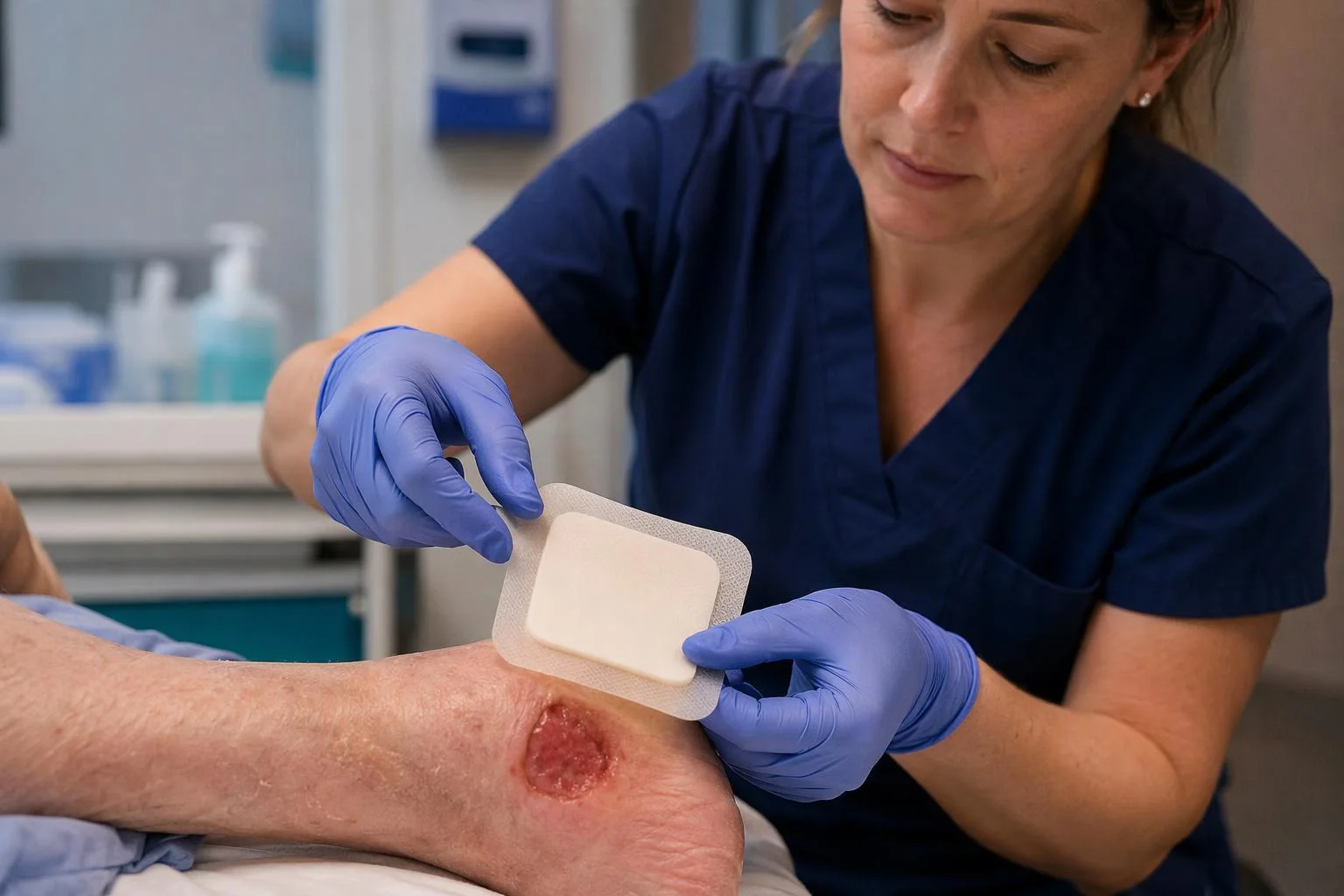
Format selection by skin status. Intact periwound skin can carry a bordered adhesive foam. Fragile or at-risk skin calls for a silicone adhesive border, a non-bordered foam secured with a separate retention layer, or a non-adhesive construction. Macerated skin needs the moisture source addressed — a barrier film, the picture-frame method of protecting the periwound under the dressing, and a change frequency matched to exudate volume. Denuded skin generally rules out any adhesive at the wound margin.
The agent-versus-format trap. A silver or PHMB foam with an aggressive border can be the wrong dressing even when the agent is exactly right. The correct move is to keep the agent and change the format — for example, from a bordered to a non-bordered or non-adhesive construction — rather than to abandon the antimicrobial indication. SLK Medical’s PHMB range illustrates the point: the same PHMB foam chemistry is offered in bordered, non-bordered and non-adhesive constructions, so the format can follow the skin rather than the other way round.
Repeated changes raise the risk. The MARSI literature is consistent that repeated application and removal of adhesives in the same area increases injury risk. A dressing that needs daily changes in a patient with fragile skin is a format problem to be solved, not a schedule to be endured.
Exit criteria: when to stop, step down, and reassess
Every branch of the tree has an exit, and the exit is defined before the dressing is applied.
The two-week review. The Wounds UK silver statement is explicit that the two-week point is an opportunity for review, not an automatic stop point — even if the wound is beginning to heal. If there is no improvement in a wound with increased bacterial burden or local infection after two weeks, the patient should be reassessed for spreading and systemic infection and comorbidities, and a different antimicrobial agent considered. The IWII adds that treatment may be required for up to four weeks to attain results in some biofilm-based care pathways.
The four-week reassessment trigger. If the wound bed has not reduced by at least 40% within four weeks — 50% for diabetic foot ulcers — a full reassessment is needed and a new treatment regimen commenced. If the wound continues not to progress, referral to an appropriate specialist follows, particularly where comorbidities or concerns about underlying pathophysiology are present.
Stepping down. Once bioburden is controlled and signs and symptoms of infection or biofilm have resolved, the antimicrobial agent should be stepped down to plain silicone foam. The Wounds UK statement’s wording is that an appropriate non-antimicrobial dressing should be considered only when the wound is improving and the signs and symptoms have resolved — the sequence matters, and stepping down too early risks relapse.
Silver-specific exit cautions. Silver should not be used for prophylaxis without clear risk indicators. SSD-containing products carry restrictions in pregnancy, lactation, newborns, sulfonamide sensitivity and hepatic or renal impairment. MRI and radiotherapy restrictions apply to specific products and must be checked in the manufacturer’s instructions. Continued use beyond the short term should involve specialist advice.
PHMB-specific exit cautions. Monitor periwound skin for sensitisation throughout use, particularly in patients with a contact dermatitis history, and stop if a reaction develops. As with silver, the antimicrobial indication should be reviewed at two weeks and stepped down once resolved.
Who should choose which: use-case recommendations
The profiles below convert the tree into self-selection scenarios. Each states a class, a format note and a review point. They are illustrations of the decision logic, not clinical protocols.
Colonised, moderate-exudate pressure ulcer with intact periwound skin. Class: plain silicone foam. Format: bordered silicone foam for retention, or non-bordered with a secondary dressing if the site is awkward. Review: standard dressing-change review; escalate to an antimicrobial only if local infection signs emerge.
Locally infected wound with fragile periwound skin. Class: PHMB or silver foam, depending on the indication language and caution list. Format: non-bordered or non-adhesive construction with a silicone contact layer; avoid an aggressive border. Review: two-week antimicrobial review, with periwound skin checked at every change.
High-exudate wound with maceration. Class: the agent decision follows bioburden, but the format decision is driven by fluid handling. Format: a foam with adequate capacity, barrier film to the periwound, picture-frame protection, and a change frequency matched to volume. Review: if exudate remains very high, reassess for infection, inflammation or oedema before escalating to a superabsorbent class.
Suspected biofilm. Class: silver is the class most directly supported by the Wounds UK statement for suspected biofilm, particularly in the window after thorough cleansing and debridement. Format: a silver foam with exudate handling matched to the wound. Review: two-week review with reassessment for spreading or systemic infection if there is no improvement.
Dry wound where silver is inappropriate. Class: none of the three in their standard foam constructions. Format: address the moisture problem first — the exudate pathway points to hydrogel or hydrocolloid where debridement is indicated. Review: reassess once the wound bed is moist and the bioburden picture is clear.
The edge case. Where the wound is spreading or systemic, where the patient has a restriction that rules out both antimicrobial classes, or where the wound is not progressing at four weeks despite appropriate dressing selection, none of the three fits. The correct action is escalation or specialist referral, not a fourth dressing.
Procurement note: what to request from suppliers
For a distributor, the clinical decision tree translates directly into a supplier checklist. The questions a formulary committee or tender specification will ask are the same questions the branches above raise.
IFU and indication wording per class. Request the instructions for use for each SKU and confirm that the stated indications match the bioburden, exudate and skin-status claims you intend to make in your market. Indication wording differs between bordered, non-bordered and non-adhesive constructions even within one chemistry.
Contraindication and caution documentation. Ask for the full caution list per product, including MRI and radiotherapy restrictions, and any population-specific restrictions. These are the items most likely to be challenged at audit.
Evidence citations behind antimicrobial claims. Request the published literature the manufacturer relies on for antimicrobial claims, and check whether the cited studies match the product’s actual construction and intended use.
Format and size range. Confirm the range across bordered and non-bordered, adhesive and non-adhesive, and the sizes available for each. A range that covers the clinical branches above reduces the number of SKUs you need to carry.
Quality-system documentation. Ask any supplier for their quality management system certificates and the scope they cover. SLK Medical holds an ISO 13485:2016 certificate and an EU MDR Annex IX quality management system certificate issued by TÜV SÜD; these are the kind of documents a buyer should request from every supplier, and their presence is a baseline expectation rather than a differentiator.
Label and IFU language coverage. For multi-market distribution, confirm which languages are available and how artwork changes are controlled, since label errors are a common cause of customs delays and recalls.
FAQ
Is any of the three classes superior? No. Current guidance does not establish a universally superior class. Each has an indication, a caution list and a review point, and the correct choice depends on the wound’s bioburden, exudate and periwound skin status.
How do I tell colonisation from local infection? Colonisation is the presence of microorganisms with limited proliferation and no host reaction. Local infection is contained within the wound and the immediate periwound region (less than 2 cm) and may present with covert or overt signs. The IWII notes that individual signs and symptoms are unreliable in isolation, so the judgement should rest on the pattern of findings alongside wound chronicity and the patient’s overall condition.
Can PHMB and silver be alternated or combined? The IWII notes that alternating or rotating topical antiseptics is popular, with the premise that different agents suppress a range of microorganisms over two- or four-week rotations. The same document does not establish that rotation improves outcomes, and the general caution about antimicrobial stewardship applies. Combining the two agents in a single dressing is not a standard approach described in the guidance reviewed here. Either strategy should be a documented clinical decision with a review point, not a default.
Can a plain silicone foam be used under an antimicrobial? A plain silicone foam is not an antimicrobial and does not substitute for one where an antimicrobial is indicated. Where an antimicrobial is indicated, the antimicrobial foam is the primary dressing; a plain silicone foam may serve as a secondary or retention layer in some constructions, but this is a format decision to be confirmed against the specific product’s IFU.
How does format choice interact with agent choice? Format is subordinate to agent but can override it. The agent is chosen on bioburden; the format is chosen on exudate and periwound skin. If the format is wrong for the skin, change the format rather than abandoning a correct agent indication.
Verdict: the decision tree in one page
The pathway in sequence: bioburden first, agent second, exudate third, skin fourth, exit criteria always.
Branch | Default choice | Override condition |
|---|---|---|
Bioburden: contamination or colonisation without host reaction | Plain silicone foam | Local infection signs, suspected biofilm or documented high re-infection risk → antimicrobial |
Bioburden: local infection (covert or overt) | PHMB or silver foam | Spreading or systemic infection → escalate, not a dressing decision |
Agent: PHMB versus silver | Silver where its indication language and caution list fit; PHMB where format range or sensitisation history favours it | Patient restriction (pregnancy, lactation, newborn, hepatic/renal impairment, sulfonamide sensitivity for SSD) → the other agent or specialist advice |
Exudate: dry | None of the three in standard foam construction | Address moisture first; silver is not effective in dry wounds |
Exudate: very high | Reassess for infection, inflammation or oedema | Superabsorbent class sits outside this comparison; do not layer |
Skin: fragile, macerated or denuded | Non-bordered or non-adhesive format with silicone adhesive where adhesive is needed | Border too aggressive → change format, keep agent |
Exit: two-week review | Review, not automatic stop | No improvement → reassess for spreading/systemic infection and consider a different agent |
Exit: four-week reassessment | Full reassessment if wound bed has not reduced by 40% (50% for DFU) | Continued non-progression → specialist referral |
The tree does not produce a single right answer for every wound. It produces a defensible sequence, a documented rationale at each step, and a review point that makes stepping down or escalating a planned decision rather than a reaction.
For distributors building a category around these three classes, the practical next step is documentation: request spec sheets, IFUs, certification packs and a sampling plan for each SKU you intend to list, and check that the indication wording on each product matches the clinical branches you will be supporting in your market.