


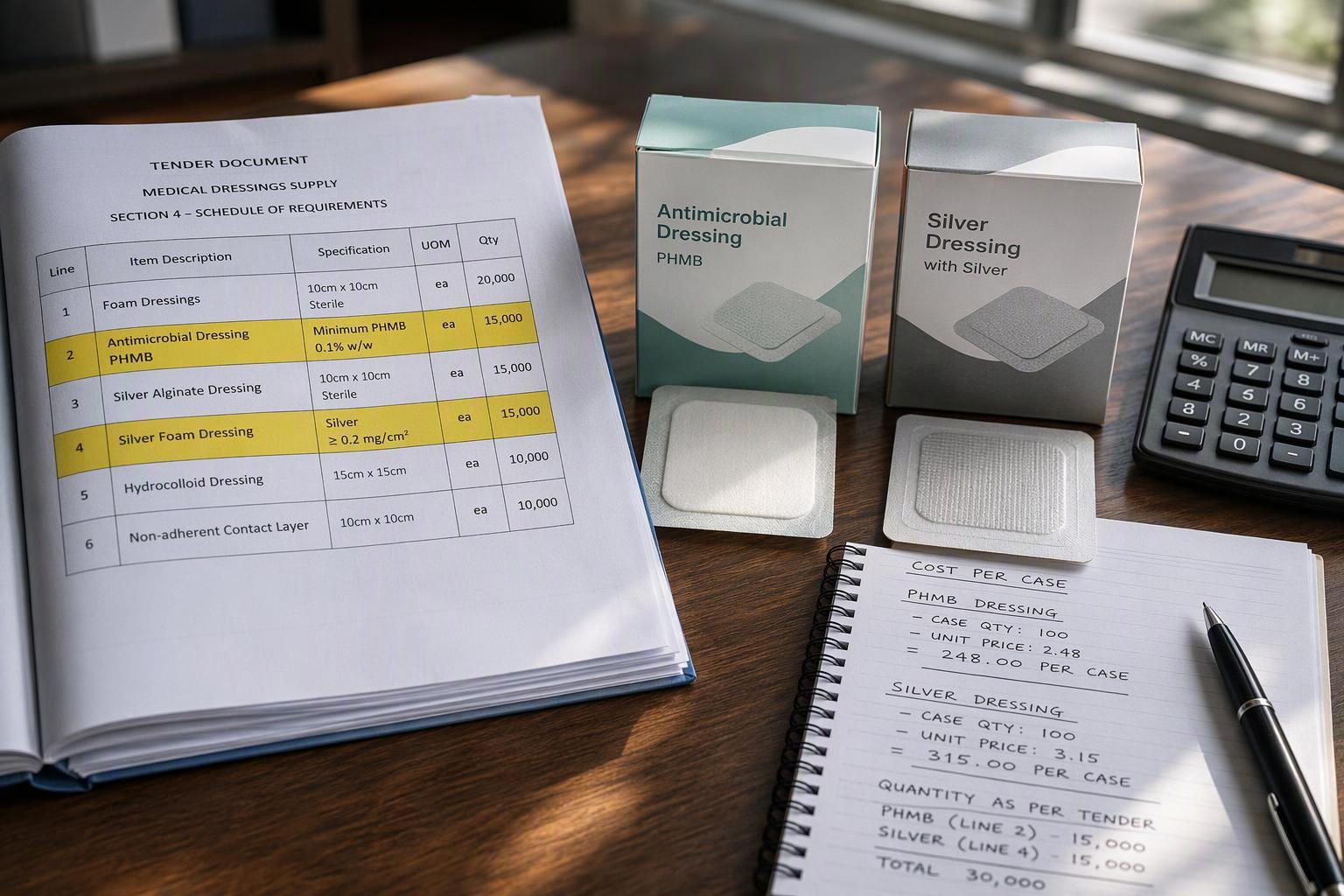
A tender that lists both PHMB and silver antimicrobial dressings is not asking you to pick a winner. It is asking you to cover two line items with two chemistries, at a landed cost you can defend for the life of the contract, from a supplier whose delivery and complaint performance you can write into an agreement. Those are three separate decisions, and distributors routinely collapse them into one price comparison.
This is a portfolio-and-terms review of SLK Medical’s two antimicrobial families — the Alexer® PHMB silicone foam range and the Alexer® silver (Ag) range — read against what the company publishes about its OEM/ODM services, its quality control process, its delivery performance and its certificate scope. It draws on SLK Medical’s own product pages, its OEM and private-label guides, its lead-time and OTIF material, its SLA guidance and its TÜV SÜD certificates. It does not report clinical trial outcomes, comparative efficacy data or independent benchmark testing of either line, and nothing here should be read as a clinical selection recommendation.
The working question throughout is narrower and more useful: which family fits which tender line item, what drives the effective minimum order and lead time behind each, and which supplier commitments are worth negotiating before signature.
What the two lines actually are
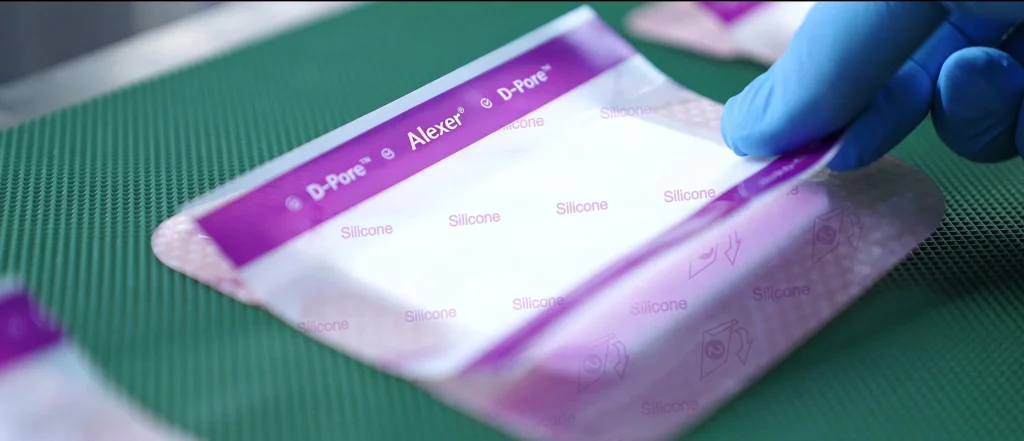
Both families are built on the same base architecture — a polyurethane film backing, a foam absorbent layer, and (on the adhesive versions) a soft silicone wound contact layer — and both are positioned by SLK Medical for moderate to heavily exuding chronic and acute wounds. The difference sits in the absorbent layer and in the format range.
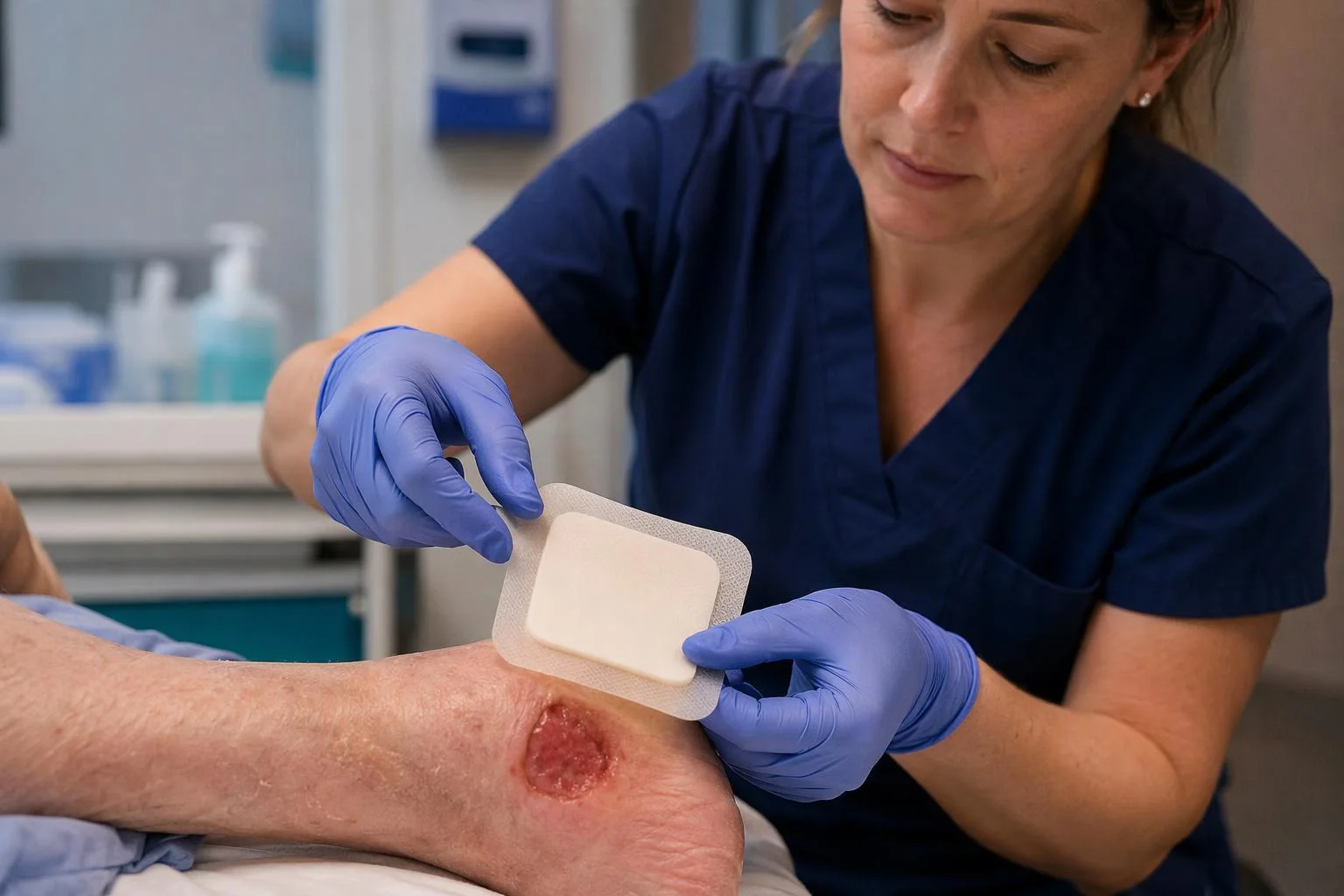
PHMB line. The antimicrobial agent is polyhexamethylene biguanide (PHMB, polihexanide), carried in the foam absorbent layer. SLK Medical’s product pages state that the foam “contains the antimicrobial substance polyhexamethylene biguanide (PHMB, polihexanide), which kills and inhibits the growth of bacteria,” and that the dressing provides “sustained antimicrobial release and effectiveness for up to 7 days.” Three formats are published: PHMB silicone foam with border, PHMB silicone foam without border, and a non-adhesive PHMB foam listed in 10×10, 15×15 and 20×20 cm squares. The bordered and non-bordered pages list the same indications: pressure ulcers, leg ulcers, foot ulcers, diabetic ulcers and surgical wounds, for moderate to heavily exuding chronic and acute wounds, usable throughout the healing process.
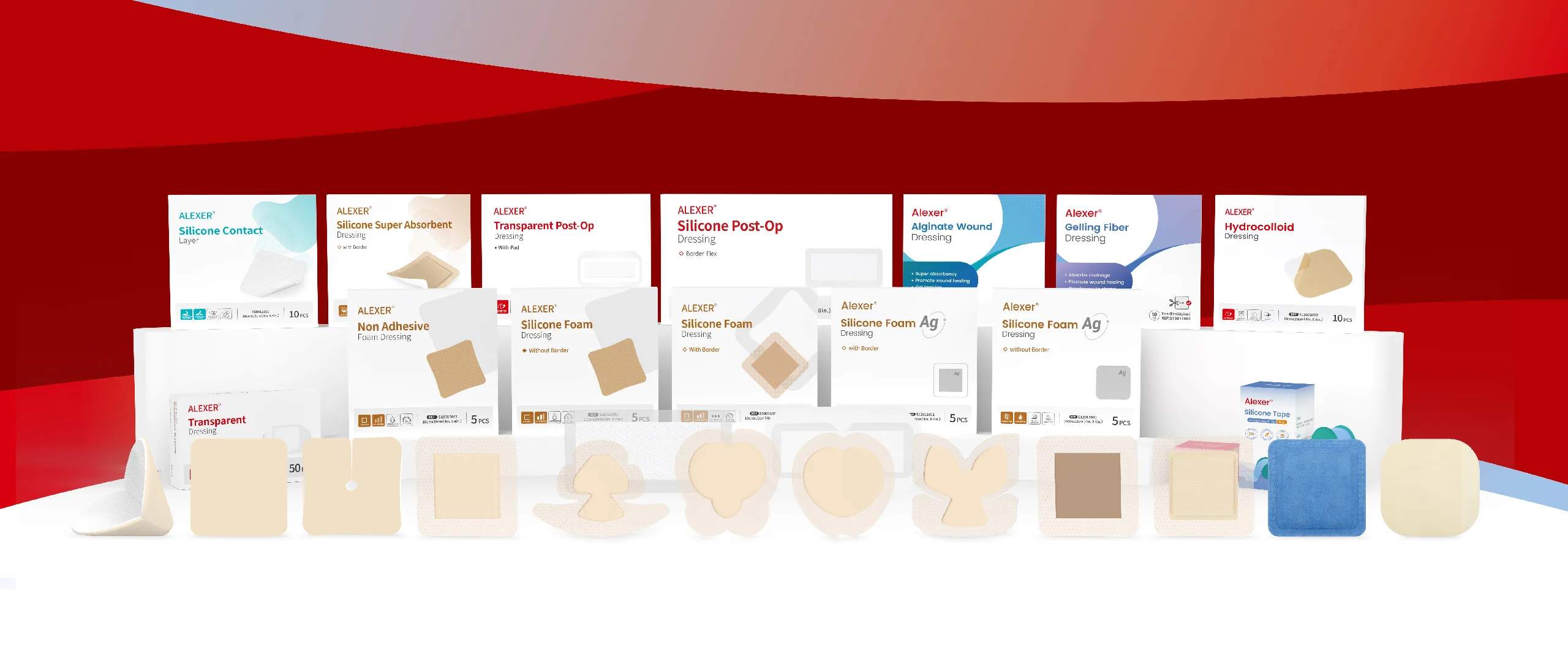
Silver line. The antimicrobial agent is ionic silver, and the format range is wider. The silicone foam Ag dressing with border adds a super-absorbent (SAF) retention layer and a non-woven distribution layer between the backing and the silver-bearing foam — a five-layer construction rather than the PHMB line’s three. The page describes “rapid sustained release ionic silver with sustained effect up to 7 days.” The non-adhesive Ag foam is published in 10×10 and 15×15 cm and describes hydro-activated silver ions working “both in the foam and in the wound bed,” with a bacterial barrier demonstrated in vitro. The silver alginate dressing is a different material class entirely: natural alginate fibers with silver ions that gel on contact with exudate, indicated for moderate to heavily exuding full- and partial-thickness wounds that are infected or at risk of infection — pressure ulcers (Phase I–IV), leg ulcers of venous, arterial and mixed etiology, diabetic foot ulcers, cavity and sinus wounds in a rope/ribbon format, donor sites, surgical post-operative wounds and second-degree burns.
Two cautions before either family goes into a bid. First, the mechanism and kill statements above are the manufacturer’s published product-page wording, not test results. A tender evaluator or a hospital infection-control committee will want the SKU-specific antimicrobial efficacy reports behind them, and those are a document request, not something the marketing copy supplies. Second, the “up to 7 days” figure is a stated sustained-effect window, not a wear-time instruction; actual change frequency is set by the IFU and by exudate level, site and clinical condition.
Portfolio fit: where each line earns its shelf space
The two families overlap on the wound types they name but diverge on format coverage, and that divergence is what decides whether a distributor bids one line or both.
Where they overlap: both cover moderate to heavily exuding pressure ulcers, leg ulcers, foot and diabetic ulcers and surgical wounds in bordered and non-bordered foam formats, and both publish a non-adhesive variant. If a tender line item simply reads “antimicrobial foam dressing, bordered, 10×10 cm” without naming a chemistry, either family can answer it — and the choice then turns on price, documentation and clinician preference rather than on coverage.
Where they diverge:
Cavity and sinus wounds. Only the silver alginate line reaches these, via the rope/ribbon format. The PHMB family has no cavity configuration in its published range. A tender with a cavity-dressing line item cannot be answered from the PHMB line alone.
Burns. Second-degree burns appear on the silver alginate indications and not on the PHMB foam pages.
High-exudate construction. The bordered silver foam’s SAF retention layer and distribution layer give it a different fluid-handling architecture from the three-layer PHMB foam. Whether that matters depends on the exudate levels in the accounts you serve; the published indications for both are described as moderate to heavily exuding, so the construction difference is a specification question to put to the supplier, not a claim to make in a bid.
Chemistry preference. Some formularies and infection-control policies name PHMB; others name silver. Where the tender names the chemistry, coverage is decided for you.
For a distributor building a catalogue, the practical read is that the silver line is the broader net — foam with and without border, non-adhesive foam, and a gelling alginate for cavity work — while the PHMB line is a focused foam range for buyers whose accounts or tenders specify PHMB. Bidding both widens the line items you can answer; bidding one is viable only if the tender set you target does not include cavity formats or a named-chemistry requirement you cannot meet.
Indication matrix: mapping lines to tender line items
The matrix below restates manufacturer-published indications by format. It is a bid-alignment tool, not a clinical selection protocol — final dressing choice sits with the treating clinician and local protocol, and the IFU governs use.
Format | Border / adhesive | Exudate level as stated | Listed wound types (published) | Documentation a tender typically asks for |
|---|---|---|---|---|
PHMB silicone foam, bordered | Self-adhesive, bordered | Moderate to heavily exuding | Pressure ulcers, leg ulcers, foot ulcers, diabetic ulcers, surgical wounds | Spec sheet, IFU, SKU test reports, certificate scope, DoC |
PHMB silicone foam, non-bordered | Silicone contact layer, no border | Moderate to heavily exuding | As above | As above, plus secondary-dressing fixation note |
PHMB foam, non-adhesive | None | Moderate to heavily exuding (per family page) | Chronic and acute wounds (family-level statement) | As above |
Silicone foam Ag, bordered | Self-adhesive, bordered | Moderate to heavily exuding | Per Ag foam family page; SAF retention layer construction | As above, plus silver-ion release test data |
Silicone foam Ag, non-bordered | Silicone contact layer, no border | Moderate to heavily exuding | Per Ag foam family page | As above |
Non-adhesive Ag foam | None; can be cut to size | Moderate to heavily exuding | Per Ag foam family page; bacterial barrier shown in vitro | As above |
Silver alginate (rope/ribbon and flat) | None; requires secondary dressing | Moderate to heavily exuding, infected or at risk of infection | Pressure ulcers (Phase I–IV), leg ulcers (venous, arterial, mixed), diabetic foot ulcers, cavity and sinus wounds, donor sites, surgical post-op wounds, second-degree burns | As above, plus gelling/absorption data and cavity-packing IFU |
Two rows deserve a flag before a bid team relies on them. The PHMB non-adhesive page publishes the family-level indication statement (“chronic and acute wounds”) without repeating the specific wound-type list that appears on the bordered and non-bordered pages; if a tender line item names a specific wound type, confirm the SKU-level indication wording with the supplier rather than inferring it from the family. And the silver foam pages publish the 7-day sustained-effect statement and the in-vitro barrier statement, but the specific antimicrobial performance figures a hospital may request are SKU test reports, not page copy.
For each row, the documentation column is the part that decides whether a bid survives evaluation. A spec sheet and IFU are table stakes; the differentiators are current SKU-specific test reports, a certificate with the scope visible, and a declaration of conformity that names the device group.
MOQ and lead times: what to plan against
SLK Medical does not publish a single headline MOQ figure, and a distributor should be wary of any supplier that leads with one. The number that matters is the effective minimum — the smallest order you can place that is commercially viable once mixed-SKU picking, private-label artwork, packaging runs and sterilization batch sizes are accounted for.
What drives the effective minimum. Four things, in roughly this order of impact. Mixed-SKU orders: a single-SKU pallet and a five-SKU mixed pallet at the same total unit count carry different setup and picking costs, and the supplier will price that difference. Private-label artwork and packaging: a custom printed pouch or carton has its own print run minimum, which can exceed the dressing MOQ. Sterilization batch size: sterile product is released by batch, so an order below a viable batch size either waits for consolidation or carries a disproportionate validation and release cost. Sampling: samples are a separate, much smaller commitment and should be treated as the first stage of the order rather than a courtesy.
Sampling. SLK Medical’s published position is that routine standard samples ship free of charge with a typical lead time of 1–5 business days, while timing for special or customized samples is agreed case by case (manufacturer guide). For a tender timeline, that 1–5 day window is the only stage you can plan with confidence from published material; everything after it is negotiated.
Lead time as a staged model. Treat the total as six stages, each with its own owner and its own risk: sample, artwork approval, production, sterilization and release, export clearance, and transit. SLK Medical’s delivery playbook is explicit that door-to-door adds 8–15 days minimum on top of port-to-port transit once customs dwell (2–5 days in a well-run entry), inland drayage (1–5 days) and final delivery are added. It also notes that US entry flagged by FDA defaults to a 7–21 day resolution timeline, and that Gulf State registration (SFDA, UAE DOH/DHA) can take 6–18 months — a market-entry constraint that sits entirely outside production lead time.
What the published performance record actually says. SLK Medical reports a distributor cohort that reached 96.1% OTIF within two quarters, with the average delivery cycle shortening by only 4 days but variance dropping from ±12 days to ±3 days. The mechanism was a pre-staged four-week finished-goods buffer against a rolling 90-day forecast submitted monthly, which cut production-to-ship time from 10–14 days to 2–4 days. Read that carefully: the headline is a cohort result under a specific inventory arrangement, not a standing commitment on any individual order, and the company’s own framing is that variance, not average speed, is what creates compliance risk against hospital contracts.
That is why the committed stage-by-stage windows belong in the contract. A published capability is a starting position; a delivery window measured from PO confirmation to your named dock, with a stated measurement period, is a term.
Total cost of ownership: comparing the two lines beyond unit price
Unit price is the easiest number to compare and the least informative. Build the model from components you can populate with your own quotes, and let the two lines compete on the total.
Component | What to capture | Why it moves between the two lines |
|---|---|---|
Unit price | Quoted price per SKU at your order quantity | Differs by format and construction; the silver bordered foam’s five-layer build is not the same cost object as the three-layer PHMB foam |
Sterilization and testing | Batch release, EO residuals, SKU-specific test reports | Batch-size effects fall harder on lower-volume SKUs |
Packaging and artwork | Pouch/carton print runs, multilingual labels, artwork revisions | Private-label runs carry their own minimums and approval cycles |
Freight and duties | By Incoterm; FOB vs CIF vs DDP changes who carries what | CIF bundles freight at a markup and caps insurance at 110% of invoice value; FOB keeps carrier choice with you |
Inventory carrying cost | Safety stock weeks × unit cost × cost of capital | Driven by MOQ and by lead-time variance, not by average lead time |
Complaint and returns handling | Administrative cost per complaint, reshipment, credit | Rises with batch variability and with slow CAPA turnaround |
Stockout cost | Penalty or lost margin per missed hospital delivery | The dominant term when a contract carries service credits |
The reason a lower unit price can lose is that three of these components scale with variance and minimums rather than with price. If one line requires four to six weeks of safety stock on high-velocity SKUs because its delivery window swings by ±12 days, the carrying cost of that buffer is a real per-unit charge that never appears on the quote. If the other line holds a tighter window, the same service level needs less stock. SLK Medical’s own playbook makes this argument directly: for medical consumables, the cost of holding two extra weeks of inventory is much lower than an emergency air freight order plus a damaged customer relationship.
Two disciplines keep the model honest. First, do not import a wear-time or change-frequency assumption into the cost-per-treated-case calculation unless the IFU for that specific SKU supports it; a 7-day sustained antimicrobial effect statement is not a 7-day wear instruction. Second, do not assert that either family is cheaper to use across a course of treatment without your own numbers — the published material does not establish a cost advantage for PHMB over silver or the reverse, and the construction differences mean the comparison has to be run on your actual SKU mix, your freight lanes and your contract terms.
SLA overview: OTIF, QC and CAPA terms worth contracting
Separate the terms regulation fixes from the terms you negotiate. Almost everything a distributor cares about sits in the second category.
Regulatory reporting clocks are fixed; complaint acknowledgement, triage, CAPA containment and OTIF measurement are contract terms. EU clocks run in calendar days from the manufacturer’s awareness date; the US 5-day clock runs in work days. Neither the FDA QMSR nor MDR Articles 83–87 sets a numeric complaint or CAPA deadline.
The regulatory floor. In the EU, MDR Article 87 sets the vigilance reporting windows at 2, 10 and 15 days, counted in calendar days from the manufacturer’s awareness date. In the US, an individual adverse-event report is due no later than 30 calendar days after awareness, with a 5 work-day report where remedial action is needed to prevent an unreasonable risk of substantial harm to public health (21 CFR Part 803). Note the unit difference — EU clocks run in calendar days, the US 5-day clock in work days. Neither the FDA quality management system regulation nor MDR Articles 83–87 sets a numeric complaint acknowledgement, triage or CAPA deadline; SLK Medical’s own SLA guidance says as much. Those are contract terms.
Lever one: an OTIF definition with a measurement basis. “On time, in full” is binary per order line — a pallet three days late is a failure even if every unit is intact, and a shipment missing 5% of quantity is a failure even if it lands on the promised date. Write down: the delivery address, the clock start (PO confirmation, not production completion), the measurement period (monthly, across all order lines rather than only large orders), and explicit treatment of partial shipments and substitutions. SLK Medical’s playbook suggests monthly targets of 97%+ for critical SKUs and 95%+ for standard SKUs, and flags that OTIF above 95% combined with a fill rate below 93% usually signals a substitution or partial-ship problem. It also proposes a committed expedite protocol — supplier-funded air freight on the next replenishment — as often more useful than a financial penalty.
Lever two: a QC package. Ask for the ISO 13485 certificate with its scope visible, SKU-specific test reports tied to the exact reference numbers you will sell, and a description of the inspection regime. SLK Medical publishes a seven-stage QC flow — incoming quality control on incoming silicone, preparation and color comparison, first article inspection, in-process quality control, post-processing checks, final QC before release, and packaging/QA — which gives you a concrete list to map against your own incoming inspection plan. Treat an approved sample as the contractual reference unit for production and incoming QC.
Lever three: a CAPA clause. Define the trigger thresholds (what complaint volume or severity opens a CAPA), the acknowledgement and triage windows, the severity bands and who classifies, the containment action, the root-cause report format and timing, and the effectiveness check that closes it. Also fix audit-document retrieval time and format — the practical test of an audit-access clause is whether the supplier can actually retrieve the record fields you ask for.
One structural point: an SLA and an exclusivity arrangement are separate documents. The SLA sets the operating rhythm; exclusivity sets territory, category scope, volume commitments and exit. If you want exclusivity, SKU-level is usually the safer first structure, defined by reference number and size, with a stated measurement period, cure window and remedy.
OEM/ODM and private label: what SLK Medical can customize
SLK Medical states that it offers OEM/ODM services across its dressing range and publishes a customization menu for silicone foam: size, shape, color, adhesive, packaging, and printed patterns, shapes or logos on the dressing itself (customization page). The company’s OEM guide also describes a structured intake — inquiry acknowledged with private follow-up within 24 hours to clarify clinical needs, volumes and customization requirements, followed by credentials and technical document exchange, then complimentary sampling.
Each customization choice interacts with three commercial levers:
MOQ. A new size or shape means new tooling or cutting setup; a printed dressing or custom pouch means a print run. Both push the effective minimum above the standard-SKU figure, and the increase is per variant, not per order.
Artwork approval cycle. Multilingual labels, UDI layout and GTIN strategy are where private-label programs lose weeks. Ask for the label template and the change-control SOP, and run one artwork cycle end to end before committing a tender date to it.
Change control. Raw material, tooling and packaging changes should carry written notification and an approval gate. Get the notification clause proposed in writing rather than assumed.
There is a regulatory layer on top of the commercial one. Under MDR Annex IX Chapter I, point 4.10, changes to an approved device that could affect its safety and performance, or the conditions prescribed for its use, must be notified to the notified body that issued the technical documentation assessment certificate, which then decides whether the change needs a new conformity assessment or can be handled by a supplement. Private-label changes to labelling and packaging of a CE-marked device can fall inside that provision depending on what changes. Scope artwork and labelling changes with the supplier before promising a specific configuration to a tender authority — the certificate does not pre-approve a configuration that has not been assessed.
Certifications: what the certificates cover, precisely
Two certificates are relevant, and both need to be read with their scope in front of you rather than as a badge.
ISO 13485:2016 — TÜV SÜD certificate Q5 112764 0001 Rev. 01. Holder and facility: SLK Medical Material (Tianchang) Co., Ltd., No. 33, Zhenglong Road, Qinlan Town Industrial Park, 239300 Tianchang City, Anhui Province, China. Report No. SH26185902. Valid from 2026-06-30 to 2028-05-08, issued 2026-06-30. Scope: design, development, production and distribution of sterile polyurethane dressing, sterile gelling fiber dressing and sterile super absorbent dressing; production and distribution of sterile foam dressing, sterile polyurethane transparent dressing, sterile waterproof dressing, sterile hydrocolloid dressing, sterile alginate dressing, sterile silicone absorbent fiber dressing, non-sterile scar gel, non-sterile medical tape, non-sterile self-adhesive silicone gel sheets and non-sterile self-adhesive silicone tapes. Applied standard: ISO 13485:2016 (EN ISO 13485:2016/AC:2018, EN ISO 13485:2016/A11:2021).
EU MDR Annex IX Chapter I — TÜV SÜD certificate G15 112764 0002 Rev. 00. Manufacturer: SLK Medical Material (Tianchang) Co., Ltd.; SRN CN-MF-000012390; authorized representative Shanghai International Holding Corp. GmbH (Europe), Hamburg. Notified Body TÜV SÜD Product Service GmbH, identification no. 0123. Report No. SH23185901. Valid from 2025-09-23 to 2030-09-22. Classification: Class IIb; device group M040101 — adhesive dressings, with absorbent pad. The certificate notes that for Class IIa or IIb devices the QMS assessment was accompanied by technical documentation assessment on a representative basis, and that periodic surveillance includes further technical documentation sampling.
What to check before relying on either. First, whether your specific PHMB and silver SKUs fall inside the listed scope. The ISO 13485 scope names sterile foam dressing, sterile alginate dressing and sterile silicone absorbent fiber dressing as production-and-distribution categories — a bid team should confirm in writing that each reference number it intends to sell sits within those categories and within the facility named. Second, that the EU certificate’s device group is the one your product is classified under; a Class IIb adhesive dressing with absorbent pad is a defined group, and a product outside it is not covered by that certificate. Third, that a QMS certificate is not a product approval. It evidences a certified quality management system; the product-level conformity evidence is the declaration of conformity, the technical documentation and the SKU test reports.
A related procurement point from SLK Medical’s own guidance: certification runs on a three-year cycle with surveillance audits in years 1 and 2 and recertification in year 3, so a certificate’s position in that cycle is part of the risk picture. Check the certificate number, revision and validity dates against the TÜV SÜD database entry rather than a PDF copy alone.
Verdict: who should shortlist which line
Shortlist the PHMB family if your tender set names PHMB, or if your accounts and formularies specify polyhexamethylene biguanide and you need bordered, non-bordered and non-adhesive foam configurations to answer those line items. Confirm SKU-level scope and test reports before submission.
Shortlist the silver family if your tender set names silver, if it includes cavity or sinus wound line items, or if it includes second-degree burns — the silver alginate rope/ribbon format is the only published configuration in either family that reaches cavity wounds, and the alginate indications are the only ones that name burns. The silver foam range also gives you bordered, non-bordered and non-adhesive configurations, with the bordered version carrying the SAF retention layer construction.
Consider both if you are building a broad antimicrobial catalogue for hospital and care-channel coverage across multiple markets. The families overlap on foam formats but the silver line’s alginate extends your answerable line items into cavity care, and the PHMB line covers accounts that specify that chemistry. Bidding both is a coverage decision, not a hedge.
Pause before committing on any of three conditions. Unconfirmed SKU scope — if you cannot get written confirmation that each reference number sits inside the ISO 13485 and EU MDR certificate scopes, do not put the certificate in a bid. MOQ that outruns forecast demand — if the effective minimum on a private-label variant exceeds what your first two quarters of demand can absorb, the carrying cost will erase the margin. SLA terms left undefined — if OTIF measurement basis, partial-shipment treatment, complaint acknowledgement and CAPA windows are not written down, you have no remedy when performance slips.
The documentation ask, in one list: spec sheets for each SKU, the IFU, the certificate pack with scope pages, SKU-specific test reports including antimicrobial efficacy data, the declaration of conformity, and a sampling plan with stage-by-stage lead times. Request these before the purchase decision, not after.
Key takeaways
The PHMB and silver lines are complementary formats, not substitutes; map them to tender line items using published indications only.
Effective MOQ is driven by mixed-SKU orders, artwork and sterilization batches, not the headline number.
Plan lead time stage by stage; treat committed windows and variance as contract terms.
TCO turns on variance, carrying cost and stockout risk as much as unit price.
OTIF, QC and CAPA terms are negotiable; only the vigilance and adverse-event reporting clocks are fixed by regulation.
Verify that the specific SKUs you bid sit inside the ISO 13485 and EU MDR certificate scopes before you rely on them.
Reader questions
Do PHMB and silver dressings do the same job in a tender?
No. They are different antimicrobial chemistries in different format ranges. PHMB is carried in the foam absorbent layer of the PHMB silicone foam family; silver is ionic silver in the foam or in the alginate fibers. Tender line items usually name one chemistry or one format, so the bid decision is about coverage — which line items each family can answer — rather than substitution of one for the other.
What MOQ should a distributor expect for a private-label run?
SLK Medical does not publish a single MOQ figure. The effective number depends on SKU mix, packaging and print runs, and sterilization batch size, and it should be requested per SKU alongside the sampling plan. Treat the standard sample (free, typically 1–5 business days) as the first stage, and ask for the MOQ tier that applies to the exact configuration you intend to sell.
Can SLK Medical’s certificates be used to support a tender submission?
They can evidence a certified quality management system and, for the EU certificate, a defined Class IIb device group (M040101, adhesive dressings with absorbent pad). They do not by themselves establish that a specific SKU is covered. The bid team must confirm in writing that each reference number falls within the listed scope and facility, and should pair the certificate with the declaration of conformity and SKU test reports.
How should OTIF be defined in the supply agreement?
Define it per order line, on time and in full, against a named delivery address, with the clock starting at PO confirmation and a stated measurement period covering all order lines rather than only large orders. Address partial shipments and substitutions explicitly — a 95%+ OTIF with a fill rate below 93% usually means one of those is happening. Consider a committed expedite protocol (supplier-funded air freight on the next replenishment) alongside any financial penalty.
What happens if a batch fails QC after delivery?
That path is a contract term, not a regulatory one. Contract for a complaint acknowledgement window, triage and severity bands with a named classifier, containment action, a root-cause report with a stated format and timing, and an effectiveness check that closes the CAPA. None of these windows is fixed by the FDA QMSR or MDR Articles 83–87; only the vigilance and adverse-event reporting clocks are.