

Introduction
A silicone foam dressing holds to intact periwound skin and lets go of the moist wound bed. That single sentence describes the whole clinical proposition, and it is also the point where most formulary discussions stall: if the dressing is gentle enough to lift without stripping skin, will it stay put through a week of exudate, repositioning and linen changes?
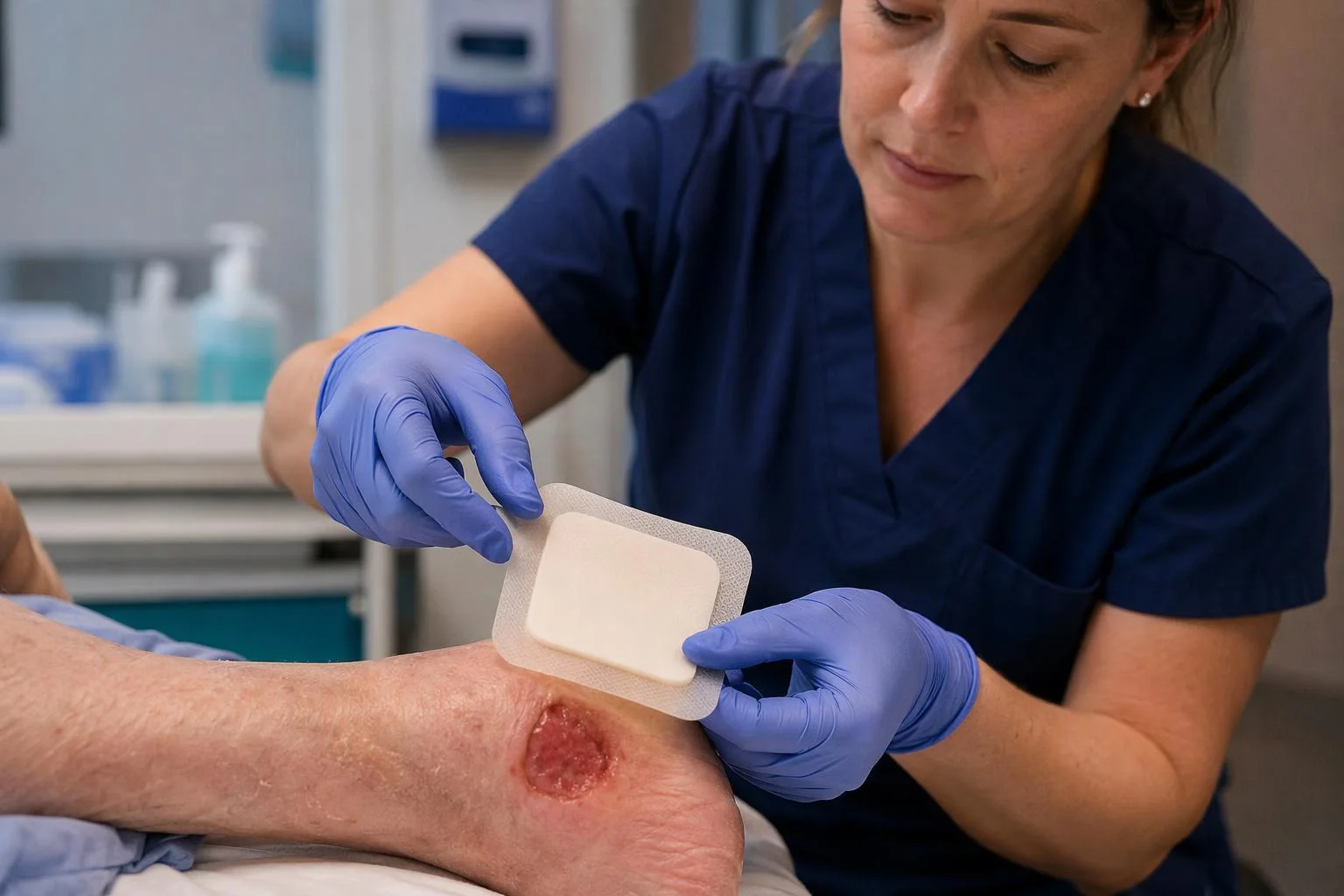
For WOC nurses, bedside nurses, nurse managers and value analysis teams moving a facility from gauze and basic dressings toward foam, the answer matters in both directions. A dressing that lifts at the sacral edge leaks, macerates the surrounding skin and costs a second change. A dressing that grips too hard removes stratum corneum with every change, and in older or fragile patients that can mean a skin tear layered on top of the original wound.
Soft silicone resolves this tension through a mechanism rather than through a compromise. It is tacky to dry, intact skin and effectively non-adherent to a moist wound surface, so the same material that seals the perimeter releases from the bed. This article sets out how that selective adhesion works at the material level, what the published evidence says about pain and skin damage on removal, and how to prepare skin, apply, seal and remove a silicone foam dressing so that adhesion is reliable without becoming traumatic. Where a decision depends on your own wound mix, product specification or local formulary, the article flags the specific item to confirm rather than assuming it.
Adhesion mechanism
Adhesion in a silicone foam dressing is not one property but an interaction between the adhesive, the substrate it meets and the conditions at that interface. Separating the material chemistry from the wet-or-dry state of the surface explains why the same dressing behaves so differently on the wound bed and on the skin 2 cm away from it.
Material properties of soft silicone
Silicones are inert synthetic compounds built from long polymer chains of silicon with carbon, hydrogen, oxygen and sometimes other elements, and they range in form from oils to rubbers and hard resins. Soft silicones are a particular family of solid silicones that are soft and tacky, which lets them conform and adhere well to dry surfaces; they have low toxicity, adverse reactions are rare, and they cannot be absorbed into the body (Wounds International).
Tack, sometimes called quick stick, is the instantaneous adhesion created when the dressing meets skin. In soft silicone it works through multiple points of contact between the dressing and the uneven skin surface, producing a tight seal rather than a chemical bond (Wounds International). Pressure-sensitive adhesives more generally act as a viscous liquid that spreads and wets the surface under light contact pressure, so adhesion rises with greater contact area and higher substrate surface energy (review of pressure-sensitive adhesives). That is why a smoothed edge holds better than a pressed one, and why wrinkled or hairy skin is harder to seal.
Dry vs. moist interface behavior
The defining behavior of soft silicone is that it adheres only to dry skin and not to the wet wound bed, which is what makes removal less painful and less traumatic (pressure-sensitive adhesive review). A hydrophobic soft silicone layer is tacky to the touch, does not stick to the moist wound bed, adheres gently to surrounding skin, and leaves no adhesive residue (Wounds International).
The practical consequence is that moisture is the switch. Where exudate is present, the silicone has nothing to grip; where the periwound skin has been cleansed and dried, it grips. This is also the mechanism’s main vulnerability: a perimeter that becomes wet from underneath, from sweat or from a barrier product that has not dried loses tack, and the dressing lifts.
Implications for silicone foam dressing adhesion
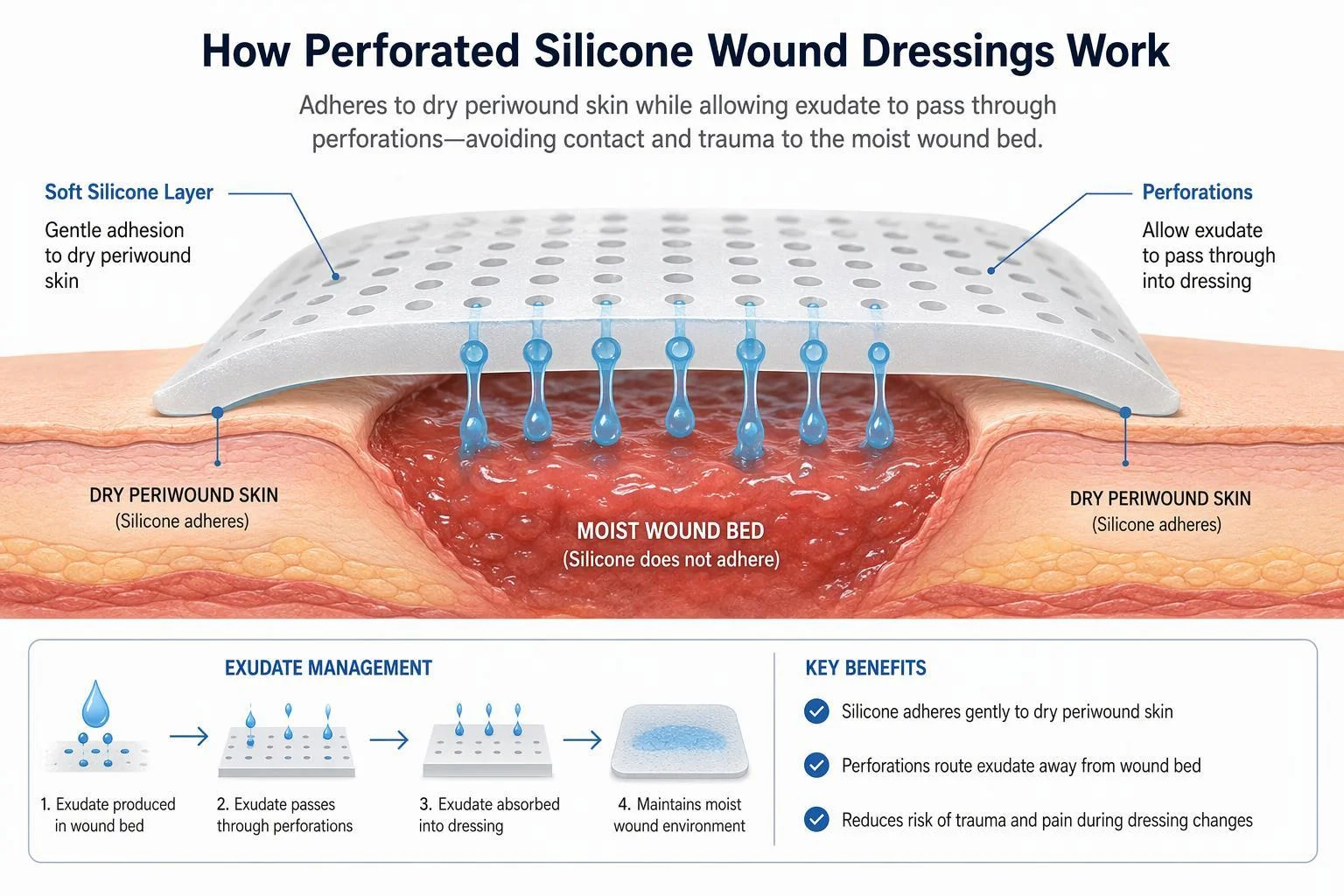
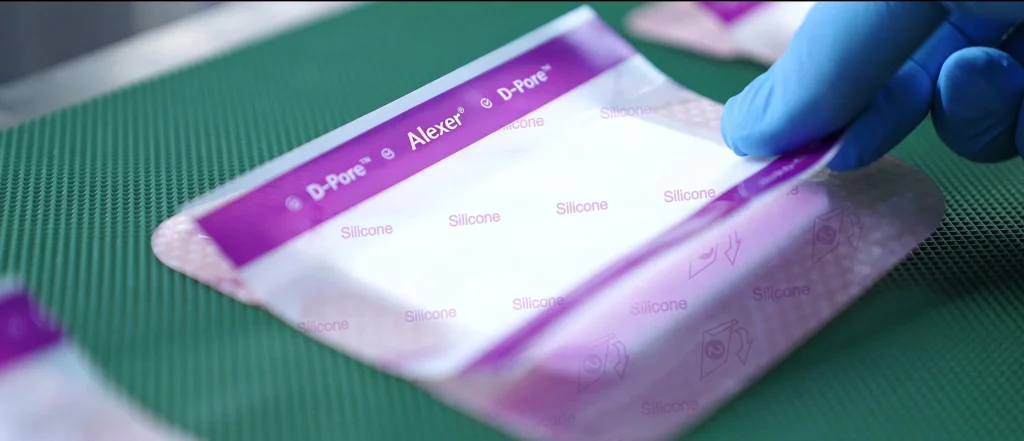
In a bordered foam dressing the silicone serves two jobs at once. A perforated silicone wound contact layer allows exudate to pass into the absorbent pad while the same material forms the adhesive border that anchors the dressing to intact skin; a typical multilayer bordered foam comprises a non-lint silicone mesh contact layer, an absorbent polyurethane foam pad, a backing film and a soft silicone adhesive border (fluid handling review).
The design intent is a dressing with enough tack to stay in place for the intended wear time but which can be removed without stripping skin or traumatizing the bed (Wounds International). Two implications follow for practice. First, adhesion quality is decided at the border, not over the wound, so border care is where application effort belongs. Second, because the contact layer does not bond to the bed, the dressing can often be lifted and repositioned without losing its adherent properties, which is useful during the first application on a contoured site.
Skin safety and MARSI
Medical adhesive-related skin injury (MARSI) is defined as an event in which erythema and/or another skin abnormality, including but not limited to vesicle, bulla, erosion or tear, persists for 30 minutes or more after removal of an adhesive medical device. Reported types include mechanical trauma such as epidermal stripping, tension injuries or blisters and skin tears, dermatitis including irritant and allergic contact dermatitis, and other reactions such as maceration and folliculitis (PREVIDA summary of the consensus definition). The category is broad, and clinicians still need to know which specific reaction occurred, because preventing maceration calls for a different response than preventing a skin tear (critical appraisal of the MARSI concept).
Stratum corneum removed on dressing removal in healthy volunteers (n = 10) after 24-hour forearm wear; lower values indicate less epidermal stripping. Volunteer design, not patient wounds.
Pain on removal: evidence overview
Wound-related pain is common and dressing change is frequently its most painful step. In one large sample of chronic wound patients (n = 2936), about 80% experienced moderate-to-severe pain during dressing change, and 77% had spontaneous pain between procedures (Woo et al.).
The comparative evidence favors silicone. In a healthy-volunteer study using the PainVision quantitative system, pain intensity during removal was significantly lower for dressings using soft silicone adhesive than for those using acrylic pressure-sensitive adhesive; the authors note the limitations of small single-institution enrollment and testing in healthy subjects rather than actual patients (Matsumura et al.). A related study found that silicone adhesive dressing induced less pain on removal than acrylic adhesive, consistent with the view that less periwound skin damage means less pain (Matsumura et al.). Soft silicone adhesives have also been reported not to alter skin barrier function or stratum corneum hydration, in contrast to repeated use of hydrocolloid dressings (Woo et al.).
MARSI risk reduction and fragile skin
Vulnerable skin is skin susceptible to damage from a traumatic incident that would not injure healthy skin, whether macroscopically, as in a skin tear, or microscopically, as in epidermal stripping from adhesive removal. Patients with paper-thin, friable skin include older adults, the very young and people with genetic skin conditions such as epidermolysis bullosa (Wounds International). Neonatal skin is only about 60% of adult thickness at full term and is less elastic, while aging skin needs less force to sustain a traumatic injury (Wounds UK meeting report).
For these patients, dressing choice is a MARSI control. Films and hydrocolloid dressings have strong adhesive components and have been reported to contribute to skin tears, and iodine-based dressings dry the periwound skin, itself a risk factor for skin tear development (Wounds UK). Soft silicone’s low peel force and clean removal make it a reasonable default where skin integrity is already compromised.
Managing edge lift and leakage trade-offs
Edge lift is not only an adhesion failure; it is a skin safety event in slow motion. When wound fluid leaks into the sides of a dressing it can pool at the edges and cause inflammation and maceration of the periwound skin (fluid handling review). The trade-off is real: more aggressive fixation reduces lift but raises removal trauma, while a gentler adhesive protects skin but demands better application and more attention to exudate volume.
Three levers usually settle the balance. Match the dressing’s fluid-handling capacity to exudate level, since a saturated pad will eventually compromise the border. Size the dressing so the border sits on dry, intact skin rather than on macerated or broken edges. And treat persistent lift as a diagnostic signal about the site or the product rather than simply reaching for tape, which reintroduces the adhesive risk the silicone was chosen to avoid.
Practical use to optimize adhesion
Mechanism and evidence only pay off through technique. The steps below follow the sequence that matters: prepare the surface the adhesive will actually meet, apply and seal the border, then remove in a way that preserves skin and decide changes on clinical triggers rather than habit.
Before the steps, the table below turns the trade-offs above into a starting point. It maps exudate level against skin fragility to suggest a size strategy, a change rhythm and a fixation approach. Treat it as a first decision to be adjusted to the individual wound, not as a substitute for assessment.
Exudate level | Skin condition | Size strategy | Change rhythm | Fixation notes |
|---|---|---|---|---|
Low (moist, lightly marked pad) | Intact, fragile | Overlap intact skin by at least 2 cm; choose the smallest size that achieves this | Review at 5–7 days unless triggered earlier | Silicone border alone; avoid tape and film reinforcement |
Low to moderate | Intact, at risk of moisture damage | Add a margin so the border never sits on macerated skin | Review at 3–5 days | Barrier film on periwound skin, fully dried, before application |
Moderate (pad soiled at removal) | Intact or mildly compromised | Size up to keep the border on dry skin as the wound changes shape | Review at 2–4 days | Re-smooth the full border at each change; check contours and sacrum |
High (strikethrough or frequent lift) | Fragile or already damaged | Move to a higher-absorbency dressing or add a secondary absorbent layer | Daily initially, extended as exudate falls | Consider a bordered shape plus secondary fixation placed over the border, not on the wound; reassess exudate management |
Any level | Broken or macerated periwound skin | Do not place the border on damaged skin | Shorten interval until the periwound recovers | Protect with a suitable barrier and document the site at each change |
Two cautions apply to the whole table. A saturated pad will compromise the border regardless of how carefully it was sealed, so when lift recurs the first question is whether the fluid-handling capacity matches the exudate, not whether the adhesive is at fault. And where tape or film is added for security, it reintroduces the adhesive risk that silicone was chosen to avoid, so any reinforcement should be the gentlest option that keeps the dressing in place.
A worked example shows how the table behaves in practice, and also how the change interval should follow the wound rather than a calendar. In a case documented in 2025, a Stage IV pressure injury on the left hip was managed with regular debridement, exudate management and a bordered silicone foam dressing. At the start of care the wound had moderate exudate, roughly 25% slough and 75% granulation tissue, with no tunneling and no signs of periwound infection (SLK Medical foam dressing guide).
The change interval was extended as the wound improved: three days, then four, then seven. Over the treatment period from 6 March to 30 April 2025 — about eight weeks — the wound showed continuous granulation, contraction and epithelialization, and was recorded as healed at final follow-up. Two things in this case map directly onto the guidance above. The dressing was sized so the border sat on intact skin while the wound still carried 25% slough, rather than being trimmed to a convenient size. And the interval lengthened only once exudate and wound condition allowed, which is the change-on-triggers principle rather than a fixed schedule.
One caveat: this is a single case from a manufacturer-documented series, not a controlled comparison. It illustrates how technique and interval decisions are sequenced; it cannot show that one dressing outperforms another.
Skin preparation and barrier compatibility
Cleanse the wound per local protocol, then ensure the periwound skin is dry before application, as the manufacturer’s instructions direct (silicone foam dressing IFU). Where periwound skin is at risk of moisture-associated damage, a barrier product can protect it, but formulation matters: barrier films contain silicone polymers such as dimethicone and dry quickly to a water-repellent film, whereas creams and ointments may impede dressing or tape adhesion (Fletcher, Wound Essentials). Whatever is used must be allowed to dry before the dressing goes on, and multiple layers should be avoided.
Application and seal integrity
Select a dressing large enough to overlap the wound edges and sit on intact skin: clinical guidance and local wound formularies commonly advise an overlap of at least 2 cm around the wound edge, which protects the surrounding skin from maceration and secures fixation (SWY Area Prescribing Committee wound formulary; East London NHS Foundation Trust wound management guidelines). Product instructions for use may recommend a larger margin on bigger sizes, so confirm the figure for the specific product you stock (IFU); where local policy sets a different margin, follow local policy. Remove the release film, apply the adherent side to the wound, and smooth from the center to the edge without leaving gaps, then press the edge to ensure good adhesion.
Because tack depends on contact area, the smoothing step is the seal. Work outward from the center so trapped air is pushed ahead of the border, and give particular attention to contours, the sacrum and the heel, where a wrinkle becomes a leak path. If the dressing must be lifted to correct placement, reposition it and re-smooth the full border rather than pressing only the lifted section.
Atraumatic removal technique and change triggers
To remove, gently lift a corner and peel slowly (IFU). Supporting the skin with one hand while peeling low and slow with the other reduces the force transmitted to the epidermis. On fragile or hairy skin, peeling in the direction of hair growth and in line with the dressing’s own orientation lowers the risk of stripping and tearing; marking an arrow on the dressing at application to indicate removal direction is a recognized aid in skin tear management (Wounds UK).
Change frequency depends on wound state rather than on a fixed schedule. Clinical guidelines and formularies advise changing the dressing according to exudate level, dressing capacity and wound condition, and changing sooner when the dressing is saturated, leaking or lifting; when exudate is controlled, many foam products can stay in place for several days, commonly up to about 5–7 days, depending on the product and the patient (East London NHS Foundation Trust wound management guidelines; PrescQIPP wound care bulletin on foam dressings). Heavily exuding or sloughy wounds may therefore need daily replacement initially, with the interval extended as exudate decreases, or as directed by the clinician; the maximum wear time stated in the manufacturer’s instructions for use always takes precedence (McKesson silicone adhesive foam dressing information). Treat strike-through, edge lift, leakage, pain or a change in wound appearance as triggers to reassess rather than to shorten the interval reflexively.
Conclusion
Three points carry the argument. Soft silicone adhesion is selective: it grips dry, intact periwound skin and releases from the moist bed, so secure fixation and gentle removal come from the same material rather than from a compromise between them. Atraumatic removal is a technique as much as a product property, and slow, low-angle peeling in the right direction protects skin that a faster pull would strip. And MARSI mitigation is a dressing-selection decision, because the adhesives most likely to lift skin are often the ones chosen for their grip.
Implementation follows from those points. Standardize selection against wound type, exudate level and skin fragility so that bedside choice is not improvised. Train staff on the parts of technique that determine outcomes: drying the periwound skin, sizing the border onto intact skin, smoothing from center to edge, and peeling slowly in the correct direction. Document what happens, including lift events, leakage, removal pain and any skin reaction, and use that record to adjust practice rather than to defend the current formulary.
For teams weighing a switch, the useful next step is a structured evaluation rather than a price comparison alone. Request the specification sheet, instructions for use, certification documentation and product samples from whichever suppliers you are considering, then run a small in-house trial that captures the outcomes above. Whichever products are shortlisted, compare them on the same measures: sustained tack at the border over the intended wear time, fluid handling against your exudate mix, available shapes for your most common wound sites, and documented removal pain and skin reactions. The question to answer is not whether silicone foam is gentler, which the mechanism and the removal-pain evidence support, but whether a given product’s tack, fluid handling and available shapes fit the wounds your unit actually treats.
About this article
This article is published by SLK Medical, a manufacturer of silicone foam and other advanced wound dressings, and is written for healthcare professionals. It is intended as clinical education, not as product-specific advice: where guidance depends on the dressing you stock, your local formulary or your patient’s condition, follow the manufacturer’s instructions for use and your local protocol. Sources cited were accessed in November 2026, and readers should check for updated guidance before changing practice.